Species · Flowering plants
Cowa Fruit Garcinia cowa
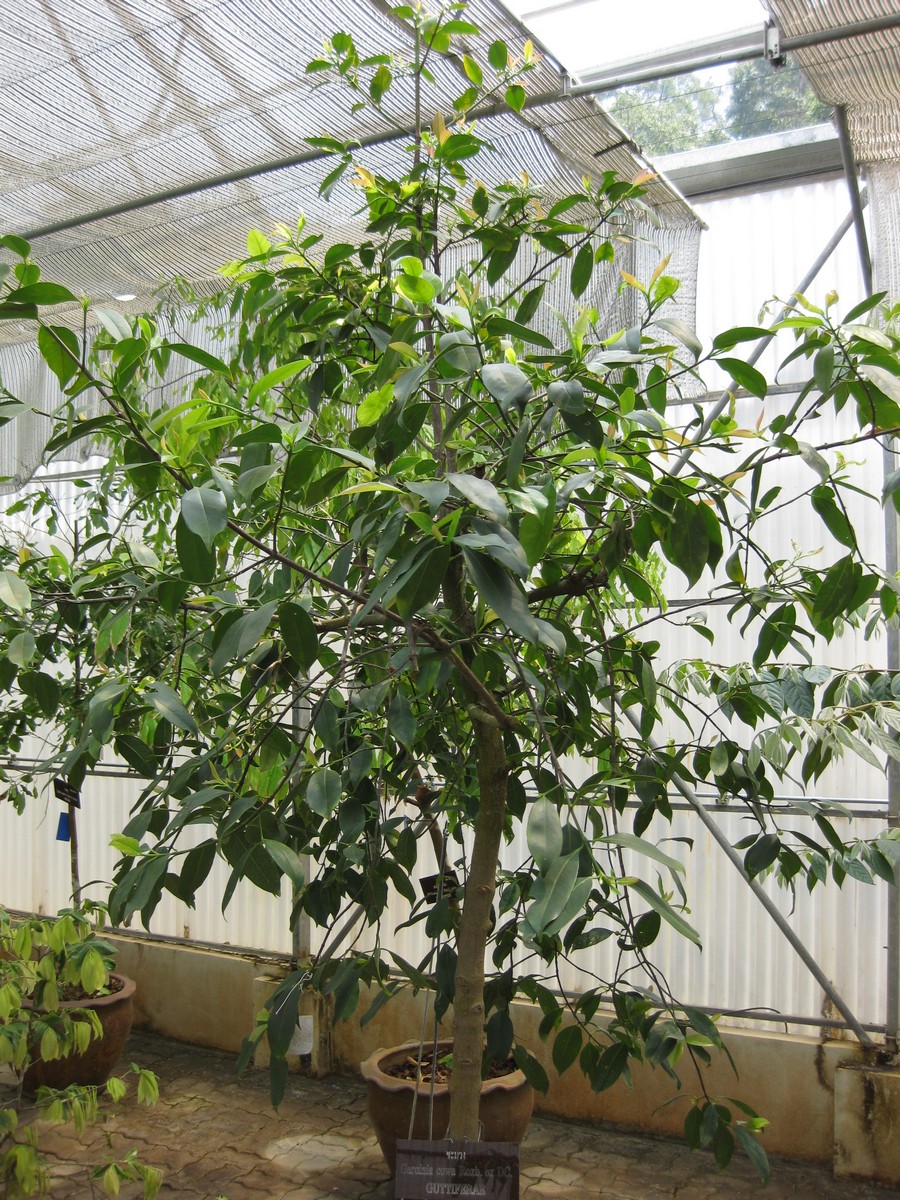
The scientific name of the Cowa Fruit is Garcinia cowa. It is a species of flowering plant in the family Clusiaceae (clusoids), order Malpighiales.
- Scientific name
- Garcinia cowa Roxb.
- Common name
- Cowa Fruit
- Genus
- Garcinia
- Family
- Clusiaceae (Clusoids)
- Order
- Malpighiales
- Class
- Magnoliopsida
- Red List category
- LC Least Concern
- Recorded in
- 14 countries
- Name status
- accepted in the Catalogue of Life
Overview
Cowa Fruit (Garcinia cowa Roxb.) is an evergreen flowering plant in the family Clusiaceae, order Malpighiales and class Magnoliopsida. It is native to India, Nepal, Bangladesh, Myanmar, Peninsular Malaysia, Thailand, Vietnam, Laos, Cambodia, and Yunnan in southwestern China. Its fruits and leaves are harvested for local use, and its fruit is eaten raw, used in curries and made into pickles.
Written 26 November 2026 from the sources listed below. Each statement was checked against the passage it cites; statements that could not be supported were removed.
Appearance
Cowa Fruit is an evergreen plant.[1]
Habitat
Cowa Fruit is native to India, Nepal, Bangladesh, Myanmar, Peninsular Malaysia, Thailand, Vietnam, Laos, Cambodia, and Yunnan in southwestern China.[2]
Uses
The fruits and leaves are harvested from the wild for local use. The fruit can be eaten raw, used as a tamarind-like flavoring in curries, and made into pickles.[3][4][5][6]
The fruit can be preserved by slicing it and drying the slices in sunlight. The leaves can be cooked and eaten.[7][8]
In Thailand, the bark has been used in folk medicine as an antipyretic and antimicrobial. The latex has been used in Thai folk medicine as an antipuretic.[9][10]
The fruits and leaves have been used in Thai folk medicine to improve blood circulation and as an expectorant for coughs and indigestion.[11][12]
The roots are traditionally believed to relieve fevers. In East India, sun-dried fruit slices have been used to treat dysentery.[13][14]
The bark contains five xanthones that have demonstrated anti-malarial properties in vitro against Plasmodium falciparum.[15]
The bark is used to produce yellow dye for clothing. The gum resin is used in varnishes.[16][17]
Classification of the Cowa Fruit
| Kingdom | Plantae |
|---|---|
| Subkingdom | Pteridobiotina |
| Phylum | Tracheophyta |
| Class | Magnoliopsida |
| Order | Malpighiales |
| Family | Clusiaceae (Clusoids) |
| Tribe | Garcinieae |
| Genus | Garcinia (Mangosteen Genus) |
| Species | Garcinia cowa Roxb. |
Where the Cowa Fruit is found
Checklists and occurrence records place Garcinia cowa in 14 countries across Asia. GBIF holds 703 georeferenced records of it.
Countries
- Bangladesh 13
- Cambodia 4
- China 115
- India 41
- Indonesia 37
- Laos 8
- Malaysia 146
- Myanmar 19
- Nepal 1
- Philippines 7
- Singapore 22
- Sri Lanka 4
- Thailand 237
- Vietnam 49
Regions and cities with the most records
- Yunnan, China 102
- Yunjinghong, China 42
- Chiang Mai, Thailand 12
- Mengla, China 12
- Negeri Sembilan, Malaysia 9
- Perak, Malaysia 8
- Anak Bukit, Singapore 7
- Bandar Seri Alam, Malaysia 7
- Bedok New Town, Singapore 7
- Boon Lay, Singapore 7
- Bukit Panjang New Town, Singapore 7
- Choa Chu Kang New Town, Singapore 7
- Horizon Hills, Malaysia 7
- Johor Bahru, Malaysia 7
- Johor Jaya, Malaysia 7
- Jurong East, Singapore 7
- Jurong Town, Singapore 7
- Jurong West, Singapore 7
- Kampong Loyang, Singapore 7
- Kampong Pasir Ris, Singapore 7
- Kampung Kangkar Teberau, Malaysia 7
- Kampung Larkin Lama, Malaysia 7
- Kampung Pasir Gudang Baru, Malaysia 7
- Keat Hong Village, Singapore 7
- Marsiling, Singapore 7
- Masai, Malaysia 7
- Matilda Estate, Singapore 7
- Pasir Gudang, Malaysia 7
- Pelentong, Malaysia 7
- Perling, Malaysia 7
- Punggol, Singapore 7
- Queenstown Estate, Singapore 7
- Sembawang Estate, Singapore 7
- Sengkang New Town, Singapore 7
- Songkhla, Thailand 7
- Sungai Simpang, Singapore 7
2 more countries have a few records outside this range
These countries hold a few records of Garcinia cowa but lie outside the range the checklists give for it. Such records are often zoo or garden specimens, museum material or vagrants, so the species is not counted as occurring there.
Range as the checklists state it
China (Yunnan); Nepal; India (Assam, Bihar, Manipur, Meghalaya, Mizoram, Nagaland, Odisha, Sikkim, Tripura, West Bengal); Bangladesh; Andaman Isl. (North Andaman Isl., Middle Andaman Isl., South Andaman Isl., Little Andaman Isl.); Myanmar (widespread); Thailand; Laos; Cambodia; Vietnam; peninsular Malaysia (throughout); Singapore; Borneo
A number beside a place is its count of GBIF occurrence records. A place without a number comes from a checklist alone. Records show where a species has been observed or collected, which can include escapes and vagrants.
Common names
English
- Cowa Fruit
- Brindal Berry
- Cowa Moangosteen
- Cowa
Names in 8 other languages
- Bengali
- Kowa
- Chinese
- yun shu, 云树, 雲樹
- Hindi
- Kattaphal, Rengram, Tekra
- Malayalam
- Kattukodapuli
- Thai
- ชะมวง
- asm
- Kau thekera, Kau-thekera, Kaugach, Kaurithekera, Kou-thekera
- san
- Dvipaja
- sun
- Ceuri
Synonyms
23 other scientific names have been used for this species and are now treated as synonyms of Garcinia cowa.
- Brindonia cochinchinensis (Lour.) Thouars
- Cambogia crassifolia Blanco
- Garcinia cochinchinensis (Lour.) Choisy
- Garcinia fusca Pierre
- Garcinia kunstleri King
- Garcinia lanceifolia Wall.
- Garcinia lobulosa Wall.
- Garcinia loureiroi Pierre
- Garcinia nigrolineata Planch. ex T.Anderson
- Garcinia plena Craib
- Garcinia umbellifera Wall.
- Garcinia wallichii Choisy
- Oxycarpus cochinchinensis Lour.
- Oxycarpus gangetica Buch.-Ham.
- Stalagmitis acida Cambess. ex Spach
- Stalagmitis cochinchinensis (Lour.) G.Don
- Stalagmitis cowa (Roxb. ex Choisy) G.Don
- Stalagmitis kydiana G.Don
- Stalagmitis umbellata G.Don
- Garcinia cambogia Roxb. ambiguous synonym
- Garcinia cornea Roxb. ex Sm. ambiguous synonym
- Garcinia dioica Sm. ambiguous synonym
- Garcinia roxburghii Wight ambiguous synonym
Subspecies and varieties
- Garcinia cowa var. cowa variety
- Garcinia cowa var. kydia variety
Related species
-
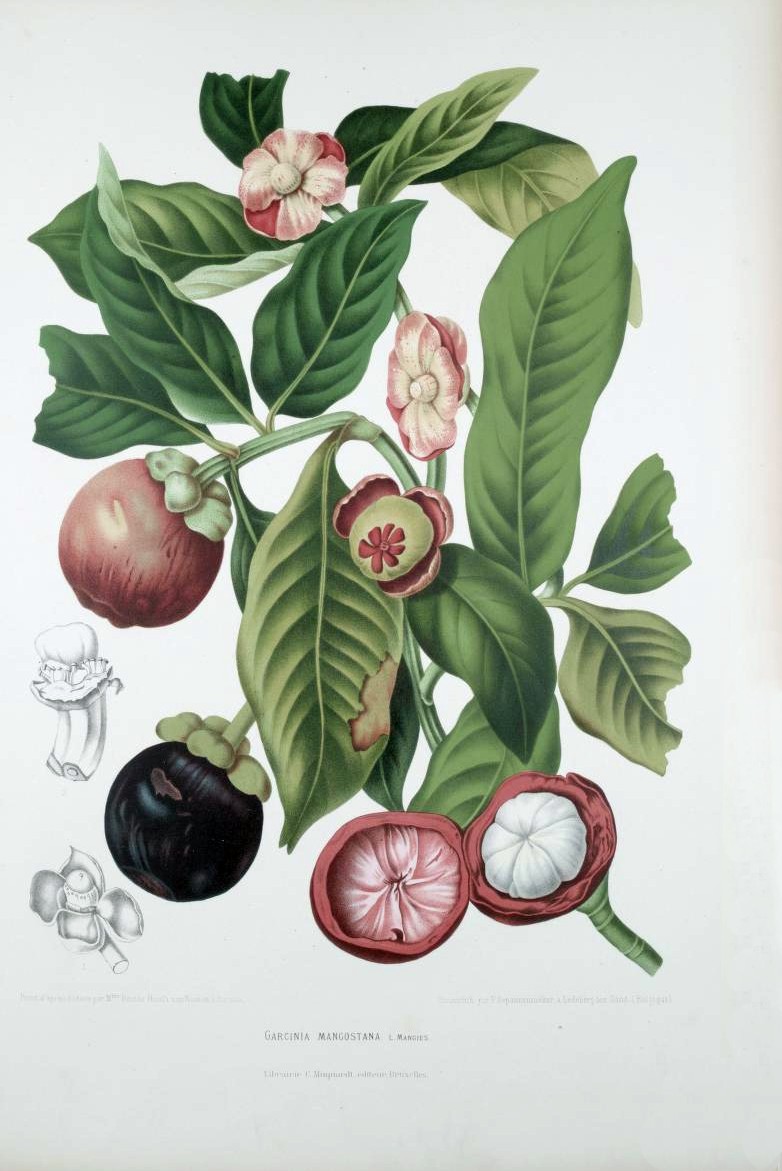 MangosteenGarcinia mangostana
-
 Malabar TamarindGarcinia gummi-gutta
-
 KokumGarcinia indica
-
 Bitter KolaGarcinia kola
-
 AchachaGarcinia gardneriana
-
 False MangosteenGarcinia xanthochymus
- African MangosteenGarcinia livingstonei
-
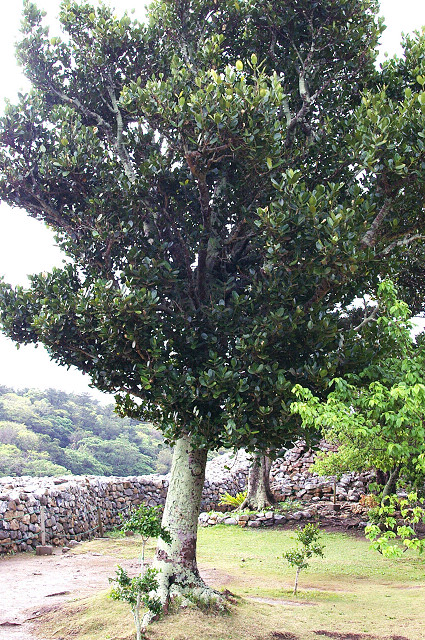 Common GarciniaGarcinia subelliptica
Compare
Questions and answers
What is the scientific name of the Cowa Fruit?
The scientific name of the Cowa Fruit is Garcinia cowa. Written with its author, the full name is Garcinia cowa Roxb..
Which family does the Cowa Fruit belong to?
Garcinia cowa belongs to the family Clusiaceae, in the order Malpighiales and the class Magnoliopsida.
Where is the Cowa Fruit found?
Checklists and occurrence records place Garcinia cowa in 14 countries, including Thailand, Malaysia, China, Vietnam, India and Indonesia.
What is the conservation status of the Cowa Fruit?
The IUCN Red List category recorded for Garcinia cowa is Least Concern (LC).
What other names does the Cowa Fruit have?
Garcinia cowa is also known in English as Brindal Berry, Cowa Moangosteen and Cowa.
What is cowa fruit?
Cowa Fruit is the fruit of Garcinia cowa, an evergreen flowering plant in the family Clusiaceae. It can be eaten raw, used as a tamarind-like flavoring in curries, and made into pickles.[1][3][4][5][6]
What is Cowa?
Cowa is Garcinia cowa, an evergreen flowering plant in the family Clusiaceae.[1]
Is garcinia fruit edible?
The fruit of Garcinia cowa can be eaten raw. It is also used as a tamarind-like flavoring in curries and to make pickles.[4][5][6]
What is garcinia cowa?
Garcinia cowa Roxb. is an evergreen flowering plant in the family Clusiaceae, order Malpighiales and class Magnoliopsida.[1]
Sources
Passages the profile rests on
- Garcinia cowa is an evergreen plant. Source passage: “is an evergreen plant with edible fruit” — English Wikipedia
- Garcinia cowa is native to India, Nepal, Bangladesh, Myanmar, Peninsular Malaysia, Thailand, Vietnam, Laos, Cambodia, and Yunnan in southwestern China. Source passage: “native to tropical Asia, including India, Nepal, Bangladesh, Myanmar, Peninsular Malaysia, Thailand, Vietnam, Laos, Cambodia, and Yunnan in southwestern China.” — English Wikipedia
- The fruits and leaves of Garcinia cowa are harvested from the wild for local use. Source passage: “The tree is harvested from the wild for its edible fruits and leaves, which are used locally.” — English Wikipedia
- The fruit of Garcinia cowa can be eaten raw. Source passage: “The fruit can be eaten raw and has an acidic flavor.” — English Wikipedia
- The fruit is used as a tamarind-like flavoring in curries. Source passage: “It is used in curries as a tamarind-like flavoring” — English Wikipedia
- The fruit of Garcinia cowa is used to make pickles. Source passage: “as well as being used for making pickles.” — English Wikipedia
- The fruit can be preserved by slicing it and drying the slices in sunlight. Source passage: “It can be made into slices and sun-dried as a way to preserve it.” — English Wikipedia
- The leaves of Garcinia cowa can be cooked and eaten. Source passage: “Its leaves can also be cooked and eaten.” — English Wikipedia
- In Thailand, the bark of Garcinia cowa has been used in folk medicine as an antipyretic and antimicrobial. Source passage: “the bark as an antipyretic and antimicrobial” — English Wikipedia
- The latex of Garcinia cowa has been used in Thai folk medicine as an antipuretic. Source passage: “the latex as an antipuretic” — English Wikipedia
- The fruits and leaves of Garcinia cowa have been used in Thai folk medicine to improve blood circulation. Source passage: “the fruits and leaves to improve blood circulation” — English Wikipedia
- The fruits and leaves of Garcinia cowa have been used in Thai folk medicine as an expectorant for coughs and indigestion. Source passage: “as an expectorant for coughs and indigestion” — English Wikipedia
- The roots of Garcinia cowa are traditionally believed to relieve fevers. Source passage: “The roots are believed to relieve fevers” — English Wikipedia
- Sun-dried fruit slices of Garcinia cowa have been used to treat dysentery in East India. Source passage: “in East India, sun-dried slices of the fruit have been used as a treatment for dysentery.” — English Wikipedia
- The bark of Garcinia cowa contains five xanthones that have demonstrated anti-malarial properties in vitro against Plasmodium falciparum. Source passage: “Studies have found that the bark contains five xanthones with anti-malarial properties in vitro against Plasmodium falciparum.” — English Wikipedia
- The bark of Garcinia cowa is used to produce yellow dye for clothing. Source passage: “The bark is also used to produce a yellow dye for clothes.” — English Wikipedia
- The gum resin of Garcinia cowa is used in varnishes. Source passage: “The gum resin is used in varnishes.” — English Wikipedia
Data
- Catalogue of Life, 2026-10-16 XR cc by
- Global Biodiversity Information Facility CC BY 4.0
- Wikidata CC0
- GeoNames CC BY 4.0
- Wikimedia Commons per image; credit shown with each image
- Within the Catalogue of Life, this name comes from Synonymic Checklists of the Vascular Plants of the World cc by
References
- Roxb. (1824). Fl. Ind. [Carey & Wallich ed.] 2: 622 (1824). where the name was published
This species in other databases
- Catalogue of Life 3F9T8
- Wikidata Q10823721
- iNaturalist 427706
- World Flora Online wfo-1000040941
- GRIN 71000
Page built on 27 November 2026. See how the catalog is made and all sources and licences.
Cite this page
ScientificNames.org. (2026). Garcinia cowa (Cowa Fruit). Retrieved November 27, 2026, from https://scientificnames.org/species/garcinia-cowa
“Garcinia cowa (Cowa Fruit).” ScientificNames.org, 2026, scientificnames.org/species/garcinia-cowa. Accessed 27 Nov. 2026.
ScientificNames.org. “Garcinia cowa (Cowa Fruit).” Accessed November 27, 2026. https://scientificnames.org/species/garcinia-cowa.
@misc{scientificnames_garcinia_cowa_cowa_fruit,
  author = {{ScientificNames.org}},
  title = {Garcinia cowa (Cowa Fruit)},
  year = {2026},
  url = {https://scientificnames.org/species/garcinia-cowa},
  note = {Accessed 2026-11-27}
}