Species · Birds
Olive-crowned Yellowthroat Geothlypis semiflava
The scientific name of the Olive-crowned Yellowthroat is Geothlypis semiflava. It is a species of bird in the family Parulidae (new world warbler), order Passeriformes. The name dates from 1860.
- Scientific name
- Geothlypis semiflava P. L. Sclater, 1860
- Common name
- Olive-crowned Yellowthroat
- Genus
- Geothlypis
- Family
- Parulidae (New World Warbler)
- Order
- Passeriformes
- Class
- Aves
- Red List category
- LC Least Concern
- Recorded in
- 6 countries
- Name status
- accepted in the Catalogue of Life

Overview
Geothlypis semiflava occurs in Colombia, Costa Rica, Ecuador, Honduras, Nicaragua, and Panama. It has an olive-colored upper surface and yellow underparts, and the sexes differ in appearance.
Written 27 November 2026 from the sources listed below. Each statement was checked against the passage it cites; statements that could not be supported were removed.
Similar species
The Olive-crowned Yellowthroat closely resembles the Common Yellowthroat and Masked Yellowthroat.[1]
Appearance
The Olive-crowned Yellowthroat measures 11.1–13.5 cm in length and weighs 15.5–17.5 g.[2][3]
Adult males of the nominate subspecies have a broad black facial mask extending from the forehead and forecrown around the eye to the side of the neck. Their upperparts, wings, and tail are olive-green, with yellow underparts and an olive wash on the flanks.[4][5]
Adult females lack black facial markings and have predominantly olive-green heads with thin yellowish supercilia.[6]
Both sexes of all subspecies have dark irises, black bills with pale horn-colored tomia and gonys, and pinkish horn or dull orange legs and feet.[7]
Males of the subspecies G. s. bairdi have a brown wash on their heads and upperparts, particularly on the rump and tail. Males of G. s. chiriquensis have a gray crown and a gray line bordering the upper and rear portions of their black facial mask.[8][9]
Habitat
The Olive-crowned Yellowthroat inhabits marshes, damp pastures with tall grass and shrubs, and bamboo thickets. It is associated with wet, grassy, and shrubby habitats, and most individuals occupy areas near water, particularly ponds and moving watercourses.[10][11][12]
In Central America, the species occurs from sea level to 1,500 m, with a maximum elevation of 1,200 m in Costa Rica. In Colombia, it occurs at elevations reaching 1,800 m, while in Ecuador it is found mostly below 1,200 m.[13][14][15]
The subspecies G. s. bairdi ranges from eastern Honduras through Nicaragua and Costa Rica to northwestern Panama. G. s. chiriquensis occurs in southwestern Costa Rica and western Panama.[16][17]
The nominate subspecies occurs from Chocó Department in western Colombia south along the Pacific coast to central Manabí Province and inland to El Oro Province in Ecuador.[18]
Diet
The species' diet has not been studied, but it is presumed to consist mainly of insects and other invertebrates.[19]
Behaviour
The Olive-crowned Yellowthroat is a sedentary resident throughout the year. It generally forages alone or in pairs, capturing prey by gleaning from low, dense vegetation.[20][21][22]
In Costa Rica, the species produces sweet, wren-like song phrases. The nominate subspecies sings a rich, musical sequence of phrases that generally ends in a jumble.[23][24]
Reproduction and life cycle
In Costa Rica, the Olive-crowned Yellowthroat's breeding activity extends at least from April through June. In Colombia, the species appears to breed at least from January through April.[25][26]
The species builds an open-cup nest from coarse grasses lined with finer plant fibers and hair. The nest is generally placed in a grass clump less than 1 m above the ground.[27][28]
The clutch contains one or two white eggs marked with several darker colors. The incubation period reported for G. s. chiriquensis is 15 days.[29][30]
Conservation
All three recognized subspecies have been assessed as Least Concern under the IUCN assessments described in the document. No immediate threats have been identified for the species' subspecies.[31][32]
The population sizes of all three subspecies and the number of mature individuals are unknown. The population of G. s. bairdi is believed to be stable, while the populations of the nominate form and G. s. chiriquensis are believed to be increasing.[33][34][35][36]
Classification of the Olive-crowned Yellowthroat
| Kingdom | Animalia |
|---|---|
| Phylum | Chordata |
| Subphylum | Vertebrata |
| Infraphylum | Gnathostomata |
| Parvphylum | Osteichthyes |
| Megaclass | Tetrapoda |
| Class | Aves (Bird) |
| Order | Passeriformes (Passerine) |
| Family | Parulidae (New World Warbler) |
| Genus | Geothlypis (Yellowthroat) |
| Species | Geothlypis semiflava P. L. Sclater, 1860 |
Where the Olive-crowned Yellowthroat is found
Checklists and occurrence records place Geothlypis semiflava in 6 countries across North America and South America. GBIF holds 19,792 georeferenced records of it.
Countries
Regions and cities with the most records
- Pichincha, Ecuador 4,186
- Alajuela Province, Costa Rica 3,707
- Heredia Province, Costa Rica 1,760
- Limón Province, Costa Rica 1,519
- Bocas del Toro Province, Panama 1,277
- Cartago Province, Costa Rica 1,227
- Turrialba, Costa Rica 1,173
- Nariño, Colombia 770
- Chimborazo Province, Ecuador 713
- El Oro, Ecuador 655
- Piñas, Ecuador 643
- Changuinola, Panama 600
- Puntarenas Province, Costa Rica 482
- Valle del Cauca Department, Colombia 429
- Guanacaste Province, Costa Rica 391
- Marsella, Colombia 293
- Caldas Department, Colombia 285
- Chinchiná, Colombia 279
- Paraíso, Costa Rica 265
- Dosquebradas, Colombia 259
- Manizales, Colombia 259
- Santa Rosa de Cabal, Colombia 259
- Villamaría, Colombia 259
- Chiriquí Province, Panama 258
- Cartago, Costa Rica 205
- Quesada, Costa Rica 195
- Limón, Costa Rica 172
- Cauca Department, Colombia 165
- Imbabura, Ecuador 159
- Río San Juan Department, Nicaragua 157
- Esmeraldas, Ecuador 153
- Siquirres, Costa Rica 152
- Guayas, Ecuador 147
- El Cerrito, Colombia 128
- Palmira, Colombia 128
- Carchi, Ecuador 118
Range as the checklists state it
Middle America
South America
A number beside a place is its count of GBIF occurrence records. A place without a number comes from a checklist alone. Records show where a species has been observed or collected, which can include escapes and vagrants.
Common names
English
- Olive-crowned Yellowthroat
Names in 25 other languages
- Catalan
- bosquerola emmascarada dels bambús
- Chinese
- 橄綠頂黃喉地鶯, 绿冠黄喉地莺
- Croatian
- travnjačka sjeničica
- Czech
- lesňáček nažloutlý
- Danish
- Olivenkronet Gulstrube
- Dutch
- Groenkruinmaskerzanger
- Esperanto
- olivkapa parulio
- Estonian
- heina-masksäälik
- Finnish
- kolumbiannaamiokerttuli
- French
- Paruline des bambous
- German
- Olivscheitel-Gelbkehlchen, Olivscheitelgelbkehlchen
- Italian
- Golagialla capoliva
- Japanese
- オリーブズキンカオグロムシクイ
- Lithuanian
- žaliavainikė geltongurklė
- Norwegian
- olivengulstrupe
- Polish
- cytrynka oliwkowogłowa
- Portuguese
- mariquita-de-coroa-olivácea, pia-cobra-de-coroa-oliva
- Russian
- Оливковоголовая желтогрудка, Оливковоголовый масковый певун
- Serbian
- Cvrkutarka sa maslinastom kapicom
- Slovak
- horárik maskový
- Spanish
- Antifacito Coroniolivo, Mascarita coronioliva
- Swedish
- olivkronad gulhake
- Turkish
- Yeşil Başlı Sarıgerdan
- Ukrainian
- жовтогорлик оливковоголовий
- Welsh
- aderyn gyddf-felyn pen melynwyrdd
Subspecies and varieties
- Geothlypis semiflava bairdi subspecies
- Geothlypis semiflava semiflava subspecies
Related species
-
 Common YellowthroatGeothlypis trichas
-
 Mourning WarblerGeothlypis philadelphia
-
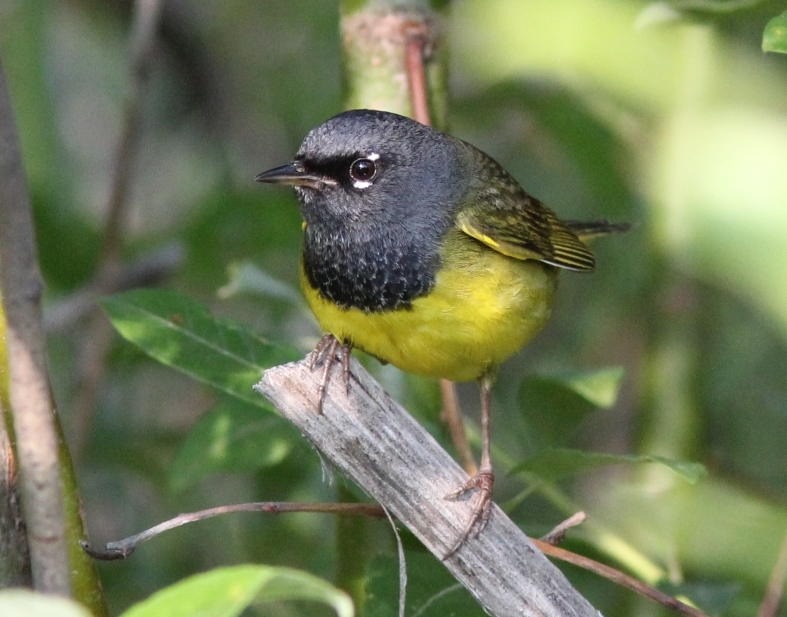 MacGillivray's WarblerGeothlypis tolmiei
-
 Kentucky WarblerGeothlypis formosa
-
 Bahama YellowthroatGeothlypis rostrata
-
 Black-polled YellowthroatGeothlypis speciosa
-
 Masked YellowthroatGeothlypis aequinoctialis
-
 Grey-crowned YellowthroatGeothlypis poliocephala
Compare
Questions and answers
What is the scientific name of the Olive-crowned Yellowthroat?
The scientific name of the Olive-crowned Yellowthroat is Geothlypis semiflava. Written with its author, the full name is Geothlypis semiflava P. L. Sclater, 1860.
Which family does the Olive-crowned Yellowthroat belong to?
Geothlypis semiflava belongs to the family Parulidae, in the order Passeriformes and the class Aves.
Where is the Olive-crowned Yellowthroat found?
Checklists and occurrence records place Geothlypis semiflava in 6 countries: Costa Rica, Ecuador, Colombia, Panama, Nicaragua and Honduras.
What is the conservation status of the Olive-crowned Yellowthroat?
The IUCN Red List category recorded for Geothlypis semiflava is Least Concern (LC).
What do yellowthroats eat?
The Olive-crowned Yellowthroat's diet is presumed to consist mainly of insects and other invertebrates.[19]
Sources
Passages the profile rests on
- The Olive-crowned Yellowthroat closely resembles the Common Yellowthroat and Masked Yellowthroat. Source passage: “Very similar to Common and Masked Yellowthroats” — ebird.org
- The Olive-crowned Yellowthroat measures 11.1–13.5 cm in length. Source passage: “The olive-crowned yellowthroat is 11.1 to 13.5 cm (4.4 to 5.3 in) long” — English Wikipedia
- The species weighs 15.5–17.5 g. Source passage: “weighs 15.5 to 17.5 g (0.55 to 0.62 oz).” — English Wikipedia
- Adult males of the nominate subspecies have a broad black facial mask extending from the forehead and forecrown around the eye to the side of the neck. Source passage: “Adult males of the nominate subspecies G. s. semiflava have a wide black mask from their forehead and forecrown around the eye to the side of the neck.” — English Wikipedia
- Adult males of the nominate subspecies have olive-green upperparts, wings, and tail, with yellow underparts and an olive wash on the flanks. Source passage: “The rest of their head and their upperparts, wings, and tail are olive-green. Their throat and underparts are yellow with an olive wash on the flanks.” — English Wikipedia
- Adult females lack black facial markings and have predominantly olive-green heads with thin yellowish supercilia. Source passage: “Adult females have no black on their face. They have a mostly olive-green head with a thin yellowish supercilium.” — English Wikipedia
- Both sexes of all subspecies have dark irises, black bills with pale horn-colored tomia and gonys, and pinkish horn or dull orange legs and feet. Source passage: “Both sexes of all subspecies have a dark iris, a black bill with pale horn tomia and gonys, and pinkish horn or dull orange legs and feet.” — English Wikipedia
- Males of the subspecies G. s. bairdi have a brown wash on their heads and upperparts, particularly on the rump and tail. Source passage: “Males of subspecies G. s. bairdi are similar to the nominate with the addition of a brown wash on the head and upperparts that is especially strong on the rump and tail.” — English Wikipedia
- Males of G. s. chiriquensis have a gray crown and a gray line bordering the upper and rear portions of their black facial mask. Source passage: “Males of G. s. chiriquensis have a gray crown and a gray line along the top and rear of the black mask.” — English Wikipedia
- The species inhabits marshes, damp pastures with tall grass and shrubs, and bamboo thickets. Source passage: “including marshes, damp pastures with tall grass and shrubs, and thickets of bamboo.” — English Wikipedia
- Most individuals occupy habitats near water, particularly ponds and moving watercourses. Source passage: “Most are near water, usually ponds but also moving watercourses.” — English Wikipedia
- The species is associated with wet, grassy, and shrubby habitats. Source passage: “Small yet chunky warbler of wet, grassy, and shrubby areas.” — ebird.org
- The species occurs from sea level to 1,500 m in Central America, with a maximum elevation of 1,200 m in Costa Rica. Source passage: “from sea level to 1,500 m (4,900 ft) overall in Central America but to 1,200 m (3,900 ft) in Costa Rica.” — English Wikipedia
- In Colombia, the species occurs at elevations reaching 1,800 m. Source passage: “In Colombia it reaches 1,800 m (5,900 ft)” — English Wikipedia
- In Ecuador, the species is found mostly below 1,200 m. Source passage: “in Ecuador is mostly below 1,200 m (3,900 ft).” — English Wikipedia
- The subspecies G. s. bairdi ranges from eastern Honduras through Nicaragua and Costa Rica to northwestern Panama. Source passage: “It is found from far eastern Honduras south along the Caribbean slope through Nicaragua and Costa Rica into northwestern Panama” — English Wikipedia
- The subspecies G. s. chiriquensis occurs in southwestern Costa Rica and western Panama. Source passage: “Subspecies G. s. chiriquensis is found from extreme southwestern Costa Rica into western Panama's Chiriquí Province.” — English Wikipedia
- The nominate subspecies occurs from Chocó Department in western Colombia south along the Pacific coast to central Manabí Province and inland to El Oro Province in Ecuador. Source passage: “G. s. semiflava is found from Chocó Department in west-central Colombia south in the Pacific coastal area to central Manabí Province and beyond there more inland to El Oro Province.” — English Wikipedia
- The species' diet has not been studied, but it is presumed to consist mainly of insects and other invertebrates. Source passage: “The olive-crowned yellowthroat's diet has not been studied but is assumed to be mostly insects and other invertebrates.” — English Wikipedia
- The Olive-crowned Yellowthroat is a sedentary resident throughout the year. Source passage: “The olive-crowned yellowthroat is a sedentary year-round resident.” — English Wikipedia
- The species generally forages alone or in pairs. Source passage: “It typically forages singly or in pairs” — English Wikipedia
- The species captures prey by gleaning from low, dense vegetation. Source passage: “captures prey by gleaning from low dense vegetation.” — English Wikipedia
- In Costa Rica, the species produces sweet, wren-like song phrases. Source passage: “In Costa Rica the olive-crowned yellowthroat sings "sweet, wren-like phrases".” — English Wikipedia
- The nominate subspecies sings a rich, musical sequence of phrases that generally ends in a jumble. Source passage: “The nominate subspecies sings "a rich and musical series of phrases that usually ends in a jumble".” — English Wikipedia
- In Costa Rica, the Olive-crowned Yellowthroat's breeding activity extends at least from April through June. Source passage: “it is known to span at least April to June in Costa Rica.” — English Wikipedia
- In Colombia, the species appears to breed at least from January through April. Source passage: “In Colombia it appears to breed at least between January and April.” — English Wikipedia
- The species builds an open-cup nest from coarse grasses lined with finer plant fibers and hair. Source passage: “The species' nest is an open cup made from coarse grasses lined with finer plant fibers and hair.” — English Wikipedia
- The nest is generally placed in a grass clump less than 1 m above the ground. Source passage: “They are typically placed in a clump of grass less than 1 m (3 ft) above the ground.” — English Wikipedia
- The clutch contains one or two white eggs marked with several darker colors. Source passage: “The clutch is one or two eggs that are white with markings of several darker colors.” — English Wikipedia
- The incubation period reported for G. s. chiriquensis is 15 days. Source passage: “The incubation period for G. s. chiriquensis is 15 days.” — English Wikipedia
- All three recognized subspecies have been assessed as Least Concern under the IUCN assessments described in the document. Source passage: “All are assessed to be of Least Concern.” — English Wikipedia
- No immediate threats have been identified for the species' subspecies. Source passage: “No immediate threats to any have been identified.” — English Wikipedia
- The population sizes of all three subspecies are unknown. Source passage: “None of their population sizes are known.” — English Wikipedia
- The population of G. s. bairdi is believed to be stable. Source passage: “The population of "Baird's" yellowthroat is believed to be stable.” — English Wikipedia
- The populations of the nominate form and G. s. chiriquensis are believed to be increasing. Source passage: “Those of the "olive-crowned" (sensu stricto) and "Chiriqui" yellowthroats are believed to be increasing.” — English Wikipedia
- The number of mature individuals is unknown. Source passage: “Number of mature individuals Unknown” — datazone.birdlife.org
- The Olive-crowned Yellowthroat occurs in Colombia, Costa Rica, Ecuador, Honduras, Nicaragua, and Panama. Source passage: “It is found in Colombia, Costa Rica, Ecuador, Honduras, Nicaragua, and Panama.” — English Wikipedia
Data
- Catalogue of Life, 2026-10-16 XR cc by
- Global Biodiversity Information Facility CC BY 4.0
- Wikidata CC0
- GeoNames CC BY 4.0
- Wikimedia Commons per image; credit shown with each image
- Within the Catalogue of Life, this name comes from The Integrated Taxonomic Information System cc0
References
- Sclater, & Philip Lutley. (1860). List of Birds Collected by Mr. Fraser at Babahoyo in Ecuador, with Descriptions of New Species. Proceedings of the Zoological Society of London, Vol. 28. where the name was published
- Gill, Frank, & and Minturn Wright. (2006). Birds of the World: Recommended English Names.
This species in other databases
Page built on 27 November 2026. See how the catalog is made and all sources and licences.
Cite this page
ScientificNames.org. (2026). Geothlypis semiflava (Olive-crowned Yellowthroat). Retrieved November 27, 2026, from https://scientificnames.org/species/geothlypis-semiflava
“Geothlypis semiflava (Olive-crowned Yellowthroat).” ScientificNames.org, 2026, scientificnames.org/species/geothlypis-semiflava. Accessed 27 Nov. 2026.
ScientificNames.org. “Geothlypis semiflava (Olive-crowned Yellowthroat).” Accessed November 27, 2026. https://scientificnames.org/species/geothlypis-semiflava.
@misc{scientificnames_geothlypis_semiflava_olive_crowned_yellowthroat,
  author = {{ScientificNames.org}},
  title = {Geothlypis semiflava (Olive-crowned Yellowthroat)},
  year = {2026},
  url = {https://scientificnames.org/species/geothlypis-semiflava},
  note = {Accessed 2026-11-27}
}