Species · Birds
Southern Yellowthroat Geothlypis velata
The scientific name of the Southern Yellowthroat is Geothlypis velata. It is a species of bird in the family Parulidae (new world warbler), order Passeriformes. The name dates from 1809.
- Scientific name
- Geothlypis velata (Vieillot, 1809)
- Common name
- Southern Yellowthroat
- Genus
- Geothlypis
- Family
- Parulidae (New World Warbler)
- Order
- Passeriformes
- Class
- Aves
- Recorded in
- 8 countries
- Name status
- accepted in the Catalogue of Life

Overview
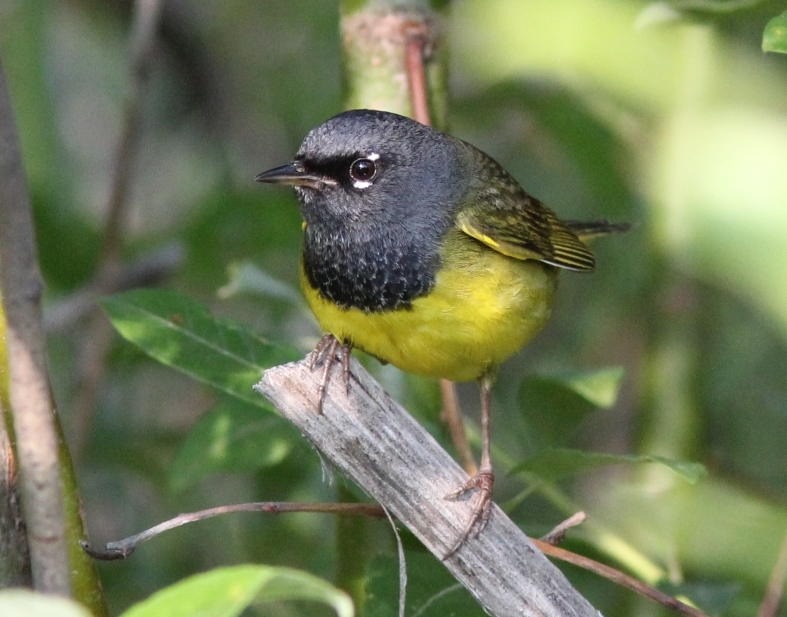
Geothlypis velata inhabits caatinga vegetation, dry woodlands of the Gran Chaco, deciduous Yungas forest in Bolivia, damp grasslands, marshes, seasonally flooded savanna, and Araucaria moist forests. Adult males have a wide black facial mask, pale slate-gray crown, yellow throat and underparts, and yellowish green to olive green upperparts.
Written 27 November 2026 from the sources listed below. Each statement was checked against the passage it cites; statements that could not be supported were removed.
Appearance
Adult males have a wide black facial mask extending from the forehead and forecrown around the eye and across the ear coverts. Their crown is pale slate-gray, while the nape, upperparts, and tail are yellowish green to olive green.[1][2][3]
Adult males have bright yellow throats and underparts, with a very light olive wash on the flanks. Females lack black coloration on the head and have a pale yellow-white stripe above the lores and a similarly colored eye-ring.[4][5][6]
Females have a gray wash on the crown and ear coverts and a stronger olive wash on the flanks than males. Both sexes have dark brown to grayish brown irises, a blackish maxilla, and a pinkish horn to gray mandible with a pale base.[7][8][9][10]
The Southern Yellowthroat measures 13–14.3 cm in length and weighs 11–17 g.[11][12]
Habitat
The Southern Yellowthroat inhabits caatinga vegetation, the dry woodlands of the Gran Chaco, and deciduous Yungas forest in Bolivia. It also occurs in damp grasslands, marshes, seasonally flooded savanna, and Araucaria moist forests.[13][14][15][16][17][18][19]
In some areas, the species favors dense undergrowth in forest clearings and along forest edges. It also occurs in cut-over woodlots and suburban areas.[20][21]
In Brazil, the species occurs from sea level to 1,500 m elevation. In Peru, it reaches elevations of 2,200 m.[22][23]
The documented range includes Argentina, Bolivia, Brazil, Paraguay, Peru, and Uruguay. The species occurs in southeastern Peru, extending eastward from Cuzco Department.[24][25]
In Brazil, the species occurs south of an approximate line from Acre east to the Atlantic in northern Bahia. It occurs throughout Paraguay and Uruguay, and its southern range extends into northern Argentina as far as northern Buenos Aires Province.[26][27][28]
Diet
The Southern Yellowthroat feeds almost exclusively on small invertebrates. Documented components of its diet include Isoptera, Hemiptera, Coleoptera, Hymenoptera, and Formicidae.[29][30][31][32][33][34]
Behaviour
The species forages individually or in pairs and obtains most of its prey by gleaning in dense vegetation. It has also been observed catching winged termites in mid-air.[35][36][37]
Most populations remain in their range throughout the year. The southernmost population moves north during the austral winter.[38][39]
Reproduction and life cycle
In Argentina, the breeding season is concentrated between November and January. The species builds a messy open-cup nest from coarse plant materials lined with finer plant and animal fibers.[40][41]
Nests are attached to sedges, cattails, other similar standing vegetation, and shrubs. The species usually places its nest within 0.5 m of the ground.[42][43]
Most clutches contain three eggs, although clutches of two to four eggs are also documented. The eggs are white with darker flecks and blotches.[44][45]
The female alone incubates the eggs for approximately 13–14 days. Young Southern Yellowthroats fledge 10–11 days after hatching.[46][47]
The shiny cowbird is a brood parasite of the Southern Yellowthroat.[48]
Conservation
The Southern Yellowthroat has not been assessed separately by the IUCN from the masked yellowthroat sensu stricto.[49]
The species is considered uncommon in Peru. It is described as frequent to uncommon in the northern half of its Brazilian range and common to frequent in the southern half.[50][51][52]
The species is common in the remainder of its range and occurs in many protected areas throughout its range.[53][54]
Similar species
The Southern Yellowthroat was formerly treated as a subspecies of the masked yellowthroat.[55][56]
Classification of the Southern Yellowthroat
| Kingdom | Animalia |
|---|---|
| Phylum | Chordata |
| Subphylum | Vertebrata |
| Infraphylum | Gnathostomata |
| Parvphylum | Osteichthyes |
| Megaclass | Tetrapoda |
| Class | Aves (Bird) |
| Order | Passeriformes (Passerine) |
| Family | Parulidae (New World Warbler) |
| Genus | Geothlypis (Yellowthroat) |
| Species | Geothlypis velata (Vieillot, 1809) |
Where the Southern Yellowthroat is found
Checklists and occurrence records place Geothlypis velata in 8 countries across South America. GBIF holds 85,442 georeferenced records of it.
Countries
- Argentina 27,508
- Bolivia 938
- Brazil 49,417
- Chile 4
- French Guiana 3
- Paraguay 2,224
- Peru 402
- Uruguay 4,946
Regions and cities with the most records
- São Paulo, Brazil 22,460
- Santa Catarina, Brazil 7,946
- Buenos Aires, Argentina 5,799
- Valentín Alsina, Argentina 5,686
- Avellaneda, Argentina 5,555
- Santos Lugares, Argentina 5,502
- Lanús, Argentina 5,497
- Sarandí, Argentina 5,448
- Quilmes, Argentina 5,207
- Monte Chingolo, Argentina 5,091
- Banfield, Argentina 5,089
- Remedios de Escalada de San Martín, Argentina 5,086
- Lomas de Zamora, Argentina 5,082
- Buenos Aires, Argentina 4,670
- Paraná, Brazil 4,579
- Rio Grande do Sul, Brazil 3,991
- Minas Gerais, Brazil 3,676
- Misiones, Argentina 3,603
- Entre Rios, Argentina 3,520
- Cordoba, Argentina 3,157
- Rio de Janeiro, Brazil 3,020
- Puerto Iguazú, Argentina 2,288
- São Caetano do Sul, Brazil 2,207
- São Paulo, Brazil 2,114
- Ribeirão Pires, Brazil 2,091
- Rio Grande da Serra, Brazil 2,001
- Santo André, Brazil 1,991
- Diadema, Brazil 1,931
- Mauá, Brazil 1,845
- São Bernardo do Campo, Brazil 1,707
- Rio Claro, Brazil 1,634
- Poá, Brazil 1,584
- Santa Gertrudes, Brazil 1,559
- Santa Fe, Argentina 1,499
- Foz do Iguaçu, Brazil 1,498
- Taboão da Serra, Brazil 1,479
Range as the checklists state it
South America
A number beside a place is its count of GBIF occurrence records. A place without a number comes from a checklist alone. Records show where a species has been observed or collected, which can include escapes and vagrants.
Common names
English
- Southern Yellowthroat
Names in 17 other languages
- Chinese
- 南方黃喉地鶯, 南黄喉地莺
- Danish
- Sydlig Guldstrube
- Dutch
- Zuidelijke Maskerzanger
- Esperanto
- vuala parulio
- Estonian
- brasiilia masksäälik
- French
- Paruline voilée
- German
- Brasiliengelbkehlchen, Südliches Gelbkehlchen
- Italian
- Golagialla meridionale
- Japanese
- ミナミカオグロアメリカムシクイ
- Norwegian
- sørgulstrupe
- Polish
- cytrynka brazylijska
- Portuguese
- Pia-cobra, mariquita-mascarada-meridional, pia-cobra-do-sul
- Russian
- Южная желтогрудка
- Slovak
- horárik južný
- Spanish
- Arañero Cara Negra, Mascarita Sureña
- Swedish
- sydlig gulhake
- Ukrainian
- жовтогорлик східний
Synonyms
3 other scientific names have been used for this species and are now treated as synonyms of Geothlypis velata.
- Geothlypis aequinoctialis velata (Vieillot, 1809)
- Sylvia velata Vieillot, 1809
- Tanagra canicapilla Swainson, WJ, 1823
Related species
-
 Common YellowthroatGeothlypis trichas
-
 Mourning WarblerGeothlypis philadelphia
-
 MacGillivray's WarblerGeothlypis tolmiei
-
 Kentucky WarblerGeothlypis formosa
-
 Bahama YellowthroatGeothlypis rostrata
-
 Black-polled YellowthroatGeothlypis speciosa
-
 Masked YellowthroatGeothlypis aequinoctialis
-
 Grey-crowned YellowthroatGeothlypis poliocephala
Compare
Questions and answers
What is the scientific name of the Southern Yellowthroat?
The scientific name of the Southern Yellowthroat is Geothlypis velata. Written with its author, the full name is Geothlypis velata (Vieillot, 1809).
Which family does the Southern Yellowthroat belong to?
Geothlypis velata belongs to the family Parulidae, in the order Passeriformes and the class Aves.
Where is the Southern Yellowthroat found?
Checklists and occurrence records place Geothlypis velata in 8 countries, including Brazil, Argentina, Uruguay, Paraguay, Bolivia and Peru.
Where do yellowthroat birds live?
The Southern Yellowthroat occurs in Argentina, Bolivia, Brazil, Paraguay, Peru, and Uruguay. Its habitats include caatinga vegetation, dry woodlands of the Gran Chaco, deciduous Yungas forest in Bolivia, damp grasslands, marshes, seasonally flooded savanna, and Araucaria moist forests.[13][14][15][16][17][18][19][24]
Sources
Passages the profile rests on
- Adult male Southern Yellowthroats have a wide black facial mask extending from the forehead and forecrown around the eye and across the ear coverts. Source passage: “Adult males have a wide black mask from their forehead and forecrown around the eye and including the ear coverts.” — English Wikipedia
- Adult males have a pale slate-gray crown. Source passage: “They have a pale slate-gray crown.” — English Wikipedia
- The male's nape, upperparts, and tail are yellowish green to olive green. Source passage: “Their nape, upperparts, and tail are yellowish green to olive green.” — English Wikipedia
- Adult males have bright yellow throats and underparts, with a very light olive wash on their flanks. Source passage: “Their throat and underparts are bright yellow with a very light olive wash on the flanks.” — English Wikipedia
- Females lack black coloration on their heads. Source passage: “Females have no black on their head.” — English Wikipedia
- Females have a pale yellow-white stripe above the lores and a similarly colored eye-ring. Source passage: “They have a pale yellow-white stripe above the lores and an eye-ring of the same color.” — English Wikipedia
- Females have a gray wash on their crowns and ear coverts. Source passage: “Their crown and ear coverts have a gray wash.” — English Wikipedia
- Females have a stronger olive wash on their flanks than males. Source passage: “Their upperparts and underparts are like the male's but with a stronger olive wash on the flanks.” — English Wikipedia
- Both sexes have dark brown to grayish brown irises. Source passage: “Both sexes have a dark brown to grayish brown iris” — English Wikipedia
- Both sexes have a blackish maxilla and a pinkish horn to gray mandible with a pale base. Source passage: “a blackish maxilla, a pinkish horn to gray mandible with a pale base” — English Wikipedia
- The Southern Yellowthroat measures 13–14.3 cm in length. Source passage: “The southern yellowthroat is 13 to 14.3 cm (5.1 to 5.6 in) long” — English Wikipedia
- The Southern Yellowthroat weighs 11–17 g. Source passage: “weighs 11 to 17 g (0.39 to 0.60 oz).” — English Wikipedia
- The species inhabits caatinga vegetation. Source passage: “At the drier end of the scale it is found in caatinga” — English Wikipedia
- The species occurs in the dry woodlands of the Gran Chaco. Source passage: “the dry woodlands of the Gran Chaco” — English Wikipedia
- The species inhabits deciduous Yungas forest in Bolivia. Source passage: “in Bolivia the deciduous Yungas forest.” — English Wikipedia
- The species occurs in damp grasslands. Source passage: “Wetter habitats include damp grasslands” — English Wikipedia
- The species inhabits marshes. Source passage: “marshes, seasonally flooded savanna, and Araucaria moist forests.” — English Wikipedia
- The species occurs in seasonally flooded savanna. Source passage: “seasonally flooded savanna” — English Wikipedia
- The species inhabits Araucaria moist forests. Source passage: “and Araucaria moist forests.” — English Wikipedia
- In some areas, the species favors dense undergrowth in forest clearings and along forest edges. Source passage: “In some areas it favors dense undergrowth in forest clearings and edges.” — English Wikipedia
- The species also occurs in cut-over woodlots and suburban areas. Source passage: “it is found in human-altered landscapes such as cut-over woodlots and suburban areas.” — English Wikipedia
- In Brazil, the species occurs from sea level to 1,500 m elevation. Source passage: “it ranges from sea level to 1,500 m (4,900 ft) in Brazil” — English Wikipedia
- In Peru, the species reaches elevations of 2,200 m. Source passage: “and reaches 2,200 m (7,200 ft) in Peru.” — English Wikipedia
- The species' documented range includes Argentina, Bolivia, Brazil, Paraguay, Peru, and Uruguay. Source passage: “It is found in Argentina, Bolivia, Brazil, Paraguay, Peru, and Uruguay.” — English Wikipedia
- The species occurs in southeastern Peru, extending eastward from Cuzco Department. Source passage: “found from Cuzco Department in southeastern Peru east through northern Bolivia and into Brazil.” — English Wikipedia
- In Brazil, the species occurs south of an approximate line from Acre east to the Atlantic in northern Bahia. Source passage: “In Brazil it is found south of a line roughly from Acre east to the Atlantic in northern Bahia.” — English Wikipedia
- The species occurs throughout Paraguay and Uruguay. Source passage: “all of Paraguay and Uruguay” — English Wikipedia
- The species' southern range extends into northern Argentina as far as northern Buenos Aires Province. Source passage: “into northern Argentina as far as northern Buenos Aires Province.” — English Wikipedia
- The Southern Yellowthroat feeds almost exclusively on small invertebrates. Source passage: “The southern yellowthroat feeds almost exclusively on small invertebrates.” — English Wikipedia
- Isoptera are documented components of the species' diet. Source passage: “Isoptera, Hemiptera, Coleoptera, Hymenoptera, and Formicidae are known components of its diet.” — English Wikipedia
- Hemiptera are documented components of the species' diet. Source passage: “Isoptera, Hemiptera, Coleoptera, Hymenoptera, and Formicidae are known components of its diet.” — English Wikipedia
- Coleoptera are documented components of the species' diet. Source passage: “Isoptera, Hemiptera, Coleoptera, Hymenoptera, and Formicidae are known components of its diet.” — English Wikipedia
- Hymenoptera are documented components of the species' diet. Source passage: “Isoptera, Hemiptera, Coleoptera, Hymenoptera, and Formicidae are known components of its diet.” — English Wikipedia
- Formicidae are documented components of the species' diet. Source passage: “Isoptera, Hemiptera, Coleoptera, Hymenoptera, and Formicidae are known components of its diet.” — English Wikipedia
- The species forages individually or in pairs. Source passage: “It forages singly or in pairs” — English Wikipedia
- The species obtains most of its prey by gleaning in dense vegetation. Source passage: “taking most prey by gleaning in dense vegetation.” — English Wikipedia
- The species has been observed catching winged termites in mid-air. Source passage: “It has also been observed taking winged termites in mid-air.” — English Wikipedia
- Most populations remain in their range throughout the year. Source passage: “In most of its range the southern yellowthroat is a year-round resident.” — English Wikipedia
- The southernmost population moves north during the austral winter. Source passage: “the far southernmost population moves north for the austral winter.” — English Wikipedia
- In Argentina, the species' breeding season is concentrated between November and January. Source passage: “The southern yellowthroat's breeding season in Argentina is concentrated in November to January.” — English Wikipedia
- The species builds a messy open-cup nest from coarse plant materials lined with finer plant and animal fibers. Source passage: “The species' nest is a messy open cup made from fairly rough plant materials lined with softer, finer plant and animal fibers.” — English Wikipedia
- Nests are attached to sedges, cattails, other similar standing vegetation, and shrubs. Source passage: “They are attached to sedges, cattails, other similar standing vegetation, and in shrubs” — English Wikipedia
- The species usually places its nest within 0.5 m of the ground. Source passage: “usually placed within 0.5 m (2 ft) of the ground.” — English Wikipedia
- Most clutches contain three eggs, although clutches of two to four eggs are also documented. Source passage: “Most clutches are of three eggs though two to four are known.” — English Wikipedia
- The eggs are white with darker flecks and blotches. Source passage: “The eggs are white with darker flecks and blotches.” — English Wikipedia
- The female alone incubates the eggs for approximately 13–14 days. Source passage: “The female alone incubates, for about 13 to 14 days.” — English Wikipedia
- Young Southern Yellowthroats fledge 10–11 days after hatching. Source passage: “Fledging occurs 10 to 11 days after hatch.” — English Wikipedia
- The shiny cowbird is a brood parasite of the Southern Yellowthroat. Source passage: “The shiny cowbird (Molothrus bonariensis) is a brood parasite.” — English Wikipedia
- The Southern Yellowthroat has not been assessed separately by the IUCN from the masked yellowthroat sensu stricto. Source passage: “has not assessed the southern yellowthroat separately from the masked yellowthroat sensu stricto.” — English Wikipedia
- The species is considered uncommon in Peru. Source passage: “It is considered uncommon in Peru” — English Wikipedia
- The species is described as frequent to uncommon in the northern half of its Brazilian range. Source passage: “"frequent to uncommon" in the northern half of its Brazilian range” — English Wikipedia
- The species is described as common to frequent in the southern half of its Brazilian range. Source passage: “"common to frequent" in the southern half” — English Wikipedia
- The species is common in the remainder of its range. Source passage: “and common in the rest of its range.” — English Wikipedia
- The species occurs in many protected areas throughout its range. Source passage: “It is found in many protected areas throughout its range.” — English Wikipedia
- The Southern Yellowthroat was formerly treated as a subspecies of the masked yellowthroat. Source passage: “Formerly considered a subspecies of Masked Yellowthroat.” — ebird.org
- The Southern Yellowthroat was previously considered a subspecies of the masked yellowthroat. Source passage: “It was previously considered a subspecies of the masked yellowthroat.” — inaturalist.org
Data
- Catalogue of Life, 2026-10-16 XR cc by
- Global Biodiversity Information Facility CC BY 4.0
- Wikidata CC0
- GeoNames CC BY 4.0
- Wikimedia Commons per image; credit shown with each image
- Within the Catalogue of Life, this name comes from The Integrated Taxonomic Information System cc0
This species in other databases
Page built on 27 November 2026. See how the catalog is made and all sources and licences.
Cite this page
ScientificNames.org. (2026). Geothlypis velata (Southern Yellowthroat). Retrieved November 27, 2026, from https://scientificnames.org/species/geothlypis-velata
“Geothlypis velata (Southern Yellowthroat).” ScientificNames.org, 2026, scientificnames.org/species/geothlypis-velata. Accessed 27 Nov. 2026.
ScientificNames.org. “Geothlypis velata (Southern Yellowthroat).” Accessed November 27, 2026. https://scientificnames.org/species/geothlypis-velata.
@misc{scientificnames_geothlypis_velata_southern_yellowthroat,
  author = {{ScientificNames.org}},
  title = {Geothlypis velata (Southern Yellowthroat)},
  year = {2026},
  url = {https://scientificnames.org/species/geothlypis-velata},
  note = {Accessed 2026-11-27}
}