Species · Birds
Eurasian Pygmy Owl Glaucidium passerinum
The scientific name of the Eurasian Pygmy Owl is Glaucidium passerinum. It is a species of bird in the family Strigidae (owls), order Strigiformes. The name dates from 1758.
- Scientific name
- Glaucidium passerinum (Linnaeus, 1758)
- Common name
- Eurasian Pygmy Owl
- Genus
- Glaucidium
- Family
- Strigidae (Owls)
- Order
- Strigiformes
- Class
- Aves
- Red List category
- LC Least Concern
- Environment
- terrestrial
- Recorded in
- 34 countries
- Name status
- accepted in the Catalogue of Life

Overview
Glaucidium passerinum inhabits mature coniferous and montane forests. It is the smallest owl in Europe.
Written 26 November 2026 from the sources listed below. Each statement was checked against the passage it cites; statements that could not be supported were removed.
Appearance
Its tail is generally darker than its body and has five narrow whitish bars. Its legs and toes are brownish-yellow and terminate in black talons.[1][2]
Newly hatched young have whitish down feathers.[3]
Habitat
The Eurasian Pygmy Owl inhabits mature coniferous and montane forests. Its habitat is predominantly fir-dominated forest at the population level.[4][5]
Within its home range, it occupies mature fir-dominated forest bordering grassland. It also occupies open coniferous and mixed forests, particularly tall forest interiors.[6][7]
It commonly occupies forest edges near clearings surrounded by moist or swampy land. In the Rila Mountains, it occurs at elevations ranging from 180 to 2,000 m.[8][9]
It uses natural tree cavities and abandoned woodpecker holes for nesting.[10]
Diet
Its diet includes voles, lemmings, bats and mice. It also preys on small birds such as thrushes, crossbills, chaffinches and leaf-warblers.[11][12]
It also consumes lizards, fish and insects. It can capture birds while they are flying.[13][14]
Behaviour
The species is generally sedentary and remains in its range throughout the year. Adults may move south during particularly harsh winters, while young individuals usually disperse during autumn or winter.[15][16][17]
It is active mainly around sunrise and sunset. It stores food in small holes for later consumption.[18][19]
Its home range covers between 0.4 and 6 km², with a median of 2.3 km². While resting, it commonly bobs its head, cocks its tail and fluffs its head feathers.[20][21]
Reproduction and life cycle
The species generally forms monogamous breeding pairs. Breeding pairs usually reunite in late autumn.[22][23]
The breeding season extends from April through July. Females lay between four and eight eggs per clutch, and egg incubation generally lasts four weeks.[24][25][26]
Young typically fledge at approximately one month of age and become independent between six and seven weeks of age. Individuals can begin breeding at approximately one year of age.[27][28][29]
Similar species
Its closest relative is the least pygmy owl (Glaucidium minutissimum).[30]
Classification of the Eurasian Pygmy Owl
| Kingdom | Animalia |
|---|---|
| Phylum | Chordata |
| Subphylum | Vertebrata |
| Infraphylum | Gnathostomata |
| Parvphylum | Osteichthyes |
| Megaclass | Tetrapoda |
| Class | Aves (Bird) |
| Order | Strigiformes (Owl) |
| Family | Strigidae (Owls) |
| Subfamily | Surniinae |
| Genus | Glaucidium (Pygmy Owl) |
| Species | Glaucidium passerinum (Linnaeus, 1758) |
Where the Eurasian Pygmy Owl is found
Checklists and occurrence records place Glaucidium passerinum in 34 countries across Asia. GBIF holds 226,612 georeferenced records of it.
Countries
- Aland Islands 36
- Austria 1,489
- Belarus 392
- Belgium 126
- Bosnia and Herzegovina 5
- Bulgaria 176
- China 78
- Croatia 26
- Czechia 815
- Denmark 1,931
- Estonia 4,866
- Finland 83,820
- France 13,798
- Germany 1,774
- Greece 80
- Hungary 56
- Italy 541
- Latvia 267
- Liechtenstein 7
- Lithuania 60
- Mongolia 26
- Montenegro 34
- Norway 17,208
- Poland 475
- Romania 111
- Russia 2,815
- Serbia 14
- Slovakia 391
- Slovenia 114
- Sweden 88,730
- Switzerland 4,896
- The Netherlands 1,124
- Ukraine 328
- United Kingdom 3
Regions and cities with the most records
- Västra Götaland, Sweden 12,160
- Uppsala, Sweden 8,594
- Västmanland, Sweden 8,196
- Valkeakoski, Finland 7,393
- Kangasala, Finland 7,188
- Lempäälä, Finland 6,802
- Tampere, Finland 6,003
- Pirkkala, Finland 5,871
- Provence-Alpes-Côte d'Azur, France 5,827
- Ylöjärvi, Finland 5,447
- Jönköping, Sweden 5,334
- Örebro, Sweden 4,700
- Stockholm, Sweden 4,693
- Dalarna, Sweden 4,632
- Värmland, Sweden 4,552
- Västerbotten, Sweden 4,373
- Auvergne-Rhône-Alpes, France 3,796
- Kokkola, Finland 3,679
- Kronoberg, Sweden 3,561
- Gävleborg, Sweden 3,423
- Nokia, Finland 3,418
- Bourgogne-Franche-Comté, France 3,342
- Västernorrland, Sweden 3,326
- Östergötland, Sweden 3,112
- Norrbotten, Sweden 3,010
- Södermanland, Sweden 2,992
- Kalmar, Sweden 2,982
- Uppsala, Sweden 2,733
- Gap, France 2,709
- Jämtland, Sweden 2,484
- Skåne, Sweden 2,221
- Telemark, Norway 2,203
- Kauhava, Finland 2,178
- Halland, Sweden 2,069
- Karlstad, Sweden 2,027
- Riihimäki, Finland 1,861
Range as the checklists state it
Europe & Northern Asia (excluding China)
Southern Asia
A number beside a place is its count of GBIF occurrence records. A place without a number comes from a checklist alone. Records show where a species has been observed or collected, which can include escapes and vagrants.
Common names
English
- Eurasian Pygmy Owl
- Eurasian Pygmy Owlet
- Eurasian Pygmy-Owl
- Pygmy Owl
Names in 54 other languages
- Arabic
- بومة قزمة أوراسية
- Basque
- Mozolo txiki
- Belarusian
- Вераб’іны сычык, Сыч вераб’іны
- Breton
- Kaouenn gorr, Kaouenn gorr Eurazia
- Bulgarian
- Врабчова кукумявка, Малка кукумявка
- Catalan
- mussolet eurasiàtic
- Chinese
- 花头鸺鹠, 花頭鵂鶹
- Croatian
- mali ćuk
- Czech
- kulíšek nejmenší
- Danish
- Spurveugle
- Dutch
- Dwerguil
- Esperanto
- Paserstrigo, eŭrazia strigeto
- Estonian
- värbkakk
- Finnish
- varpuspöllö
- French
- Chevêchette d'Europe, Chevêchette d’Europe, Chouette chevêchette
- Galician
- Moucho pequeno
- Georgian
- ბუკნაჭოტი
- German
- Sperlingskauz
- Greek
- Σπουργιτόγλαυκα
- Hebrew
- כוס גמדי
- Hungarian
- Európai törpekuvik, törpekuvik
- Icelandic
- Sparrugla
- Irish
- Mionulchabhán Eoráiseach, Ulchabhán aghaidh-bhán
- Italian
- Civetta nana
- Japanese
- スズメフクロウ
- Kazakh
- Байғызша, Торғайдай байғызша
- Latvian
- apodziņš
- Lithuanian
- paprastoji žvirblinė pelėda, Žvirblinė pelėda
- Macedonian
- мала кукумјавка
- Mongolian
- Буслаг сүлиг
- Northern Sami
- Cihceskuolfi, čuonanskuolfi
- Norwegian Nynorsk
- sporveugle
- Persian
- جغد پیگمی اوراسیایی
- Polish
- Sóweczka, Sóweczka zwyczajna, sóweczka (zwyczajna)
- Portuguese
- Mocho-pigmeu, mocho-anão, mocho-pigmeu-eurasiático
- Romanian
- Ciuvică
- Russian
- Воробьиный сыч, Воробьиный сычик, Сычик воробьиный
- Serbian
- Mala sova, Мала сова
- Slovak
- kuvičok vrabčí
- Slovenian
- mali skovik
- Spanish
- Mochuelo Chico, Mochuelo alpino
- Swedish
- sparvuggla
- Turkish
- Serçe Baykuşu
- Ukrainian
- Сичик-горобець, сичик-горобець євразійський
- Welsh
- cordylluan
- arg
- Mucholet d'Eurasia
- bak
- Һаҡ
- chv
- Çерçи тăмани, Ҫерҫи тӑмана
- glv
- Hullad vinniagagh
- kom
- Дзоля сюзь
- lld
- Ciuita
- mhr
- пӧрткайыквараш
- rue
- Сыч воробинный
- sah
- Лэкээрик мэкчиргэ
Synonyms
4 other scientific names have been used for this species and are now treated as synonyms of Glaucidium passerinum.
- Glaucidium pesserinum
- Noctua minima Forster, T, 1817
- Strix bohemica Schmidt, FW, 1795
- Strix passerina Linnaeus, 1758
Subspecies and varieties
- Glaucidium passerinum orientale subspecies
- Glaucidium passerinum passerinum (European Pygmy-Owl) subspecies
Related species
-
 Northern Pygmy OwlGlaucidium gnoma
-
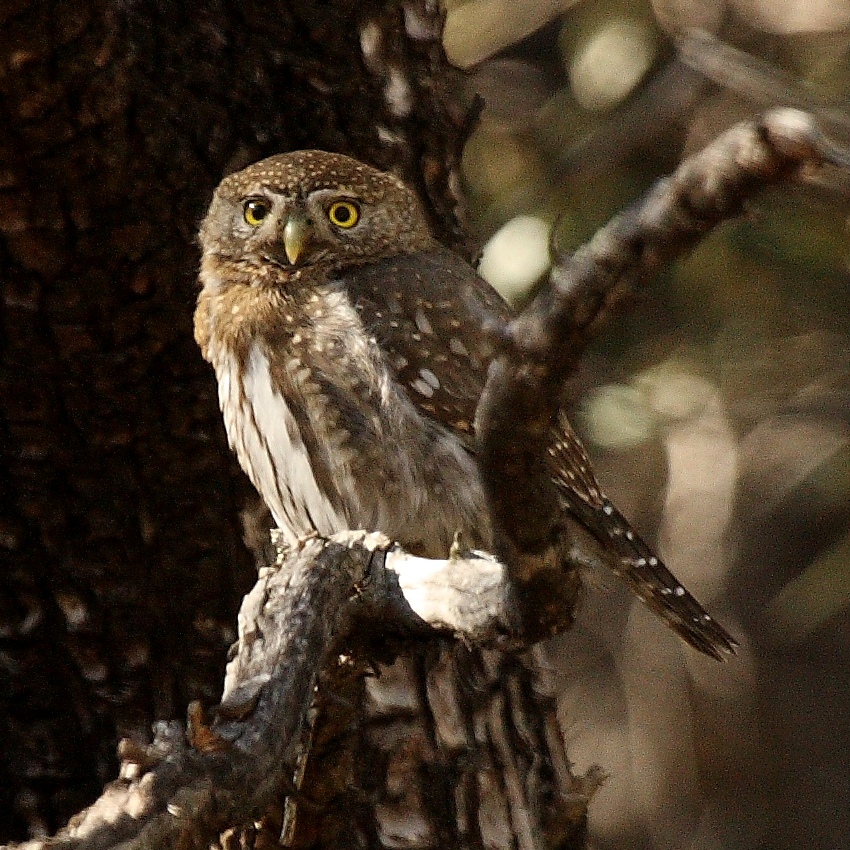 Northern Pygmy OwlGlaucidium californicum
-
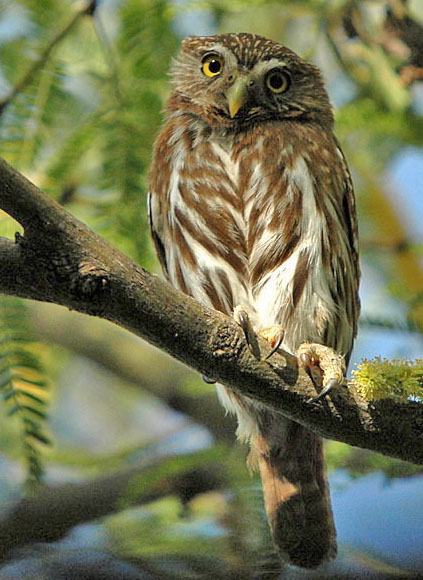 Ferruginous Pygmy OwlGlaucidium brasilianum
-
 Pearl-spotted OwletGlaucidium perlatum
-
 Asian Barred OwletGlaucidium cuculoides
-
 Jungle OwletGlaucidium radiatum
- Pernambuco Pygmy OwlGlaucidium mooreorum
-
 African Barred OwletGlaucidium capense
Compare
Questions and answers
What is the scientific name of the Eurasian Pygmy Owl?
The scientific name of the Eurasian Pygmy Owl is Glaucidium passerinum. Written with its author, the full name is Glaucidium passerinum (Linnaeus, 1758).
Which family does the Eurasian Pygmy Owl belong to?
Glaucidium passerinum belongs to the family Strigidae, in the order Strigiformes and the class Aves.
Where is the Eurasian Pygmy Owl found?
Checklists and occurrence records place Glaucidium passerinum in 34 countries, including Sweden, Finland, Norway, France, Switzerland and Estonia.
What is the conservation status of the Eurasian Pygmy Owl?
The IUCN Red List category recorded for Glaucidium passerinum is Least Concern (LC).
What other names does the Eurasian Pygmy Owl have?
Glaucidium passerinum is also known in English as Eurasian Pygmy Owlet, Eurasian Pygmy-Owl and Pygmy Owl.
Are pygmy owls the smallest owl?
The Eurasian Pygmy Owl is the smallest owl in Europe. Adult individuals measure between 15 and 19 cm in length.[31][32]
Sources
Passages the profile rests on
- Its tail is generally darker than its body and has five narrow whitish bars. Source passage: “The tail is generally darker than the body with five narrow, whitish bars.” — English Wikipedia
- Its legs and toes are brownish-yellow and terminate in black talons. Source passage: “The legs and toes are a brownish-yellow with black talons.” — English Wikipedia
- Newly hatched young have whitish down feathers. Source passage: “These owls are born with whitish colored down feathers.” — animaldiversity.org
- The species inhabits mature coniferous and montane forests. Source passage: “Eurasian pygmy owls are found in mature coniferous and montane forests.” — animaldiversity.org
- Its habitat is predominantly fir-dominated forest at the population level. Source passage: “Their main habitat is fir-dominant at population level.” — animaldiversity.org
- Within its home range, it occupies mature fir-dominated forest bordering grassland. Source passage: “Within their home range, the habitat is mature fir-dominant forest with grassland borders.” — animaldiversity.org
- It occupies open coniferous and mixed forests, particularly tall forest interiors. Source passage: “The species occupies open coniferous and mixed forest mainly in tall forest interior” — datazone.birdlife.org
- It commonly occupies forest edges near clearings surrounded by moist or swampy land. Source passage: “The owl usually lives along the edges of clearings surrounded by moist or swampy land” — English Wikipedia
- It occurs at elevations ranging from 180 to 2,000 m in the Rila Mountains. Source passage: “They can be found in elevations as low as 180 m and as high as 2,000 m in the Rila Mountains.” — animaldiversity.org
- It uses natural tree cavities and abandoned woodpecker holes for nesting. Source passage: “Holes from woodpeckers are usually used for nests, but natural holes and nest boxes are also used.” — animaldiversity.org
- Its diet includes voles, lemmings, bats and mice. Source passage: “such as voles, lemmings, bats, and mice” — English Wikipedia
- Its prey includes small birds such as thrushes, crossbills, chaffinches and leaf-warblers. Source passage: “small birds such as thrushes, crossbills, chaffinches, and leaf-warblers.” — English Wikipedia
- It also consumes lizards, fish and insects. Source passage: “Other prey items may include lizards, fish, and insects.” — English Wikipedia
- It can capture birds while they are flying. Source passage: “They are able to catch birds in flight.” — English Wikipedia
- The species is generally sedentary and remains in its range throughout the year. Source passage: “This is a sedentary species, meaning that adults are resident throughout the year in its range.” — English Wikipedia
- Adults may move south during particularly harsh winters. Source passage: “The exception may be during harsh winters, when the adults may move south.” — English Wikipedia
- Young individuals usually disperse during autumn or winter. Source passage: “Young of the species usually move in autumn or winter.” — English Wikipedia
- It is active mainly around sunrise and sunset. Source passage: “This owl is crepuscular, being active during the daylight hours near sunrise and sunset.” — English Wikipedia
- It stores food in small holes for later consumption. Source passage: “These owls cache their food in small holes.” — animaldiversity.org
- Its home range covers between 0.4 and 6 km², with a median of 2.3 km². Source passage: “ranges between 0.4 and 6 km^2 (median=2.3 km^2).” — animaldiversity.org
- It commonly bobs its head, cocks its tail and fluffs its head feathers while resting. Source passage: “When at rest, they bob their heads, cock their tails, and fluff the feathers on their heads.” — animaldiversity.org
- The species generally forms monogamous breeding pairs. Source passage: “Eurasian pygmy owls are usually monogamous and breed with the same partner each breeding season.” — animaldiversity.org
- Breeding pairs usually reunite in late autumn. Source passage: “They usually pair again in late autumn” — animaldiversity.org
- Females lay between four and eight eggs per clutch. Source passage: “Eurasian pygmy owls lay four to eight eggs.” — animaldiversity.org
- The breeding season extends from April through July. Source passage: “The breeding season for this species is April- July.” — animaldiversity.org
- Egg incubation generally lasts four weeks. Source passage: “Incubation usually lasts four weeks.” — animaldiversity.org
- Young typically fledge at approximately one month of age. Source passage: “The young fledge at about a month” — animaldiversity.org
- Young become independent between six and seven weeks of age. Source passage: “The young are independent between six and seven weeks old.” — animaldiversity.org
- Individuals can begin breeding at approximately one year of age. Source passage: “These owls can begin breeding around the age of one year.” — animaldiversity.org
- Its closest relative is the least pygmy owl (Glaucidium minutissimum). Source passage: “their closest relative is the least pygmy owl ( Glaucidium minutissimum ).” — animaldiversity.org
- The species is the smallest owl in Europe. Source passage: “The Eurasian pygmy owl (Glaucidium passerinum) is the smallest owl in Europe.” — English Wikipedia
- Adult individuals measure between 15 and 19 cm in length. Source passage: “Adult lengths range from 15 to 19 cm” — animaldiversity.org
- The species occurs across northern and central Europe through Siberia. Source passage: “This species is found in the boreal forests of Northern and Central Europe to Siberia.” — English Wikipedia
Data
- Catalogue of Life, 2026-10-16 XR cc by
- Global Biodiversity Information Facility CC BY 4.0
- Wikidata CC0
- GeoNames CC BY 4.0
- Wikimedia Commons per image; credit shown with each image
- Within the Catalogue of Life, this name comes from The Integrated Taxonomic Information System cc0
References
- Syst. Nat. ed. 10 p. 93 where the name was published
- Gill, Frank, & and Minturn Wright. (2006). Birds of the World: Recommended English Names.
- Dickinson, E. C., and J. V. Remsen Jr., eds. (2013). The Howard and Moore Complete Checklist of the Birds of the World, 4th Edition, Vol. 1 Non-Passerines.
This species in other databases
- Catalogue of Life 3G64C
- Wikidata Q191155
- iNaturalist 19848
- WoRMS urn:lsid:marinespecies.org:taxname:1629578
- Avibase eupowl1
Page built on 27 November 2026. See how the catalog is made and all sources and licences.
Cite this page
ScientificNames.org. (2026). Glaucidium passerinum (Eurasian Pygmy Owl). Retrieved November 27, 2026, from https://scientificnames.org/species/glaucidium-passerinum
“Glaucidium passerinum (Eurasian Pygmy Owl).” ScientificNames.org, 2026, scientificnames.org/species/glaucidium-passerinum. Accessed 27 Nov. 2026.
ScientificNames.org. “Glaucidium passerinum (Eurasian Pygmy Owl).” Accessed November 27, 2026. https://scientificnames.org/species/glaucidium-passerinum.
@misc{scientificnames_glaucidium_passerinum_eurasian_pygmy_owl,
  author = {{ScientificNames.org}},
  title = {Glaucidium passerinum (Eurasian Pygmy Owl)},
  year = {2026},
  url = {https://scientificnames.org/species/glaucidium-passerinum},
  note = {Accessed 2026-11-27}
}