Species · Birds
Jungle Owlet Glaucidium radiatum
The scientific name of the Jungle Owlet is Glaucidium radiatum. It is a species of bird in the family Strigidae (owls), order Strigiformes. The name dates from 1833.
- Scientific name
- Glaucidium radiatum (Tickell, 1833)
- Common name
- Jungle Owlet
- Genus
- Glaucidium
- Family
- Strigidae (Owls)
- Order
- Strigiformes
- Class
- Aves
- Red List category
- LC Least Concern
- Recorded in
- 5 countries
- Name status
- accepted in the Catalogue of Life

Overview
The Jungle Owlet (Glaucidium radiatum) is a small bird in the family Strigidae, order Strigiformes and class Aves. It occurs in scrub forest, deciduous forests and moist deciduous forests across parts of the Indian Subcontinent. It has a rounded head, dense body barring and no clearly defined facial disk.
Written 26 November 2026 from the sources listed below. Each statement was checked against the passage it cites; statements that could not be supported were removed.
Appearance
The Jungle Owlet has a rounded head and finely barred plumage across its body. It is squat, with dark black-brown upperparts marked by white barring.[1][2][3]
Its wings are brownish, with white and rufous patches on the wing coverts and pale chestnut barring on the dark brown primaries and secondaries. The tail has narrow white bars.[4][5][6]
The underparts are whitish or pale rufous with black barring, and whitish patches occur on the chin, upper breast and central abdomen. The bill and tarsi are greenish, and the claws are black.[7][8][9]
The Jungle Owlet lacks a clearly defined facial disk and does not have the false eyes on the back of the head found in many other owlets.[10][11]
Habitat
The Jungle Owlet occurs in scrub forest, deciduous forests and moist deciduous forests. In Sri Lanka, it is associated with drier forests.[12][13][14][15]
Diet
The Jungle Owlet feeds on insects, small birds, reptiles and rodents.[16][17][18][19]
Behaviour
The Jungle Owlet occurs singly, in pairs or in small groups. It is mainly active at dawn and dusk but also calls and flies during daylight.[20][21]
The species is usually detected through its calls at dawn and dusk. Its call consists of a rapid series of notes that increase and then decrease in volume before stopping abruptly.[22][23]
Its peak foraging periods occur an hour before sunrise and after sunset. It has been recorded capturing small Phylloscopus warblers during daylight.[24][25]
Jungle Owlets roost inside tree cavities. When disturbed at their roosts, they freeze and resemble dead tree stumps.[26][27]
Drongos, treepies and sunbirds may mob Jungle Owlets at their daytime roosts. They sometimes perch conspicuously on wires and bask in the morning sun before returning to their roosts.[28][29][30]
Reproduction and life cycle
The breeding season of the Jungle Owlet in India extends from March to May. It nests in tree hollows approximately 3 to 5 metres above the ground.[31][32][33]
The typical clutch contains four eggs. The Western Ghats subspecies Glaucidium radiatum malabaricum typically lays three eggs per clutch.[34][35]
Similar species
The chestnut-backed owlet was formerly treated as a subspecies of the Jungle Owlet but is now classified as a separate species.[36]
Classification of the Jungle Owlet
| Kingdom | Animalia |
|---|---|
| Phylum | Chordata |
| Subphylum | Vertebrata |
| Infraphylum | Gnathostomata |
| Parvphylum | Osteichthyes |
| Megaclass | Tetrapoda |
| Class | Aves (Bird) |
| Order | Strigiformes (Owl) |
| Family | Strigidae (Owls) |
| Subfamily | Surniinae |
| Genus | Glaucidium (Pygmy Owl) |
| Species | Glaucidium radiatum (Tickell, 1833) |
Where the Jungle Owlet is found
Checklists and occurrence records place Glaucidium radiatum in 5 countries across Asia. GBIF holds 93,708 georeferenced records of it.
Countries
Regions and cities with the most records
- Kerala, India 35,686
- Madhya Pradesh, India 23,976
- Baihar, India 11,851
- Malajkhand, India 11,144
- Maharashtra, India 7,436
- Uttarakhand, India 5,764
- Thiruvankulam, India 4,609
- Thanneermukkom, India 4,591
- Tripunittura, India 4,583
- Maradu, India 4,576
- Manakunnam, India 4,475
- Mulamthuruthy, India 4,326
- Kumbalam, India 4,281
- Arukutti, India 4,227
- Srīkandamangalam, India 4,194
- Kokōtamangalam South, India 4,146
- Kochi, India 4,068
- Aroor, India 3,888
- Vaikam, India 3,773
- Thaikkattussery, India 3,606
- Vayalār, India 3,557
- Kutiatodu, India 3,551
- Shertallai, India 3,536
- Cherthala, India 3,508
- Nedumangād, India 3,500
- Pallipuram, India 3,439
- Ezhupunna, India 3,396
- Kidarakulam, India 3,396
- Vettanād, India 3,352
- Vilappil, India 3,347
- Kodamthuruth, India 3,310
- Vattiyūrkāvu, India 3,307
- Kudappanakkunnu, India 3,292
- Panayāttur Vadakkumbhāgam, India 3,219
- Vilavoorkkal, India 3,179
- Perunād, India 3,176
Range as the checklists state it
Southern Asia
A number beside a place is its count of GBIF occurrence records. A place without a number comes from a checklist alone. Records show where a species has been observed or collected, which can include escapes and vagrants.
Common names
English
- Jungle Owlet
Names in 27 other languages
- Catalan
- mussolet de jungla
- Chinese
- 丛林鸺鹠, 林鵂鶹
- Croatian
- indijski ćuk
- Czech
- kulíšek džunglový, kulíšek indický
- Danish
- Junglespurveugle
- Dutch
- Jungledwerguil
- Esperanto
- ĝangala strigeto
- Estonian
- džungli-värbkakk
- Finnish
- intianvarpuspöllö
- French
- Chevêchette de jungle
- German
- Dschungel-Sperlingskauz, Dschungelkauz, Dschungelzwergkauz
- Hungarian
- dzsungel törpekuvik
- Italian
- Civetta nana della giungla, Civettina della giungla
- Japanese
- モリスズメフクロウ
- Lithuanian
- džiunglinė žvirblinė pelėda
- Malayalam
- ചെമ്പൻനത്ത്
- Marathi
- वनपिंगळा
- Norwegian
- indiaugle
- Polish
- sóweczka prążkowana
- Portuguese
- mochinho-indiano, mocho-pigmeu-da-selva
- Russian
- Джунглевый воробьиный сыч, Джунглевый сычик
- Slovak
- kuvičok džungľový
- Spanish
- Mochuelo de jungla
- Swedish
- indisk sparvuggla
- Turkish
- Hint Yazılı Serçe Baykuşu
- Ukrainian
- сичик-горобець індійський
- Welsh
- cordylluan y goedwig
Synonyms
2 other scientific names have been used for this species and are now treated as synonyms of Glaucidium radiatum.
- Strix radiata Tickell, 1833
- Taenioglaux radiata Tickell, SR, 1833
Subspecies and varieties
- Glaucidium radiatum malabaricum (Malabar Jungle Owlet) subspecies
- Glaucidium radiatum radiatum (Common Jungle Owlet) subspecies
Related species
-
 Eurasian Pygmy OwlGlaucidium passerinum
-
 Northern Pygmy OwlGlaucidium gnoma
-
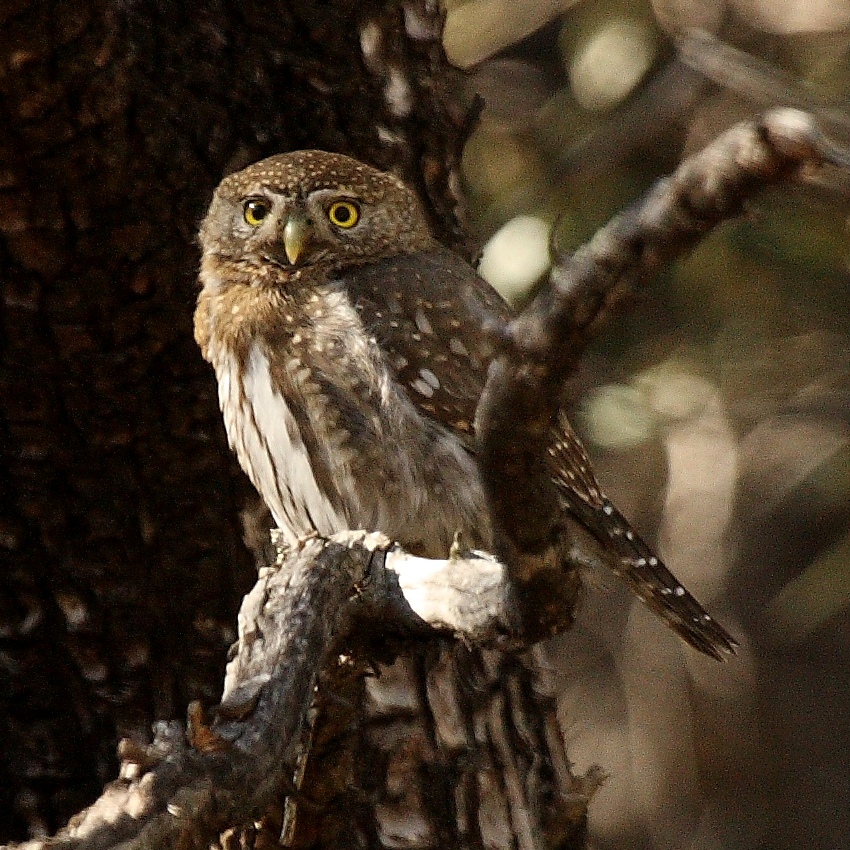 Northern Pygmy OwlGlaucidium californicum
-
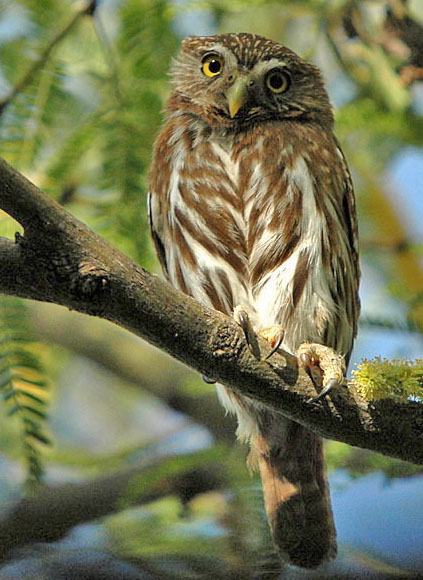 Ferruginous Pygmy OwlGlaucidium brasilianum
-
 Pearl-spotted OwletGlaucidium perlatum
-
 Asian Barred OwletGlaucidium cuculoides
- Pernambuco Pygmy OwlGlaucidium mooreorum
-
 African Barred OwletGlaucidium capense
Compare
Questions and answers
What is the scientific name of the Jungle Owlet?
The scientific name of the Jungle Owlet is Glaucidium radiatum. Written with its author, the full name is Glaucidium radiatum (Tickell, 1833).
Which family does the Jungle Owlet belong to?
Glaucidium radiatum belongs to the family Strigidae, in the order Strigiformes and the class Aves.
Where is the Jungle Owlet found?
Checklists and occurrence records place Glaucidium radiatum in 5 countries: India, Nepal, Sri Lanka, Bangladesh and Bhutan.
What is the conservation status of the Jungle Owlet?
The IUCN Red List category recorded for Glaucidium radiatum is Least Concern (LC).
Sources
Passages the profile rests on
- The Jungle Owlet has a rounded head and finely barred plumage across its body. Source passage: “This small owlet has a rounded head and is finely barred all over.” — English Wikipedia
- The upperparts are dark black-brown with white barring. Source passage: “The plumage on the upper parts is dark black-brown barred with white.” — English Wikipedia
- The Jungle Owlet is squat and has dense barring across its body. Source passage: “Squat little owl with dense barring all over the body.” — ebird.org
- Its wings are brownish and its tail has narrow white bars. Source passage: “the wings are brownish and the tail is narrowly barred in white.” — English Wikipedia
- The wing coverts have white and rufous patches. Source passage: “The wing coverts have white and rufous patches.” — English Wikipedia
- The primaries and secondaries are dark brown with pale chestnut barring. Source passage: “The primaries and secondaries are dark brown and barred with pale chestnut.” — English Wikipedia
- The underparts are whitish or pale rufous with black barring. Source passage: “The lower side is whitish or pale rufous barred with black.” — English Wikipedia
- The bird has whitish patches on its chin, upper breast and central abdomen. Source passage: “There is a whitish patch on the chin, upper breast and centre of the abdomen.” — English Wikipedia
- Its bill and tarsi are greenish, and its claws are black. Source passage: “the bill and tarsi are greenish with black claws.” — English Wikipedia
- The Jungle Owlet lacks a clearly defined facial disk. Source passage: “There is no clear facial disk” — English Wikipedia
- The Jungle Owlet lacks the false eyes on the back of the head found in many other owlets. Source passage: “Lacks the false eyes on the back of the head possessed by many other owlets.” — ebird.org
- The Jungle Owlet occurs in scrub forest. Source passage: “They are found in habitats ranging from scrub forest to deciduous and moist deciduous forests.” — English Wikipedia
- The species inhabits deciduous forests. Source passage: “They are found in habitats ranging from scrub forest to deciduous and moist deciduous forests.” — English Wikipedia
- The species inhabits moist deciduous forests. Source passage: “They are found in habitats ranging from scrub forest to deciduous and moist deciduous forests.” — English Wikipedia
- The Jungle Owlet is associated with drier forests in Sri Lanka. Source passage: “G. radiatum is found in drier forests.” — English Wikipedia
- The Jungle Owlet feeds on insects. Source passage: “Their diet consists of insects, small birds, reptiles, and rodents.” — English Wikipedia
- Small birds form part of the Jungle Owlet's diet. Source passage: “Their diet consists of insects, small birds, reptiles, and rodents.” — English Wikipedia
- The Jungle Owlet eats reptiles. Source passage: “Their diet consists of insects, small birds, reptiles, and rodents.” — English Wikipedia
- The Jungle Owlet feeds on rodents. Source passage: “Their diet consists of insects, small birds, reptiles, and rodents.” — English Wikipedia
- The Jungle Owlet occurs singly, in pairs or in small groups. Source passage: “The species is often found singly, in pairs or small groups” — English Wikipedia
- The Jungle Owlet is mainly active at dawn and dusk but also calls and flies during daylight. Source passage: “This owlet is mainly active at dawn and dusk, but is known to call and fly during the daytime as well.” — English Wikipedia
- The species is usually detected through its calls at dawn and dusk. Source passage: “they are usually detected by their calls at dawn and dusk.” — English Wikipedia
- Its call consists of a rapid series of notes that increase and then decrease in volume before stopping abruptly. Source passage: “The call is distinctive and consists of a rapid series of prao..prao.prao-prao-prao that increases and then fades in volume before ending abruptly.” — English Wikipedia
- The species has been recorded capturing small Phylloscopus warblers during daylight. Source passage: “they have been known to capture small Phylloscopus warblers during the day” — English Wikipedia
- Its peak foraging periods occur an hour before sunrise and after sunset. Source passage: “their peak foraging hours are an hour before sunrise and after sunset.” — English Wikipedia
- Jungle Owlets roost inside tree cavities. Source passage: “The Jungle Owlets roost inside tree cavities” — English Wikipedia
- When disturbed at their roosts, Jungle Owlets freeze and resemble dead tree stumps. Source passage: “when disturbed they freeze and appear like a dead tree stump.” — English Wikipedia
- Drongos, treepies and sunbirds may mob Jungle Owlets at their daytime roosts. Source passage: “At their daytime roosts, they may be mobbed by drongos, treepies and sunbirds.” — English Wikipedia
- Jungle Owlets sometimes perch conspicuously on wires. Source passage: “They sometimes perch prominently on wires” — English Wikipedia
- Jungle Owlets sometimes bask in the morning sun before returning to their roosts. Source passage: “bask in the morning sun before retiring to their roost.” — English Wikipedia
- The breeding season of the Jungle Owlet in India extends from March to May. Source passage: “The breeding season in India is March to May” — English Wikipedia
- The Jungle Owlet nests in tree hollows. Source passage: “they nest in the hollow of a tree” — English Wikipedia
- Its nest is located approximately 3 to 5 metres above the ground. Source passage: “at a height of 3 to 5 m (10 to 16 ft).” — English Wikipedia
- The typical clutch contains four eggs. Source passage: “The typical clutch consists of four eggs” — English Wikipedia
- The Western Ghats subspecies Glaucidium radiatum malabaricum typically lays three eggs per clutch. Source passage: “three eggs in G. r. malabaricum” — English Wikipedia
- The chestnut-backed owlet was formerly treated as a subspecies of the Jungle Owlet but is now classified as a separate species. Source passage: “In Sri Lanka, the chestnut-backed owlet (Glaucidium castanonotum) was once included as a subspecies but this is elevated to full species.” — English Wikipedia
- The Jungle Owlet is described as a small owlet. Source passage: “This small owlet has a rounded head and is finely barred all over.” — English Wikipedia
Data
- Catalogue of Life, 2026-10-16 XR cc by
- Global Biodiversity Information Facility CC BY 4.0
- Wikidata CC0
- GeoNames CC BY 4.0
- Wikimedia Commons per image; credit shown with each image
- Within the Catalogue of Life, this name comes from The Integrated Taxonomic Information System cc0
References
- Gill, Frank, & and Minturn Wright. (2006). Birds of the World: Recommended English Names.
- Dickinson, E. C., and J. V. Remsen Jr., eds. (2013). The Howard and Moore Complete Checklist of the Birds of the World, 4th Edition, Vol. 1 Non-Passerines.
This species in other databases
Page built on 27 November 2026. See how the catalog is made and all sources and licences.
Cite this page
ScientificNames.org. (2026). Glaucidium radiatum (Jungle Owlet). Retrieved November 27, 2026, from https://scientificnames.org/species/glaucidium-radiatum
“Glaucidium radiatum (Jungle Owlet).” ScientificNames.org, 2026, scientificnames.org/species/glaucidium-radiatum. Accessed 27 Nov. 2026.
ScientificNames.org. “Glaucidium radiatum (Jungle Owlet).” Accessed November 27, 2026. https://scientificnames.org/species/glaucidium-radiatum.
@misc{scientificnames_glaucidium_radiatum_jungle_owlet,
  author = {{ScientificNames.org}},
  title = {Glaucidium radiatum (Jungle Owlet)},
  year = {2026},
  url = {https://scientificnames.org/species/glaucidium-radiatum},
  note = {Accessed 2026-11-27}
}