Species · Birds
Pearl-spotted Owlet Glaucidium perlatum
The scientific name of the Pearl-spotted Owlet is Glaucidium perlatum. It is a species of bird in the family Strigidae (owls), order Strigiformes. The name dates from 1817.
- Scientific name
- Glaucidium perlatum (Vieillot, 1817)
- Common name
- Pearl-spotted Owlet
- Genus
- Glaucidium
- Family
- Strigidae (Owls)
- Order
- Strigiformes
- Class
- Aves
- Red List category
- LC Least Concern
- Recorded in
- 34 countries
- Name status
- accepted in the Catalogue of Life

Overview
Glaucidium perlatum inhabits woodland and bushveld, particularly mopane and open thorn savanna with sparse ground cover. It is distinguished by white spots on its brownish plumage and two black false eyes with white outlines on the back of its head.
Written 26 November 2026 from the sources listed below. Each statement was checked against the passage it cites; statements that could not be supported were removed.
Appearance
The Pearl-spotted Owlet has brownish plumage heavily marked with white spots. Its upperparts are cinnamon-brown with white spots.[1][2]
Two black false eyes with white outlines are present on the back of its head. Its facial disc is off-white, and its eyes are yellow.[3][4]
Its bill and cere are pale greenish yellow, while its feet are yellow.[5]
Juveniles resemble adults but may have fewer or less prominent spots on their heads and backs.[6]
Adults measure approximately 17–21 cm in length. Females are slightly larger and heavier than males, weighing approximately 100 g compared with 65 g for males.[7][8]
The species is also reported to weigh approximately 75 g.[9]
Habitat
The Pearl-spotted Owlet inhabits woodland and bushveld, particularly mopane and open thorn savanna with sparse ground cover. It occurs in both moist and dry wooded savanna, including areas near villages.[10][11]
It avoids dense woodland, forests, open grassland and shrubland.[12]
Diet
Arthropods constitute the main component of the Pearl-spotted Owlet's diet. Important prey includes grasshoppers, crickets and solifuges.[13][14]
The species also hunts rodents, bats, lizards, snakes and small birds.[15]
Behaviour
The Pearl-spotted Owlet is often active during daylight but hunts and calls mostly at night. It hunts mainly at night from low perches, taking prey from the ground below.[16][17]
It sometimes catches prey by swooping into foliage, taking it from nests or capturing it in flight. Its flight is fast and undulating, with whirring wingbeats.[18][19]
When alarmed, individuals often flick or wag their tail feathers. The species regularly bathes during the day when open water is available.[20][21]
The species calls during both daytime and nighttime, especially before breeding, but becomes quiet while nesting. Breeding pairs sometimes produce duetting calls, with the female giving the higher-pitched notes.[22][23]
The species is commonly encountered alone or in pairs.[24]
Its false eyes are described as an adaptation that can confuse predators about the owl's facing direction. The species competes with shrikes, bee-eaters, rollers and other small owls for prey and hunting territories.[25][26]
Reproduction and life cycle
The Pearl-spotted Owlet is monogamous and nests solitarily. It generally nests in old holes excavated by large barbets or woodpeckers.[27][28]
Males bring food to females as part of their courtship behaviour. Females spend extended periods calling softly from inside the nest before laying eggs.[29][30]
Females usually lay between two and four eggs. The incubation period lasts approximately 29 days.[31][32]
The availability of nest holes limits nesting density in lightly wooded habitats and determines the number of nesting pairs in lightly wooded areas. A female has been recorded using the same nest site for at least four years.[33][34][35]
Conservation
The Pearl-spotted Owlet is classified as Least Concern on the IUCN Red List. Its population trend is reported as stable.[36][37]
The species' population is reported as decreasing in the SANBI account.[38]
Classification of the Pearl-spotted Owlet
| Kingdom | Animalia |
|---|---|
| Phylum | Chordata |
| Subphylum | Vertebrata |
| Infraphylum | Gnathostomata |
| Parvphylum | Osteichthyes |
| Megaclass | Tetrapoda |
| Class | Aves (Bird) |
| Order | Strigiformes (Owl) |
| Family | Strigidae (Owls) |
| Subfamily | Surniinae |
| Genus | Glaucidium (Pygmy Owl) |
| Species | Glaucidium perlatum (Vieillot, 1817) |
Where the Pearl-spotted Owlet is found
Checklists and occurrence records place Glaucidium perlatum in 34 countries across Africa. GBIF holds 62,125 georeferenced records of it.
Countries
- Angola 176
- Benin 242
- Botswana 3,683
- Burkina Faso 198
- Burundi 12
- Cameroon 79
- Chad 22
- Democratic Republic of the Congo 40
- Eritrea 5
- Eswatini 166
- Ethiopia 346
- Gambia 2,460
- Ghana 663
- Guinea 9
- Guinea-Bissau 47
- Ivory Coast 26
- Kenya 3,612
- Malawi 180
- Mali 17
- Mozambique 83
- Namibia 7,989
- Niger 37
- Nigeria 623
- Republic of the Congo 5
- Rwanda 118
- Senegal 819
- Somalia 22
- South Africa 34,751
- Sudan 21
- Tanzania 2,597
- Togo 20
- Uganda 427
- Zambia 467
- Zimbabwe 2,163
Regions and cities with the most records
- Limpopo, South Africa 15,080
- Mpumalanga, South Africa 9,680
- North West, South Africa 4,918
- Northern Cape, South Africa 2,266
- Khomas Region, Namibia 1,827
- Gauteng, South Africa 1,695
- North-West, Botswana 1,582
- Busumbala, Gambia 1,383
- Matabeleland North, Zimbabwe 1,284
- Otjozondjupa Region, Namibia 1,281
- Oshikoto Region, Namibia 1,273
- Sinchu Alagi, Gambia 1,240
- Kunkujang, Gambia 1,174
- Abuko, Gambia 1,144
- Welingara, Gambia 1,140
- Faji Kunda, Gambia 1,135
- Latri Sabiji, Gambia 1,134
- Talinding, Gambia 1,130
- Sukuta, Gambia 1,128
- Windhoek, Namibia 1,123
- Bakoti, Gambia 1,120
- Sanchaba, Gambia 1,119
- Serekunda, Gambia 1,112
- Brufut, Gambia 1,107
- Dippa Kunda, Gambia 1,103
- Manjai Kunda, Gambia 1,095
- Tanji, Gambia 1,094
- Kanifing, Gambia 1,086
- New Jeshwang, Gambia 1,084
- Kunene Region, Namibia 1,083
- Kotu, Gambia 1,064
- Western, Gambia 1,054
- Bakau, Gambia 1,021
- Erongo Region, Namibia 960
- Banjul, Gambia 926
- Manyara, Tanzania 887
2 more countries have a few records outside this range
These countries hold a few records of Glaucidium perlatum but lie outside the range the checklists give for it. Such records are often zoo or garden specimens, museum material or vagrants, so the species is not counted as occurring there.
Range as the checklists state it
Africa
A number beside a place is its count of GBIF occurrence records. A place without a number comes from a checklist alone. Records show where a species has been observed or collected, which can include escapes and vagrants.
Common names
English
- Pearl-spotted Owlet
- PSOW
- Pearlspotted Owl
Names in 29 other languages
- Afrikaans
- Dwerg-uiltjie, Witkoluil
- Catalan
- mussolet perlat
- Chinese
- 珠斑鵂鶹, 珠斑鸺鹠
- Croatian
- biserasti ćuk
- Czech
- kulíšek perlový
- Danish
- Plettet Spurveugle
- Dutch
- Geparelde Dwerguil
- Esperanto
- perla strigeto
- Estonian
- savanni-värbkakk
- Finnish
- savannivarpuspöllö
- French
- Chevêchette perlée
- German
- Perlkauz, Perlzwergkauz
- Hungarian
- gyöngyös törpekuvik
- Italian
- Civetta nana perlata, Civettina perlata
- Japanese
- アフリカスズメフクロウ
- Lithuanian
- perlinė žvirblinė pelėda
- Norwegian
- savanneugle
- Polish
- sóweczka sawannowa
- Portuguese
- Mochinho-pintado, mochinho-perlado, mocho-perlado, mocho-pigmeu-perlado
- Russian
- Жемчужный воробьиный сыч, Жемчужный сычик
- Serbian
- Biserna mala sova
- Slovak
- kuvičok perlovaný
- Spanish
- Mochuelo perlado
- Swedish
- pärlsparvuggla
- Tamil
- முத்துப் புள்ளி ஆந்தை
- Tswana
- mMankgotlhwe
- Turkish
- İncili Serçe Baykuşu
- Ukrainian
- сичик-горобець савановий
- Welsh
- cordylluan fannog
Synonyms
2 other scientific names have been used for this species and are now treated as synonyms of Glaucidium perlatum.
- Glaucidium albiventer Alexander, B, 1901
- Strix perlata Vieillot, 1817
Subspecies and varieties
- Glaucidium perlatum licua (Southern Pearl-spotted Owlet) subspecies
- Glaucidium perlatum perlatum subspecies
Related species
-
 Eurasian Pygmy OwlGlaucidium passerinum
-
 Northern Pygmy OwlGlaucidium gnoma
-
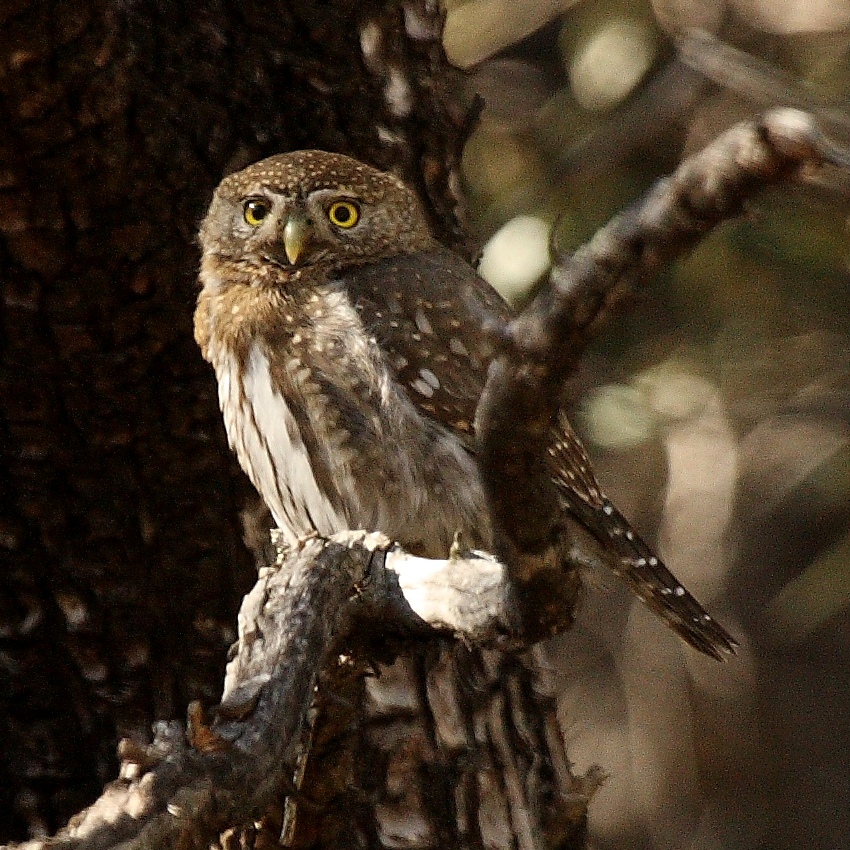 Northern Pygmy OwlGlaucidium californicum
-
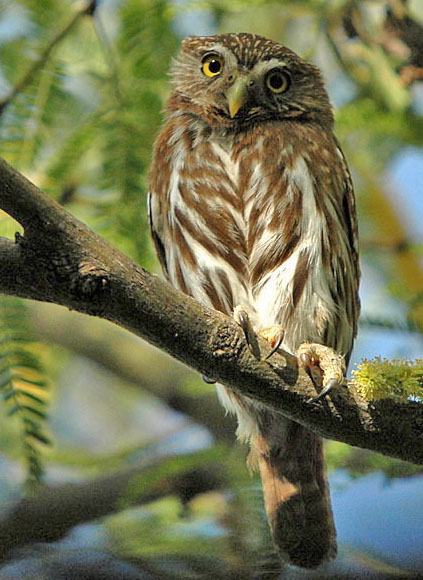 Ferruginous Pygmy OwlGlaucidium brasilianum
-
 Asian Barred OwletGlaucidium cuculoides
-
 Jungle OwletGlaucidium radiatum
- Pernambuco Pygmy OwlGlaucidium mooreorum
-
 African Barred OwletGlaucidium capense
Compare
Questions and answers
What is the scientific name of the Pearl-spotted Owlet?
The scientific name of the Pearl-spotted Owlet is Glaucidium perlatum. Written with its author, the full name is Glaucidium perlatum (Vieillot, 1817).
Which family does the Pearl-spotted Owlet belong to?
Glaucidium perlatum belongs to the family Strigidae, in the order Strigiformes and the class Aves.
Where is the Pearl-spotted Owlet found?
Checklists and occurrence records place Glaucidium perlatum in 34 countries, including South Africa, Namibia, Botswana, Kenya, Tanzania and Gambia.
What is the conservation status of the Pearl-spotted Owlet?
The IUCN Red List category recorded for Glaucidium perlatum is Least Concern (LC).
What other names does the Pearl-spotted Owlet have?
Glaucidium perlatum is also known in English as PSOW and Pearlspotted Owl.
How big is a pearl spotted owl?
Adults measure approximately 17–21 cm in length. Females weigh approximately 100 g compared with 65 g for males, and are slightly larger and heavier.[7][8]
Sources
Passages the profile rests on
- The Pearl-spotted Owlet has brownish plumage heavily marked with white spots. Source passage: “Pearl-spotted owlets are brownish and heavily spotted white” — English Wikipedia
- Its upperparts are cinnamon-brown with white spots. Source passage: “The upper parts are cinnamon-brown with white spots.” — English Wikipedia
- The species has two black false eyes with white outlines on the back of its head. Source passage: “At the back of the head there are two striking false black 'eyes' with a white outline.” — English Wikipedia
- Its facial disc is off-white and its eyes are yellow. Source passage: “The facial disc is off-white and the eyes are yellow.” — English Wikipedia
- Its bill and cere are pale greenish yellow, while its feet are yellow. Source passage: “The bill and cere are pale greenish yellow, the legs are feathered white and feet are yellow.” — English Wikipedia
- Juveniles resemble adults but may have fewer or less prominent spots on their heads and backs. Source passage: “Juveniles are similar to adults but the head and back spots may be lacking or much reduced” — English Wikipedia
- Adults measure approximately 17–21 cm in length. Source passage: “The pearl-spotted owlet is one of the smallest owls in Africa with a length of 17 to 21 cm.” — English Wikipedia
- Females are slightly larger and heavier than males, weighing approximately 100 g compared with 65 g for males. Source passage: “The females are slightly larger and heavier (100g) than the males (65g).” — English Wikipedia
- The species is reported to weigh approximately 75 g. Source passage: “measuring just 17–21 cm in length and weighing about 75 g.” — sanbi.org
- The species inhabits woodland and bushveld, particularly mopane and open thorn savanna with sparse ground cover. Source passage: “They occur in a wide range of woodland and bushveld habitats, especially mopane and open thorn savanna with areas of sparse ground cover.” — English Wikipedia
- The species occurs in both moist and dry wooded savanna, including areas near villages. Source passage: “Pearl-spotted Owlets are commonly found alone or in pairs in both moist and dry wooded savanna, including areas near villages.” — sanbi.org
- The species avoids dense woodland, forests, open grassland and shrubland. Source passage: “They avoid dense woodland and forest, and open grassland and shrubland.” — English Wikipedia
- Arthropods constitute the main component of the Pearl-spotted Owlet's diet. Source passage: “Pearl-spotted owlets predominantly eat arthropods” — English Wikipedia
- Important arthropod prey includes grasshoppers, crickets and solifuges. Source passage: “especially grasshoppers, crickets, and solifuges” — English Wikipedia
- The species also hunts rodents, bats, lizards, snakes and small birds. Source passage: “such as rodents, bats, lizards, snakes and small birds.” — English Wikipedia
- The Pearl-spotted Owlet is often active during daylight but hunts and calls mostly at night. Source passage: “The pearl-spotted owlet is often active by day, but hunts and calls mostly at night.” — English Wikipedia
- It hunts mainly at night from low perches, taking prey from the ground below. Source passage: “They hunt mostly at night from a low perch, taking prey from the ground below” — English Wikipedia
- It sometimes catches prey by swooping into foliage, taking it from nests or capturing it in flight. Source passage: “but sometimes swooping to snatch it from foliage, off nests or in flight.” — English Wikipedia
- Its flight is fast and undulating, with whirring wingbeats. Source passage: “Their flight is fast and undulating with whirring wings.” — English Wikipedia
- When alarmed, individuals often flick or wag their tail feathers. Source passage: “When alarmed they will often flick or wag their tail feathers.” — English Wikipedia
- The species regularly bathes during the day when open water is available. Source passage: “They are seen bathing regularly by day when open water is available.” — English Wikipedia
- The species calls during both daytime and nighttime, especially before breeding, but becomes quiet while nesting. Source passage: “Pearl-spotted owlets call by day and night, especially before breeding, but are quiet when nesting.” — English Wikipedia
- Breeding pairs sometimes produce duetting calls, with the female giving the higher-pitched notes. Source passage: “A breeding pair may call in duet, whereby the female is higher pitched.” — English Wikipedia
- The species is commonly encountered alone or in pairs. Source passage: “Pearl-spotted Owlets are commonly found alone or in pairs” — sanbi.org
- The species' false eyes are described as an adaptation that can confuse predators about the owl's facing direction. Source passage: “it confuses potential predators about which direction the owl is facing” — sanbi.org
- The species competes with shrikes, bee-eaters, rollers and other small owls for prey and hunting territories. Source passage: “They compete with shrikes, bee-eaters, rollers and other small owls for insects and small vertebrates.” — sanbi.org
- The Pearl-spotted Owlet is monogamous and nests solitarily. Source passage: “Pearl-spotted owlets are monogamous, solitary nesters, and highly territorial.” — English Wikipedia
- The species generally nests in old holes excavated by large barbets or woodpeckers. Source passage: “Their nests are usually old holes excavated by large barbets or woodpeckers.” — English Wikipedia
- Males bring food to females as part of their courtship behaviour. Source passage: “The male takes food to the female as a courtship display” — English Wikipedia
- Females spend extended periods calling softly from inside the nest before laying eggs. Source passage: “the female spends long periods calling softly from within the nest before laying.” — English Wikipedia
- Females usually lay between two and four eggs. Source passage: “Females usually have from 2 to 4 eggs” — English Wikipedia
- The incubation period lasts approximately 29 days. Source passage: “with an incubation period around 29 days.” — English Wikipedia
- The availability of nest holes limits nesting density in lightly wooded habitats. Source passage: “The density of nesting in lightly wooded habitat is limited by nest-hole availability.” — English Wikipedia
- A female has been recorded using the same nest site for at least four years. Source passage: “A single female has been observed to use the same nest site for at least 4 years.” — English Wikipedia
- Suitable nest-hole availability determines the number of nesting pairs in lightly wooded areas. Source passage: “In lightly wooded areas, the number of nesting pairs is limited by how many suitable nest holes are available.” — sanbi.org
- The Pearl-spotted Owlet is classified as Least Concern on the IUCN Red List. Source passage: “For these reasons the pearl-spotted owlet is evaluated as Least Concern on the IUCN Red List.” — English Wikipedia
- The species' population trend is reported as stable. Source passage: “The population trend appears to be stable” — English Wikipedia
- The species' population is reported as decreasing in the SANBI account. Source passage: “however the population is decreasing.” — sanbi.org
Data
- Catalogue of Life, 2026-10-16 XR cc by
- Global Biodiversity Information Facility CC BY 4.0
- Wikidata CC0
- GeoNames CC BY 4.0
- Wikimedia Commons per image; credit shown with each image
- Within the Catalogue of Life, this name comes from The Integrated Taxonomic Information System cc0
References
- Gill, Frank, & and Minturn Wright. (2006). Birds of the World: Recommended English Names.
- Dickinson, E. C., and J. V. Remsen Jr., eds. (2013). The Howard and Moore Complete Checklist of the Birds of the World, 4th Edition, Vol. 1 Non-Passerines.
This species in other databases
Page built on 26 November 2026. See how the catalog is made and all sources and licences.
Cite this page
ScientificNames.org. (2026). Glaucidium perlatum (Pearl-spotted Owlet). Retrieved November 26, 2026, from https://scientificnames.org/species/glaucidium-perlatum
“Glaucidium perlatum (Pearl-spotted Owlet).” ScientificNames.org, 2026, scientificnames.org/species/glaucidium-perlatum. Accessed 26 Nov. 2026.
ScientificNames.org. “Glaucidium perlatum (Pearl-spotted Owlet).” Accessed November 26, 2026. https://scientificnames.org/species/glaucidium-perlatum.
@misc{scientificnames_glaucidium_perlatum_pearl_spotted_owlet,
  author = {{ScientificNames.org}},
  title = {Glaucidium perlatum (Pearl-spotted Owlet)},
  year = {2026},
  url = {https://scientificnames.org/species/glaucidium-perlatum},
  note = {Accessed 2026-11-26}
}