Species · Reptiles
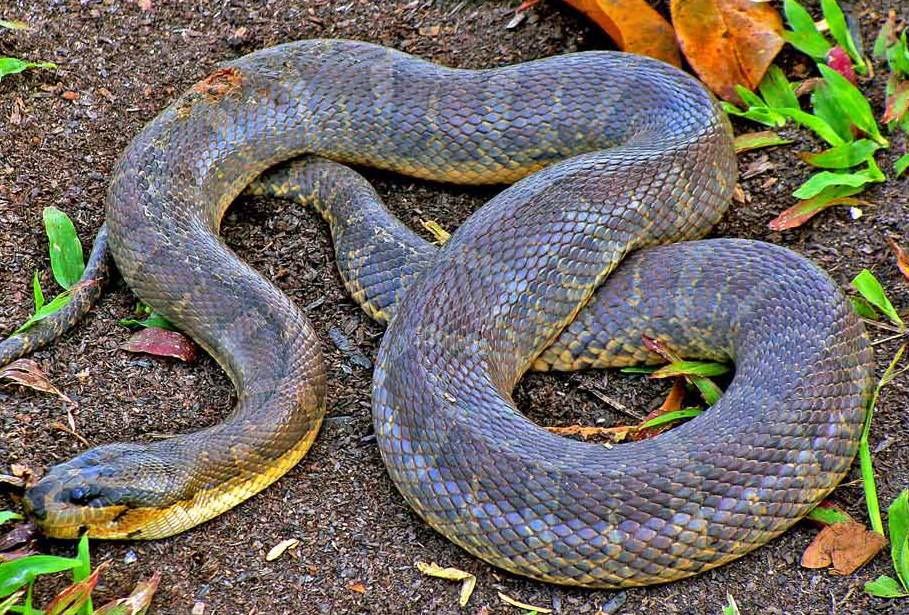
Boie’s Mud Snake Hypsiscopus plumbeus
The scientific name of the Boie’s Mud Snake is Hypsiscopus plumbeus. It is a species of reptile in the family Homalopsidae (mud snakes), order Squamata. The name dates from 1827.
- Scientific name
- Hypsiscopus plumbeus (Boie, 1827)
- Common name
- Boie’s Mud Snake
- Genus
- Hypsiscopus
- Family
- Homalopsidae (Mud Snakes)
- Order
- Squamata
- Class
- Reptilia
- Red List category
- LC Least Concern
- Environment
- freshwater, terrestrial
- Recorded in
- 11 countries
- Name status
- accepted in the Catalogue of Life

Overview
The rice paddy snake (Hypsiscopus plumbea), also known as grey water snake, Boie's mud snake, yellow or orange bellied water snake, lead water snake or plumbeous water snake is a species of non - venomous, rear-fanged snake endemic to South Asia. It is somewhat common, and is one of the most widespread species of water snake in Asia.
Classification of the Boie’s Mud Snake
| Kingdom | Animalia |
|---|---|
| Phylum | Chordata |
| Subphylum | Vertebrata |
| Infraphylum | Gnathostomata |
| Parvphylum | Osteichthyes |
| Megaclass | Tetrapoda |
| Class | Reptilia (Reptile) |
| Order | Squamata (Snakes) |
| Suborder | Serpentes (Snakes) |
| Infraorder | Alethinophidia |
| Family | Homalopsidae (Mud Snakes) |
| Genus | Hypsiscopus |
| Species | Hypsiscopus plumbeus (Boie, 1827) |
Where the Boie’s Mud Snake is found
Checklists and occurrence records place Hypsiscopus plumbeus in 11 countries across Asia. GBIF holds 1,710 georeferenced records of it.
Countries
- Cambodia 36
- China 296
- Hong Kong 25
- India 5
- Indonesia 260
- Laos 42
- Malaysia 110
- Myanmar 8
- Taiwan 415
- Thailand 282
- Vietnam 231
Regions and cities with the most records
- Thị Trấn Đông Triều, Vietnam 43
- Majenang, Indonesia 36
- Gia Lai, Vietnam 35
- Vĩnh Yên, Vietnam 33
- Hainan, China 31
- Thị Trấn Đại Từ, Vietnam 27
- Bandar Sri Damansara, Malaysia 26
- Bandar Utama, Malaysia 26
- Damansara Damai, Malaysia 26
- Desa Parkcity, Malaysia 26
- Mont Kiara, Malaysia 26
- SS2, Malaysia 26
- Selangor, Malaysia 26
- Taman Tun Dr Ismail, Malaysia 26
- Tropicana Indah, Malaysia 26
- Ara Damansara, Malaysia 25
- Bangsar, Malaysia 25
- Denai Alam, Malaysia 25
- Discovery Bay, Hong Kong 25
- Kampung Baru Subang, Malaysia 25
- Kota Damansara, Malaysia 25
- Petaling Jaya, Malaysia 25
- Shah Alam, Malaysia 25
- Bukit Rahman Putra, Malaysia 24
- Butterfly, Hong Kong 24
- Elmina, Malaysia 24
- Kampung Setia, Malaysia 24
- Kuang, Malaysia 24
- Sam Shing, Hong Kong 24
- San Tung Chung Hang, Hong Kong 24
- Sungai Buloh, Malaysia 24
- Taman Petaling, Malaysia 24
- Taman Sri Sinar, Malaysia 24
- Tung Chung, Hong Kong 24
- Bandar Saujana Utama, Malaysia 23
- Cheung Chau, Hong Kong 23
Range as the checklists state it
India (incl. Nicobar islands), Myanmar (Burma), Cambodia,
A number beside a place is its count of GBIF occurrence records. A place without a number comes from a checklist alone. Records show where a species has been observed or collected, which can include escapes and vagrants.
Common names
English
- Boie’s Mud Snake
- Boie's Mud Snake
- Plumbeous Water Snake
- Rice Paddy Snake
- Yellow-bellied Water Snake
Names in 6 other languages
- Chinese
- 水蛇, 鉛色水蛇, 铅色水蛇, 铅色蛇
- Danish
- Orangebuget Muddersnog
- German
- Olivfarbene Wassertrugnatter
- Indonesian
- Ular Air Kelabu
- Spanish
- Serpiente Acuática de Vientre Amarillo
- Thai
- งูปลิง
Synonyms
9 other scientific names have been used for this species and are now treated as synonyms of Hypsiscopus plumbeus.
- Coluber plumbeus (H. Boie in F. Boie, 1827)
- Enhydris plumbea (Boie)
- Enhydrus plumbeus (Boie, 1827)
- Eurostus plumbeus (H. Boie in F. Boie, 1827)
- Homalopsis plumbea Boie, 1827
- Homalopsis plumbea " Schlegel, 1826
- Hydroscopus plumbeus
- Hypsirhina hardwickii Gray, 1834
- Hypsirhina plumbea (H. Boie in F. Boie, 1827)
Related species
-
 Murphy’s Mud SnakeHypsiscopus murphyi
- Boulenger's Water SnakeHypsiscopus matannensis
- Lake Towuti Paddle-tailed Water SnakeHypsiscopus indonesiensis
- Wettstein’s Mud SnakeHypsiscopus wettsteini
-
 Tentacled SnakeErpeton tentaculatum
-
 South Asian BockadamCerberus rynchops
-
 Puff-faced Water SnakeHomalopsis buccata
-
 Rainbow Water SnakeEnhydris enhydris
Compare
Questions and answers
What is the scientific name of the Boie’s Mud Snake?
The scientific name of the Boie’s Mud Snake is Hypsiscopus plumbeus. Written with its author, the full name is Hypsiscopus plumbeus (Boie, 1827).
Which family does the Boie’s Mud Snake belong to?
Hypsiscopus plumbeus belongs to the family Homalopsidae, in the order Squamata and the class Reptilia.
Where is the Boie’s Mud Snake found?
Checklists and occurrence records place Hypsiscopus plumbeus in 11 countries, including Taiwan, China, Thailand, Indonesia, Vietnam and Malaysia.
What is the conservation status of the Boie’s Mud Snake?
The IUCN Red List category recorded for Hypsiscopus plumbeus is Least Concern (LC).
What other names does the Boie’s Mud Snake have?
Hypsiscopus plumbeus is also known in English as Boie's Mud Snake, Plumbeous Water Snake, Rice Paddy Snake and Yellow-bellied Water Snake.
Sources
Data
- Catalogue of Life, 2026-10-16 XR cc by
- Global Biodiversity Information Facility CC BY 4.0
- Wikidata CC0
- English Wikipedia CC BY-SA 4.0
- GeoNames CC BY 4.0
- Wikimedia Commons per image; credit shown with each image
- Within the Catalogue of Life, this name comes from The Reptile Database cc by
References
- F. Boie, 1827 where the name was published
- Boie, F. (1827). Bemerkungen über Merrem’s Versuch eines Systems der Amphibien, 1. Lieferung: Ophidier. Isis von Oken 20: 508-566.
- Gray. J. E. (1834). Illustrations of Indian Zoology, chiefly selected from the collection of Major - General Hardwicke. Vol. 2. London (1833-1834): 263 Pp., 95 Plates.
- Eydoux, F. & P. Gervais. (1837). Voyage de la Favourite. Reptiles. Dragon spiloptère, Draco spilopterus. Magasin Zool. Guérin, Paris, III: 1 - 10.
- Gray, J. E. (1842). Monographic Synopsis of the Water Snakes, or the Family of Hydridae. Zoological Miscellany 2: 59-68.
- Diesing, C. M. (1850). Systema Helminthum. Vol. I. Apud Wilhelmum Braumüller, Vindobonae: [I]-XIII, [1]-679.
- Günther, A. (1863). Contribution to the herpetology of Ceram. Ann. Mag. Nat. Hist. (3) 12: 397-399.
- Günther, A. (1864). The Reptiles of British India. London (Taylor & Francis), Xxvii + 452 Pp.
- Stoliczka, F. (1870). Observations on some Indian and Malayan Amphibia and Reptilia. J. Asiat. Soc. Bengal 39: 134-228.
- Boulenger, G. A. (1896). Catalogue of the snakes in the British Museum, Vol. 3. London (Taylor & Francis), Xiv + 727 Pp.
- Vaillant, M. L. (1904). Quelques reptiles, batraciens et poissons du Haut-Tonkin. Bull. Mus. Natl. Hist. Nat. Paris 10 (26): 297-300.
- Stejneger, LEONHARD H. (1907). Herpetology of Japan and adjacent territory. Bull. US Natl. Mus. 58: Xx, 1-577.
- Barbour, & Thomas. (1909). Notes on Amphibia and Reptilia from Eastern Asia. Proc. New England Zool. Club 4: 53-78, 2 Plates.
- Oshima, MASAMITSU. (1910). An annotated list of Formosan snakes, with descriptions of four new species and one new subspecies. Annot. Zool. Japon., Tokyo, 7 (3): 185-207.
- Stejneger, L. (1910). The batrachians and reptiles of Formosa. Proc. US Natl. Mus. 38: 91-114.
- Amaral, & do, A. (1929). Studies of neotropical ophidia XIII: A new colubrine snake in the collection of the Vienna Museum. Bull. Antivenin Inst. America 3 (2): 40.
- Mell, R. (1931). List of Chinese snakes. Lingnan Sci. Jour., Canton, 8 [1929]: 199-219.
- Deuve, J. (1961). Liste annotee des Serpents du Laos. Bull. Soc. Sci. Nat. Laos 1:5-32.
- Taylor, E. H. (1965). The serpents of Thailand and adjacent waters. Univ. Kansas Sci. Bull. 45 (9): 609-1096.
- Saint Girons, & Hubert. (1972). Notes sur l’Ecologie des Serpents du Cambodge. Zoologische Mededelingen 47: 65-87.
- Dowling, H.G., & Jenner, J.V. (1988). Snakes of Burma: checklist of reported species and bibliography. Smithsonian Herp. Inf. Serv. (76): 19 Pp.
- Zhao, E., & Adler, K. (1993). Herpetology of China. SSAR, Oxford/Ohio, 1-522.
- David, P., & Vogel, G. (1996). The snakes of Sumatra. An annotated checklist and key with natural history notes. Bücher Kreth, Frankfurt/M.
- Mori, & Akira. (1996). Diel cycle in microhabitat utilization by newborns of the homalopsine snake, Enhydris plumbea. The Snake 27 (2): 135-139.
- Voris, Harold K.;Karns, Daryl R. (1996). Habitat utilization, movements, and activity patterns of Enhydris plumbea (Serpentes: Homalopsinae) in a rice paddy wetland in Borneo. Herpetological Natural History 4 (2): 111-126.
This species in other databases
- Catalogue of Life 6MT3P
- Wikidata Q29913594
- iNaturalist 539840
- WoRMS urn:lsid:marinespecies.org:taxname:1500058
- ITIS 1008573
Page built on 26 November 2026. See how the catalog is made and all sources and licences.
Cite this page
ScientificNames.org. (2026). Hypsiscopus plumbeus (Boie’s Mud Snake). Retrieved November 26, 2026, from https://scientificnames.org/species/hypsiscopus-plumbeus
“Hypsiscopus plumbeus (Boie’s Mud Snake).” ScientificNames.org, 2026, scientificnames.org/species/hypsiscopus-plumbeus. Accessed 26 Nov. 2026.
ScientificNames.org. “Hypsiscopus plumbeus (Boie’s Mud Snake).” Accessed November 26, 2026. https://scientificnames.org/species/hypsiscopus-plumbeus.
@misc{scientificnames_hypsiscopus_plumbeus_boies_mud_snake,
  author = {{ScientificNames.org}},
  title = {Hypsiscopus plumbeus (Boie’s Mud Snake)},
  year = {2026},
  url = {https://scientificnames.org/species/hypsiscopus-plumbeus},
  note = {Accessed 2026-11-26}
}