Species · Fishes
Huchen Hucho hucho
The scientific name of the Huchen is Hucho hucho. It is a species of fish in the family Salmonidae (trouts), order Salmoniformes. The name dates from 1758.
- Scientific name
- Hucho hucho (Linnaeus, 1758)
- Common name
- Huchen
- Genus
- Hucho
- Family
- Salmonidae (Trouts)
- Order
- Salmoniformes
- Class
- Teleostei
- Red List category
- VU Vulnerable
- Environment
- freshwater
- Recorded in
- 11 countries
- Name status
- accepted in the Catalogue of Life

Overview
The Huchen (Hucho hucho) is a freshwater fish belonging to the Salmonidae family and Salmoniformes order. It is endemic to the Danube basin in Europe. It has a slender, nearly round body, a reddish-brown back with dark X-shaped or crescent-shaped patches, and a large elongated mouth.
Written 26 November 2026 from the sources listed below. Each statement was checked against the passage it cites; statements that could not be supported were removed.
Similar species
The Huchen belongs to the Salmonidae family, which includes salmonids. It is the type species of the genus Hucho.[1][2]
Appearance
The Huchen has a slender body that is nearly round in cross-section. Its back is reddish brown and marked with dark patches shaped like Xs or crescents.[3][4]
Its head is larger, longer, and wider than those of other salmonids, with a large elongated mouth.[5]
Its average length ranges from 60 to 120 centimetres. Adults can reach a standard length of 1.65 metres and a maximum mass of 60 kilograms.[6][7]
Habitat
The Huchen inhabits cool montane and submontane sections of large streams and fast-flowing rivers. It can establish populations in accessible natural lakes, including Lake Plav in Montenegro.[8][9]
Diet
Juvenile Huchen feed on aquatic insect larvae and insects that fall into the water. Older individuals prey on other fish species and small vertebrates.[10][11]
The common nase is an important food source. Older angler-caught individuals in a Slovakian study primarily appeared to consume spirlin, chub, brown trout, and barbel.[12][13]
Behaviour
The Huchen exhibits facultative migratory behaviour when spawning. It migrates upstream into small, shallow tributaries to spawn.[14][15]
The species can live for more than 20 years.[16]
Reproduction and life cycle
The Huchen spawns in April when water temperatures reach 6–9 °C. Females excavate depressions in gravel to deposit their eggs.[17][18]
After fertilization, larvae hatch within 30–35 days.[19]
Conservation
The Huchen is considered one of the most endangered members of the Salmonidae family and is considered endangered in relation to its global distribution. Its populations have declined substantially because of human-caused habitat alterations.[20][21][22]
Habitat degradation includes river regulation, dam and weir construction, spawning-ground siltation, hydropower development, and industrial and agricultural pollution.[23]
In Austria, self-sustaining populations occupy approximately 10% of the species' previous distribution. The species is listed in Annexes II and V of the European Fauna Flora Habitat Directive 92/43/EWG.[24][25]
The Huchen is regarded as an indicator of stream connectivity and ecosystem health because of its demanding water and substrate quality requirements.[26]
Broodstocks in Poland, Germany, Slovakia, and Ukraine generally exhibited moderate genetic diversity, with the German broodstock showing higher diversity. All four investigated broodstocks showed reduced genetic variation associated with founder or bottleneck effects.[27][28]
Uses
The Huchen is a popular target for anglers. It is also bred in artificial conditions to supplement local fish populations.[29][30]
Classification of the Huchen
| Kingdom | Animalia |
|---|---|
| Phylum | Chordata |
| Subphylum | Vertebrata |
| Infraphylum | Gnathostomata |
| Parvphylum | Osteichthyes |
| Gigaclass | Actinopterygii |
| Superclass | Actinopteri |
| Class | Teleostei (Teleost) |
| Order | Salmoniformes |
| Family | Salmonidae (Trouts) |
| Subfamily | Salmoninae |
| Genus | Hucho (Taimens) |
| Species | Hucho hucho (Linnaeus, 1758) |
Where the Huchen is found
Checklists and occurrence records place Hucho hucho in 11 countries. GBIF holds 390 georeferenced records of it.
Countries
- Austria 101
- Bosnia and Herzegovina 41
- Germany 106
- Montenegro 9
- Poland 8
- Romania 6
- Serbia 31
- Slovakia 3
- Slovenia 53
- Spain 5
- Ukraine 27
Regions and cities with the most records
- Bavaria, Germany 60
- Styria, Austria 38
- Ljubljana, Slovenia 25
- Lower Austria, Austria 25
- Ljubljana, Slovenia 23
- Graz, Austria 20
- Garching, Germany 14
- Unterschleißheim, Germany 14
- Erding, Germany 13
- Freising, Germany 13
- Neufahrn bei Freising, Germany 13
- Upper Austria, Austria 13
- Zakarpattia, Ukraine 13
- Baden-Wurttemberg, Germany 12
- Karlsfeld, Germany 12
- Kranj, Slovenia 12
- Dachau, Germany 11
- Ivano-Frankivsk, Ukraine 11
- Sankt Pölten, Austria 11
- Goražde, Bosnia and Herzegovina 9
- Primorje-Gorski Kotar, Croatia 9
- Starnberg, Germany 8
- Geretsried, Germany 7
- Wolfratshausen, Germany 7
- Carinthia, Austria 6
- Loznica, Serbia 6
- Maramureş, Romania 6
- Vişeu de Sus, Romania 6
- Khust, Ukraine 5
- Trbovlje, Slovenia 5
- Velenje, Slovenia 5
- Burghausen, Germany 4
- Celje, Slovenia 4
- Eselsberg, Germany 4
- Klingenstein, Germany 4
- Mühldorf, Germany 4
A number beside a place is its count of GBIF occurrence records. A place without a number comes from a checklist alone. Records show where a species has been observed or collected, which can include escapes and vagrants.
Common names
English
- Huchen
- Danube Taimen
- Danube Salmon
- Danube Trout
- Danube Salmon Or Huchen
- Hunchen
- Sulec
Names in 28 other languages
- Azerbaijani
- Dunay qızılbalığı
- Belarusian
- Дунайскі ласось
- Bulgarian
- Дунавска пъстърва
- Catalan
- Salmó del Danubi
- Chinese
- 多瑙哲羅魚
- Croatian
- Mladica
- Czech
- Hlavatka obecná
- Danish
- Donaulaks
- Dutch
- Donauzalm
- Finnish
- tonavanjokilohi
- French
- Saumon du Danube, huchon
- Galician
- Salmón do Danubio
- German
- Donaulachs, Donausalm, Rotfisch
- Hungarian
- Dunai galóca
- Italian
- salmone del Danubio
- Japanese
- ドナウイトウ
- Persian
- آزادماهی دانوب
- Polish
- Głowacica, głowacica dunajska
- Portuguese
- hucho, salmão-do-danúbio, truta-hucho
- Romanian
- Lostriță, Somon dunărean
- Russian
- Дунайский лосось
- Serbian
- Младица
- Slovak
- Hlavátka podunajská
- Spanish
- Salmón del Danubio
- Swedish
- donaulax
- Turkish
- Alabalik türü
- Ukrainian
- Головатиця, Лосось дунайський
- Vietnamese
- Cá hồi Danube
Synonyms
3 other scientific names have been used for this species and are now treated as synonyms of Hucho hucho.
- Hucho germanorum Günther, 1866
- Salmo germanorum Günther, 1866
- Salmo hucho Linnaeus, 1758
Related species
-
 Siberian TaimenHucho taimen
-
 Sichuan TaimenHucho bleekeri
- Korean TaimenHucho ishikawae
-
 Arctic CharSalvelinus alpinus
-
 Sockeye SalmonOncorhynchus nerka
-
 Rainbow TroutOncorhynchus mykiss
-
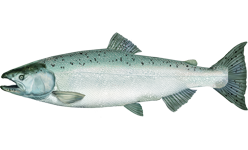 Chinook SalmonOncorhynchus tshawytscha
-
 Atlantic SalmonSalmo salar
Compare
Questions and answers
What is the scientific name of the Huchen?
The scientific name of the Huchen is Hucho hucho. Written with its author, the full name is Hucho hucho (Linnaeus, 1758).
Which family does the Huchen belong to?
Hucho hucho belongs to the family Salmonidae, in the order Salmoniformes and the class Teleostei.
Where is the Huchen found?
Checklists and occurrence records place Hucho hucho in 11 countries, including Germany, Austria, Slovenia, Bosnia and Herzegovina, Serbia and Ukraine.
What is the conservation status of the Huchen?
The IUCN Red List category recorded for Hucho hucho is Vulnerable (VU).
What other names does the Huchen have?
Hucho hucho is also known in English as Danube Taimen, Danube Salmon, Danube Trout, Danube Salmon Or Huchen, Hunchen and Sulec.
Are huchen and taimen the same?
Danube Taimen is one of the English names recorded for the Huchen (Hucho hucho).[1]
What is a Hucho?
Hucho is the genus of which Hucho hucho is the type species. The Huchen belongs to the Salmonidae family and is exclusively freshwater-resident.[1][2][31]
What category does salmon fall under?
The Huchen belongs to the Salmonidae family and the Salmoniformes order.[2]
Sources
Passages the profile rests on
- The species is the type species of the genus Hucho. Source passage: “It is the type species of genus Hucho” — English Wikipedia
- The species belongs to the Salmonidae family and the Salmoniformes order. Source passage: “a large species of freshwater fish in the salmon family of order Salmoniformes.” — inaturalist.org
- The species has a slender body that is nearly round in cross-section. Source passage: “The huchen has a slender body that is nearly round in cross-section.” — English Wikipedia
- Its back is reddish brown and marked with dark patches shaped like Xs or crescents. Source passage: “On the reddish brown back are several dark patches in an X or crescent shape” — English Wikipedia
- Its head is larger, longer, and wider than those of other salmonids, with a large elongated mouth. Source passage: “head, which is larger than in other salmonides (longer and wider), with large elongated mouth.” — English Wikipedia
- Its average length ranges from 60 to 120 centimetres. Source passage: “The average length is between 60 and 120 centimetres (24 and 47 in).” — English Wikipedia
- Adults can reach a standard length of 1.65 metres and a maximum mass of 60 kilograms. Source passage: “adults are large piscivorous predators of up to 1.65 m standard length (SL) and with a maximum mass of 60 kg” — pmc.ncbi.nlm.nih.gov
- The species inhabits cool montane and submontane sections of large streams and fast-flowing rivers. Source passage: “occurring in cool montane and submontane reaches of large streams and swift rivers” — pmc.ncbi.nlm.nih.gov
- The species can establish populations in accessible natural lakes, including Lake Plav in Montenegro. Source passage: “Huchen sometimes successfully establish in accessible natural lakes, like glacial Lake Plav” — English Wikipedia
- Juvenile individuals feed on aquatic insect larvae and insects that fall into the water. Source passage: “Smaller fish feed on the larvae of water insects or on insects dropped into the water.” — English Wikipedia
- Older individuals prey on other fish species and small vertebrates. Source passage: “As they get older, larger individuals prey on other species of fish and small vertebrates.” — English Wikipedia
- The common nase is an important food source for the species. Source passage: “Common nase is the most important food source for a Danube salmon (huchen).” — English Wikipedia
- Older angler-caught individuals in a Slovakian study primarily appeared to consume spirlin, chub, brown trout, and barbel. Source passage: “older angler caught individuals primarily seemed to prey on spirlin Alburnoides bipunctatus, chub Leuciscus cephalus, brown trout Salmo trutta, and barbel Barbus barbus.” — English Wikipedia
- The species exhibits facultative migratory behaviour when spawning. Source passage: “facultative migratory spawning behavior.” — pmc.ncbi.nlm.nih.gov
- The species migrates upstream into small, shallow tributaries to spawn. Source passage: “For spawning, the huchen migrates up the river and enters small and shallow affluents” — English Wikipedia
- The species can live for more than 20 years. Source passage: “this fish species can live for more than 20 years” — pmc.ncbi.nlm.nih.gov
- The species spawns in April when water temperatures reach 6–9 °C. Source passage: “spawns in April, once water reaches a temperature of 6 to 9 °C (43 to 48 °F).” — English Wikipedia
- Females excavate depressions in gravel to deposit their eggs. Source passage: “where females excavate depressions in the gravel into which they deposit their eggs” — English Wikipedia
- After fertilization, larvae hatch within 30–35 days. Source passage: “Larvae hatch 30 to 35 days after fertilization.” — English Wikipedia
- The species is considered one of the most endangered members of the Salmonidae family. Source passage: “one of the most endangered members of the Salmonidae family” — pmc.ncbi.nlm.nih.gov
- Its populations have declined substantially because of human-caused habitat alterations. Source passage: “In recent years the size of the European huchen populations has strongly declined through the effects of anthropogenic habitat alterations” — pmc.ncbi.nlm.nih.gov
- The species is considered endangered in relation to its global distribution. Source passage: “is considered as an endangered species with respect to its global distribution” — pmc.ncbi.nlm.nih.gov
- Habitat degradation affecting the species includes river regulation, dam and weir construction, spawning-ground siltation, hydropower development, and industrial and agricultural pollution. Source passage: “river regulation by constructing of dams and weirs, siltation of spawning ground, hydropower development as well as both industrial and agricultural pollution” — pmc.ncbi.nlm.nih.gov
- In Austria, self-sustaining populations occupy approximately 10% of the species' previous distribution. Source passage: “In Austria, European huchen inhabit 10 % of their previous distribution, considering self-sustaining populations” — pmc.ncbi.nlm.nih.gov
- The species is listed in Annexes II and V of the European Fauna Flora Habitat Directive 92/43/EWG. Source passage: “European huchen is listed in annex II and annex V of the European Fauna Flora Habitat (FFH) directive 92/43/EWG” — pmc.ncbi.nlm.nih.gov
- The species is regarded as an indicator of stream connectivity and ecosystem health because of its demanding water and substrate quality requirements. Source passage: “good indicator for overall stream connectivity and ecosystem health due to the species’ stringent water and substratum quality requirements” — pmc.ncbi.nlm.nih.gov
- The species' broodstocks in Poland, Germany, Slovakia, and Ukraine generally exhibited moderate genetic diversity, with the German broodstock showing higher diversity. Source passage: “The European huchen broodstocks exhibited moderate genetic diversity (PIC = 0.405–0.496 and I = 0.831–1.047) with the exception of German broodstock which presented higher genetic diversity” — pmc.ncbi.nlm.nih.gov
- All four investigated broodstocks showed reduced genetic variation associated with founder or bottleneck effects. Source passage: “revealed a reduction of genetic variation in all studied broodstocks because of the founder or bottleneck effect.” — pmc.ncbi.nlm.nih.gov
- The species is a popular target for anglers. Source passage: “Distinctive characters of the species make European huchen a popular target species for anglers” — pmc.ncbi.nlm.nih.gov
- The species is bred in artificial conditions to supplement local fish populations. Source passage: “European huchen are bred in artificial conditions for a fishery supplementation of the local populations.” — pmc.ncbi.nlm.nih.gov
- The species is exclusively freshwater-resident. Source passage: “European huchen, together with its sister species taimen (Hucho taimen) are exclusively freshwater residents.” — pmc.ncbi.nlm.nih.gov
Data
- Catalogue of Life, 2026-10-16 XR cc by
- Global Biodiversity Information Facility CC BY 4.0
- Wikidata CC0
- GeoNames CC BY 4.0
- Wikimedia Commons per image; credit shown with each image
- Within the Catalogue of Life, this name comes from World Register of Marine Species cc by
This species in other databases
- Catalogue of Life 3MSJL
- Wikidata Q550211
- iNaturalist 102966
- WoRMS urn:lsid:marinespecies.org:taxname:1023062
- ITIS 162024
Page built on 29 November 2026. See how the catalog is made and all sources and licences.
Cite this page
ScientificNames.org. (2026). Hucho hucho (Huchen). Retrieved November 29, 2026, from https://scientificnames.org/species/hucho-hucho
“Hucho hucho (Huchen).” ScientificNames.org, 2026, scientificnames.org/species/hucho-hucho. Accessed 29 Nov. 2026.
ScientificNames.org. “Hucho hucho (Huchen).” Accessed November 29, 2026. https://scientificnames.org/species/hucho-hucho.
@misc{scientificnames_hucho_hucho_huchen,
  author = {{ScientificNames.org}},
  title = {Hucho hucho (Huchen)},
  year = {2026},
  url = {https://scientificnames.org/species/hucho-hucho},
  note = {Accessed 2026-11-29}
}