Species · Fishes
Siberian Taimen Hucho taimen
The scientific name of the Siberian Taimen is Hucho taimen. It is a species of fish in the family Salmonidae (trouts), order Salmoniformes. The name dates from 1773.
- Scientific name
- Hucho taimen (Pallas, 1773)
- Common name
- Siberian Taimen
- Genus
- Hucho
- Family
- Salmonidae (Trouts)
- Order
- Salmoniformes
- Class
- Teleostei
- Red List category
- VU Vulnerable
- Environment
- brackish, freshwater
- Recorded in
- 3 countries
- Name status
- accepted in the Catalogue of Life

Overview
Hucho taimen occurs from the Volga and Pechora River basins in the west to the Yana and Amur River basins in the east, across parts of Russia, Kazakhstan, Mongolia, and China. It primarily inhabits flowing water and can live for at least 55 years.
Written 26 November 2026 from the sources listed below. Each statement was checked against the passage it cites; statements that could not be supported were removed.
Appearance
Coloration varies geographically. The head is generally olive green, transitioning to reddish brown toward the tail, while the adipose, anal, and caudal fins are often dark red.[1][2]
The belly ranges in color from nearly white to dark gray.[3]
The average length is approximately 70 to 120 centimetres, and the reported maximum length is approximately 150 to 180 centimetres. Most mature individuals caught weigh between 15 and 30 kilograms.[4][5][6]
Habitat
Siberian Taimen primarily inhabits flowing water. It is occasionally found in lakes, generally near the mouths of tributaries.[7][8]
Its range extends across the Caspian, Arctic, and Pacific drainage systems of Eurasia. In Mongolia, it inhabits the Yenisei/Selenga, Lena, and Amur river basins.[9][10]
Diet
Adult Siberian Taimen primarily eat fish. They also frequently consume terrestrial prey, including rodents and birds.[11][12]
Behaviour
Siberian Taimen is not anadromous. Its movement rates increase during the spawning season.[13][14]
Taimen in Mongolia's Eg-Üur rivers have an average home range of 23 kilometres. Some tagged individuals have recorded home ranges of up to 93 kilometres.[15][16]
Similar species
Some authors consider Siberian Taimen to be a subspecies of the huchen.[17]
Conservation
The 2024 IUCN Red List assessment classifies the species as Data Deficient. The species is also assessed as vulnerable and declining in the first document.[18][19]
Habitat degradation and disturbance associated with overgrazing, mining, motor boats, agriculture, and infrastructure development are identified as major threats. Illegal fishing throughout the year is a particular problem in remote parts of Mongolia.[20][21]
Sand and gravel industries in Heilongjiang Province, China, industrial water pollution in Europe, and commercial fishing in the Amur River region of Russia and China are identified as conservation challenges. Climate change impacts are also listed among the challenges facing the species.[22][23][24][25]
Catch-and-release fishing using barbless hooks is practised in many areas to help conserve the species. The IUCN recommends considering the species for inclusion in the Convention on Migratory Species to encourage international conservation cooperation.[26][27]
Uses
Siberian Taimen is increasingly recognized as a game fish, particularly among fly fishers. It is also sometimes harvested commercially, often illegally.[28][29]
Classification of the Siberian Taimen
| Kingdom | Animalia |
|---|---|
| Phylum | Chordata |
| Subphylum | Vertebrata |
| Infraphylum | Gnathostomata |
| Parvphylum | Osteichthyes |
| Gigaclass | Actinopterygii |
| Superclass | Actinopteri |
| Class | Teleostei (Teleost) |
| Order | Salmoniformes |
| Family | Salmonidae (Trouts) |
| Subfamily | Salmoninae |
| Genus | Hucho (Taimens) |
| Species | Hucho taimen (Pallas, 1773) |
Where the Siberian Taimen is found
Checklists and occurrence records place Hucho taimen in 3 countries. GBIF holds 136 georeferenced records of it.
Countries
Regions and cities with the most records
- Primorye, Russia 39
- Khabarovsk, Russia 15
- Perm Krai, Russia 11
- Sakha, Russia 4
- Hentiy, Mongolia 3
- Krasnoyarsk Krai, Russia 3
- Selenge Province, Mongolia 3
1 more country has a few records outside this range
These countries hold a few records of Hucho taimen but lie outside the range the checklists give for it. Such records are often zoo or garden specimens, museum material or vagrants, so the species is not counted as occurring there.
A number beside a place is its count of GBIF occurrence records. A place without a number comes from a checklist alone. Records show where a species has been observed or collected, which can include escapes and vagrants.
Common names
English
- Siberian Taimen
- Mongolian Taimen
- Siberian Salmon
- Siberian Giant Trout
- Taimen
Names in 17 other languages
- Belarusian
- Звычайны таймень
- Chinese
- 哲罗鲑, 哲羅魚
- Czech
- hlavatka sibiřská
- Danish
- Taimenlaks
- Estonian
- Harilik taimen
- Finnish
- Jokinieriä, Siperianjokilohi
- Japanese
- アムールイトウ
- Kazakh
- Таймен
- Mongolian
- Тул
- Polish
- Tajmen
- Russian
- Taimen' obyknovennyi, Обыкновенный таймень, Таймень обыкновенный
- Spanish
- Trucha gigante siberiana
- Thai
- ปลาไทเมน
- bak
- Ҡыҙыл балыҡ
- bua
- Туда
- tat
- Кызылбалык
- tyv
- Бел
Synonyms
5 other scientific names have been used for this species and are now treated as synonyms of Hucho taimen.
- Hucho hucho taimen (Pallas, 1773)
- Salmo fluviatilis Pallas, 1814
- Salmo lossos Günther, 1866
- Salmo taimen Pallas, 1773
- Salvelinus taimen (Pallas, 1773)
Related species
-
 HuchenHucho hucho
-
 Sichuan TaimenHucho bleekeri
- Korean TaimenHucho ishikawae
-
 Arctic CharSalvelinus alpinus
-
 Sockeye SalmonOncorhynchus nerka
-
 Rainbow TroutOncorhynchus mykiss
-
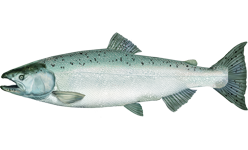 Chinook SalmonOncorhynchus tshawytscha
-
 Atlantic SalmonSalmo salar
Compare
Questions and answers
What is the scientific name of the Siberian Taimen?
The scientific name of the Siberian Taimen is Hucho taimen. Written with its author, the full name is Hucho taimen (Pallas, 1773).
Which family does the Siberian Taimen belong to?
Hucho taimen belongs to the family Salmonidae, in the order Salmoniformes and the class Teleostei.
Where is the Siberian Taimen found?
Checklists and occurrence records place Hucho taimen in 3 countries: Russia, Mongolia and China.
What is the conservation status of the Siberian Taimen?
The IUCN Red List category recorded for Hucho taimen is Vulnerable (VU).
What other names does the Siberian Taimen have?
Hucho taimen is also known in English as Mongolian Taimen, Siberian Salmon, Siberian Giant Trout and Taimen.
Are taimen rare?
The species is assessed as vulnerable and declining in the first document, while the 2024 IUCN Red List assessment classifies it as Data Deficient.[18][19]
What do taimen eat?
Adult taimen primarily eat fish and frequently consume terrestrial prey, including rodents and birds.[11][12]
Do taimen go to the ocean?
Siberian Taimen is not anadromous.[13]
Sources
Passages the profile rests on
- The species' coloration varies geographically, but its head is generally olive green and transitions to reddish brown toward the tail. Source passage: “Coloration varies geographically, but is generally olive green on the head blending to reddish brown in the tail.” — English Wikipedia
- The adipose, anal, and caudal fins are often dark red. Source passage: “Adipose, anal, and caudal fins are often dark red.” — English Wikipedia
- The belly coloration ranges from nearly white to dark gray. Source passage: “The belly ranges from nearly white to dark gray.” — English Wikipedia
- Most mature individuals caught weigh between 15 and 30 kilograms. Source passage: “Most mature fish caught weigh from 15 to 30 kg (33 to 66 lb).” — English Wikipedia
- The species has an average length of approximately 70 to 120 centimetres. Source passage: “The average length is from 70 to 120 cm (28 to 47 in).” — English Wikipedia
- The reported maximum length is approximately 150 to 180 centimetres. Source passage: “The maximum length is about 150 to 180 cm (59 to 71 in).” — English Wikipedia
- The species primarily inhabits flowing water. Source passage: “The taimen lives in flowing water” — English Wikipedia
- The species is occasionally found in lakes, generally near the mouths of tributaries. Source passage: “only occasionally found in lakes, usually near the mouth of a tributary.” — English Wikipedia
- The species occurs in the Caspian, Arctic, and Pacific drainage systems of Eurasia. Source passage: “this includes parts of the Caspian, Arctic, and Pacific drainages in Eurasia.” — English Wikipedia
- In Mongolia, the species inhabits the Yenisei/Selenga, Lena, and Amur river basins. Source passage: “specifically the Yenisei/Selenga, the Lena, and the Amur River Basins.” — English Wikipedia
- Adult taimen primarily eat fish. Source passage: “Adult taimen are mainly piscivores” — English Wikipedia
- Adult taimen also frequently consume terrestrial prey, including rodents and birds. Source passage: “though they frequently eat terrestrial prey such as rodents and birds.” — English Wikipedia
- The species is not anadromous. Source passage: “The taimen is not anadromous” — English Wikipedia
- The species increases its movement rates during the spawning season. Source passage: “does show increased movement rates during the spawning season.” — English Wikipedia
- Taimen in Mongolia's Eg-Üur rivers have an average home range of 23 kilometres. Source passage: “The average home range size of taimen in the Eg-Üur rivers of Mongolia is 23 kilometres (14 mi)” — English Wikipedia
- Some tagged individuals have recorded home ranges of up to 93 kilometres. Source passage: “some tagged individuals show home ranges up to 93 kilometres (58 mi).” — English Wikipedia
- Some authors consider the species to be a subspecies of the huchen. Source passage: “Some authors consider the taimen to be a subspecies of the huchen, i.e. Hucho hucho taimen.” — English Wikipedia
- The species is assessed as vulnerable and declining in the first document. Source passage: “The taimen has been assessed as vulnerable and in decline by the International Union for Conservation of Nature (IUCN).” — English Wikipedia
- The 2024 IUCN Red List assessment classifies the species as Data Deficient. Source passage: “Hucho taimen has most recently been assessed for The IUCN Red List of Threatened Species in 2024. Hucho taimen is listed as Data Deficient.” — iucnredlist.org
- Habitat degradation and disturbance associated with overgrazing, mining, motor boats, agriculture, and infrastructure development are identified as major threats. Source passage: “Habitat degradation and disturbance caused by overgrazing, mining, motor boats, agriculture, and infrastructure development are primary threats.” — English Wikipedia
- Illegal fishing throughout the year is a particular problem in remote parts of Mongolia. Source passage: “illegal fishing is a year round problem particularly in remote Mongolia.” — English Wikipedia
- Sand and gravel industries in Heilongjiang Province, China, are identified as an additional conservation challenge. Source passage: “the establishment of sand and gravel industries in Heilongjiang Province, China” — English Wikipedia
- Industrial water pollution in Europe is identified as a conservation challenge. Source passage: “industrial water pollution in Europe” — English Wikipedia
- Commercial fishing in the Amur River region of Russia and China is identified as a threat. Source passage: “commercial fishing in the Amur River region of Russia and China” — English Wikipedia
- Climate change impacts are listed among the conservation challenges facing the species. Source passage: “the impacts of climate change.” — English Wikipedia
- Catch-and-release fishing using barbless hooks is practised in many areas to help conserve the species. Source passage: “Catch-and-release with barbless hooks is practised in many areas to conserve dwindling populations.” — English Wikipedia
- The IUCN recommends considering the species for inclusion in the Convention on Migratory Species to encourage international conservation cooperation. Source passage: “The IUCN recommends that the fish be considered for inclusion in the Convention on Migratory Species to spur international cooperation” — English Wikipedia
- The species is increasingly recognized as a game fish, particularly among fly fishers. Source passage: “The taimen is becoming a more well-known game fish, particularly for fly fishers.” — English Wikipedia
- Taimen are sometimes harvested commercially, often illegally. Source passage: “While the taimen is sometimes (often illegally) harvested commercially” — English Wikipedia
- The species occurs from the Volga and Pechora River basins in the west to the Yana and Amur River basins in the east. Source passage: “The taimen is distributed from the Volga and Pechora River basins in the west to the Yana and Amur River basins in the east” — English Wikipedia
- Its geographic range includes parts of Russia, Kazakhstan, Mongolia, and China. Source passage: “spanning portions of Russia, Kazakhstan, Mongolia, and China.” — English Wikipedia
Data
- Catalogue of Life, 2026-10-16 XR cc by
- Global Biodiversity Information Facility CC BY 4.0
- Wikidata CC0
- GeoNames CC BY 4.0
- Wikimedia Commons per image; credit shown with each image
- Within the Catalogue of Life, this name comes from World Register of Marine Species cc by
This species in other databases
- Catalogue of Life 3MSJQ
- Wikidata Q597930
- iNaturalist 187548
- WoRMS urn:lsid:marinespecies.org:taxname:1026969
- ITIS 623484
Page built on 28 November 2026. See how the catalog is made and all sources and licences.
Cite this page
ScientificNames.org. (2026). Hucho taimen (Siberian Taimen). Retrieved November 28, 2026, from https://scientificnames.org/species/hucho-taimen
“Hucho taimen (Siberian Taimen).” ScientificNames.org, 2026, scientificnames.org/species/hucho-taimen. Accessed 28 Nov. 2026.
ScientificNames.org. “Hucho taimen (Siberian Taimen).” Accessed November 28, 2026. https://scientificnames.org/species/hucho-taimen.
@misc{scientificnames_hucho_taimen_siberian_taimen,
  author = {{ScientificNames.org}},
  title = {Hucho taimen (Siberian Taimen)},
  year = {2026},
  url = {https://scientificnames.org/species/hucho-taimen},
  note = {Accessed 2026-11-28}
}