Species · Amphibians
Japanese Rift Salamander Hynobius fossigenus
The scientific name of the Japanese Rift Salamander is Hynobius fossigenus. It is a species of amphibian in the family Hynobiidae (asiatic salamander), order Caudata. The name dates from 2018.
- Scientific name
- Hynobius fossigenus Okamiya, Sugawara, Nagano & Poyarkov, 2018
- Common name
- Japanese Rift Salamander
- Genus
- Hynobius
- Family
- Hynobiidae (Asiatic Salamander)
- Order
- Caudata
- Class
- Amphibia
- Red List category
- VU Vulnerable
- Recorded in
- 1 country
- Name status
- accepted in the Catalogue of Life

Overview
Hynobius fossigenus occurs in the Japanese prefectures of Gunma, Saitama, Tokyo, Kanagawa, Yamanashi, Shizuoka, Nagano, and Aichi, at elevations between 300 and 1,100 meters. It has brownish-purple to faded black dorsal coloration with irregular golden-yellow or golden-orange spots, prominent swollen parotoid glands, and generally 56 U-shaped vomerine teeth.
Written 26 November 2026 from the sources listed below. Each statement was checked against the passage it cites; statements that could not be supported were removed.
Appearance
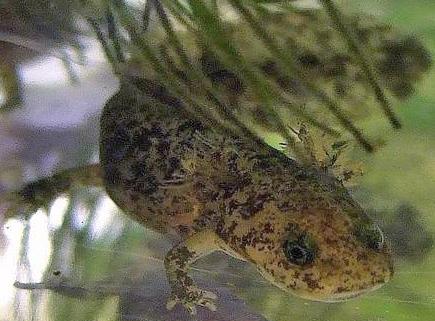
Its dorsal coloration ranges from brownish-purple to faded black, with irregular golden-yellow or golden-orange spots. Its legs are generally grayer than the rest of its body.[1][2]
Its tail is smaller than its body and becomes thicker toward the base. Males generally have smaller bodies and taller tails than females.[3][4]
The belly and back have smooth skin with microscopic glands distributed across the body. Its parotoid glands are prominent and swollen, extending between the lower jaw and throat fold.[5][6]
The dental arch generally contains 56 U-shaped vomerine teeth arranged in long, broad, oblique rows.[7]
Adult males have a snout-to-vent length ranging from 66.0 to 80.9 millimeters. Adult females have a larger snout-to-vent length range than males, and the species has an average total length ranging from 66 to 82.5 millimeters.[8][9][10]
Habitat
The Japanese Rift Salamander inhabits mountain streams surrounded by evergreen Japanese cedar forests. Its breeding streams occur in evergreen Cryptomeria japonica forests or mixed forests.[11][12]
Its preferred breeding streams are less than 1.5 meters wide and 20–30 centimeters deep. Breeding waters generally have temperatures between 5.5 and 6.5 °C.[13][14]
The species occurs at elevations between 300 and 1,100 meters and is most frequently encountered between 400 and 900 meters.[15][16]
Diet
The larvae consume amphipods and the larvae of caddisflies and mayflies.[17]
After metamorphosis, individuals feed on spiders, insects, and worms.[18]
Behaviour
Adults begin searching for breeding sites in November. Mating takes place outside the water in burrows beneath rocks and stones.[19][20]
After laying eggs, females leave the breeding site while males generally remain nearby for some time.[21]
Larvae can be found beneath rocks and fallen leaves or in the deepest parts of streams. Cannibalism has been reported among larvae, with older individuals consuming younger ones.[22][23]
Reproduction and life cycle
The breeding season extends from December through April. Breeding generally occurs during spring in small mountain streams whose temperatures do not exceed 20 °C.[24][25]
Females deposit their eggs in thick, transparent, resistant envelopes attached to rocks in streams or waterfalls. Egg development takes approximately 60 days before hatching.[26][27]
Larvae complete metamorphosis in approximately one year. Males reach adulthood at a minimum age of five years, while females reach adulthood at a minimum age of seven years.[28][29][30]
Similar species
Hynobius katoi occurs in the same geographic area but is smaller and has fewer vomerine teeth.[31]
Hynobius kimurae is smaller than Hynobius fossigenus, with a reported length of 74 millimeters.[32]
Conservation
The species is classified as Least Concern in the conservation assessment described in the document. Some isolated populations may face threats from human activities or habitat loss.[33][34]
The species had not yet been assessed by the IUCN according to the document. Its most recent assessment for the IUCN Red List was in 2020.[35][36]
Classification of the Japanese Rift Salamander
| Kingdom | Animalia |
|---|---|
| Phylum | Chordata |
| Subphylum | Vertebrata |
| Infraphylum | Gnathostomata |
| Parvphylum | Osteichthyes |
| Megaclass | Tetrapoda |
| Class | Amphibia (Amphibians) |
| Order | Caudata (Salamanders) |
| Family | Hynobiidae (Asiatic Salamander) |
| Subfamily | Hynobiinae |
| Genus | Hynobius (Asian Salamanders) |
| Species | Hynobius fossigenus Okamiya, Sugawara, Nagano & Poyarkov, 2018 |
Where the Japanese Rift Salamander is found
Checklists and occurrence records place Hynobius fossigenus in 1 country. GBIF holds 46 georeferenced records of it.
Countries
Regions and cities with the most records
- Ōme, Japan 15
- Hamura, Japan 14
- Iwai, Japan 13
- Akiruno, Japan 12
- Itsukaichi, Japan 12
- Fussa, Japan 11
- Akishima, Japan 10
- Hachiōji, Japan 10
- Hakonegasaki, Japan 10
- Hannō, Japan 10
- Yokota, Japan 10
- Tokyo, Japan 9
- Aihara, Japan 7
- Hino, Japan 7
- Iruma, Japan 7
- Morohongō, Japan 7
- Uenohara, Japan 7
- Sagamihara, Japan 6
- Hidaka, Japan 5
- Higashiyamato, Japan 5
- Sakado, Japan 5
- Sayama, Japan 5
- Tokorozawa, Japan 5
- Tsurugashima, Japan 5
- Higashimurayama, Japan 4
- Saitama, Japan 4
- Chichibu, Japan 3
- Kamifukuoka, Japan 3
- Kawagoe, Japan 3
- Ōi, Japan 3
A number beside a place is its count of GBIF occurrence records. A place without a number comes from a checklist alone. Records show where a species has been observed or collected, which can include escapes and vagrants.
Common names
English
- Japanese Rift Salamander
- Eastern Hida Salamander
- Mount Hinode Salamander
Names in 3 other languages
- Arabic
- سمندل الشق الياباني
- Japanese
- Higashi-hida Sanshouuo, ヒガシヒダサンショウウオ
- Korean
- 동히다도롱뇽
Related species
-
 Ezo SalamanderHynobius retardatus
-
 Hida SalamanderHynobius kimurae
- Korean SalamanderHynobius leechii
-
 Japanese Black SalamanderHynobius nigrescens
-
 Taiwan SalamanderHynobius formosanus
-
 Alishan SalamanderHynobius arisanensis
-
 Abe's SalamanderHynobius abei
- Jeju SalamanderHynobius quelpaertensis
Compare
Questions and answers
What is the scientific name of the Japanese Rift Salamander?
The scientific name of the Japanese Rift Salamander is Hynobius fossigenus. Written with its author, the full name is Hynobius fossigenus Okamiya, Sugawara, Nagano & Poyarkov, 2018.
Which family does the Japanese Rift Salamander belong to?
Hynobius fossigenus belongs to the family Hynobiidae, in the order Caudata and the class Amphibia.
Where is the Japanese Rift Salamander found?
Checklists and occurrence records place Hynobius fossigenus in 1 country: Japan.
What is the conservation status of the Japanese Rift Salamander?
The IUCN Red List category recorded for Hynobius fossigenus is Vulnerable (VU).
What other names does the Japanese Rift Salamander have?
Hynobius fossigenus is also known in English as Eastern Hida Salamander and Mount Hinode Salamander.
Sources
Passages the profile rests on
- Its dorsal coloration ranges from brownish-purple to faded black and includes irregular golden-yellow or golden-orange spots. Source passage: “The coloration of its back varies from brownish-purple to faded black, and it has several small irregularly shaped spots distributed throughout the body, which can be golden yellow or golden orange” — English Wikipedia
- Its legs are generally grayer than the rest of its body. Source passage: “Its legs have a more grayish coloration than the rest of the body.” — English Wikipedia
- Its tail is smaller than its body and becomes thicker toward its base. Source passage: “The tail is long, but smaller than the body, ranging in shape from cylindrical to oval, and thicker near the base.” — English Wikipedia
- Males generally have smaller bodies and taller tails than females. Source passage: “The main sexual dimorphism is the size of the males, which is usually smaller than the females, and the tail, which is usually higher.” — English Wikipedia
- Its belly and back have smooth skin with microscopic glands distributed across the body. Source passage: “The skin of its belly and back is smooth, with microscopic glands scattered all over the body.” — English Wikipedia
- Its parotoid glands are prominent and swollen, extending between the lower jaw and throat fold. Source passage: “They have prominent, swollen parotoid glands, which extend in the region between the lower jaw and the throat fold.” — English Wikipedia
- Its dental arch generally contains 56 U-shaped vomerine teeth arranged in long, broad, oblique rows. Source passage: “Their dental arch is composed of long, wide, oblique rows of usually 56 U-shaped vomerine teeth.” — English Wikipedia
- Adult males have a snout-to-vent length ranging from 66.0 to 80.9 millimeters. Source passage: “Adult H. fossigenus males have a snout-vent length range of 66.0 – 80.9 mm” — amphibiaweb.org
- Adult females have a larger snout-to-vent length range than males. Source passage: “while the female range is larger” — amphibiaweb.org
- The species has an average total length ranging from 66 to 82.5 millimeters. Source passage: “Its average length varies between 66 and 82.5 millimeters” — English Wikipedia
- The species inhabits mountain streams surrounded by evergreen Japanese cedar forests. Source passage: “The individuals breed between December and April in mountain streams surrounded by Cryptomeria japonica evergreen forests.” — English Wikipedia
- Its breeding streams occur in evergreen Cryptomeria japonica forests or mixed forests. Source passage: “located in evergreen Cryptomeria japonica or mixed forests.” — English Wikipedia
- Its preferred breeding streams are less than 1.5 meters wide and 20–30 centimeters deep. Source passage: “The preferred places are those less than one and a half meters wide and twenty to thirty centimeters deep” — English Wikipedia
- Its breeding waters generally have temperatures between 5.5 and 6.5 °C. Source passage: “where the water is usually between 5.5 and 6.5 °C.” — English Wikipedia
- The species occurs at elevations between 300 and 1,100 meters. Source passage: “It is present between the altitude range of 300 and 1 100 meters” — English Wikipedia
- It is most frequently encountered at elevations between 400 and 900 meters. Source passage: “but is most common between 400 and 900 meters.” — English Wikipedia
- Its larvae consume amphipods and the larvae of caddisflies and mayflies. Source passage: “Outside, they usually feed on amphipods and larvae of tricoptera and ephemeroptera.” — English Wikipedia
- After metamorphosis, individuals feed on spiders, insects, and worms. Source passage: “The metamorphosis lasts about a year, and when it is over, the imagos start feeding on spiders, insects, and worms.” — English Wikipedia
- Adults begin searching for breeding sites in November. Source passage: “Adults begin searching for such sites in November” — English Wikipedia
- Mating takes place outside the water in burrows beneath rocks and stones. Source passage: “Mating occurs out of the water, in burrows under rocks and stones.” — English Wikipedia
- After laying eggs, females leave the breeding site while males generally remain nearby for some time. Source passage: “Soon after, the female leaves the site, and the male usually stays for a while in the surrounding region where oviposition occurred.” — English Wikipedia
- Larvae can be found beneath rocks and fallen leaves or in the deepest parts of streams. Source passage: “They are easily found under rocks and fallen leaves or in the deepest part of streams.” — English Wikipedia
- Cannibalism has been reported among larvae, with older individuals consuming younger ones. Source passage: “There are reports of cannibalism, in which the older ones feed on the younger ones.” — English Wikipedia
- The breeding season extends from December through April. Source passage: “with the reproductive period lasting from December to April.” — English Wikipedia
- Breeding generally occurs during spring in small mountain streams whose temperatures do not exceed 20 °C. Source passage: “The species usually breeds in the spring of small mountain streams, with temperatures never exceeding 20 °C.” — English Wikipedia
- Females deposit their eggs in thick, transparent, resistant envelopes attached to rocks in streams or waterfalls. Source passage: “After that, the females lay their eggs in thick, resistant, transparent envelopes, which are attached to the rocks in the stream or waterfalls” — English Wikipedia
- Egg development takes approximately 60 days before hatching. Source passage: “The eggs usually develop for sixty days” — English Wikipedia
- Larvae complete metamorphosis in approximately one year. Source passage: “The metamorphosis lasts about a year” — English Wikipedia
- Males reach adulthood at a minimum age of five years. Source passage: “Males take a minimum of five years to become adults” — English Wikipedia
- Females reach adulthood at a minimum age of seven years. Source passage: “while females take a little longer, with a minimum of seven years.” — English Wikipedia
- Hynobius katoi occurs in the same geographic area but is smaller and has fewer vomerine teeth. Source passage: “H. katoi, a sympatric species, can be differentiated by being smaller (60 millimeters) and having fewer teeth, a total of 39.” — English Wikipedia
- Hynobius kimurae is smaller than Hynobius fossigenus, with a reported length of 74 millimeters. Source passage: “from H. kimurae, the phylogenetically closest species, by being larger than the latter, which has 74 millimeters” — English Wikipedia
- The species is classified as Least Concern in the conservation assessment described in the document. Source passage: “making it a least-concern species (LC).” — English Wikipedia
- Some isolated populations may face threats from human activities or habitat loss. Source passage: “only a few isolated populations may be threatened by anthropogenic actions or habitat loss” — English Wikipedia
- The species had not yet been assessed by the IUCN according to the document. Source passage: “It has not yet been assessed by the International Union for Conservation of Nature (IUCN).” — English Wikipedia
- The species was most recently assessed for the IUCN Red List in 2020. Source passage: “has most recently been assessed for The IUCN Red List of Threatened Species in 2020.” — iucnredlist.org
Data
- Catalogue of Life, 2026-10-16 XR cc by
- Global Biodiversity Information Facility CC BY 4.0
- Wikidata CC0
- GeoNames CC BY 4.0
- Wikimedia Commons per image; credit shown with each image
- Within the Catalogue of Life, this name comes from The Integrated Taxonomic Information System cc0
References
- Okamiya, Hisanori, Hirotaka Sugawara, Masahiro Nagano & Nikolay A. Poyarkov. 2018. An integrative taxonomic analysis reveals a cryptic species of lotic Hynobius salamander from Japan. PeerJ 6: e5084. Link where the name was published
This species in other databases
Page built on 29 November 2026. See how the catalog is made and all sources and licences.
Cite this page
ScientificNames.org. (2026). Hynobius fossigenus (Japanese Rift Salamander). Retrieved November 29, 2026, from https://scientificnames.org/species/hynobius-fossigenus
“Hynobius fossigenus (Japanese Rift Salamander).” ScientificNames.org, 2026, scientificnames.org/species/hynobius-fossigenus. Accessed 29 Nov. 2026.
ScientificNames.org. “Hynobius fossigenus (Japanese Rift Salamander).” Accessed November 29, 2026. https://scientificnames.org/species/hynobius-fossigenus.
@misc{scientificnames_hynobius_fossigenus_japanese_rift_salamander,
  author = {{ScientificNames.org}},
  title = {Hynobius fossigenus (Japanese Rift Salamander)},
  year = {2026},
  url = {https://scientificnames.org/species/hynobius-fossigenus},
  note = {Accessed 2026-11-29}
}