Species · Amphibians
Ezo Salamander Hynobius retardatus
The scientific name of the Ezo Salamander is Hynobius retardatus. It is a species of amphibian in the family Hynobiidae (asiatic salamander), order Caudata. The name dates from 1923.
- Scientific name
- Hynobius retardatus Dunn, 1923
- Common name
- Ezo Salamander
- Genus
- Hynobius
- Family
- Hynobiidae (Asiatic Salamander)
- Order
- Caudata
- Class
- Amphibia
- Red List category
- LC Least Concern
- Environment
- freshwater
- Recorded in
- 1 country
- Name status
- accepted in the Catalogue of Life

Overview
The Ezo Salamander (Hynobius retardatus Dunn, 1923) is an amphibian in the family Hynobiidae, order Caudata and class Amphibia. It inhabits Hokkaido, Japan, where it occupies still freshwater habitats, including swamps, freshwater marshes, springs, canals and ditches. It has a biphasic life cycle and can exhibit paedomorphosis, allowing sexually mature individuals to retain larval characteristics.
Written 26 November 2026 from the sources listed below. Each statement was checked against the passage it cites; statements that could not be supported were removed.
Appearance
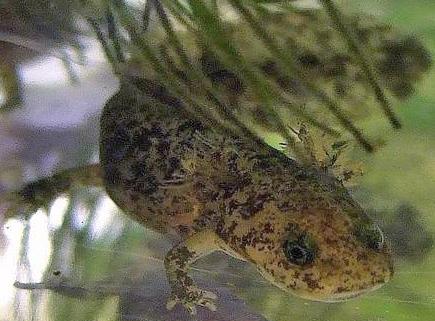
Adult individuals are dark brown. Aquatic juveniles have dark brown bodies with golden flecks.[1][2]
Terrestrial adults have five digits on each hindlimb. Some sexually mature individuals retain larval characteristics, including external gills and caudal fins.[3][4]
Adult body length ranges from 115 to 200 mm. Individuals in the Obihiro-shi population can have larger adult body sizes and larger egg sacs than other populations.[5][6]
Habitat
The species inhabits temperate forests and temperate shrubland. Its documented habitats include swamps and freshwater marshes.[7][8]
It also inhabits freshwater springs, irrigated land, canals and ditches. The species is restricted to still freshwater habitats.[9][10]
On Hokkaido, the species occupies alpine forests and grasslands.[11]
Diet
Adults consume invertebrates, including snails and worms.[12]
Larvae consume tadpoles of the Japanese brown frog and the Hokkaido frog. They also feed on sewage worms belonging to the genus Tubifex and gammaridean amphipods.[13][14][15][16]
Larvae may also consume Siberian salamander larvae. Larval cannibalism occurs when prey is scarce.[17][18]
Behaviour
The species swallows its prey whole.[19]
Under high-density conditions, larvae fed exclusively conspecific prey are more likely to develop cannibalistic characteristics. Cannibalistic differences among larvae within ponds are restricted to early development and disappear later.[20][21]
Reproduction and life cycle
The breeding season occurs from April through May. Eggs hatch between early and mid-May.[22][23]
The species has a biphasic life cycle, beginning with aquatic larvae and continuing as terrestrial adults after metamorphosis. It can also exhibit paedomorphosis, allowing sexually mature adults to retain larval characteristics.[24][25]
Conservation
The Lake Kuttara population is extinct. The introduction of salmon into Lake Kuttara is considered a likely cause of the population's extinction.[26][27]
Populations in Ishikari and Tokachi subprefectures are classified as endangered Local Populations in the Hokkaido Red List.[28]
Uses
The species is commonly sold online as a pet.[29]
Classification of the Ezo Salamander
| Kingdom | Animalia |
|---|---|
| Phylum | Chordata |
| Subphylum | Vertebrata |
| Infraphylum | Gnathostomata |
| Parvphylum | Osteichthyes |
| Megaclass | Tetrapoda |
| Class | Amphibia (Amphibians) |
| Order | Caudata (Salamanders) |
| Family | Hynobiidae (Asiatic Salamander) |
| Subfamily | Hynobiinae |
| Genus | Hynobius (Asian Salamanders) |
| Species | Hynobius retardatus Dunn, 1923 |
Where the Ezo Salamander is found
Checklists and occurrence records place Hynobius retardatus in 1 country. GBIF holds 305 georeferenced records of it.
Countries
Regions and cities with the most records
- Hokkaido, Japan 60
- Sapporo, Japan 23
- Ebetsu, Japan 10
- Tōbetsu, Japan 9
- Ishikari, Japan 7
- Yoichi, Japan 5
- Honchō, Japan 4
- Kitahiroshima, Japan 4
- Noboribetsu, Japan 4
- Date, Japan 3
- Eniwa, Japan 3
- Hakodate, Japan 3
- Hokuto, Japan 3
- Iwamizawa, Japan 3
- Kamiiso, Japan 3
- Kutchan, Japan 3
- Muroran, Japan 3
- Otaru, Japan 3
A number beside a place is its count of GBIF occurrence records. A place without a number comes from a checklist alone. Records show where a species has been observed or collected, which can include escapes and vagrants.
Common names
English
- Ezo Salamander
- Hokkaido Salamander
- Japanese Axolotl
- Wooper Looper
Names in 8 other languages
- Arabic
- سمندل هوكايدو
- Chinese
- 滯育小鯢
- Czech
- pamlok hokkaidský
- French
- Hynobie de Yéso
- German
- Hokkaido-Winkelzahnmolch
- Japanese
- Ezo Sanshouo, エゾサンショウウオ
- Korean
- 에조도롱뇽
- Russian
- Хоккайдский углозуб
Synonyms
One other scientific name has been used for this species and is now treated as a synonym of Hynobius retardatus.
- Satobius retardatus (Dunn, 1923)
Related species
-
 Hida SalamanderHynobius kimurae
-
 Japanese Rift SalamanderHynobius fossigenus
- Korean SalamanderHynobius leechii
-
 Japanese Black SalamanderHynobius nigrescens
-
 Taiwan SalamanderHynobius formosanus
-
 Alishan SalamanderHynobius arisanensis
-
 Abe's SalamanderHynobius abei
- Jeju SalamanderHynobius quelpaertensis
Compare
Questions and answers
What is the scientific name of the Ezo Salamander?
The scientific name of the Ezo Salamander is Hynobius retardatus. Written with its author, the full name is Hynobius retardatus Dunn, 1923.
Which family does the Ezo Salamander belong to?
Hynobius retardatus belongs to the family Hynobiidae, in the order Caudata and the class Amphibia.
Where is the Ezo Salamander found?
Checklists and occurrence records place Hynobius retardatus in 1 country: Japan.
What is the conservation status of the Ezo Salamander?
The IUCN Red List category recorded for Hynobius retardatus is Least Concern (LC).
What other names does the Ezo Salamander have?
Hynobius retardatus is also known in English as Hokkaido Salamander, Japanese Axolotl and Wooper Looper.
What is the scientific name of a salamander?
The scientific name of the Ezo Salamander is Hynobius retardatus Dunn, 1923.[30]
What do salamanders eat?
Adult Ezo Salamanders consume invertebrates, including snails and worms. Their larvae consume tadpoles of the Japanese brown frog and the Hokkaido frog, sewage worms belonging to the genus Tubifex, and gammaridean amphipods. Larvae may also consume Siberian salamander larvae.[12][13][14][15][16][17]
Sources
Passages the profile rests on
- Adult individuals are dark brown in coloration. Source passage: “Adults are dark brown in coloration” — English Wikipedia
- Aquatic juveniles have dark brown bodies with golden flecks. Source passage: “aquatic juveniles are a similar dark brown sprinkled with golden flecks across the body.” — English Wikipedia
- Terrestrial adults have five digits on each hindlimb. Source passage: “Hindlimbs of the terrestrial adults have five digits.” — English Wikipedia
- Some sexually mature individuals retain larval characteristics, including external gills and caudal fins. Source passage: “with features such as external gills and caudal fins.” — English Wikipedia
- Adult body length ranges from 115 to 200 mm. Source passage: “Adult Ezo salamanders can reach 115–200 mm (4.52-7.87 inch) in length.” — English Wikipedia
- Individuals in the Obihiro-shi population can have larger adult body sizes and larger egg sacs than other populations. Source passage: “some individuals of the Obihiro-shi population in eastern Hokkaido displaying larger adult body size as well as larger egg sac size and diameter.” — English Wikipedia
- The species inhabits temperate forests and temperate shrubland. Source passage: “natural habitats are temperate forests, temperate shrubland” — English Wikipedia
- Its documented habitats include swamps and freshwater marshes. Source passage: “swamps, freshwater marshes, intermittent freshwater marshes” — English Wikipedia
- The species also inhabits freshwater springs, irrigated land, canals and ditches. Source passage: “freshwater springs, irrigated land, canals, and ditches.” — English Wikipedia
- The species is restricted to still freshwater habitats. Source passage: “Ezo salamanders can only live within lentic freshwater habitats” — English Wikipedia
- The species occupies alpine forests and grasslands on Hokkaido. Source passage: “The Ezo salamander lives in alpine forests and grasslands only on the island of Hokkaido” — English Wikipedia
- Adults consume invertebrates, including snails and worms. Source passage: “Adults of the species feed on invertebrates like snails and worms.” — English Wikipedia
- Larvae consume tadpoles of the Japanese brown frog. Source passage: “H. retardatus larvae are known to consume the tadpoles of multiple frog species such as the Japanese brown frog (Rana pirica)” — English Wikipedia
- Larvae also consume tadpoles of the Hokkaido frog. Source passage: “and the Hokkaido frog” — English Wikipedia
- Larvae feed on sewage worms belonging to the genus Tubifex. Source passage: “as well as sewage worms (Tubifex)” — English Wikipedia
- Larvae consume gammaridean amphipods. Source passage: “gammaridean amphipods” — English Wikipedia
- Larvae may also consume Siberian salamander larvae. Source passage: “and possibly larvae of Siberian salamanders.” — English Wikipedia
- Larval cannibalism occurs when prey is scarce. Source passage: “Cannibalism by the larvae is not uncommon when prey items are scarce.” — English Wikipedia
- The species swallows its prey whole. Source passage: “that swallows its prey whole.” — English Wikipedia
- Larvae are more likely to develop cannibalistic characteristics when fed exclusively conspecific prey under high-density conditions. Source passage: “H. retardatus larvae artificially fed exclusively conspecific prey were found to more likely develop into the cannibalistic morph when subjected to high-density conditions.” — English Wikipedia
- Cannibalistic differences among larvae within ponds are restricted to early development and disappear later. Source passage: “cannibalistic dimorphism within ponds was limited to early periods of development and disappeared as development progressed.” — English Wikipedia
- The breeding season occurs from April through May. Source passage: “The breeding season of the Ezo salamander runs from April to May” — English Wikipedia
- Eggs hatch between early and mid-May. Source passage: “with eggs hatching between early- and mid-May.” — English Wikipedia
- The species has a biphasic life cycle, beginning with aquatic larvae and continuing as terrestrial adults after metamorphosis. Source passage: “The species has a biphasic life cycle, with the first stage of life spent as aquatic larvae and the second, after metamorphosis, spent on land as a terrestrial adult.” — English Wikipedia
- The species can exhibit paedomorphosis, allowing sexually mature adults to retain larval characteristics. Source passage: “adults maintain larval features even after metamorphosing and reaching sexual maturity.” — English Wikipedia
- The Lake Kuttara population is extinct. Source passage: “although this specific population is now extinct.” — English Wikipedia
- The introduction of salmon into Lake Kuttara is considered a likely cause of the population's extinction. Source passage: “can likely be attributed to the introduction of salmon into the lake habitat.” — English Wikipedia
- Populations in Ishikari and Tokachi subprefectures are classified as endangered Local Populations in the Hokkaido Red List. Source passage: “The populations in Ishikari and Tokachi subprefectures are listed as endangered “Local Populations (Lp)” in the Hokkaido Red List.” — pmc.ncbi.nlm.nih.gov
- The species is commonly sold online as a pet. Source passage: “Ezo salamanders are commonly sold through the internet as part of the pet trade.” — English Wikipedia
- The species is endemic to Hokkaido, Japan. Source passage: “H. retardatus is endemic to Japan's northernmost prefecture, the island of Hokkaido.” — English Wikipedia
Data
- Catalogue of Life, 2026-10-16 XR cc by
- Global Biodiversity Information Facility CC BY 4.0
- Wikidata CC0
- GeoNames CC BY 4.0
- Wikimedia Commons per image; credit shown with each image
- Within the Catalogue of Life, this name comes from The Integrated Taxonomic Information System cc0
References
- Dunn, E. R. (1923). New species of Hynobius from Japan. Proceedings of the California Academy of Sciences, 4th Series. 12: 27–29. where the name was published
This species in other databases
- Catalogue of Life 6MQL6
- Wikidata Q2382604
- iNaturalist 26872
- WoRMS urn:lsid:marinespecies.org:taxname:1470196
Page built on 29 November 2026. See how the catalog is made and all sources and licences.
Cite this page
ScientificNames.org. (2026). Hynobius retardatus (Ezo Salamander). Retrieved November 29, 2026, from https://scientificnames.org/species/hynobius-retardatus
“Hynobius retardatus (Ezo Salamander).” ScientificNames.org, 2026, scientificnames.org/species/hynobius-retardatus. Accessed 29 Nov. 2026.
ScientificNames.org. “Hynobius retardatus (Ezo Salamander).” Accessed November 29, 2026. https://scientificnames.org/species/hynobius-retardatus.
@misc{scientificnames_hynobius_retardatus_ezo_salamander,
  author = {{ScientificNames.org}},
  title = {Hynobius retardatus (Ezo Salamander)},
  year = {2026},
  url = {https://scientificnames.org/species/hynobius-retardatus},
  note = {Accessed 2026-11-29}
}