Species · Amphibians
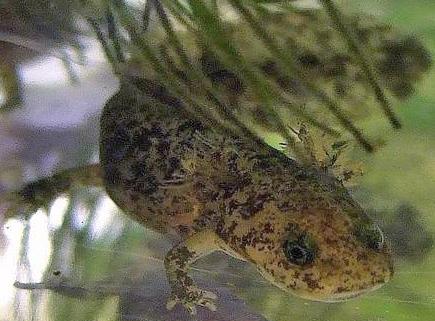
Japanese Black Salamander Hynobius nigrescens
The scientific name of the Japanese Black Salamander is Hynobius nigrescens. It is a species of amphibian in the family Hynobiidae (asiatic salamander), order Caudata. The name dates from 1907.
- Scientific name
- Hynobius nigrescens Stejneger, 1907
- Common name
- Japanese Black Salamander
- Genus
- Hynobius
- Family
- Hynobiidae (Asiatic Salamander)
- Order
- Caudata
- Class
- Amphibia
- Red List category
- LC Least Concern
- Environment
- freshwater
- Recorded in
- 1 country
- Name status
- accepted in the Catalogue of Life

Overview
The species is endemic to Japan and inhabits temperate forests, temperate grasslands, swamps, freshwater marshes, intermittent freshwater marshes, irrigated land, canals and ditches. During metamorphosis, its larval gills and fins are replaced by lungs and legs.
Written 26 November 2026 from the sources listed below. Each statement was checked against the passage it cites; statements that could not be supported were removed.
Habitat
Japanese Black Salamander inhabits temperate forests and temperate grasslands. It also occurs in swamps, freshwater marshes and intermittent freshwater marshes.[1][2][3][4][5]
The species also occurs in irrigated land, canals and ditches.[6][7][8]
Reproduction and life cycle
Japanese Black Salamander belongs to a salamander family characterized by external fertilization of eggs.[9]
Behaviour
During metamorphosis, the species' larval gills and fins are replaced by lungs and legs. As it grows, its muscles are shifted or created to accommodate changes in size and weight.[10][11]
Classification of the Japanese Black Salamander
| Kingdom | Animalia |
|---|---|
| Phylum | Chordata |
| Subphylum | Vertebrata |
| Infraphylum | Gnathostomata |
| Parvphylum | Osteichthyes |
| Megaclass | Tetrapoda |
| Class | Amphibia (Amphibians) |
| Order | Caudata (Salamanders) |
| Family | Hynobiidae (Asiatic Salamander) |
| Subfamily | Hynobiinae |
| Genus | Hynobius (Asian Salamanders) |
| Species | Hynobius nigrescens Stejneger, 1907 |
Where the Japanese Black Salamander is found
Checklists and occurrence records place Hynobius nigrescens in 1 country. GBIF holds 718 georeferenced records of it.
Countries
Regions and cities with the most records
- Niigata, Japan 22
- Tochigi, Japan 10
- Fukushima, Japan 9
- Nikkō, Japan 8
- Imaichi, Japan 7
- Kamo, Japan 7
- Maki, Japan 7
- Sanjō, Japan 7
- Shirone, Japan 7
- Tsubame, Japan 7
- Yoshida-kasugachō, Japan 7
- Akita, Japan 6
- Mitsuke, Japan 6
- Nagano, Japan 6
- Ryōtsu-minato, Japan 6
- Nakano, Japan 5
- Toyama, Japan 5
- Daigo, Japan 4
- Hitachi, Japan 4
- Hitachi-ota, Japan 4
- Hitachiomiya, Japan 4
- Ibaraki, Japan 4
- Sado, Japan 4
- Takahagi, Japan 4
- Ōmiya, Japan 4
- Arai, Japan 3
- Hanawa, Japan 3
- Iiyama, Japan 3
- Minamiuonuma, Japan 3
- Myoko, Japan 3
- Nanto, Japan 3
- Tōkamachi, Japan 3
A number beside a place is its count of GBIF occurrence records. A place without a number comes from a checklist alone. Records show where a species has been observed or collected, which can include escapes and vagrants.
Common names
English
- Japanese Black Salamander
- Black Salamander
Names in 8 other languages
- Arabic
- سمندل أسود ياباني
- Chinese
- 黑小鯢
- Czech
- pamlok tmavý
- French
- Hynobie noir du Japon
- German
- Dunkler Winkelzahnmolch
- Japanese
- Kurosanshouo, クロサンショウウオ
- Korean
- 일본흑도롱뇽
- Russian
- Чёрный углозуб
Synonyms
2 other scientific names have been used for this species and are now treated as synonyms of Hynobius nigrescens.
- Hynobius fuscus Tago, 1907
- Hynobius sadoensis Sato, 1940
Related species
-
 Ezo SalamanderHynobius retardatus
-
 Hida SalamanderHynobius kimurae
-
 Japanese Rift SalamanderHynobius fossigenus
- Korean SalamanderHynobius leechii
-
 Taiwan SalamanderHynobius formosanus
-
 Alishan SalamanderHynobius arisanensis
-
 Abe's SalamanderHynobius abei
- Jeju SalamanderHynobius quelpaertensis
Compare
Questions and answers
What is the scientific name of the Japanese Black Salamander?
The scientific name of the Japanese Black Salamander is Hynobius nigrescens. Written with its author, the full name is Hynobius nigrescens Stejneger, 1907.
Which family does the Japanese Black Salamander belong to?
Hynobius nigrescens belongs to the family Hynobiidae, in the order Caudata and the class Amphibia.
Where is the Japanese Black Salamander found?
Checklists and occurrence records place Hynobius nigrescens in 1 country: Japan.
What is the conservation status of the Japanese Black Salamander?
The IUCN Red List category recorded for Hynobius nigrescens is Least Concern (LC).
What other names does the Japanese Black Salamander have?
Hynobius nigrescens is also known in English as Black Salamander.
Sources
Passages the profile rests on
- The species inhabits temperate forests. Source passage: “Its natural habitats are temperate forests, temperate grassland, swamps, freshwater marshes, intermittent freshwater marshes, irrigated land, canals and ditches.” — English Wikipedia
- The species inhabits temperate grasslands. Source passage: “Its natural habitats are temperate forests, temperate grassland, swamps, freshwater marshes, intermittent freshwater marshes, irrigated land, canals and ditches.” — English Wikipedia
- The species inhabits swamps. Source passage: “Its natural habitats are temperate forests, temperate grassland, swamps, freshwater marshes, intermittent freshwater marshes, irrigated land, canals and ditches.” — English Wikipedia
- The species inhabits freshwater marshes. Source passage: “Its natural habitats are temperate forests, temperate grassland, swamps, freshwater marshes, intermittent freshwater marshes, irrigated land, canals and ditches.” — English Wikipedia
- The species inhabits intermittent freshwater marshes. Source passage: “Its natural habitats are temperate forests, temperate grassland, swamps, freshwater marshes, intermittent freshwater marshes, irrigated land, canals and ditches.” — English Wikipedia
- The species occurs in irrigated land. Source passage: “Its natural habitats are temperate forests, temperate grassland, swamps, freshwater marshes, intermittent freshwater marshes, irrigated land, canals and ditches.” — English Wikipedia
- The species occurs in canals. Source passage: “Its natural habitats are temperate forests, temperate grassland, swamps, freshwater marshes, intermittent freshwater marshes, irrigated land, canals and ditches.” — English Wikipedia
- The species occurs in ditches. Source passage: “Its natural habitats are temperate forests, temperate grassland, swamps, freshwater marshes, intermittent freshwater marshes, irrigated land, canals and ditches.” — English Wikipedia
- Hynobius nigrescens belongs to a salamander family characterized by external fertilization of eggs. Source passage: “Hynobius nigrescens belongs to the family Hynobiidae, which is one of only two salamander families exhibiting external fertilization of eggs.” — amphibiaweb.org
- During metamorphosis, the species' larval gills and fins are replaced by lungs and legs. Source passage: “When the larva goes through metamorphosis its gills and fins are replaced with lungs and legs.” — English Wikipedia
- As the salamander grows, its muscles are shifted or created to accommodate changes in size and weight. Source passage: “As the salamander grows, many of its muscles are shifted or are created in order to account for its size and weight.” — English Wikipedia
Data
- Catalogue of Life, 2026-10-16 XR cc by
- Global Biodiversity Information Facility CC BY 4.0
- Wikidata CC0
- GeoNames CC BY 4.0
- Wikimedia Commons per image; credit shown with each image
- Within the Catalogue of Life, this name comes from The Integrated Taxonomic Information System cc0
References
- Stejneger, L. (1907). Herpetology of Japan and adjacent territory. Bulletin of the United States National Museum. 58: xx + 577. Link where the name was published
This species in other databases
- Catalogue of Life 6N2KZ
- Wikidata Q2276273
- iNaturalist 26881
- WoRMS urn:lsid:marinespecies.org:taxname:1728510
Page built on 29 November 2026. See how the catalog is made and all sources and licences.
Cite this page
ScientificNames.org. (2026). Hynobius nigrescens (Japanese Black Salamander). Retrieved November 29, 2026, from https://scientificnames.org/species/hynobius-nigrescens
“Hynobius nigrescens (Japanese Black Salamander).” ScientificNames.org, 2026, scientificnames.org/species/hynobius-nigrescens. Accessed 29 Nov. 2026.
ScientificNames.org. “Hynobius nigrescens (Japanese Black Salamander).” Accessed November 29, 2026. https://scientificnames.org/species/hynobius-nigrescens.
@misc{scientificnames_hynobius_nigrescens_japanese_black_salamander,
  author = {{ScientificNames.org}},
  title = {Hynobius nigrescens (Japanese Black Salamander)},
  year = {2026},
  url = {https://scientificnames.org/species/hynobius-nigrescens},
  note = {Accessed 2026-11-29}
}