Species · Birds
Spot-backed Antshrike Hypoedaleus guttatus
The scientific name of the Spot-backed Antshrike is Hypoedaleus guttatus. It is a species of bird in the family Thamnophilidae (antbird), order Passeriformes. The name dates from 1816.
- Scientific name
- Hypoedaleus guttatus (Vieillot, 1816)
- Common name
- Spot-backed Antshrike
- Genus
- Hypoedaleus
- Family
- Thamnophilidae (Antbird)
- Order
- Passeriformes
- Class
- Aves
- Red List category
- LC Least Concern
- Recorded in
- 3 countries
- Name status
- accepted in the Catalogue of Life

Overview
Hypoedaleus guttatus inhabits the subcanopy and canopy of lowland evergreen Atlantic Forest. Adult males have black upperparts marked with white spots, while females have buff spots on their upperparts.
Written 27 November 2026 from the sources listed below. Each statement was checked against the passage it cites; statements that could not be supported were removed.
Appearance
The Spot-backed Antshrike has a chunky body, a long tail, and a short, heavy gray bill with a hooked tip. It measures 20–21 cm in length.[1][2][3]
Adult males have black crowns, napes, and upperparts marked with white spots. Their brownish-black tails have white bars, and their throats and breasts are white with pale gray sides.[4][5][6]
The male's belly and crissum range from nearly white in the northern population to brownish yellow in the south.[7]
Females have buff spots on their upperparts and more extensive brownish-yellow underparts than males.[8][9]
Habitat
The Spot-backed Antshrike inhabits the subcanopy and canopy of lowland evergreen Atlantic Forest. It occurs predominantly in wetter forest areas with dense vines and other vegetation.[10][11]
Its recorded habitat is subtropical or tropical moist lowland habitat, and its recorded elevation range extends from sea level to approximately 900 m.[12][13][14]
Diet
The Spot-backed Antshrike feeds on insects and other arthropods. Its diet also includes snails and possibly small vertebrates such as tree frogs and lizards.[15][16]
Behaviour
The Spot-backed Antshrike usually forages in pairs, generally approximately 8–15 m above the ground. It sometimes joins mixed-species feeding flocks.[17][18][19]
It moves sluggishly through dense vegetation by hopping. It captures prey by gleaning it from leaves, stems, and branches while reaching from a perch.[20][21]
The species has been observed following army ant swarms and capturing prey disturbed by the ants.[22]
The Spot-backed Antshrike is presumed to remain in its range throughout the year.[23]
Reproduction and life cycle
The Spot-backed Antshrike lays white eggs marked with lilac dots and larger blackish spots.[24]
Conservation
The Spot-backed Antshrike has been classified as Least Concern since 2004. Its population size is unknown and its population is believed to be decreasing.[25][26]
No immediate threats to the species have been identified. It occurs in several protected areas but appears to be generally rare outside them.[27][28]
The species is of conservation concern because of its relatively small range and the fragmentation of the remaining Atlantic Forest. It appears to require large territories.[29][30]
Classification of the Spot-backed Antshrike
| Kingdom | Animalia |
|---|---|
| Phylum | Chordata |
| Subphylum | Vertebrata |
| Infraphylum | Gnathostomata |
| Parvphylum | Osteichthyes |
| Megaclass | Tetrapoda |
| Class | Aves (Bird) |
| Order | Passeriformes (Passerine) |
| Family | Thamnophilidae (Antbird) |
| Genus | Hypoedaleus |
| Species | Hypoedaleus guttatus (Vieillot, 1816) |
Where the Spot-backed Antshrike is found
Checklists and occurrence records place Hypoedaleus guttatus in 3 countries across South America. GBIF holds 27,264 georeferenced records of it.
Countries
Regions and cities with the most records
- São Paulo, Brazil 10,650
- Misiones, Argentina 6,764
- Santa Catarina, Brazil 2,914
- Puerto Iguazú, Argentina 2,409
- Rio de Janeiro, Brazil 2,134
- Paraná, Brazil 2,057
- Ubatuba, Brazil 1,504
- Mairiporã, Brazil 1,345
- Foz do Iguaçu, Brazil 1,340
- Guarulhos, Brazil 1,245
- Vila Galvão, Brazil 1,198
- Paraty, Brazil 1,125
- Presidente Franco, Paraguay 1,033
- Franco da Rocha, Brazil 1,028
- Caieiras, Brazil 1,018
- Guapiara, Brazil 873
- Juquitiba, Brazil 847
- São Paulo, Brazil 773
- São Lourenço da Serra, Brazil 695
- Osasco, Brazil 652
- Embu-Guaçu, Brazil 641
- Bahia, Brazil 634
- Itapúa, Paraguay 602
- Bertioga, Brazil 595
- Ciudad del Este, Paraguay 589
- Cubatão, Brazil 575
- Itapecerica da Serra, Brazil 556
- Rio Grande da Serra, Brazil 553
- San Vicente, Argentina 550
- Ribeirão Pires, Brazil 547
- San Pedro, Argentina 542
- Pirapora do Bom Jesus, Brazil 535
- Jardim Presidente Dutra, Brazil 531
- Cajamar, Brazil 486
- Francisco Morato, Brazil 482
- Schroeder, Brazil 478
Range as the checklists state it
South America
A number beside a place is its count of GBIF occurrence records. A place without a number comes from a checklist alone. Records show where a species has been observed or collected, which can include escapes and vagrants.
Common names
English
- Spot-backed Antshrike
Names in 23 other languages
- Catalan
- batarà maculat
- Chinese
- 斑背蚁鵙, 斑背蟻鵙
- Croatian
- pjegavoleđa mravarica
- Czech
- mravenčík perlohřbetý
- Danish
- Pletrygget Myretornskade
- Dutch
- Vlekrugmierklauwier
- Esperanto
- gutodorsa formikulo
- Finnish
- ruotomuura
- French
- Batara moucheté
- German
- Perlenmantel-Ameisenwürger, Perlmantel-Ameisenwürger
- Hungarian
- gyöngyös hangyászgébics
- Italian
- Averla formichiera dorsomacchiato
- Japanese
- セボシアリモズ
- Lithuanian
- dėmėtoji skruzdlesė
- Norwegian
- dråpemaurvarsler
- Polish
- perlinek
- Portuguese
- chocão-carijó, formigueiro-carijó
- Russian
- Пятнистая батара, Пятнистый эсперито
- Slovak
- batara maľovaná
- Spanish
- Batará goteado
- Swedish
- fläckryggig myrtörnskata
- Turkish
- Damla Sırtlı Karıncaavcısı
- Ukrainian
- кущівник плямистий
Synonyms
3 other scientific names have been used for this species and are now treated as synonyms of Hypoedaleus guttatus.
- Hypoedaleus guttatus guttatus (Vieillot, 1816)
- Hypoedaleus guttatus leucogaster Pinto, 1932
- Thamnophilus guttatus Vieillot, 1816
Related species
-
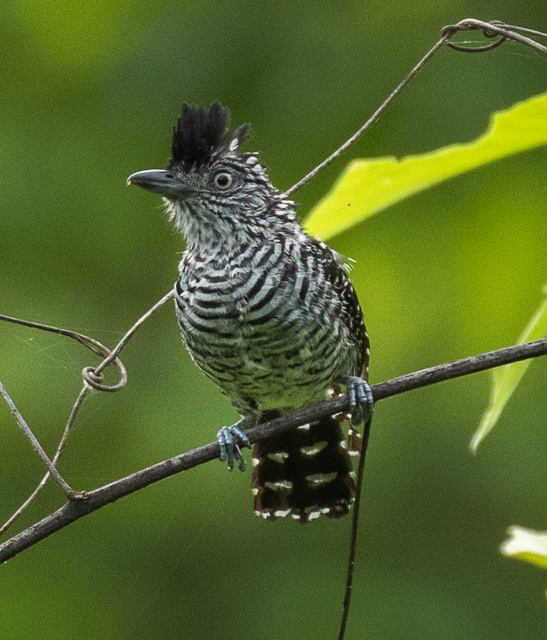 Barred AntshrikeThamnophilus doliatus
-
 Great AntshrikeTaraba major
-
 Black-crowned AntshrikeThamnophilus atrinucha
-
 Ocellated AntbirdPhaenostictus mcleannani
-
 Bicolored AntbirdGymnopithys bicolor
-
 Fasciated AntshrikeCymbilaimus lineatus
-
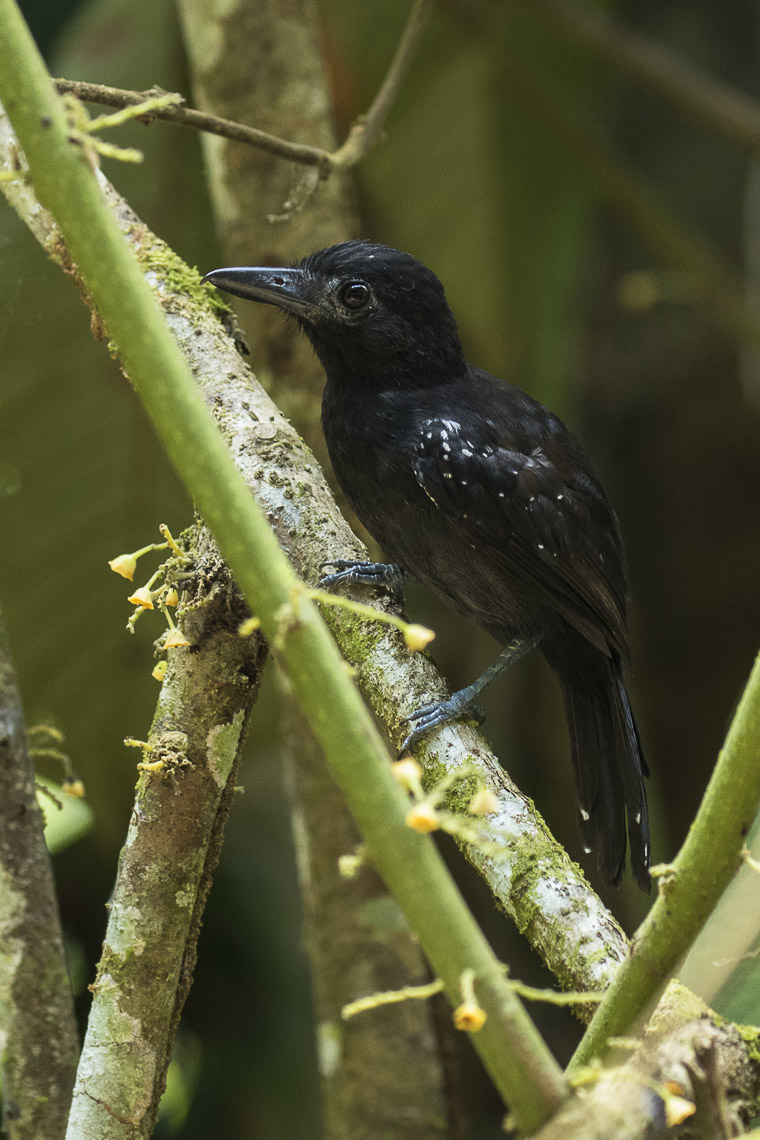 Black-hooded AntshrikeThamnophilus bridgesi
-
 Black-crested AntshrikeSakesphorus canadensis
Compare
Questions and answers
What is the scientific name of the Spot-backed Antshrike?
The scientific name of the Spot-backed Antshrike is Hypoedaleus guttatus. Written with its author, the full name is Hypoedaleus guttatus (Vieillot, 1816).
Which family does the Spot-backed Antshrike belong to?
Hypoedaleus guttatus belongs to the family Thamnophilidae, in the order Passeriformes and the class Aves.
Where is the Spot-backed Antshrike found?
Checklists and occurrence records place Hypoedaleus guttatus in 3 countries: Brazil, Argentina and Paraguay.
What is the conservation status of the Spot-backed Antshrike?
The IUCN Red List category recorded for Hypoedaleus guttatus is Least Concern (LC).
Sources
Passages the profile rests on
- The species has a short, heavy gray bill with a hooked tip. Source passage: “Both sexes have a short, heavy, gray bill with a hook at the end like true shrikes.” — English Wikipedia
- The species has a chunky body, a long tail, and a heavy hooked bill. Source passage: “Chunky antshrike with a long tail and heavy bill with a hooked tip.” — ebird.org
- The species measures 20–21 cm in length. Source passage: “The spot-backed antshrike is a large antbird, 20 to 21 cm (7.9 to 8.3 in) long.” — English Wikipedia
- Adult males have black crowns, napes, and upperparts marked with white spots. Source passage: “Adult males have a black crown, nape, and upperparts spotted with white” — English Wikipedia
- Adult males have brownish-black tails with white bars. Source passage: “a brownish black tail with white bars.” — English Wikipedia
- Adult males have white throats and breasts and pale gray sides. Source passage: “Their throat and breast are white and their sides pale gray.” — English Wikipedia
- The male's belly and crissum range from nearly white in the northern population to brownish yellow in the south. Source passage: “Their belly and crissum are nearly white in the northern part of their range and gradually darken to brownish yellow to the south.” — English Wikipedia
- Females have buff spots on their upperparts and more extensive brownish-yellow underparts than males. Source passage: “Adult females have a similar pattern as males, but with buff spots on their upperparts and more extensive brownish yellow on their underparts.” — English Wikipedia
- Males are spotted black and white above, while females have buffier upperparts. Source passage: “Males are spotted black and white above (buffier in females)” — ebird.org
- The species inhabits the subcanopy and canopy of lowland evergreen Atlantic Forest. Source passage: “It is a bird of the Atlantic Forest, where it inhabits the subcanopy and canopy of lowland evergreen forest.” — English Wikipedia
- The species occurs predominantly in wetter forest areas with dense vines and other vegetation. Source passage: “It almost exclusively stays in wetter areas with dense vines and other vegetation.” — English Wikipedia
- The species inhabits subtropical or tropical moist lowland habitat. Source passage: “habitat is subtropical or tropical moist lowland” — inaturalist.org
- The species is found in the forest subcanopy. Source passage: “Found in the sub-canopy of” — ebird.org
- Its recorded elevation range extends from sea level to approximately 900 m. Source passage: “In elevation it ranges from sea level to about 900 m (3,000 ft).” — English Wikipedia
- The species feeds on insects and other arthropods. Source passage: “The spot-backed antshrike feeds on a variety of insects and other arthropods” — English Wikipedia
- Its diet includes snails and possibly small vertebrates such as tree frogs and lizards. Source passage: “its diet also includes snails and possibly small vertebrates like tree-frogs and lizards.” — English Wikipedia
- The species usually forages in pairs. Source passage: “It usually forages in pairs” — English Wikipedia
- The species generally forages approximately 8–15 m above the ground. Source passage: “mostly about between 8 and 15 m (25 and 50 ft) above the ground” — English Wikipedia
- The species sometimes joins mixed-species feeding flocks. Source passage: “and sometimes joins mixed-species feeding flocks.” — English Wikipedia
- The species moves sluggishly through dense vegetation by hopping. Source passage: “It hops sluggishly through dense vines and other vegetation” — English Wikipedia
- The species captures prey by gleaning it from leaves, stems, and branches while reaching from a perch. Source passage: “reaching from a perch to glean prey from leaves, especially those of bromeliads and epiphytic ferns, and also from stems and branches.” — English Wikipedia
- The species has been observed following army ant swarms and capturing prey disturbed by the ants. Source passage: “It was once observed following an army ant swarm, staying low to the ground to capture prey disturbed by the ants.” — English Wikipedia
- The species is presumed to remain in its range throughout the year. Source passage: “The spot-backed antshrike is presumed to be a year-round resident throughout its range.” — English Wikipedia
- The species lays white eggs marked with lilac dots and larger blackish spots. Source passage: “The spot-backed antshrike's eggs are white with lilac dots and larger blackish spots.” — English Wikipedia
- The species has been classified as Least Concern since 2004. Source passage: “and since 2004 as of Least Concern.” — English Wikipedia
- The species' population size is unknown and its population is believed to be decreasing. Source passage: “Its population size is not known and is believed to be decreasing.” — English Wikipedia
- No immediate threats to the species have been identified. Source passage: “No immediate threats have been identified.” — English Wikipedia
- The species occurs in several protected areas but appears to be generally rare outside them. Source passage: “It occurs in several protected areas but appears to be generally rare outside them.” — English Wikipedia
- The species is of conservation concern because of its relatively small range and the fragmentation of the remaining Atlantic Forest. Source passage: “Although not currently considered threatened, its relatively small range and the highly fragmented nature of remaining Atlantic Forest are causes for concern for this species” — English Wikipedia
- The species appears to require large territories. Source passage: “which seems to require large territories.” — English Wikipedia
Data
- Catalogue of Life, 2026-10-16 XR cc by
- Global Biodiversity Information Facility CC BY 4.0
- Wikidata CC0
- GeoNames CC BY 4.0
- Wikimedia Commons per image; credit shown with each image
- Within the Catalogue of Life, this name comes from The Integrated Taxonomic Information System cc0
References
- Gill, Frank, & and Minturn Wright. (2006). Birds of the World: Recommended English Names.
This species in other databases
Page built on 27 November 2026. See how the catalog is made and all sources and licences.
Cite this page
ScientificNames.org. (2026). Hypoedaleus guttatus (Spot-backed Antshrike). Retrieved November 27, 2026, from https://scientificnames.org/species/hypoedaleus-guttatus
“Hypoedaleus guttatus (Spot-backed Antshrike).” ScientificNames.org, 2026, scientificnames.org/species/hypoedaleus-guttatus. Accessed 27 Nov. 2026.
ScientificNames.org. “Hypoedaleus guttatus (Spot-backed Antshrike).” Accessed November 27, 2026. https://scientificnames.org/species/hypoedaleus-guttatus.
@misc{scientificnames_hypoedaleus_guttatus_spot_backed_antshrike,
  author = {{ScientificNames.org}},
  title = {Hypoedaleus guttatus (Spot-backed Antshrike)},
  year = {2026},
  url = {https://scientificnames.org/species/hypoedaleus-guttatus},
  note = {Accessed 2026-11-27}
}