Species · Birds
Tawny Fish Owl Ketupa flavipes
The scientific name of the Tawny Fish Owl is Ketupa flavipes. It is a species of bird in the family Strigidae (owls), order Strigiformes. The name dates from 1836.
- Scientific name
- Ketupa flavipes (Hodgson, 1836)
- Common name
- Tawny Fish Owl
- Genus
- Ketupa
- Family
- Strigidae (Owls)
- Order
- Strigiformes
- Class
- Aves
- Red List category
- LC Least Concern
- Recorded in
- 8 countries
- Name status
- accepted in the Catalogue of Life

Overview
Ketupa flavipes inhabits subtropical and temperate forests containing mountain streams, within a documented range extending from southern Nepal and northern India to Laos, Vietnam, and southern China. It is distinguished by orangey-rufous upperparts with broad blackish feather markings, yellow eyes, and a dingy-yellow band across the shoulders.
Written 26 November 2026 from the sources listed below. Each statement was checked against the passage it cites; statements that could not be supported were removed.
Appearance
The Tawny Fish Owl has yellow eyes and an orangey-rufous crown and upperparts marked with broad blackish feather markings. Its scapulars form a contrasting dingy-yellow band across the shoulders, while its flight and tail feathers have dark-brown and buffish bars.[1][2][3][4]
Its facial disc is poorly defined, with a conspicuous off-white area on the eyebrows and forehead. Feathers cover approximately two-thirds of its tarsi, and the unfeathered portions of its legs are greenish-yellow, with greyish-horn-coloured talons.[5][6][7]
Its toes have a rough texture on their undersides. Its body length ranges from 48 to 61 cm.[8][9]
Six adult individuals averaged 2,415 g in body mass, with recorded weights ranging from 2,050 to 2,650 g. Its wing chord ranges from 410 to 477 mm, its tail measures 215 to 227 mm, its tarsus measures 60 to 67 mm, and its bill measures 48 to 52 mm.[10][11][12][13][14]
Habitat
The Tawny Fish Owl inhabits subtropical and temperate forests and requires forest tracts containing mountain streams. It avoids grasslands, agricultural land, and areas near villages.[15][16][17]
In Darjeeling and Nepal, it occurs at elevations between 1,500 and 2,450 m. In Laos and Vietnam, it prefers fast-flowing waters in remote wilderness areas with little or no disturbance.[18][19]
Radio-tracked individuals used roosting sites in old-growth forest located 20 to 550 m from streams.[20]
Its documented range includes southern Nepal, northern India, Bangladesh, Bhutan, China, Laos, Myanmar, Taiwan, and Vietnam. Its Himalayan distribution extends from Kashmir and Garhwal eastward to Laos, Vietnam, and southern China, while its recorded Chinese range extends northward to Zhejiang and Anhui.[21][22][23]
Diet
The Tawny Fish Owl eats freshwater crabs, shrimps, and fish. Recorded prey includes Taiwan mitten crabs, tip-nosed frogs, brown tree frogs, and Asiatic toads.[24][25][26][27]
Its other recorded prey includes lizards, snakes, moles, rodents, bamboo rats, and the small Malayan porcupine.[28][29]
Its avian prey includes Mandarin ducks, junglefowl, pheasants, and eared pheasants.[30][31]
Behaviour
The Tawny Fish Owl is highly solitary and territorial. Its territorial call is a deep whoo-hoo, and it also produces a cat-like meow.[32][33]
Radio-tracked individuals in Taiwan were mainly nocturnal. Individuals were most active in movement and foraging during twilight and moved distances of up to 1,800 m in one hour.[34][35][36]
Individuals moved more frequently during the cold season. Breeding individuals showed some daytime activity during summer, mainly involving preening, and the species may hunt during daylight when provisioning fledglings.[37][38][39]
When disturbed or threatened, individuals tend to remain perched rather than take flight.[40]
The species typically captures fish by swooping down to the water and taking them from the surface. It also hunts by wading into shallow water on foot.[41][42]
Reproduction and life cycle
The breeding season in India is November to February and in Assam is December to February.[43][44]
Recorded nest sites include large holes in riverbanks, cliff caves, and forks of large trees. The species does not construct nests and lays its eggs directly on the bare surface of the nesting site.[45][46]
It sometimes nests in abandoned nests constructed by Pallas's fish eagles. Its usual clutch consists of two eggs, although a single egg is sometimes laid.[47][48]
Its eggs measure 56 to 58.8 mm by 45.5 to 48.3 mm.[49]
Conservation
The Tawny Fish Owl is classified as Least Concern on the IUCN Red List.[50]
Classification of the Tawny Fish Owl
| Kingdom | Animalia |
|---|---|
| Phylum | Chordata |
| Subphylum | Vertebrata |
| Infraphylum | Gnathostomata |
| Parvphylum | Osteichthyes |
| Megaclass | Tetrapoda |
| Class | Aves (Bird) |
| Order | Strigiformes (Owl) |
| Family | Strigidae (Owls) |
| Subfamily | Striginae |
| Genus | Ketupa (Fish-Owls and Allied Eagle-Owls) |
| Species | Ketupa flavipes (Hodgson, 1836) |
Where the Tawny Fish Owl is found
Checklists and occurrence records place Ketupa flavipes in 8 countries across Asia. GBIF holds 2,378 georeferenced records of it.
Countries
Regions and cities with the most records
- Uttarakhand, India 1,584
- Naini Tāl, India 793
- Haldwani, India 759
- Rāmnagar, India 305
- Sichuan, China 270
- Shaanxi, China 75
- Mongar, Bhutan 74
- Arunachal Pradesh, India 38
- Punākha, Bhutan 36
- Zhemgang District, Bhutan 35
- Punakha, Bhutan 32
- Afzalgarh, India 29
- Sarpang District, Bhutan 26
- Taiwan, Taiwan 26
- Yilan, Taiwan 26
- Yangzhou, China 22
- Xizhi, Taiwan 21
- Banqiao, Taiwan 17
- Guangdong, China 17
- Shulin, Taiwan 15
- Paro, Bhutan 13
- Taipei, Taiwan 13
- Kotdwāra, India 12
- Neihu, Taiwan 12
- Jiangxi, China 11
- Thimphu, Bhutan 11
- Thimphu District, Bhutan 10
- Wangdi Phodrang, Bhutan 9
- Haridwar, India 8
- Kachin State, Myanmar 8
- Henan, China 7
- Zhejiang, China 7
- Dong Nai, Vietnam 6
- Jaspur, India 6
- Kashipur, India 6
- Tsirang, Bhutan 5
Range as the checklists state it
Southern Asia
A number beside a place is its count of GBIF occurrence records. A place without a number comes from a checklist alone. Records show where a species has been observed or collected, which can include escapes and vagrants.
Common names
English
- Tawny Fish Owl
- Tawny Fish-Owl
Names in 30 other languages
- Arabic
- بوم السمك الأسمر
- Bengali
- কৃষ্ণকায় মেছো পেঁচা
- Catalan
- duc pescador lleonat
- Chinese
- 黃漁鴞, 黃魚鴞, 黄腿渔鸮
- Croatian
- ušara ribarica
- Czech
- ketupa žlutohnědá, ketupa žlutonohá
- Danish
- Gulbenet Fiskeugle
- Dutch
- Geelpootvisuil, Himalayavisuil
- Esperanto
- Rufa fiŝgufo, himalaja fiŝgufo
- Estonian
- ida-kalakakk
- Finnish
- vuorikalahuuhkaja
- French
- Grand-duc roux, Kétoupa roux
- German
- Himalaja-Fischuhu, Himalajafischuhu, Himalaya-Fischuhu, Himalayafischuhu
- Hebrew
- קטופה כתומה
- Hungarian
- himalájai halászbagoly
- Italian
- Gufo pescatore fulvo
- Japanese
- ウオミミズク
- Lithuanian
- himalajinis žuvinis apuokas
- Nepali
- कैलो मलाहा हुचील
- Norwegian
- rustfiskeugle
- Polish
- ketupa rdzawa
- Portuguese
- bufo-pescador-fulvo, bufo-pescador-ruivo, coruja-pescadora
- Russian
- Гималайский рыбный филин
- Serbian
- Kineska sova ribar
- Slovak
- ketupa hrdzavá
- Spanish
- Búho Pescador, Búho pescador leonado
- Swedish
- himalayafiskuv
- Thai
- นกทึดทือสีน้ำตาลอ่อน
- Turkish
- Kumral Balık Baykuşu
- Ukrainian
- пугач-рибоїд рудий
Synonyms
3 other scientific names have been used for this species and are now treated as synonyms of Ketupa flavipes.
- Bubo flavipes Hodgson, BH, 1836
- Cultrunguis flavipes Hodgson, 1836
- Ketupa magnifica Swinhoe, 1873
Related species
-
 Brown Fish OwlKetupa zeylonensis
-
 Buffy Fish OwlKetupa ketupu
-
 Akun Eagle-owlKetupa leucosticta
- Verreaux's Eagle-OwlKetupa lactea
-
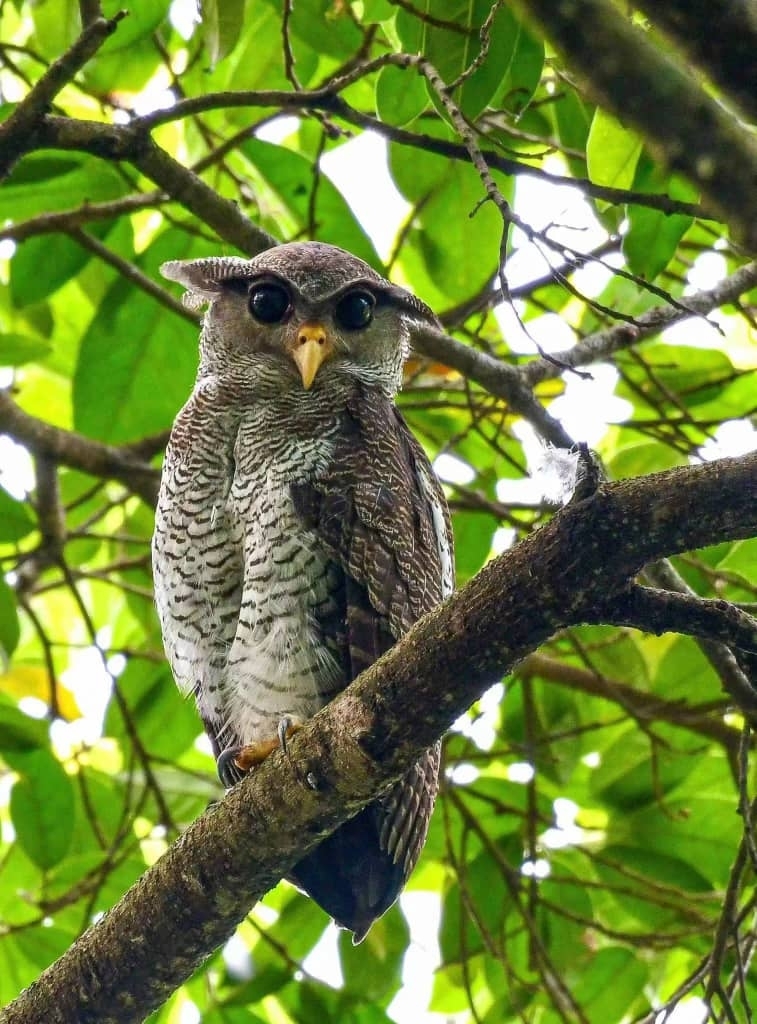 Barred Eagle-OwlKetupa sumatrana
- Dusky Eagle-OwlKetupa coromanda
- Spot-bellied Eagle-OwlKetupa nipalensis
- Fraser's Eagle-OwlKetupa poensis
Compare
Questions and answers
What is the scientific name of the Tawny Fish Owl?
The scientific name of the Tawny Fish Owl is Ketupa flavipes. Written with its author, the full name is Ketupa flavipes (Hodgson, 1836).
Which family does the Tawny Fish Owl belong to?
Ketupa flavipes belongs to the family Strigidae, in the order Strigiformes and the class Aves.
Where is the Tawny Fish Owl found?
Checklists and occurrence records place Ketupa flavipes in 8 countries, including India, China, Bhutan, Taiwan, Myanmar and Nepal.
What is the conservation status of the Tawny Fish Owl?
The IUCN Red List category recorded for Ketupa flavipes is Least Concern (LC).
What other names does the Tawny Fish Owl have?
Ketupa flavipes is also known in English as Tawny Fish-Owl.
Sources
Passages the profile rests on
- Its eyes are yellow. Source passage: “They have yellow eyes.” — English Wikipedia
- Its crown and upperparts are orangey-rufous with broad blackish feather markings. Source passage: “They tend to be an orangey-rufous color on the crown and upperparts, which are overlaid with broad, blackish markings” — English Wikipedia
- Its scapulars form a contrasting dingy-yellow band across the shoulders. Source passage: “The scapulars are a dingy yellow color, forming a contrasting band which runs across the owl's shoulders.” — English Wikipedia
- Its flight and tail feathers have dark-brown and buffish bars. Source passage: “The flight and tail feathers are strongly barred dark brown and buffish.” — English Wikipedia
- Its facial disc is poorly defined, with a conspicuous off-white area on the eyebrows and forehead. Source passage: “The facial disc is poorly defined but a sizeable off-white area on the eyebrows and forehead stands out.” — English Wikipedia
- Feathers cover approximately two-thirds of its tarsi. Source passage: “the tawny fish owl has feathering over two-thirds of the tarsi.” — English Wikipedia
- The unfeathered portions of its legs are greenish-yellow, and its talons are greyish-horn coloured. Source passage: “The legs below feathering are greenish-yellow with greyish-horn coloured talons.” — English Wikipedia
- Its toes have a rough texture on their undersides. Source passage: “have a rough texture to the bottom of their toes.” — English Wikipedia
- Its body length ranges from 48 to 61 cm. Source passage: “The tawny is 48 to 61 cm (19 to 24 in) long from bill to tail.” — English Wikipedia
- Six adult individuals averaged 2,415 g in body mass, with recorded weights ranging from 2,050 to 2,650 g. Source passage: “Six adult tawny fish owls were found to weigh an average of 2,415 g (5.324 lb), with a reported range of 2,050 to 2,650 g” — English Wikipedia
- Its wing chord ranges from 410 to 477 mm. Source passage: “the wing chord is 410 to 477 mm (16.1 to 18.8 in)” — English Wikipedia
- Its tail measures 215 to 227 mm. Source passage: “the tail is 215 to 227 mm (8.5 to 8.9 in)” — English Wikipedia
- Its tarsus measures 60 to 67 mm. Source passage: “the tarsus is 60 to 67 mm (2.4 to 2.6 in)” — English Wikipedia
- Its bill measures 48 to 52 mm. Source passage: “the bill is 48 to 52 mm (1.9 to 2.0 in).” — English Wikipedia
- The species inhabits subtropical and temperate forests. Source passage: “The tawny fish owl lives in subtropical to temperate forests” — English Wikipedia
- It requires forest tracts containing mountain streams. Source passage: “It requires forest tracts with mountain streams.” — English Wikipedia
- The species avoids grasslands, agricultural land, and areas near villages. Source passage: “They avoided disturbed habitat like grassland, agricultural land and the vicinity of villages.” — English Wikipedia
- In Darjeeling and Nepal, it occurs at elevations between 1,500 and 2,450 m. Source passage: “In areas such as Darjeeling and Nepal, it lives at elevations of 1,500 to 2,450 m (4,920 to 8,040 ft).” — English Wikipedia
- In Laos and Vietnam, it prefers fast-flowing waters in remote wilderness areas with little or no disturbance. Source passage: “where it prefers fast flowing waters in remote wilderness with little to no disturbance.” — English Wikipedia
- Radio-tracked individuals used roosting sites in old-growth forest located 20 to 550 m from streams. Source passage: “Each owl used up to 17 different roosting sites that were all located in old-growth forest 20 to 550 m (66 to 1,804 ft) away from a stream.” — English Wikipedia
- Its documented range includes southern Nepal, northern India, Bangladesh, Bhutan, China, Laos, Myanmar, Taiwan, and Vietnam. Source passage: “in southern Nepal, northern India, Bangladesh, Bhutan, China, Laos, Myanmar, Taiwan, and Vietnam.” — English Wikipedia
- Its Himalayan distribution extends from Kashmir and Garhwal eastward to Laos, Vietnam, and southern China. Source passage: “It inhabits the Himalayan foothills from Kashmir and Garhwal east to the mountains in Laos, Vietnam and southern China” — English Wikipedia
- Its recorded Chinese range extends northward to Zhejiang and Anhui. Source passage: “up to Zhejiang and Anhui.” — English Wikipedia
- Its recorded prey includes Taiwan mitten crabs. Source passage: “They contained remains of Taiwan mitten crab (Eriocheir formosa)” — English Wikipedia
- Its recorded prey includes tip-nosed frogs. Source passage: “tip-nosed frog (Odorrana swinhoana)” — English Wikipedia
- Its recorded prey includes brown tree frogs and Asiatic toads. Source passage: “brown tree frog (Buergeria robusta), Asiatic toad (Bufo gargarizans)” — English Wikipedia
- Its diet includes freshwater crabs, shrimps, and fish. Source passage: “freshwater crabs, shrimps and fish.” — English Wikipedia
- It also hunts lizards, snakes, moles, rodents, and bamboo rats. Source passage: “the species may also hunt toads, lizards, snakes, and small mammals such as moles, and particularly rodents, with one of the few mammalian prey recorded semi-regularly being bamboo rats (Rhizomys).” — English Wikipedia
- Its recorded prey includes the small Malayan porcupine. Source passage: “A small Malayan porcupine (Hystrix brachyura) has also been reported amongst their prey.” — English Wikipedia
- Its recorded avian prey includes Mandarin ducks. Source passage: “It also prey on birds including Mandarin ducks (Aix galericulata) in Taiwan” — English Wikipedia
- It has been recorded preying on junglefowl, pheasants, and eared pheasants. Source passage: “has overtaken large ground birds such junglefowl (Gallus ssp.), pheasants and eared pheasants” — English Wikipedia
- Its territorial call is a deep whoo-hoo, and it also produces a cat-like meow. Source passage: “The tawny fish owl's territorial call is a deep whoo-hoo. It also makes a cat-like meow.” — English Wikipedia
- The species is highly solitary and territorial. Source passage: “Tawny fish owls are highly solitary and territorial as are a majority of owls.” — English Wikipedia
- Radio-tracked individuals in Taiwan were mainly nocturnal. Source passage: “They were mainly nocturnal, left their day-time roosts around sunset and returned before sunrise.” — English Wikipedia
- Individuals were most active in movement and foraging during twilight. Source passage: “They were most active moving and foraging during twilight” — English Wikipedia
- Tracked individuals moved distances of up to 1,800 m in one hour. Source passage: “and moved up to 1,800 m (5,900 ft) in an hour.” — English Wikipedia
- Individuals moved more frequently during the cold season. Source passage: “They moved more frequently in the cold season.” — English Wikipedia
- Breeding individuals showed some daytime activity during summer, mainly involving preening. Source passage: “In summer, breeding owls showed some daytime activity, consisting mainly of preening.” — English Wikipedia
- The species may hunt during daylight when provisioning fledglings. Source passage: “They also hunted during the day when feeding their fledglings.” — English Wikipedia
- When disturbed or threatened, individuals tend to remain perched rather than take flight. Source passage: “If disturbed or threatened, these owls tend to sit tight and not take flight.” — English Wikipedia
- It typically captures fish by swooping down to the water and taking them from the surface. Source passage: “They usually hunt by swooping down to the water, capture fish from the surface” — English Wikipedia
- It also hunts by wading into shallow water on foot. Source passage: “although fish owls will hunt on foot, wading into the shallows.” — English Wikipedia
- The breeding season in India is November to February. Source passage: “The breeding season is November to February in India” — English Wikipedia
- The breeding season in Assam is December to February. Source passage: “and December to February in Assam.” — English Wikipedia
- Recorded nest sites include large holes in riverbanks, cliff caves, and forks of large trees. Source passage: “Nest locations found have included large holes in river banks, caves in cliffs and the fork or crotch of a large tree.” — English Wikipedia
- The species does not construct nests and lays its eggs directly on the bare surface of the nesting site. Source passage: “As in all owls, tawny fish owls do not build a nest so merely lay their eggs on the bare ground of whatever surface they use.” — English Wikipedia
- It sometimes nests in abandoned nests constructed by Pallas's fish eagles. Source passage: “They also not infrequently nest in abandoned nests built by Pallas's fish eagles (Haliaeetus leucoryphus).” — English Wikipedia
- Its usual clutch consists of two eggs, although a single egg is sometimes laid. Source passage: “Usually two eggs are laid but sometimes only one is.” — English Wikipedia
- Its eggs measure 56 to 58.8 mm by 45.5 to 48.3 mm. Source passage: “The eggs can range in size from 56 to 58.8 mm (2.20 to 2.31 in) x 45.5 to 48.3 mm (1.79 to 1.90 in)” — English Wikipedia
- The species is classified as Least Concern on the IUCN Red List. Source passage: “it is listed as Least Concern on the IUCN Red List.” — English Wikipedia
Data
- Catalogue of Life, 2026-10-16 XR cc by
- Global Biodiversity Information Facility CC BY 4.0
- Wikidata CC0
- GeoNames CC BY 4.0
- Wikimedia Commons per image; credit shown with each image
- Within the Catalogue of Life, this name comes from The Integrated Taxonomic Information System cc0
References
- Gill, Frank, & and Minturn Wright. (2006). Birds of the World: Recommended English Names.
- Dickinson, E. C., and J. V. Remsen Jr., eds. (2013). The Howard and Moore Complete Checklist of the Birds of the World, 4th Edition, Vol. 1 Non-Passerines.
This species in other databases
Page built on 26 November 2026. See how the catalog is made and all sources and licences.
Cite this page
ScientificNames.org. (2026). Ketupa flavipes (Tawny Fish Owl). Retrieved November 26, 2026, from https://scientificnames.org/species/ketupa-flavipes
“Ketupa flavipes (Tawny Fish Owl).” ScientificNames.org, 2026, scientificnames.org/species/ketupa-flavipes. Accessed 26 Nov. 2026.
ScientificNames.org. “Ketupa flavipes (Tawny Fish Owl).” Accessed November 26, 2026. https://scientificnames.org/species/ketupa-flavipes.
@misc{scientificnames_ketupa_flavipes_tawny_fish_owl,
  author = {{ScientificNames.org}},
  title = {Ketupa flavipes (Tawny Fish Owl)},
  year = {2026},
  url = {https://scientificnames.org/species/ketupa-flavipes},
  note = {Accessed 2026-11-26}
}