Species · Birds
Buffy Fish Owl Ketupa ketupu
The scientific name of the Buffy Fish Owl is Ketupa ketupu. It is a species of bird in the family Strigidae (owls), order Strigiformes. The name dates from 1821.
- Scientific name
- Ketupa ketupu (Horsfield, 1821)
- Common name
- Buffy Fish Owl
- Genus
- Ketupa
- Family
- Strigidae (Owls)
- Order
- Strigiformes
- Class
- Aves
- Red List category
- LC Least Concern
- Recorded in
- 10 countries
- Name status
- accepted in the Catalogue of Life

Overview
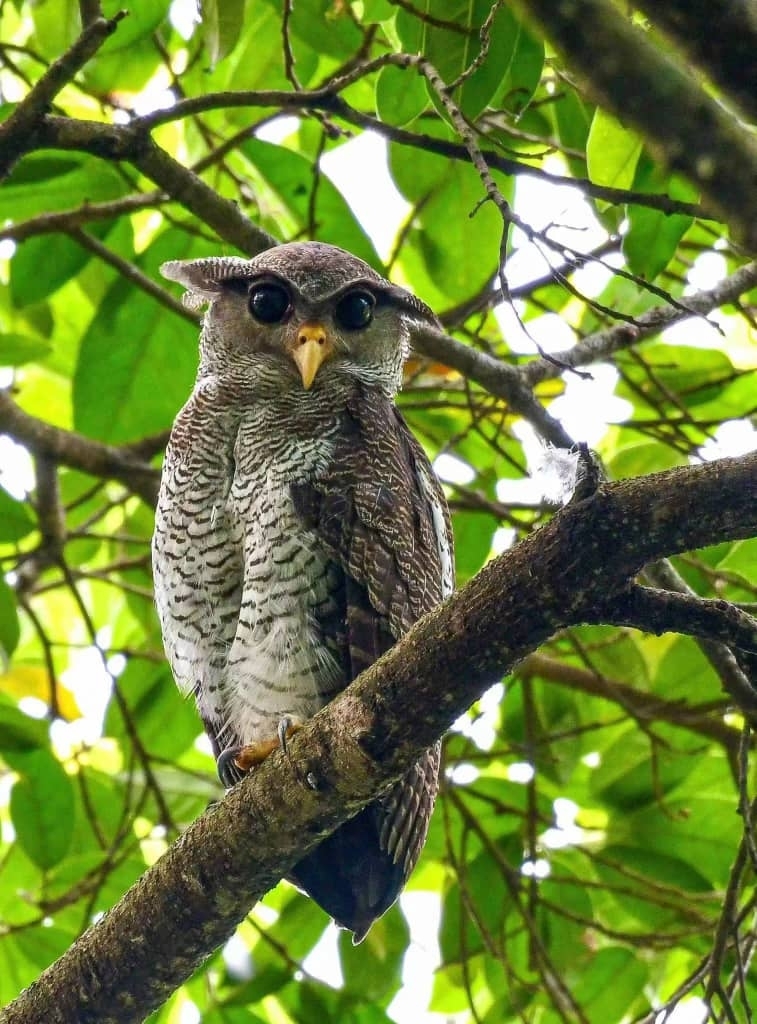
Ketupa ketupu inhabits tropical forests, freshwater wetlands, plantations, and rural and urban gardens. It has buff-brown plumage, prominent ear tufts, distinctly rounded wings, and long unfeathered legs.
Written 26 November 2026 from the sources listed below. Each statement was checked against the passage it cites; statements that could not be supported were removed.
Appearance
The Buffy Fish Owl has buff-brown plumage with darker tawny-brown feathers on its back. Its face is paler than its body and has light brown eyebrows, while prominent ear tufts extend from both sides of its head.[1][2][3]
Its wings and tail have broad yellowish and dark brown bars, and its wings are distinctly rounded. Its underparts range from yellowish brown to rich buff or fulvous, with broad blackish shaft stripes.[4][5][6]
Its long legs are unfeathered. Adults measure 40–48 cm in length and weigh between 1,028 and 2,100 g.[7][8][9]
Habitat
The Buffy Fish Owl inhabits tropical forests and freshwater wetlands near rivers, lakes, and aquaculture sites. It also occupies plantations and rural and urban gardens.[10][11]
It occurs at elevations of up to 1,600 m.[12]
The species occurs in Bangladesh, Myanmar, Thailand, Malaysia, Singapore, Cambodia, Laos, Vietnam, and the Sunda Islands. It also occurs on Cocos (Keeling) Island as a nonbreeding visitor.[13][14]
The subspecies Ketupa ketupu ketupu occurs from West Bengal and Assam through southern Thailand and Vietnam to the Malay Peninsula, Riau Archipelago, Sumatra, Belitung, Java, Bali, and much of Borneo. Ketupa ketupu pageli occurs in northern Borneo, while Ketupa ketupu minor is endemic to Nias Island.[15][16][17]
Diet
The Buffy Fish Owl primarily feeds on fish, crabs, frogs, small reptiles, and birds. It also feeds on carrion.[18][19]
Insects, winged ants, and winged termites have been recorded in the stomach contents of Javan Buffy Fish Owls. Goldfish (Carassius auratus) and the gold-ringed cat snake (Boiga dendrophila) have also been recorded among the stomach contents of Javan individuals.[20][21][22]
Other recorded stomach contents of Javan individuals include immature false gharials (Tomistoma schlegelii), red junglefowl (Gallus gallus), and black rats (Rattus rattus).[23][24][25]
Behaviour
The species produces hissing and rapidly repeated rattling vocalizations. Pairs may engage in duetting for several minutes before breeding.[26][27]
During daylight, individuals often shelter alone in densely foliaged trees. When hunting, they generally swoop down from riverbanks without getting their feathers wet, or walk into shallow streams and brooks to catch food.[28][29][30]
Unlike most owls, the Buffy Fish Owl does not produce firm pellets.[31]
Reproduction and life cycle
Eggs have mainly been recorded between February and April in western Java, with occasional records in May. In the Malay Peninsula, eggs have been recorded between September and January.[32][33]
The species frequently nests on large bird's-nest ferns (Asplenium nidus). A single egg per breeding season is the only recorded clutch size.[34][35]
The eggs are round to oval and dull white. Eggs from western Java average 57.4 × 47 mm.[36][37]
Incubation lasts 28–29 days. Young fledge approximately six weeks after hatching.[38][39]
Conservation
In Malaysia, the species is protected under the Protection of Wild Life Act 1972. It is also listed under Appendix II of CITES in Malaysia.[40][41]
Classification of the Buffy Fish Owl
| Kingdom | Animalia |
|---|---|
| Phylum | Chordata |
| Subphylum | Vertebrata |
| Infraphylum | Gnathostomata |
| Parvphylum | Osteichthyes |
| Megaclass | Tetrapoda |
| Class | Aves (Bird) |
| Order | Strigiformes (Owl) |
| Family | Strigidae (Owls) |
| Subfamily | Striginae |
| Genus | Ketupa (Fish-Owls and Allied Eagle-Owls) |
| Species | Ketupa ketupu (Horsfield, 1821) |
Where the Buffy Fish Owl is found
Checklists and occurrence records place Ketupa ketupu in 10 countries across Asia. GBIF holds 11,314 georeferenced records of it.
Countries
- Bangladesh 113
- Brunei 21
- Cambodia 61
- India 244
- Indonesia 299
- Malaysia 5,128
- Myanmar 8
- Singapore 4,179
- Thailand 1,242
- Vietnam 19
Regions and cities with the most records
- Yishun New Town, Singapore 4,180
- Sungai Simpang, Singapore 4,178
- Ang Mo Kio New Town, Singapore 4,177
- Yio Chu Kang, Singapore 4,175
- Sembawang Estate, Singapore 4,170
- Novena, Singapore 4,163
- Bukit Timah, Singapore 4,101
- Sengkang New Town, Singapore 4,089
- Queenstown Estate, Singapore 4,087
- Woodlands, Singapore 4,080
- Sabah, Malaysia 3,876
- Matilda Estate, Singapore 3,586
- Anak Bukit, Singapore 3,570
- Marsiling, Singapore 3,525
- Bukit Panjang New Town, Singapore 3,520
- Teck Whye, Singapore 3,500
- Choa Chu Kang New Town, Singapore 3,498
- Yew Tee, Singapore 3,498
- Keat Hong Village, Singapore 3,497
- Jurong West, Singapore 3,495
- Jurong East, Singapore 3,494
- Jurong Town, Singapore 3,492
- Johor Bahru, Malaysia 3,483
- Kampung Pasir Gudang Baru, Malaysia 3,474
- Pasir Gudang, Malaysia 3,332
- Masai, Malaysia 3,155
- Bandar Seri Alam, Malaysia 3,072
- Kampung Larkin Lama, Malaysia 2,831
- Boon Lay, Singapore 2,789
- Singapore, Singapore 2,695
- MacPherson, Singapore 2,637
- Eunos, Singapore 2,635
- Punggol, Singapore 2,620
- Taman Permas Jaya, Malaysia 2,525
- Pelentong, Malaysia 2,384
- Marine Parade, Singapore 2,305
Range as the checklists state it
Southern Asia
A number beside a place is its count of GBIF occurrence records. A place without a number comes from a checklist alone. Records show where a species has been observed or collected, which can include escapes and vagrants.
Common names
English
- Buffy Fish Owl
- Buffy Fish-Owl
Names in 31 other languages
- Arabic
- بوم السمك البرتقالي
- Belarusian
- Пугач рыбны малайскі
- Catalan
- duc pescador de Malàisia
- Chinese
- 馬來漁鴞, 馬來魚鴞, 马来渔鸮
- Croatian
- malajska ušara
- Czech
- ketupa malajská
- Danish
- Malajfiskeugle, Malayfiskeugle
- Dutch
- Maleise Visuil
- Esperanto
- Malaja fiŝgufo, malajzia fiŝgufo
- Estonian
- väike-kalakakk
- Finnish
- sundankalahuuhkaja
- French
- Grand-duc malais, Kétoupa malais
- German
- Sunda-Fischuhu, Sundafischuhu
- Hebrew
- קטופה מלאית
- Hungarian
- szundai halászbagoly
- Indonesian
- Beluk Ketupu, Beluk ketupa
- Italian
- Gufo pescatore camoscio, Gufo pescatore della Malesia, gufo pescatore malese
- Japanese
- マレーウオミミズク
- Lithuanian
- malajinis žuvinis apuokas
- Malay
- Burung Hantu Kuning
- Persian
- جغد ماهیخوار مالای
- Polish
- ketupa płowa
- Portuguese
- bufo-pescador-bege, bufo-pescador-malaio
- Russian
- Малайский рыбный филин
- Serbian
- Indonezijska sova ribar
- Slovak
- ketupa riečna
- Spanish
- Búho Pescador Malayo de Sonda, Búho pescador malayo
- Swedish
- blek fiskuv
- Thai
- นกทึดทือพันธุ์มลายู, นกทึดทือมลายู
- Turkish
- Sunda Balık Baykuşu
- Ukrainian
- пугач-рибоїд малазійський
Synonyms
5 other scientific names have been used for this species and are now treated as synonyms of Ketupa ketupu.
- Bubo ketupu (Horsfield, 1821)
- Bubo ketupu ketupu Christidis & Boles (2008)
- Ketupa javanensis Lesson, RP, 1830
- Ketupa ketupa Horsfield, T, 1821
- Strix ketupu Horsfield, 1821
Subspecies and varieties
- Ketupa ketupu ketupu subspecies
- Ketupa ketupu minor subspecies
- Ketupa ketupu pageli subspecies
Related species
-
 Brown Fish OwlKetupa zeylonensis
-
 Tawny Fish OwlKetupa flavipes
-
 Akun Eagle-owlKetupa leucosticta
- Verreaux's Eagle-OwlKetupa lactea
-
 Barred Eagle-OwlKetupa sumatrana
- Dusky Eagle-OwlKetupa coromanda
- Spot-bellied Eagle-OwlKetupa nipalensis
- Fraser's Eagle-OwlKetupa poensis
Compare
Questions and answers
What is the scientific name of the Buffy Fish Owl?
The scientific name of the Buffy Fish Owl is Ketupa ketupu. Written with its author, the full name is Ketupa ketupu (Horsfield, 1821).
Which family does the Buffy Fish Owl belong to?
Ketupa ketupu belongs to the family Strigidae, in the order Strigiformes and the class Aves.
Where is the Buffy Fish Owl found?
Checklists and occurrence records place Ketupa ketupu in 10 countries, including Malaysia, Singapore, Thailand, Indonesia, India and Bangladesh.
What is the conservation status of the Buffy Fish Owl?
The IUCN Red List category recorded for Ketupa ketupu is Least Concern (LC).
What other names does the Buffy Fish Owl have?
Ketupa ketupu is also known in English as Buffy Fish-Owl.
Sources
Passages the profile rests on
- The buffy fish owl has buff-brown plumage with darker tawny-brown feathers on its back. Source passage: “The buffy fish owl is buff brown with darker tawny brown feathers on the back.” — English Wikipedia
- Its face is paler than its body and has light brown eyebrows. Source passage: “Its face is paler and it has light brown eyebrows.” — English Wikipedia
- The species has prominent ear tufts on both sides of its head. Source passage: “Like all fish owls, the buffy fish owl has prominent ear tufts on the sides of its head.” — English Wikipedia
- Its wings and tail have broad yellowish and dark brown bars. Source passage: “Its wing feathers and tail are broadly barred yellowish and dark brown.” — English Wikipedia
- Its underparts range from yellowish brown to rich buff or fulvous and have broad blackish shaft stripes. Source passage: “The underparts are a yellowish brown, rich buff, or fulvous with broad, blackish shaft stripes.” — English Wikipedia
- Its wings are distinctly rounded. Source passage: “The wings are distinctly rounded in shape.” — English Wikipedia
- Its long legs are unfeathered. Source passage: “Its long legs are not feathered.” — English Wikipedia
- Adults measure 40–48 cm in length. Source passage: “With an adult size of 40 to 48 cm (16 to 19 in)” — English Wikipedia
- Adults weigh between 1,028 and 2,100 g. Source passage: “a weight of 1,028 to 2,100 g (36.3 to 74.1 oz)” — English Wikipedia
- The species inhabits tropical forests and freshwater wetlands near rivers, lakes, and aquaculture sites. Source passage: “It inhabits tropical forests and freshwater wetlands near rivers, lakes, and aquaculture sites” — English Wikipedia
- The species also occupies plantations and rural and urban gardens. Source passage: “It also lives in plantations and rural and urban gardens.” — English Wikipedia
- It occurs at elevations of up to 1,600 m. Source passage: “up to an elevation of 1,600 m (5,200 ft).” — English Wikipedia
- The buffy fish owl occurs in Bangladesh, Myanmar, Thailand, Malaysia, Singapore, Cambodia, Laos, Vietnam, and the Sunda Islands. Source passage: “The buffy fish owl is distributed from Bangladesh, Myanmar, Thailand, Malaysia, and Singapore to Cambodia, Laos, Vietnam, and the Sunda Islands.” — English Wikipedia
- The species occurs on Cocos (Keeling) Island as a nonbreeding visitor. Source passage: “On Cocos (Keeling) Island, it is nonbreeding.” — English Wikipedia
- The subspecies Ketupa ketupu ketupu occurs from West Bengal and Assam through southern Thailand and Vietnam to the Malay Peninsula, Riau Archipelago, Sumatra, Belitung, Java, Bali, and much of Borneo. Source passage: “West Bengal, Assam, southern Thailand and Vietnam, the Malay Peninsula to Riau Archipelago, Sumatra, Belitung, Java, Bali and much of Borneo” — English Wikipedia
- The subspecies Ketupa ketupu pageli occurs in northern Borneo. Source passage: “K. k. pageli (Neumann, 1936) - northern Borneo” — English Wikipedia
- The subspecies Ketupa ketupu minor is endemic to Nias Island. Source passage: “K. k. minor Büttikofer, 1966 - endemic to Nias island.” — English Wikipedia
- The buffy fish owl primarily feeds on fish, crabs, frogs, small reptiles, and birds. Source passage: “The buffy fish owl feeds foremost on fish, crabs, frogs, small reptiles and birds.” — English Wikipedia
- The species also feeds on carrion. Source passage: “It also forages on carrion.” — English Wikipedia
- Insects, winged ants, and winged termites have been recorded in the stomach contents of Javan buffy fish owls. Source passage: “Stomach content found in Javan buffy fish owls included insects, winged ants and winged termites” — English Wikipedia
- Goldfish (Carassius auratus) have been recorded among the stomach contents of Javan individuals. Source passage: “goldfish (Carassius auratus)” — English Wikipedia
- The gold-ringed cat snake (Boiga dendrophila) has been recorded among the stomach contents of Javan individuals. Source passage: “gold-ringed cat snake (Boiga dendrophila)” — English Wikipedia
- Immature false gharials (Tomistoma schlegelii) have been recorded among the stomach contents of Javan individuals. Source passage: “immature false gharials (Tomistoma schlegelii)” — English Wikipedia
- Red junglefowl (Gallus gallus) have been recorded among the stomach contents of Javan individuals. Source passage: “red junglefowl (Gallus gallus)” — English Wikipedia
- Black rats (Rattus rattus) have been recorded among the stomach contents of Javan individuals. Source passage: “black rat (Rattus rattus)” — English Wikipedia
- The species produces hissing and rapidly repeated rattling vocalizations. Source passage: “Among those recorded are included hissing sounds and a rattling kutook, repeated rapidly about seven times.” — English Wikipedia
- Pairs may engage in duetting for several minutes before breeding. Source passage: “pairs may engage in bouts of duetting for several minutes at a time.” — English Wikipedia
- During daylight, individuals often shelter alone in densely foliaged trees. Source passage: “During the daytime, it shelters often singly in densely foliaged trees.” — English Wikipedia
- When hunting, the species generally swoops down from riverbanks without getting its feathers wet. Source passage: “The buffy fish owl hunts mainly from the bank, swooping down much in the manner of a fish eagle, but never getting its feathers wet.” — English Wikipedia
- The species also walks into shallow streams and brooks to catch food. Source passage: “It also walks into shallow streams and brooks, additionally snatching food in such locations.” — English Wikipedia
- Unlike most owls, the buffy fish owl does not produce firm pellets. Source passage: “The buffy fish owl does not produce firm pellets as do most owls.” — English Wikipedia
- Eggs have mainly been recorded between February and April in western Java, with occasional records in May. Source passage: “Eggs of buffy fish owls have mainly been found in February through April in western Java, less commonly into May” — English Wikipedia
- Eggs have also been recorded between September and January in the Malay Peninsula. Source passage: “and in the Malay Peninsula also in September through January.” — English Wikipedia
- The species frequently nests on large bird's-nest ferns (Asplenium nidus). Source passage: “The buffy fish owl frequently nests on top of a large fern (Asplenium nidus)” — English Wikipedia
- A single egg per breeding season is the only clutch size recorded for this species. Source passage: “Only one egg per breeding season has ever been recorded in a buffy fish owl nest” — English Wikipedia
- The eggs are round to oval and dull white. Source passage: “The egg is round, oval, and dull white.” — English Wikipedia
- Eggs from western Java average 57.4 × 47 mm. Source passage: “The average dimensions of eggs in western Java were 57.4 mm × 47 mm (2.26 in × 1.85 in).” — English Wikipedia
- Incubation lasts 28–29 days. Source passage: “Incubation of the eggs lasts 28 to 29 days” — English Wikipedia
- Young fledge approximately six weeks after hatching. Source passage: “fledging occurs after six weeks.” — English Wikipedia
- In Malaysia, the species is protected under the Protection of Wild Life Act 1972. Source passage: “In Malaysia, owl species are protected by the Protection of Wild Life Act 1972” — English Wikipedia
- In Malaysia, the species is listed under Appendix II of CITES. Source passage: “and listed by the Convention on International Trade in Endangered Species on Appendix II.” — English Wikipedia
Data
- Catalogue of Life, 2026-10-16 XR cc by
- Global Biodiversity Information Facility CC BY 4.0
- Wikidata CC0
- GeoNames CC BY 4.0
- Wikimedia Commons per image; credit shown with each image
- Within the Catalogue of Life, this name comes from The Integrated Taxonomic Information System cc0
References
- Gill, Frank, & and Minturn Wright. (2006). Birds of the World: Recommended English Names.
- Dickinson, E. C., and J. V. Remsen Jr., eds. (2013). The Howard and Moore Complete Checklist of the Birds of the World, 4th Edition, Vol. 1 Non-Passerines.
This species in other databases
Page built on 29 November 2026. See how the catalog is made and all sources and licences.
Cite this page
ScientificNames.org. (2026). Ketupa ketupu (Buffy Fish Owl). Retrieved November 29, 2026, from https://scientificnames.org/species/ketupa-ketupu
“Ketupa ketupu (Buffy Fish Owl).” ScientificNames.org, 2026, scientificnames.org/species/ketupa-ketupu. Accessed 29 Nov. 2026.
ScientificNames.org. “Ketupa ketupu (Buffy Fish Owl).” Accessed November 29, 2026. https://scientificnames.org/species/ketupa-ketupu.
@misc{scientificnames_ketupa_ketupu_buffy_fish_owl,
  author = {{ScientificNames.org}},
  title = {Ketupa ketupu (Buffy Fish Owl)},
  year = {2026},
  url = {https://scientificnames.org/species/ketupa-ketupu},
  note = {Accessed 2026-11-29}
}