Species · Birds
Brown Fish Owl Ketupa zeylonensis
The scientific name of the Brown Fish Owl is Ketupa zeylonensis. It is a species of bird in the family Strigidae (owls), order Strigiformes. The name dates from 1788.
- Scientific name
- Ketupa zeylonensis (J. F. Gmelin, 1788)
- Common name
- Brown Fish Owl
- Genus
- Ketupa
- Family
- Strigidae (Owls)
- Order
- Strigiformes
- Class
- Aves
- Red List category
- LC Least Concern
- Environment
- terrestrial
- Recorded in
- 17 countries
- Name status
- accepted in the Catalogue of Life

Overview
Ketupa zeylonensis has a conspicuously puffed white throat, golden-yellow iris, and large curved claws with sharp cutting edges.
Written 26 November 2026 from the sources listed below. Each statement was checked against the passage it cites; statements that could not be supported were removed.
Appearance
Its underparts range from buffy-fulvous to whitish, with wavy dark streaks and finer brown barring. Its throat is white and conspicuously puffed, and its facial disk is indistinct.[1][2][3]
Its bill is dark, its iris is golden yellow, and its feet are yellow and featherless. It has large, curved claws with sharp cutting edges and prickly scales beneath its feet.[3][4][5]
Adults measure 48–61 cm in body length, with a wingspan of 125 to 140 cm and a body weight of 1.1 to 2.5 kg. Females are generally larger than males, and juveniles are paler than adults.[6][7][8][9][10]
Habitat
The Brown Fish Owl inhabits forests and wooded areas bordering streams, lakes, and rice fields. Its habitats range from open woodland to dense forest and plantations, including deciduous forests surrounding bodies of water.[11][12][13]
It also occurs around reservoirs, canals, village outskirts, and sea coasts. Recorded habitats include arid deserts, rocky shores, and tropical forests.[14][15]
Western populations occur in semiarid landscapes and may breed in desert oases. In the Himalayan foothills, the species occurs in submontane forest up to approximately 1,500 m elevation.[16][17]
The species depends on proximity to substantial bodies of water and frequently roosts during daylight in bamboo stands and other large shady trees.[18][19]
The species occurs from Turkey through South and Southeast Asia, with a western range extending patchily into the Levant and southern Asia Minor. It is resident throughout most tropical and subtropical parts of the Indian subcontinent and Southeast Asia, occupying a geographic range exceeding 7,000 km.[20][21][22][23]
Four subspecies are recognized. K. z. semenowi occurs from southeastern Turkey through the Middle East to northwestern India, K. z. leschenaulti from India through Myanmar to western Thailand, K. z. zeylonensis in Sri Lanka, and K. z. orientalis from northeastern Myanmar to southeastern China, Indochina, and the Malay Peninsula.[24][25][26][27][28]
Diet
Its principal foods include fish, frogs, and aquatic crustaceans, particularly Potamon crabs. It also consumes crayfish and aquatic crustaceans belonging to the genera Potamon and Barytelphusa.[29][30]
Freshwater crabs of the family Gecarcinucidae, particularly Barytelphusa, dominated the recorded diet in Melghat Tiger Reserve, India. Rats and Asian house shrews contributed substantially to the recorded food biomass in Melghat.[31][32]
Other recorded prey include snakes, lizards, water beetles, insects, small mammals, and water birds. Recorded bird prey includes lesser whistling ducks and Indian pond herons.[33][34]
Behaviour
The species is primarily nocturnal but may hunt during daylight in cloudy weather. It generally remains close to its nest while hunting.[35][36]
It hunts by perching above water or wading into shallow water. It captures prey by extending its long legs while gliding close over the water surface.[37][38]
Reproduction and life cycle
Brown Fish Owls breed between November and April, generally coinciding with the dry season. They commonly nest in natural holes in large trees and sometimes use abandoned nests built by fish eagles and vultures.[39][40][41][42]
Clutches contain two eggs, although occasionally only one egg is laid. The incubation period lasts approximately 38 days or slightly less, and young owls fledge at approximately seven weeks of age.[43][44][45]
Parents provide food to their young at the nest, with one parent hunting while the other watches the nest.[46]
Conservation
The species is classified as Least Concern on the IUCN Red List. Habitat destruction can cause it to abandon affected regions.[47][48]
The species has apparently become extinct as a breeding bird in Israel, largely because damming has dried up waterways. In Turkey and most of Europe, it is classified as Critically Endangered in the cited account because of environmental changes caused by dam construction.[49][50]
Thousands of owls, including the Brown Fish Owl, are reportedly killed in India during Diwali.[51]
Uses
Local tribes use Brown Fish Owls in spiritual rituals and sell them in markets for black magic practices.[52]
Classification of the Brown Fish Owl
| Kingdom | Animalia |
|---|---|
| Phylum | Chordata |
| Subphylum | Vertebrata |
| Infraphylum | Gnathostomata |
| Parvphylum | Osteichthyes |
| Megaclass | Tetrapoda |
| Class | Aves (Bird) |
| Order | Strigiformes (Owl) |
| Family | Strigidae (Owls) |
| Subfamily | Striginae |
| Genus | Ketupa (Fish-Owls and Allied Eagle-Owls) |
| Species | Ketupa zeylonensis (J. F. Gmelin, 1788) |
Where the Brown Fish Owl is found
Checklists and occurrence records place Ketupa zeylonensis in 17 countries across Asia. GBIF holds 21,824 georeferenced records of it.
Countries
- Bangladesh 225
- Bhutan 11
- Cambodia 412
- China 161
- Germany 5
- Hong Kong 376
- India 16,506
- Iran 7
- Laos 18
- Malaysia 41
- Myanmar 39
- Nepal 692
- Singapore 47
- Sri Lanka 2,695
- Thailand 232
- Turkey 260
- Vietnam 97
Regions and cities with the most records
- Kerala, India 2,548
- Uttarakhand, India 2,501
- Madhya Pradesh, India 2,222
- Karnataka, India 2,103
- Tamil Nadu, India 1,834
- Maharashtra, India 1,402
- Rajasthan, India 857
- Kataragama, Sri Lanka 786
- Naini Tāl, India 750
- Baihar, India 728
- Rāmnagar, India 719
- Assam, India 716
- Haldwani, India 699
- Malajkhand, India 665
- Sawai Madhopur, India 656
- Kotamangalam, India 639
- Kuttampuzha, India 567
- Ooty, India 543
- Iramallūr, India 504
- Gujarat, India 413
- Gudalur, India 372
- Kollivāyal, India 368
- Goa, India 367
- Preah Vihear, Cambodia 361
- West Bengal, India 315
- Telangana, India 302
- Mei Foo, Hong Kong 295
- Mei Foo Sun Chuen, Hong Kong 295
- Ting Kau, Hong Kong 291
- Kērkandi, India 289
- Hoi Lai Estate, Hong Kong 287
- Olympic, Hong Kong 287
- Fu Cheong Estate, Hong Kong 285
- Mong Kok, Hong Kong 285
- Nam Cheong, Hong Kong 285
- Sham Shui Po, Hong Kong 285
Range as the checklists state it
Europe & Northern Asia (excluding China)
Southern Asia
A number beside a place is its count of GBIF occurrence records. A place without a number comes from a checklist alone. Records show where a species has been observed or collected, which can include escapes and vagrants.
Common names
English
- Brown Fish Owl
- Brown Fish-Owl
Names in 41 other languages
- Arabic
- بوم السمك البني, بومة سمك بنية, بوهة السمك بنية
- Bulgarian
- Цейлонски бухал
- Burmese
- ဒီးဒုတ်
- Catalan
- duc pescador bru
- Chinese
- 褐渔鸮, 褐漁鴞, 褐魚鴞
- Croatian
- smeđa ušara
- Czech
- ketupa rybí
- Danish
- Brun Fiskeugle
- Dutch
- Bruine Visuil
- Esperanto
- bruna fiŝgufo
- Estonian
- kalakakk
- Finnish
- kalahuuhkaja
- French
- Grand-duc brun, Kétoupa brun
- German
- Fischuhu, Wellenbrust-Fischuhu
- Greek
- Ψαρόμπουφος
- Hebrew
- קטופה, קטופה מצויה
- Hungarian
- barna halászbagoly, indiai halászbagoly
- Icelandic
- Árugla
- Irish
- Iasc-ulchabán donn
- Italian
- Gufo pescatore bruno
- Japanese
- カッショクウオミミズク, ミナミシマフクロウ
- Latvian
- brūnais zivjūpis
- Lithuanian
- rudasis žuvinis apuokas
- Malay
- Burung Hantu Ikan
- Malayalam
- മീൻകൂമൻ
- Marathi
- हुमण
- Nepali
- मलाहा हुचील
- Northern Sami
- Ruškesguollelidnu
- Persian
- جغد ماهی خوار, جغد ماهیخوار قهوهای
- Polish
- ketupa bosonoga
- Portuguese
- bufo-pescador, bufo-pescador-castanho
- Russian
- Бурый рыбный филин
- Serbian
- Azijska sova ribar, Сова рибар
- Slovak
- ketupa rybárka
- Slovenian
- ribja uharica
- Spanish
- Búho Pescador Castaño, Búho pescador de Ceilán
- Swedish
- brun fiskuv
- Tamil
- பூமன் ஆந்தை
- Thai
- นกทึดทือพันธุ์เหนือ
- Turkish
- Balık Baykuşu
- Ukrainian
- пугач-рибоїд бурий
Synonyms
3 other scientific names have been used for this species and are now treated as synonyms of Ketupa zeylonensis.
- Bubo zeylonensis Gmelin, JF, 1788
- Strix ceylonensis Latham, J, 1790
- Strix zeylonensis J. F. Gmelin, 1788
Subspecies and varieties
- Ketupa zeylonensis leschenaulti subspecies
- Ketupa zeylonensis orientalis subspecies
- Ketupa zeylonensis semenowi (Turkish Fish-Owl) subspecies
- Ketupa zeylonensis zeylonensis (Brown Fish Owl) subspecies
Related species
-
 Buffy Fish OwlKetupa ketupu
-
 Tawny Fish OwlKetupa flavipes
-
 Akun Eagle-owlKetupa leucosticta
- Verreaux's Eagle-OwlKetupa lactea
-
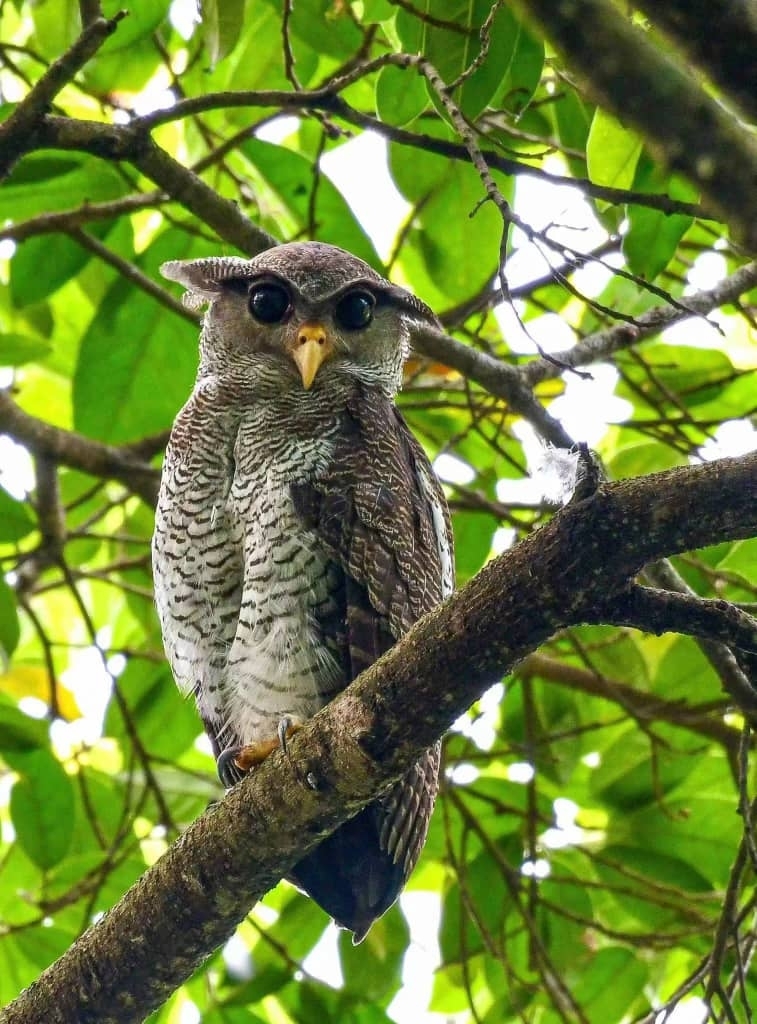 Barred Eagle-OwlKetupa sumatrana
- Dusky Eagle-OwlKetupa coromanda
- Spot-bellied Eagle-OwlKetupa nipalensis
- Fraser's Eagle-OwlKetupa poensis
Compare
Questions and answers
What is the scientific name of the Brown Fish Owl?
The scientific name of the Brown Fish Owl is Ketupa zeylonensis. Written with its author, the full name is Ketupa zeylonensis (J. F. Gmelin, 1788).
Which family does the Brown Fish Owl belong to?
Ketupa zeylonensis belongs to the family Strigidae, in the order Strigiformes and the class Aves.
Where is the Brown Fish Owl found?
Checklists and occurrence records place Ketupa zeylonensis in 17 countries, including India, Sri Lanka, Nepal, Cambodia, Hong Kong and Turkey.
What is the conservation status of the Brown Fish Owl?
The IUCN Red List category recorded for Ketupa zeylonensis is Least Concern (LC).
What other names does the Brown Fish Owl have?
Ketupa zeylonensis is also known in English as Brown Fish-Owl.
Sources
Passages the profile rests on
- Its underparts range from buffy-fulvous to whitish and have wavy dark streaks and finer brown barring. Source passage: “Its underparts are buffy-fulvous to whitish, with wavy dark brown streaks and finer brown barring.” — English Wikipedia
- Its throat is white and conspicuously puffed. Source passage: “Its throat is white and conspicuously puffed.” — English Wikipedia
- Its facial disk is indistinct, its bill is dark, and its iris is golden yellow. Source passage: “Its facial disk is indistinct, the bill dark and the iris golden yellow.” — English Wikipedia
- Its feet are yellow and featherless. Source passage: “Its featherless feet are yellow.” — English Wikipedia
- The species has large, curved claws with sharp cutting edges and prickly scales beneath its feet. Source passage: “Brown fish owls are large, powerful birds of prey with prickly scales on the bottom of their feet. Their claws are large and well curved, with a sharp cutting-edge.” — animaldiversity.org
- Juveniles are paler than adult brown fish owls. Source passage: “Juveniles look similar to adults, but are paler.” — animaldiversity.org
- Adults measure 48–61 cm in body length. Source passage: “In body size, it ranges from 48 to 61 cm (19 to 24 in)” — English Wikipedia
- The wingspan ranges from 125 to 140 cm. Source passage: “with a wingspan from 125 to 140 cm (49 to 55 in).” — English Wikipedia
- Adult body weight ranges from 1.1 to 2.5 kg. Source passage: “Its weight varies considerably, ranging from 1.1 to 2.5 kg (2.4 to 5.5 lb).” — English Wikipedia
- Females are generally larger than males. Source passage: “Also, females are invariably at least somewhat larger than males” — English Wikipedia
- The species inhabits forests and wooded areas bordering streams, lakes, and rice fields. Source passage: “The typical habitat of brown fish owls is forest and woodland bordering streams, lakes or rice fields.” — English Wikipedia
- It occupies habitats ranging from open woodland to dense forest and plantations. Source passage: “It inhabits mainly the lowlands, from open woodland to dense forest as well as in plantations;” — English Wikipedia
- Brown fish owls inhabit deciduous forests surrounding bodies of water. Source passage: “They occur in deciduous forests that surround bodies of water.” — animaldiversity.org
- The species also occurs around reservoirs, canals, village outskirts, and sea coasts. Source passage: “They be found around water reservoirs, along canals, on the outskirts of villages and along sea coasts.” — English Wikipedia
- Its recorded habitats include arid deserts, rocky shores, and tropical forests. Source passage: “Brown fish owls can be found in a range of habitats, including arid deserts, rocky shores, and tropical forests.” — animaldiversity.org
- In the Himalayan foothills, it occurs in submontane forest up to approximately 1,500 m elevation. Source passage: “in the Himalayas foothills it ranges into submontane forest up to 1,500 m (4,900 ft) above mean sea level or so but not higher.” — English Wikipedia
- Western populations occur in semiarid landscapes and may breed in desert oases. Source passage: “Western birds are found in semiarid landscape and may breed in oases in arid regions.” — English Wikipedia
- It frequently roosts during daylight in bamboo stands and other large shady trees. Source passage: “It frequently spends the day in stands of bamboo or other large shady trees.” — English Wikipedia
- The species depends on proximity to substantial bodies of water. Source passage: “Regardless of habitat, it rarely strays far from larger bodies of water such as rivers and lakes.” — English Wikipedia
- The species occurs from Turkey through South and Southeast Asia. Source passage: “It is native from Turkey to South and Southeast Asia.” — English Wikipedia
- Its western range extends patchily into the Levant and southern Asia Minor. Source passage: “West of its main range, it is patchily distributed to the Levant (possibly extinct) and southern Asia Minor (recently rediscovered).” — English Wikipedia
- The species is resident throughout most tropical and subtropical parts of the Indian subcontinent and Southeast Asia. Source passage: “The brown fish owl is an all-year resident throughout most tropical and subtropical parts of the Indian subcontinent to Southeast Asia and adjoining regions.” — English Wikipedia
- The species occupies a geographic range exceeding 7,000 km. Source passage: “It occupies a range of over 7,000 km (4,300 mi).” — English Wikipedia
- The western subspecies K. z. semenowi occurs from southeastern Turkey through the Middle East to northwestern India. Source passage: “K. z. semenowi Zarudny, 1905 – southeast Turkey, Middle East to northwest India” — English Wikipedia
- The subspecies K. z. leschenaulti occurs from India through Myanmar to western Thailand. Source passage: “K. z. leschenaulti (Temminck, 1820) – India through Myanmar to west Thailand” — English Wikipedia
- The nominate subspecies K. z. zeylonensis occurs in Sri Lanka. Source passage: “K. z. zeylonensis (Gmelin, JF, 1788) – Sri Lanka” — English Wikipedia
- The subspecies K. z. orientalis occurs from northeastern Myanmar to southeastern China, Indochina, and the Malay Peninsula. Source passage: “K. z. orientalis Delacour, 1926 – northeast Myanmar to southeast China, Indochina and the Malay Peninsula” — English Wikipedia
- Four subspecies of the brown fish owl are recognized. Source passage: “Four subspecies are recognised:” — English Wikipedia
- Its principal foods include fish, frogs, and aquatic crustaceans, particularly Potamon crabs. Source passage: “It feeds mainly on fishes, frogs and aquatic crustaceans, especially Potamon crabs.” — English Wikipedia
- The species also consumes crayfish and aquatic crustaceans belonging to the genera Potamon and Barytelphusa. Source passage: “Common prey items include fish, frogs, and aquatic crustaceans, including crabs in the genera Potamon and Barytelphusa , and crayfish.” — animaldiversity.org
- Freshwater crabs of the family Gecarcinucidae, particularly Barytelphusa, dominated the recorded diet in Melghat Tiger Reserve, India. Source passage: “By number in the Melghat Tiger Reserve in India, freshwater crabs of the family Gecarcinucidae (of genus Barytelphusa) almost totally dominated the diet.” — English Wikipedia
- Rats and Asian house shrews contribute substantially to the recorded food biomass in Melghat. Source passage: “In Melghat, the largest biomass of food consisted of small mammals, namely rats (Rattus ssp.), other types of murids and Asian house shrews (Suncus murinus).” — English Wikipedia
- Other recorded prey include snakes, lizards, water beetles, insects, small mammals, and water birds. Source passage: “However, other recorded foods have included snakes, lizards, water beetles, other insects, small mammals (including bats) and occasionally water birds.” — English Wikipedia
- Recorded bird prey includes lesser whistling ducks and Indian pond herons. Source passage: “Birds hunted by brown fish owls have including lesser whistling duck (Dendrocygna javanica) and Indian pond heron (Ardeola grayii).” — English Wikipedia
- The species is primarily nocturnal but may hunt during daylight in cloudy weather. Source passage: “The buffy fish owl is nocturnal but can often be located by the small birds that mob it while roosting in a tree. However, in some areas it may be semi-diurnal and has been seen hunting during daytime, especially in cloudy weather.” — English Wikipedia
- Brown fish owls generally remain close to their nests while hunting. Source passage: “Brown fish owls are residents, staying very close to their nests while hunting.” — animaldiversity.org
- It hunts by perching above water or wading into shallow water. Source passage: “Brown fish owl primarily hunt by stationing itself on a rock overhang or hanging perch over water, or by wading into shallow waters.” — English Wikipedia
- It captures prey by extending its long legs while gliding close over the water surface. Source passage: “It grabs food by gliding over the water, nearly skimming it with its feet and grabbing its prey by quickly extending its long legs.” — English Wikipedia
- Brown fish owls breed between November and April. Source passage: “Brown fish owls breed from November to April,” — English Wikipedia
- Breeding generally coincides with the dry season. Source passage: “The breeding season is concurrent with the dry season,” — English Wikipedia
- The species commonly nests in natural holes in large trees. Source passage: “Usually nest are large natural holes, in hollows or at the base of large branches.” — English Wikipedia
- It sometimes uses abandoned nests built by fish eagles and vultures. Source passage: “Deserted nest built by fish eagles and vultures are also sometimes used as nesting locations.” — English Wikipedia
- Clutches contain two eggs, although occasionally only one egg is laid. Source passage: “The clutch is two or occasionally just one egg.” — English Wikipedia
- The incubation period lasts approximately 38 days or slightly less. Source passage: “Incubation is 38 days or somewhat less,” — English Wikipedia
- Young brown fish owls fledge at approximately seven weeks of age. Source passage: “and the young fledge after about seven weeks.” — English Wikipedia
- Parents provide food to their young at the nest, with one parent hunting while the other watches the nest. Source passage: “One parent will hunt for food while the other stays close by to watch over the nest.” — animaldiversity.org
- The species is classified as Least Concern on the IUCN Red List. Source passage: “Due its wide distribution it is listed as Least Concern on the IUCN Red List.” — English Wikipedia
- Habitat destruction can cause the species to abandon affected regions. Source passage: “Habitat destruction will eventually cause the species to desert a region.” — English Wikipedia
- The species has apparently become extinct as a breeding bird in Israel, largely because damming has dried up waterways. Source passage: “Due to this, it seems to be extinct as a breeding bird in Israel nowadays, attributable largely to damming practices leading to drying up of many waterways.” — English Wikipedia
- In Turkey and most of Europe, the species is classified as Critically Endangered in the cited account because of environmental changes caused by dam construction. Source passage: “In Turkey and most of Europe, it is labeled as Critically Endangered due to dam construction causing changes to their environment and habitat.” — animaldiversity.org
- Thousands of owls, including this species, are reportedly killed in India during Diwali. Source passage: “Apparently in India, during the festival of Diwali, thousands of owls are killed” — English Wikipedia
- Local tribes use brown fish owls in spiritual rituals and sell them in markets for black magic practices. Source passage: “Local tribes use these birds, along with other owls, as important parts in their spiritual rituals and are thus commonly sold at markets for black magic.” — animaldiversity.org
Data
- Catalogue of Life, 2026-10-16 XR cc by
- Global Biodiversity Information Facility CC BY 4.0
- Wikidata CC0
- GeoNames CC BY 4.0
- Wikimedia Commons per image; credit shown with each image
- iNaturalist per image; credit shown with each image
- Within the Catalogue of Life, this name comes from The Integrated Taxonomic Information System cc0
References
- Gill, Frank, & and Minturn Wright. (2006). Birds of the World: Recommended English Names.
- Dickinson, E. C., and J. V. Remsen Jr., eds. (2013). The Howard and Moore Complete Checklist of the Birds of the World, 4th Edition, Vol. 1 Non-Passerines.
This species in other databases
- Catalogue of Life 3R6SM
- Wikidata Q828255
- iNaturalist 20343
- WoRMS urn:lsid:marinespecies.org:taxname:1649196
- Avibase brfowl1
Page built on 28 November 2026. See how the catalog is made and all sources and licences.
Cite this page
ScientificNames.org. (2026). Ketupa zeylonensis (Brown Fish Owl). Retrieved November 28, 2026, from https://scientificnames.org/species/ketupa-zeylonensis
“Ketupa zeylonensis (Brown Fish Owl).” ScientificNames.org, 2026, scientificnames.org/species/ketupa-zeylonensis. Accessed 28 Nov. 2026.
ScientificNames.org. “Ketupa zeylonensis (Brown Fish Owl).” Accessed November 28, 2026. https://scientificnames.org/species/ketupa-zeylonensis.
@misc{scientificnames_ketupa_zeylonensis_brown_fish_owl,
  author = {{ScientificNames.org}},
  title = {Ketupa zeylonensis (Brown Fish Owl)},
  year = {2026},
  url = {https://scientificnames.org/species/ketupa-zeylonensis},
  note = {Accessed 2026-11-28}
}