Species · Birds
Akun Eagle-owl Ketupa leucosticta
The scientific name of the Akun Eagle-owl is Ketupa leucosticta. It is a species of bird in the family Strigidae (owls), order Strigiformes. The name dates from 1855.
- Scientific name
- Ketupa leucosticta (Hartlaub, 1855)
- Common name
- Akun Eagle-owl
- Genus
- Ketupa
- Family
- Strigidae (Owls)
- Order
- Strigiformes
- Class
- Aves
- Red List category
- LC Least Concern
- Recorded in
- 9 countries
- Name status
- accepted in the Catalogue of Life

Overview
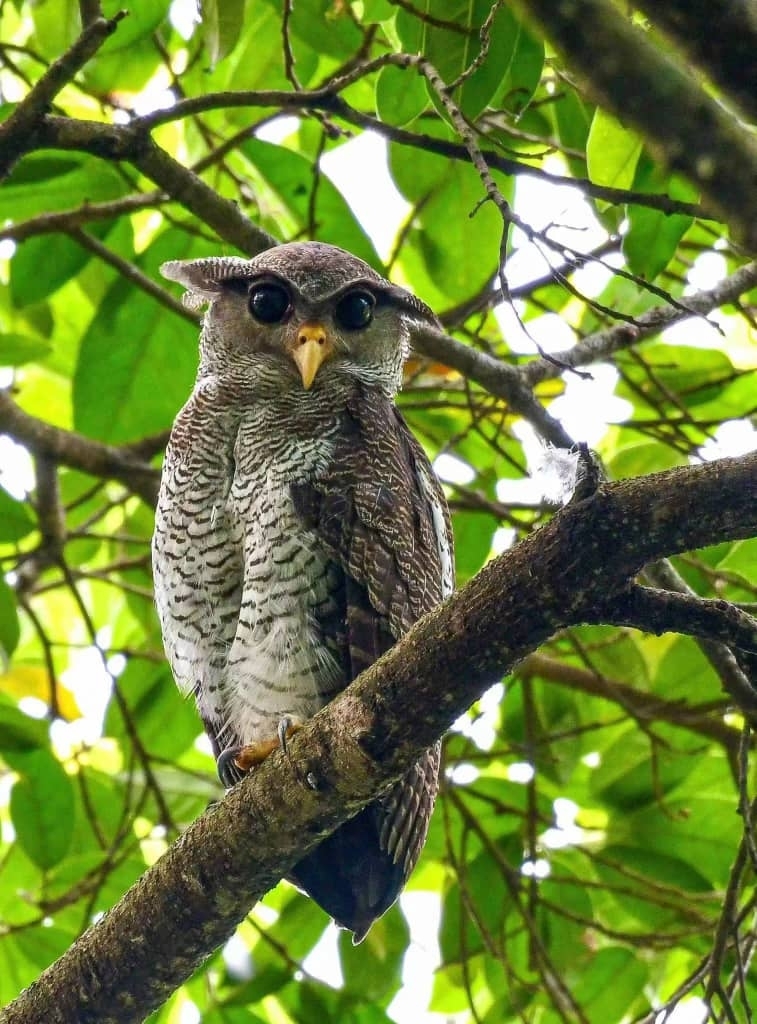
Ketupa leucosticta inhabits lowland primary and secondary rainforests, particularly forest edges, clearings and river edges. It is distinguished by large dark-brown ear tufts with white spots and pale yellow eyes.
Written 26 November 2026 from the sources listed below. Each statement was checked against the passage it cites; statements that could not be supported were removed.
Appearance
The species has predominantly dark to reddish-brown head and upperparts. Its wings and back have pale, dusky brown bars and white shoulder markings.[1][2]
It has two large dark-brown ear tufts with white spots and pale yellow eyes. Its upper breast is light reddish-brown with dark bars.[3][4][5]
The lower breast, belly and vent are white with reddish-brown vermiculations and large blackish spots. Juveniles have whitish heads and bodies with reddish-brown barring and brown wings and tails.[6][7]
The species measures 40–46 cm in length. Males weigh between 486 and 536 g, while females weigh between 524 and 607 g.[8][9][10]
Habitat
The Akun Eagle-owl inhabits lowland primary and secondary rainforests. It particularly occupies forest edges and clearings.[11][12]
It also occurs along river edges and on forested river islands.[13]
The species is native to the African tropical rainforest. Its patchy distribution extends from Guinea east to Cameroon and south to Angola, with its range extending inland into the southern Central African Republic, Congo and northern Democratic Republic of Congo.[14][15][16]
Diet
The species apparently feeds almost exclusively on insects. Its main prey include beetles, cicadas and locusts.[17][18]
Behaviour
After capturing prey, it carries it to a perch, holds it in its feet and tears it into small pieces with its bill.[19]
Its usual call is a low, accelerating, clucking rattle. When alarmed, it produces an unusual quacking sound.[20][21]
Reproduction and life cycle
In West Africa, the species appears to lay eggs between November and January. Young owlets have been recorded in nests in Liberia between February and April.[22][23]
The species builds its nest on the ground. Its breeding biology remains poorly known.[24][25]
Similar species
The Akun Eagle-owl is one of the smaller eagle-owls. Its small feet and relatively weak bill limit its ability to tackle larger prey.[26][27]
Classification of the Akun Eagle-owl
| Kingdom | Animalia |
|---|---|
| Phylum | Chordata |
| Subphylum | Vertebrata |
| Infraphylum | Gnathostomata |
| Parvphylum | Osteichthyes |
| Megaclass | Tetrapoda |
| Class | Aves (Bird) |
| Order | Strigiformes (Owl) |
| Family | Strigidae (Owls) |
| Subfamily | Striginae |
| Genus | Ketupa (Fish-Owls and Allied Eagle-Owls) |
| Species | Ketupa leucosticta (Hartlaub, 1855) |
Where the Akun Eagle-owl is found
Checklists and occurrence records place Ketupa leucosticta in 9 countries across Africa. GBIF holds 736 georeferenced records of it.
Countries
- Cameroon 6
- Democratic Republic of the Congo 12
- Equatorial Guinea 12
- Gabon 13
- Ghana 634
- Ivory Coast 36
- Liberia 11
- Nigeria 7
- Republic of the Congo 5
Regions and cities with the most records
- Western, Ghana 330
- Elubo, Ghana 257
- Central, Ghana 221
- Ashanti, Ghana 62
- Effiduase, Ghana 25
- Konongo, Ghana 25
- Eastern, Ghana 15
- Bas-Sassandra District, Ivory Coast 12
- Montagnes, Ivory Coast 12
- Anyinam, Ghana 11
- Ciudad de la Paz, Equatorial Guinea 11
- Wele-Nzas, Equatorial Guinea 11
- Begoro, Ghana 8
- Assin Foso, Ghana 7
- Lagunes District, Ivory Coast 6
- Ogooué-Ivindo, Gabon 6
- Shama Junction, Ghana 6
- Abidjan, Ivory Coast 4
- Abobo, Ivory Coast 4
- Anyama, Ivory Coast 4
- Bingerville, Ivory Coast 4
- Boende, Democratic Republic of the Congo 4
- Erémankono, Ivory Coast 4
- Koumassi, Ivory Coast 4
- Marcory, Ivory Coast 4
- Ndouci, Ivory Coast 4
- Para, Ivory Coast 4
- Petit Grabo, Ivory Coast 4
- Tiassalé, Ivory Coast 4
- Tshuapa, Democratic Republic of the Congo 4
- Bong County, Liberia 3
- Likouala, Republic of the Congo 3
- Makokou, Gabon 3
- Sekondi, Ghana 3
Range as the checklists state it
Africa
A number beside a place is its count of GBIF occurrence records. A place without a number comes from a checklist alone. Records show where a species has been observed or collected, which can include escapes and vagrants.
Common names
English
- Akun Eagle-Owl
- AKEO
Names in 26 other languages
- Arabic
- بوم النسر الأكوني
- Catalan
- duc tacat
- Chinese
- 蝶斑雕鸮, 蝶斑鵰鴞
- Croatian
- mrka ušara
- Czech
- ketupa skvrnitá, výr běloperý
- Danish
- Akun Hornugle
- Dutch
- Akoenoehoe
- Esperanto
- makula gufo
- Estonian
- tsikaadi-kassikakk
- Finnish
- hyönteishuuhkaja
- French
- Grand-duc tacheté
- German
- Schwachschnabeluhu
- Hungarian
- Akun-uhu
- Italian
- Gufo reale di Akun
- Japanese
- アクンワシミミズク
- Lithuanian
- Vakarų Afrikos didysis apuokas
- Norwegian
- billehubro
- Polish
- puchacz białoplamy
- Portuguese
- bufo-de-cabinda, bufo-malhado
- Russian
- Западноафриканский филин, Пепельный филин
- Slovak
- ketupa malozobá, výr malozobý
- Spanish
- Búho Akún, Búho de Akún
- Swedish
- akunuv
- Turkish
- Akun Puhusu
- Ukrainian
- пугач плямистогрудий
- Welsh
- eryrdylluan lygadfelen
Synonyms
One other scientific name has been used for this species and is now treated as a synonym of Ketupa leucosticta.
- Bubo leucostictus Hartlaub, 1855
Related species
-
 Brown Fish OwlKetupa zeylonensis
-
 Buffy Fish OwlKetupa ketupu
-
 Tawny Fish OwlKetupa flavipes
- Verreaux's Eagle-OwlKetupa lactea
-
 Barred Eagle-OwlKetupa sumatrana
- Dusky Eagle-OwlKetupa coromanda
- Spot-bellied Eagle-OwlKetupa nipalensis
- Fraser's Eagle-OwlKetupa poensis
Compare
Questions and answers
What is the scientific name of the Akun Eagle-owl?
The scientific name of the Akun Eagle-owl is Ketupa leucosticta. Written with its author, the full name is Ketupa leucosticta (Hartlaub, 1855).
Which family does the Akun Eagle-owl belong to?
Ketupa leucosticta belongs to the family Strigidae, in the order Strigiformes and the class Aves.
Where is the Akun Eagle-owl found?
Checklists and occurrence records place Ketupa leucosticta in 9 countries, including Ghana, Ivory Coast, Gabon, Democratic Republic of the Congo, Equatorial Guinea and Liberia.
What is the conservation status of the Akun Eagle-owl?
The IUCN Red List category recorded for Ketupa leucosticta is Least Concern (LC).
What other names does the Akun Eagle-owl have?
Ketupa leucosticta is also known in English as AKEO.
What does an eagle owl eat?
The Akun Eagle-owl apparently feeds almost exclusively on insects, including beetles, cicadas and locusts.[17][18]
What is an owl's main diet?
The Akun Eagle-owl apparently feeds almost exclusively on insects.[17]
Sources
Passages the profile rests on
- The species has predominantly dark to reddish-brown head and upperparts. Source passage: “It has predominantly dark to reddish-brown head and upperparts” — English Wikipedia
- Its wings and back have pale, dusky brown bars and white shoulder markings. Source passage: “with pale, dusky brown bars on the wings and back, and white markings around the shoulders.” — English Wikipedia
- The species has two large dark-brown ear tufts with white spots. Source passage: “There are two large "ear" tufts on the head which are dark brown accompanied with white spots” — English Wikipedia
- Its eyes are pale yellow. Source passage: “while the eyes are pale yellow.” — English Wikipedia
- Its upper breast is light reddish-brown with dark bars. Source passage: “The upper breast is light reddish-brown and marked with dark bars” — English Wikipedia
- Its lower breast, belly and vent are white with reddish-brown vermiculations and large blackish spots. Source passage: “the lower breast, belly and vent are white, with reddish-brown vermiculations and large blackish spots.” — English Wikipedia
- Juveniles have whitish heads and bodies with reddish-brown barring and brown wings and tails. Source passage: “Juveniles have a whitish head and body, with reddish-brown barring and brown wings and tail.” — English Wikipedia
- The species measures 40–46 cm in length. Source passage: “with 40–46 cm length” — English Wikipedia
- Males weigh between 486 and 536 g. Source passage: “body weight of 486–536 g for males” — English Wikipedia
- Females weigh between 524 and 607 g. Source passage: “524–607 g for females.” — English Wikipedia
- The species inhabits lowland primary and secondary rainforests. Source passage: “found mainly in lowland primary and secondary rainforest” — English Wikipedia
- It particularly occupies forest edges and clearings. Source passage: “particularly around forest edges and clearings” — English Wikipedia
- It also occurs along river edges and on forested river islands. Source passage: “and also along the edges of rivers and on forested river islands.” — English Wikipedia
- The species has a patchy distribution extending from Guinea east to Cameroon and south to Angola. Source passage: “from Guinea east to Cameroon and south to Angola” — English Wikipedia
- Its range extends inland into the southern Central African Republic, Congo and northern Democratic Republic of Congo. Source passage: “extending inland into the southern Central African Republic, Congo and northern parts of the Democratic Republic of Congo.” — English Wikipedia
- The species is native to the African tropical rainforest. Source passage: “is native to the African tropical rainforest.” — English Wikipedia
- The species apparently feeds almost exclusively on insects. Source passage: “it apparently feeds almost exclusively on insects” — English Wikipedia
- Its main prey include beetles, cicadas and locusts. Source passage: “Its main prey are beetles, cicadas and locusts” — English Wikipedia
- After capturing prey, it carries it to a perch, holds it in its feet and tears it into small pieces with its bill. Source passage: “before being brought back to a perch, held in the feet and ripped into small pieces with the bill.” — English Wikipedia
- Its usual call is a low, accelerating, clucking rattle. Source passage: “The usual call is a low, accelerating, clucking rattle” — English Wikipedia
- When alarmed, it produces an unusual quacking sound. Source passage: “when alarmed it produces an unusual quacking sound.” — English Wikipedia
- In West Africa, the species appears to lay eggs between November and January. Source passage: “In west Africa it appears to lay eggs around the period from November to January” — English Wikipedia
- Young owlets have been recorded in nests in Liberia between February and April. Source passage: “young owlets have been recorded in the nest in Liberia between February and April.” — English Wikipedia
- The species builds its nest on the ground. Source passage: “the Akun eagle-owl builds its nest on the ground.” — English Wikipedia
- The breeding biology of the species remains poorly known. Source passage: “Little is known regarding the breeding biology of the Akun eagle-owl.” — English Wikipedia
- The species is one of the smaller eagle-owls. Source passage: “The akun eagle-owl is one of the smaller eagle-owls” — English Wikipedia
- Its small feet and relatively weak bill limit its ability to tackle larger prey. Source passage: “its small feet and a relatively weak bill prevent it from tackling larger prey.” — English Wikipedia
Data
- Catalogue of Life, 2026-10-16 XR cc by
- Global Biodiversity Information Facility CC BY 4.0
- Wikidata CC0
- GeoNames CC BY 4.0
- Wikimedia Commons per image; credit shown with each image
- Within the Catalogue of Life, this name comes from The Integrated Taxonomic Information System cc0
This species in other databases
Page built on 28 November 2026. See how the catalog is made and all sources and licences.
Cite this page
ScientificNames.org. (2026). Ketupa leucosticta (Akun Eagle-owl). Retrieved November 28, 2026, from https://scientificnames.org/species/ketupa-leucosticta
“Ketupa leucosticta (Akun Eagle-owl).” ScientificNames.org, 2026, scientificnames.org/species/ketupa-leucosticta. Accessed 28 Nov. 2026.
ScientificNames.org. “Ketupa leucosticta (Akun Eagle-owl).” Accessed November 28, 2026. https://scientificnames.org/species/ketupa-leucosticta.
@misc{scientificnames_ketupa_leucosticta_akun_eagle_owl,
  author = {{ScientificNames.org}},
  title = {Ketupa leucosticta (Akun Eagle-owl)},
  year = {2026},
  url = {https://scientificnames.org/species/ketupa-leucosticta},
  note = {Accessed 2026-11-28}
}