Species · Flowering plants
Dense-flowered Loosestrife Lysimachia congestiflora
The scientific name of the Dense-flowered Loosestrife is Lysimachia congestiflora. It is a species of flowering plant in the family Primulaceae (primrose family), order Ericales.
- Scientific name
- Lysimachia congestiflora Hemsl.
- Common name
- Dense-flowered Loosestrife
- Genus
- Lysimachia
- Family
- Primulaceae (Primrose Family)
- Order
- Ericales
- Class
- Magnoliopsida
- Recorded in
- 9 countries
- Name status
- accepted in the Catalogue of Life

Overview
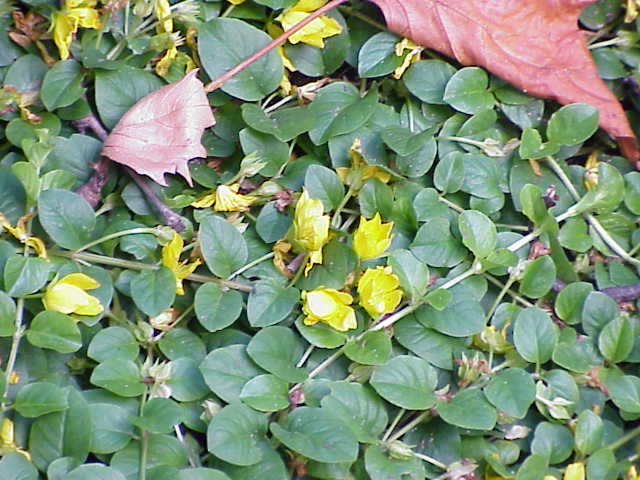
Dense-flowered loosestrife is a perennial herbaceous flowering plant in the genus Lysimachia and family Primulaceae. It is native to Southeast Asia and occurs in China, Bhutan, northeast India, Nepal, Sikkim, Myanmar, and Thailand. It has yellow flowers with a red central eye and creeping to ascending stems that form knots where they root.
Written 26 November 2026 from the sources listed below. Each statement was checked against the passage it cites; statements that could not be supported were removed.
Appearance
Dense-flowered loosestrife has creeping to ascending stems that form knots where they root. The leaves are arranged in opposite pairs along the stems.[1][2]
The leaf blades range from ovate to broadly ovate or nearly circular. Their margins bear mainly reddish or black glandular points.[3][4]
The flowers are yellow with a red central eye. The plant reaches a height of 10 to 20 centimetres.[5][6]
The leaf blades measure 1.4 to 3 centimetres long and 1.3 to 2.2 centimetres wide in the typical stated range.[7]
Habitat
The species occurs along moist forest edges and the edges of rice fields.[8][9]
It is native to Southeast Asia and occurs in China, Bhutan, northeast India, Nepal, Sikkim, Myanmar, and Thailand. It occurs at elevations between 200 and 2,100 metres.[10][11][12]
Reproduction and life cycle
The flowering period extends from spring through summer. The flowers occur in groups of two to four at the ends of the stems.[13][14]
The species can be propagated using stem cuttings.[15]
Uses
Dense-flowered loosestrife is cultivated as an ornamental plant because of its bright yellow flowers and ease of maintenance.[16]
When cultivated, it grows well in moist, well-drained soil and can thrive in full sun or partial shade.[17][18]
Classification of the Dense-flowered Loosestrife
| Kingdom | Plantae |
|---|---|
| Subkingdom | Pteridobiotina |
| Phylum | Tracheophyta |
| Class | Magnoliopsida |
| Order | Ericales |
| Family | Primulaceae (Primrose Family) |
| Subfamily | Myrsinoideae |
| Tribe | Lysimachieae |
| Genus | Lysimachia (Loosestrife) |
| Species | Lysimachia congestiflora Hemsl. |
Where the Dense-flowered Loosestrife is found
Checklists and occurrence records place Lysimachia congestiflora in 9 countries across Asia. GBIF holds 1,740 georeferenced records of it.
Countries
Regions and cities with the most records
- Yunnan, China 247
- Sichuan, China 182
- Hunan, China 163
- Guangxi, China 122
- Taiwan, Taiwan 85
- Jiangxi, China 82
- Hubei, China 80
- Chongqing, China 71
- Changsha, China 56
- Leifeng, China 53
- Guizhou, China 48
- Guangdong, China 46
- Kunming, China 29
- Majie, China 29
- Zhejiang, China 28
- Fujian, China 25
- Guilin, China 24
- Shaanxi, China 21
- Anhui, China 20
- Jiujiang, China 20
- Dali Old Town, China 19
- Dali, China 16
- Fengyi, China 16
- Gansu, China 15
- Hangzhou, China 15
- Xiaoshan, China 15
- Yongjian, China 15
- Pingwu County, China 14
- Anping, China 13
- Baidi, China 13
- Donghui, China 13
- Fenhe, China 13
- Kangle, China 13
- Menglang, China 13
- Shigang, China 13
- Wenxian Chengguanzhen, China 13
2 more countries have a few records outside this range
These countries hold a few records of Lysimachia congestiflora but lie outside the range the checklists give for it. Such records are often zoo or garden specimens, museum material or vagrants, so the species is not counted as occurring there.
Range as the checklists state it
China (Anhui, Fujian, Gansu, Guangdong, Guangxi, Guizhou, Hainan, Hubei, Hunan, Jiangsu, Jiangxi, Qinghai, Shaanxi, Sichuan, Yunnan, Zhejiang); Tibet; Taiwan; Nepal; Bhutan; N-India (Arunachal Pradesh, Sikkim); Myanmar; N-Thailand; Vietnam
A number beside a place is its count of GBIF occurrence records. A place without a number comes from a checklist alone. Records show where a species has been observed or collected, which can include escapes and vagrants.
Common names
English
- Dense-flowered Loosestrife
Names in 6 other languages
- Chinese
- 臨時救
- Finnish
- kesäalpi
- Japanese
- クロボシコナスビ, タニガワコナスビ
- Russian
- Вербейник скученноцветковый
- Slovak
- čerkáč zhlukokvetý
- Spanish
- Monedita de flor amarilla
Synonyms
8 other scientific names have been used for this species and are now treated as synonyms of Lysimachia congestiflora.
- Lysimachia congestiflora var. atronervata C.C.Wu
- Lysimachia gymnocephala Hand.-Mazz.
- Lysimachia hui Diels
- Lysimachia japonica var. cephalantha Franch.
- Lysimachia nigropunctata Masam.
- Lysimachia rubroglandulosa C.Y.Wu
- Lysimachia smithiana Craib
- Lysimachia taiwaniana T.Suzuki ex M.T.Kao
Subspecies and varieties
Related species
-
 Creeping-JennyLysimachia nummularia
-
 Scarlet PimpernelLysimachia arvensis
-
 Gooseneck LoosestrifeLysimachia clethroides
-
 Yellow LoosestrifeLysimachia vulgaris
-
 Large Yellow LoosestrifeLysimachia punctata
-
 Arctic StarflowerLysimachia europaea
-
 Pacific StarflowerLysimachia latifolia
-
 Fringed LoosestrifeLysimachia ciliata
Compare
Questions and answers
What is the scientific name of the Dense-flowered Loosestrife?
The scientific name of the Dense-flowered Loosestrife is Lysimachia congestiflora. Written with its author, the full name is Lysimachia congestiflora Hemsl..
Which family does the Dense-flowered Loosestrife belong to?
Lysimachia congestiflora belongs to the family Primulaceae, in the order Ericales and the class Magnoliopsida.
Where is the Dense-flowered Loosestrife found?
Checklists and occurrence records place Lysimachia congestiflora in 9 countries, including China, Taiwan, India, Nepal, Bhutan and Macao.
Does Lysimachia come back every year?
Dense-flowered loosestrife is a perennial herbaceous plant.[19]
Sources
Passages the profile rests on
- The plant has creeping to ascending stems that form knots where they root. Source passage: “The stem is creeping to ascending and forms knots at the roots.” — English Wikipedia
- The leaves are arranged in opposite pairs along the stems. Source passage: “The leaves are opposite.” — English Wikipedia
- The leaf blades range from ovate to broadly ovate or nearly circular in shape. Source passage: “is ovate to broadly ovate or almost circular.” — English Wikipedia
- The leaf margins bear mainly reddish or black glandular points. Source passage: “mainly has reddish or black glandular points on the edge.” — English Wikipedia
- The flowers are yellow with a red central eye. Source passage: “The flowers are colored yellow with a red eye.” — English Wikipedia
- The plant reaches a height of 10 to 20 centimetres. Source passage: “reaches heights of 10 to 20 cm.” — English Wikipedia
- The leaf blades measure 1.4 to 3 centimetres long and 1.3 to 2.2 centimetres wide in the typical stated range. Source passage: “The leaf blade measures (0.7) 1.4 to 3 (4.5) × (0.6) 1.3 to 2.2 (3) centimetres” — English Wikipedia
- The species occurs along moist forest edges. Source passage: “in moist forest edges,” — English Wikipedia
- The species occurs along the edges of rice fields. Source passage: “the edges of rice fields” — English Wikipedia
- The species is native to Southeast Asia. Source passage: “It is native to southeast Asia.” — English Wikipedia
- The species occurs in China, Bhutan, northeast India, Nepal, Sikkim, Myanmar, and Thailand. Source passage: “It occurs in China, Bhutan, northeast India, Nepal, Sikkim, Myanmar and Thailand” — English Wikipedia
- The species occurs at elevations between 200 and 2,100 metres. Source passage: “at altitudes of 200 to 2100 meters.” — English Wikipedia
- The flowering period extends from spring through summer. Source passage: “The flowering period extends from spring to summer.” — English Wikipedia
- The flowers occur in groups of two to four at the ends of the stems. Source passage: “The flowers are heaped upside down at the end of the stem in two to four.” — English Wikipedia
- The species can be propagated using stem cuttings. Source passage: “It can be grown from stem cuttings.” — English Wikipedia
- The species is cultivated as an ornamental plant because of its bright yellow flowers and ease of maintenance. Source passage: “It is grown as an ornamental plant for its bright yellow flowers and easy maintenance,” — English Wikipedia
- The plant grows well in moist, well-drained soil. Source passage: “in moist well-drained soils,” — English Wikipedia
- The species can thrive in full sun or partial shade when cultivated. Source passage: “thriving in full sun to partial shade.” — English Wikipedia
- The species is a perennial herbaceous plant that forms stolons. Source passage: “It is an aboveground perennial and a herbaceous, stolon-former plant” — English Wikipedia
Data
- Catalogue of Life, 2026-10-16 XR cc by
- Global Biodiversity Information Facility CC BY 4.0
- Wikidata CC0
- GeoNames CC BY 4.0
- Wikimedia Commons per image; credit shown with each image
- Within the Catalogue of Life, this name comes from Synonymic Checklists of the Vascular Plants of the World cc by
References
- Hemsl. (1889). J. Linn. Soc., Bot. 26(173): 50 (1889). where the name was published
This species in other databases
- Catalogue of Life 732P6
- Wikidata Q943024
- iNaturalist 553161
- World Flora Online wfo-0001105684
- GRIN 468738
Page built on 27 November 2026. See how the catalog is made and all sources and licences.
Cite this page
ScientificNames.org. (2026). Lysimachia congestiflora (Dense-flowered Loosestrife). Retrieved November 27, 2026, from https://scientificnames.org/species/lysimachia-congestiflora
“Lysimachia congestiflora (Dense-flowered Loosestrife).” ScientificNames.org, 2026, scientificnames.org/species/lysimachia-congestiflora. Accessed 27 Nov. 2026.
ScientificNames.org. “Lysimachia congestiflora (Dense-flowered Loosestrife).” Accessed November 27, 2026. https://scientificnames.org/species/lysimachia-congestiflora.
@misc{scientificnames_lysimachia_congestiflora_dense_flowered_loosestrife,
  author = {{ScientificNames.org}},
  title = {Lysimachia congestiflora (Dense-flowered Loosestrife)},
  year = {2026},
  url = {https://scientificnames.org/species/lysimachia-congestiflora},
  note = {Accessed 2026-11-27}
}