Species · Mammals
Japanese Badger Meles anakuma
The scientific name of the Japanese Badger is Meles anakuma. It is a species of mammal in the family Mustelidae (mustelids), order Carnivora. The name dates from 1844.
- Scientific name
- Meles anakuma Temminck, 1844
- Common name
- Japanese Badger
- Genus
- Meles
- Family
- Mustelidae (Mustelids)
- Order
- Carnivora
- Class
- Mammalia
- Red List category
- LC Least Concern
- Recorded in
- 1 country
- Name status
- accepted in the Catalogue of Life

Overview
Meles anakuma is endemic to Japan and occurs on Honshu, Kyushu, Shikoku, and Shōdoshima. It has a blunt torso, short limbs, powerful digging claws on its front feet, and a gray-brown outer coat.
Written 26 November 2026 from the sources listed below. Each statement was checked against the passage it cites; statements that could not be supported were removed.
Appearance
The Japanese Badger has a blunt torso and short limbs. Its front feet have powerful claws adapted for digging, while its hind feet have smaller claws.[1][2][3]
Its outer coat consists of long gray-brown hair, while its ventral hair is short and black. Its face has black-and-white stripes that are less distinct than those of the European badger, with dark coloration concentrated around the eyes.[4][5][6][7]
Its skull is smaller than that of the European badger.[8]
Adult males have an average body length of 79 cm, while adult females have an average body length of 72 cm. Its tail measures between 14 and 20 cm.[9][10][11]
Adults generally weigh between 3.8 and 11 kg. A study in the Tokyo area recorded average weights of 6.6 kg for females and 7.76 kg for males.[12][13][14]
In Yamaguchi Prefecture, average spring weights were 4.4 kg for females and 5.7 kg for males.[15][16]
Habitat
The Japanese Badger inhabits a variety of woodland and forest environments.[17]
Diet
The Japanese Badger has an omnivorous diet that includes earthworms, beetles, berries, and persimmons.[18]
Earthworms are consumed most heavily during warmer seasons. During summer, its diet includes berries, persimmons, and small insects.[19][20]
During cooler months, the species consumes more wild berries, including Rubus palmatus and Rubus hirsutus, when earthworms are less abundant. It consumes the greatest quantity of persimmons during their peak availability in autumn.[21][22]
Behaviour
The Japanese Badger is nocturnal and hibernates during the coldest months of the year.[23][24]
Japanese badgers are more solitary than European badgers and do not form social clans. Mating pairs do not establish pair bonds.[25][26]
During the mating season, a male's range overlaps with the ranges of two or three females. Japanese badgers with overlapping ranges may communicate through scent marking.[27][28]
Reproduction and life cycle
Female Japanese badgers begin mating and reproducing at two years of age. They give birth to litters of two or three cubs during spring, particularly March and April.[29][30]
Females mate again shortly after giving birth. Following mating, implantation is delayed until the following February.[31][32]
Similar species
The Japanese Badger is assigned to the same genus as the European, Caucasian, and Asian badgers.[33]
It is generally smaller and exhibits less sexual size dimorphism than the European badger, except in canine tooth size. It is similar in size to, or slightly larger than, the Asian badger.[34][35]
Conservation
The estimated area occupied by the Japanese Badger covered approximately 29 percent of Japan in 2003. Its range decreased by seven percent over the 25 years preceding the reported assessment.[36][37]
Land development, agriculture, and competition from introduced raccoons are identified as threats to the Japanese Badger. Hunting is legal in Japan but has declined sharply since the 1970s.[38][39]
Uses
By digging burrows, the Japanese Badger helps aerate soil and increase water penetration.[40]
Classification of the Japanese Badger
| Kingdom | Animalia |
|---|---|
| Phylum | Chordata |
| Subphylum | Vertebrata |
| Infraphylum | Gnathostomata |
| Parvphylum | Osteichthyes |
| Megaclass | Tetrapoda |
| Class | Mammalia (Mammal) |
| Subclass | Theria |
| Infraclass | Eutheria |
| Order | Carnivora (Carnivores) |
| Suborder | Caniformia (Dog-like Carnivores) |
| Family | Mustelidae (Mustelids) |
| Subfamily | Melinae (Hog-badgers) |
| Genus | Meles (Eurasian Badgers) |
| Species | Meles anakuma Temminck, 1844 |
Where the Japanese Badger is found
Checklists and occurrence records place Meles anakuma in 1 country across Asia. GBIF holds 953 georeferenced records of it.
Countries
Regions and cities with the most records
- Miyagi, Japan 163
- Iwanuma, Japan 149
- Murata, Japan 148
- Natori-shi, Japan 148
- Sendai, Japan 148
- Tomiya, Japan 148
- Rifu, Japan 147
- Tagajō-shi, Japan 147
- Yoshioka, Japan 147
- Shiogama, Japan 146
- Shōbudahama, Japan 145
- Gunma, Japan 84
- Midori, Japan 83
- Ōmamachō-ōmama, Japan 83
- Kiryū, Japan 82
- Ibaraki, Japan 62
- Hachiōji, Japan 60
- Aihara, Japan 59
- Akishima, Japan 58
- Hakonegasaki, Japan 58
- Hamura, Japan 58
- Hino, Japan 58
- Fussa, Japan 57
- Kunitachi, Japan 57
- Tachikawa, Japan 57
- Tokyo, Japan 57
- Yokota, Japan 57
- Musashimurayama, Japan 55
- Minawa, Japan 53
- Higashiyamato, Japan 52
- Zama, Japan 49
- Tama, Japan 48
- Machida, Japan 47
- Minamirinkan, Japan 47
- Sagamihara, Japan 47
- Fuchū, Japan 46
Range as the checklists state it
Southern Asia
A number beside a place is its count of GBIF occurrence records. A place without a number comes from a checklist alone. Records show where a species has been observed or collected, which can include escapes and vagrants.
Common names
English
- Japanese Badger
- Anaguma
Names in 19 other languages
- Arabic
- غرير ياباني
- Chinese
- 日本狗獾
- Czech
- jezevec japonský
- Dutch
- Japanse Das
- Finnish
- japaninmäyrä
- French
- Blaireau japonais
- German
- Japanischer Dachs
- Hebrew
- גירית יפנית
- Italian
- Tasso giapponese
- Japanese
- むじな, アナグマ, ニホンアナグマ, 狢
- Korean
- 일본오소리
- Norwegian Bokmål
- Japangrevling
- Polish
- Borsuk japoński
- Portuguese
- Texugo-japonês
- Russian
- Японский барсук
- Spanish
- Tejón japonés
- Swedish
- Japansk grävling
- Turkish
- Japon Porsuğu
- bos
- Japanski jazavac
Synonyms
One other scientific name has been used for this species and is now treated as a synonym of Meles anakuma.
- Meles meles anakuma Temminck, 1844
Related species
-
 European BadgerMeles meles
-
 Asian BadgerMeles leucurus
-
 Caucasian BadgerMeles canescens
-
 WolverineGulo gulo
-
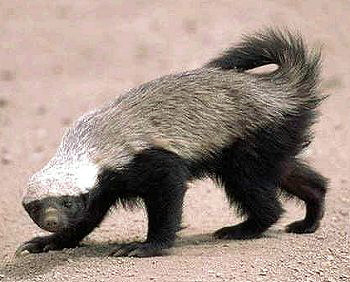 Honey BadgerMellivora capensis
-
 StoatMustela erminea
-
 Sea OtterEnhydra lutris
- SableMartes zibellina
Compare
Questions and answers
What is the scientific name of the Japanese Badger?
The scientific name of the Japanese Badger is Meles anakuma. Written with its author, the full name is Meles anakuma Temminck, 1844.
Which family does the Japanese Badger belong to?
Meles anakuma belongs to the family Mustelidae, in the order Carnivora and the class Mammalia.
Where is the Japanese Badger found?
Checklists and occurrence records place Meles anakuma in 1 country: Japan.
What is the conservation status of the Japanese Badger?
The IUCN Red List category recorded for Meles anakuma is Least Concern (LC).
What other names does the Japanese Badger have?
Meles anakuma is also known in English as Anaguma.
What is the Japanese badger called in Japanese?
The Japanese name anaguma means hole-bear.[41]
What do Japanese badgers eat?
Japanese badgers eat earthworms, beetles, berries, and persimmons. Their diet also includes small insects and wild berries such as Rubus palmatus and Rubus hirsutus.[18][20][21]
Where do Japanese badgers live?
Japanese badgers are endemic to Japan and occur on Honshu, Kyushu, Shikoku, and Shōdoshima.[42]
What is the habitat of badgers?
The Japanese Badger inhabits a variety of woodland and forest environments.[17]
Sources
Passages the profile rests on
- The Japanese badger has a blunt torso and short limbs. Source passage: “The torso is blunt and limbs are short.” — English Wikipedia
- Its front feet have powerful claws adapted for digging. Source passage: “The front feet are equipped with powerful digging claws.” — English Wikipedia
- Its hind feet have smaller claws than its front feet. Source passage: “The claws on the hind feet are smaller.” — English Wikipedia
- Its outer coat consists of long gray-brown hair. Source passage: “The outer coat has long gray-brown hair.” — English Wikipedia
- Its ventral hair is short and black. Source passage: “Ventral hair is short and black.” — English Wikipedia
- Its face has black-and-white stripes that are less distinct than those of the European badger. Source passage: “The face has characteristic black-white stripes that are not as distinct as in the European badger.” — English Wikipedia
- The dark facial coloration is concentrated around the eyes. Source passage: “The dark color is concentrated around the eyes.” — English Wikipedia
- Its skull is smaller than that of the European badger. Source passage: “The skull is smaller than the European badger.” — English Wikipedia
- Adult males have an average body length of 79 cm. Source passage: “At an average length of 79 cm (31 in) in males” — English Wikipedia
- Adult females have an average body length of 72 cm. Source passage: “72 cm (28 in) in females.” — English Wikipedia
- Its tail measures between 14 and 20 cm in length. Source passage: “Tail length is between 14 and 20 cm (5.5 and 7.9 in).” — English Wikipedia
- Adults generally weigh between 3.8 and 11 kg. Source passage: “Adults usually weigh from 3.8 to 11 kg (8.4 to 24.3 lb).” — English Wikipedia
- A study in the Tokyo area recorded an average female weight of 6.6 kg. Source passage: “The average weight of female Japanese badgers in one study from the Tokyo area was found to be 6.6 kg (15 lb)” — English Wikipedia
- A study in the Tokyo area recorded an average male weight of 7.76 kg. Source passage: “while that of males was 7.76 kg (17.1 lb).” — English Wikipedia
- In Yamaguchi Prefecture, the average spring weight of females was 4.4 kg. Source passage: “In Yamaguchi Prefecture, the average spring weight of female and male Japanese badgers was 4.4 kg (9.7 lb)” — English Wikipedia
- In Yamaguchi Prefecture, the average spring weight of males was 5.7 kg. Source passage: “and 5.7 kg (13 lb) respectively.” — English Wikipedia
- The species inhabits a variety of woodland and forest environments. Source passage: “This badger species is found in a variety of woodland and forest habitats.” — English Wikipedia
- The Japanese badger has an omnivorous diet that includes earthworms, beetles, berries, and persimmons. Source passage: “it includes earthworms, beetles, berries and persimmons.” — English Wikipedia
- Earthworms are consumed most heavily during warmer seasons. Source passage: “studies have shown that earthworm consumption is highest in the warmer seasons” — English Wikipedia
- During summer, its diet includes berries, persimmons, and small insects. Source passage: “coupled with berries, persimmons, and small insects in the summer months.” — English Wikipedia
- During cooler months, the species consumes more wild berries, including Rubus palmatus and Rubus hirsutus, when earthworms are less abundant. Source passage: “When earthworms are less abundant in cooler months, the Japanese badger consumes more wild berries, like Rubus palmatus and Rubus hirsutus” — English Wikipedia
- The species consumes the greatest quantity of persimmons during their peak availability in autumn. Source passage: “while consuming the most persimmons during the fruit's peak availability in the fall season.” — English Wikipedia
- The Japanese badger is nocturnal. Source passage: “the Japanese badger is nocturnal” — English Wikipedia
- The species hibernates during the coldest months of the year. Source passage: “and hibernates during the coldest months of the year.” — English Wikipedia
- Japanese badgers are more solitary than European badgers and do not form social clans. Source passage: “The Japanese badger is more solitary than the European badger; it does not aggregate into social clans” — English Wikipedia
- Mating pairs do not establish pair bonds. Source passage: “and mates do not form pair bonds.” — English Wikipedia
- During the mating season, a male's range overlaps with the ranges of two or three females. Source passage: “During mating season, the range of a male badger overlaps with those of 2 to 3 females.” — English Wikipedia
- Japanese badgers with overlapping ranges may communicate through scent marking. Source passage: “Badgers with overlapping ranges may communicate by scent marking.” — English Wikipedia
- Female Japanese badgers begin mating and reproducing at two years of age. Source passage: “Beginning at 2 years of age, females mate” — English Wikipedia
- Females give birth to litters of two or three cubs during spring, particularly March and April. Source passage: “give birth to litters of two or three cubs in the spring (March–April).” — English Wikipedia
- Females mate again shortly after giving birth. Source passage: “They mate again shortly afterwards” — English Wikipedia
- Following mating, implantation is delayed until the following February. Source passage: “but delay implantation until the following February.” — English Wikipedia
- The Japanese badger is assigned to the same genus as the European, Caucasian, and Asian badgers. Source passage: “It is assigned to the genus Meles with its close relatives, the European (M. meles), Caucasian (M. canescens) and Asian (M. leucurus) badgers.” — English Wikipedia
- The Japanese badger is generally smaller and exhibits less sexual size dimorphism than the European badger, except in canine tooth size. Source passage: “the Japanese badger is generally smaller and less sexually dimorphic (except in the size of the canine teeth) than its European counterparts.” — English Wikipedia
- The Japanese badger is similar in size to, or slightly larger than, the Asian badger. Source passage: “This species is similar or mildly larger than the Asian badger.” — English Wikipedia
- The estimated area occupied by the Japanese badger covered approximately 29 percent of Japan in 2003. Source passage: “Covering an estimated 29 per cent of the country in 2003” — English Wikipedia
- The Japanese badger's range decreased by seven percent over the 25 years preceding the reported assessment. Source passage: “the area had decreased 7 per cent over the previous 25 years.” — English Wikipedia
- Land development, agriculture, and competition from introduced raccoons are identified as threats to the Japanese badger. Source passage: “Increased land development and agriculture, as well as competition from introduced raccoons are threats.” — English Wikipedia
- Hunting of Japanese badgers is legal in Japan but has declined sharply since the 1970s. Source passage: “Hunting is legal but has declined sharply since the 1970s.” — English Wikipedia
- By digging burrows, the Japanese badger helps aerate soil and increase water penetration. Source passage: “By digging burrows, Meles anakuma helps aerate soil and increase water penetration.” — animaldiversity.org
- The Japanese name anaguma means hole-bear. Source passage: “In Japan, it is called by the name anaguma (穴熊, 貛) meaning "hole-bear"” — English Wikipedia
- The Japanese badger is endemic to Japan and occurs on Honshu, Kyushu, Shikoku, and Shōdoshima. Source passage: “Endemic to Japan, it is found on Honshu, Kyushu, Shikoku, and Shōdoshima.” — English Wikipedia
Data
- Catalogue of Life, 2026-10-16 XR cc by
- Global Biodiversity Information Facility CC BY 4.0
- Wikidata CC0
- GeoNames CC BY 4.0
- Wikimedia Commons per image; credit shown with each image
- Within the Catalogue of Life, this name comes from The Integrated Taxonomic Information System cc0
References
- Fauna Japon., Mamm. vol.30 p.pl. 6 where the name was published
- Wilson, Don E., and DeeAnn M. Reeder, eds. (2005). Mammal Species of the World: A Taxonomic and Geographic Reference, 3rd Ed., Vols. 1 & 2.
- Larivière, S., and A. P. Jennings / Don E. Wilson and Russell A. Mittermeier, eds. (2009). Family Mustelidae (Weasels and relatives). Handbook of the Mammals of the World. Vol. 1: Carnivores.
- Abramov, Alexei V., Andrey Yu. Puzachenko. (2013). The taxonomic status of badgers (Mammalia, Mustelidae) from Southwest Asia based on cranial morphometrics, with the redescription of Meles canescens. Zootaxa, Vol. 3681, No. 1.
- Sato, Jun J. / Proulx, G., and E. Do Linh San, eds. (2016). Chapter 1: The Systematics and Taxonomy of the World’s Badger Species - A Review. Badgers: Systematics, Biology, Conservation and Research Techniques.
- Burgin, Connor J., Don E. Wilson, Russell A. Mittermeier, Anthony B. Rylands, et al. (2020). Illustrated Checklist of the Mammals of the World. Vol. 1. Monotremata to Rodentia.
This species in other databases
Page built on 27 November 2026. See how the catalog is made and all sources and licences.
Cite this page
ScientificNames.org. (2026). Meles anakuma (Japanese Badger). Retrieved November 27, 2026, from https://scientificnames.org/species/meles-anakuma
“Meles anakuma (Japanese Badger).” ScientificNames.org, 2026, scientificnames.org/species/meles-anakuma. Accessed 27 Nov. 2026.
ScientificNames.org. “Meles anakuma (Japanese Badger).” Accessed November 27, 2026. https://scientificnames.org/species/meles-anakuma.
@misc{scientificnames_meles_anakuma_japanese_badger,
  author = {{ScientificNames.org}},
  title = {Meles anakuma (Japanese Badger)},
  year = {2026},
  url = {https://scientificnames.org/species/meles-anakuma},
  note = {Accessed 2026-11-27}
}