Species · Mammals
Caucasian Badger Meles canescens
The scientific name of the Caucasian Badger is Meles canescens. It is a species of mammal in the family Mustelidae (mustelids), order Carnivora. The name dates from 1875.
- Scientific name
- Meles canescens Blanford, 1875
- Common name
- Caucasian Badger
- Genus
- Meles
- Family
- Mustelidae (Mustelids)
- Order
- Carnivora
- Class
- Mammalia
- Recorded in
- 8 countries
- Name status
- accepted in the Catalogue of Life

Overview
Meles canescens is native to Western Asia and some islands in the Mediterranean Sea. It has a dirty-greyish back with brown highlights and a facial mask resembling that of the European badger.
Written 26 November 2026 from the sources listed below. Each statement was checked against the passage it cites; statements that could not be supported were removed.
Appearance
The Caucasian Badger has a dirty-greyish back with brown highlights. Its head resembles that of the European badger but has weaker crests.[1][2]
Its upper molars are elongated in a manner similar to those of the Asian badger. Its facial mask resembles that of the European badger and distinguishes its fur from that of Asian and Japanese badgers.[3][4]
The species is smaller than the European badger.[5]
Similar species
The Caucasian Badger was formerly classified as a subspecies of the European badger. A 2013 study identified significant genetic divergence between the two.[6][7]
The two species are thought to have diverged during the Pleistocene, between 2.37 million and 450,000 years ago. The American Society of Mammalogists recognizes the Caucasian Badger as a distinct species.[8][9]
The North Caucasus is considered a possible boundary between their ranges, although the boundary has not been clearly defined. The two species occur sympatrically in some places, and potential hybrids have been identified.[10][11][12]
Classification of the Caucasian Badger
| Kingdom | Animalia |
|---|---|
| Phylum | Chordata |
| Subphylum | Vertebrata |
| Infraphylum | Gnathostomata |
| Parvphylum | Osteichthyes |
| Megaclass | Tetrapoda |
| Class | Mammalia (Mammal) |
| Subclass | Theria |
| Infraclass | Eutheria |
| Order | Carnivora (Carnivores) |
| Suborder | Caniformia (Dog-like Carnivores) |
| Family | Mustelidae (Mustelids) |
| Subfamily | Melinae (Hog-badgers) |
| Genus | Meles (Eurasian Badgers) |
| Species | Meles canescens Blanford, 1875 |
Where the Caucasian Badger is found
Checklists and occurrence records place Meles canescens in 8 countries. GBIF holds 202 georeferenced records of it.
Countries
Regions and cities with the most records
- Northern District, Israel 40
- Qiryat Tiv‘on, Israel 25
- Rekhasim, Israel 24
- Safed, Israel 24
- Shefar‘am, Israel 24
- Yoqne‘am ‘Illit, Israel 24
- Qiryat Ata, Israel 23
- Qiryat Bialik, Israel 22
- Kafr Mandā, Israel 21
- Tamra, Israel 21
- Daliyat al Karmel, Israel 20
- Nazareth, Israel 19
- Nesher, Israel 19
- Qiryat Motsqin, Israel 19
- Qiryat Yam, Israel 19
- Yāfā, Israel 19
- Haifa, Israel 18
- Migdal Ha‘Emeq, Israel 18
- Qiryat Shmona, Israel 18
- Karmi’el, Israel 17
- Sakhnīn, Israel 17
- Ar Rayna, Israel 16
- Tirat Karmel, Israel 16
- Afula, Israel 15
- Haifa, Israel 15
- Modi‘in Makkabbim Re‘ut, Israel 14
- Naẕerat ‘Illit, Israel 14
- Acre, Israel 13
- Bet Shemesh, Israel 13
- Majd el Kurūm, Israel 13
- Mevasseret Tsiyyon, Israel 13
- West Bank, Palestinian Territory 13
- Ḩalḩūl, Palestinian Territory 13
- Judeida Makr, Israel 12
- Kafr Kannā, Israel 12
- Southern District, Israel 12
1 more country has a few records outside this range
These countries hold a few records of Meles canescens but lie outside the range the checklists give for it. Such records are often zoo or garden specimens, museum material or vagrants, so the species is not counted as occurring there.
Range as the checklists state it
Europe & Northern Asia (excluding China)
A number beside a place is its count of GBIF occurrence records. A place without a number comes from a checklist alone. Records show where a species has been observed or collected, which can include escapes and vagrants.
Common names
English
- Caucasian Badger
- Middle Eastern Badger
- Southwest Asian Badger
Names in 17 other languages
- Arabic
- غرير جنوب غرب آسيا
- Chinese
- 高加索狗獾
- Finnish
- kaukasianmäyrä
- French
- Blaireau de Perse
- German
- Transkaukasischer Dachs
- Greek
- Άρκαλος
- Hebrew
- גירית מצויה
- Italian
- Tasso del Caucaso
- Kazakh
- Ферғана борсығы
- Korean
- 캅카스오소리
- Norwegian Bokmål
- Kaukasusgrevling
- Polish
- borsuk kaukaski
- Romanian
- Bursuc mic
- Russian
- Закавказский барсук
- Spanish
- Tejón del Caucaso
- Turkish
- Güneybatı Asya Porsuğu
- kur
- کوڕەباشە، قوربەشك، قورەباشە
Synonyms
8 other scientific names have been used for this species and are now treated as synonyms of Meles canescens.
- Meles arcalus Miller, 1907
- Meles meles arcalus Miller, 1907
- Meles meles bokharensis Petrov, 1953
- Meles meles canescens Blanford, 1875
- Meles meles minor Satunin, 1905
- Meles meles ponticus Blackler, 1916
- Meles meles rhodius Festa, 1914
- Meles meles severzovi Heptner, 1940
Related species
-
 European BadgerMeles meles
-
 Japanese BadgerMeles anakuma
-
 Asian BadgerMeles leucurus
-
 WolverineGulo gulo
-
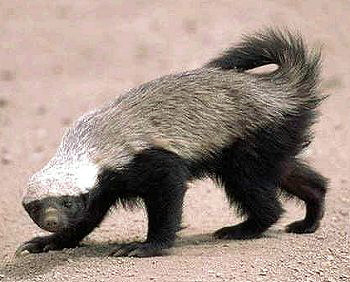 Honey BadgerMellivora capensis
-
 StoatMustela erminea
-
 Sea OtterEnhydra lutris
- SableMartes zibellina
Compare
Questions and answers
What is the scientific name of the Caucasian Badger?
The scientific name of the Caucasian Badger is Meles canescens. Written with its author, the full name is Meles canescens Blanford, 1875.
Which family does the Caucasian Badger belong to?
Meles canescens belongs to the family Mustelidae, in the order Carnivora and the class Mammalia.
Where is the Caucasian Badger found?
Checklists and occurrence records place Meles canescens in 8 countries, including Israel, Turkey, Iran, Palestinian Territory, Syria and Georgia.
What other names does the Caucasian Badger have?
Meles canescens is also known in English as Middle Eastern Badger and Southwest Asian Badger.
Sources
Passages the profile rests on
- The species has a dirty-greyish back with brown highlights. Source passage: “with a dirty-greyish back and brown highlights;” — English Wikipedia
- Its head resembles that of the European badger but has weaker crests. Source passage: “its head is identical to the European badger, though with weaker crests;” — English Wikipedia
- Its upper molars are elongated in a manner similar to those of the Asian badger. Source passage: “its upper molars are elongated in a similar way as the Asian badger's.” — English Wikipedia
- Its facial mask resembles that of the European badger and distinguishes its fur from that of Asian and Japanese badgers. Source passage: “Its fur can be distinguished from the Asian and Japanese badgers by its facial mask, which resembles that of the European badger.” — English Wikipedia
- The species is smaller than the European badger. Source passage: “This species is smaller than the European badger,” — English Wikipedia
- The species was formerly classified as a subspecies of the European badger. Source passage: “The Caucasian badger was formerly thought to be a subspecies of the European badger (M. meles), along with the other subspecies also classified within it.” — English Wikipedia
- A 2013 study identified significant genetic divergence between the Caucasian badger and the European badger. Source passage: “However, a 2013 study found significant genetic divergence between both species.” — English Wikipedia
- The Caucasian badger and European badger are thought to have diverged during the Pleistocene, between 2.37 million and 450,000 years ago. Source passage: “It is thought that both diverged during the Pleistocene, between 2.37 million years ago to 450,000 years ago.” — English Wikipedia
- The American Society of Mammalogists recognizes the Caucasian badger as a distinct species. Source passage: “The American Society of Mammalogists recognises it as a distinct species.” — English Wikipedia
- The North Caucasus is considered a possible boundary between the ranges of the Caucasian and European badgers, although the boundary has not been clearly defined. Source passage: “The boundary of its range to the European badger is thought to be in the North Caucasus, but a clear boundary has not been defined,” — English Wikipedia
- The Caucasian badger and European badger occur sympatrically in some places. Source passage: “as both are known to be sympatric in some places,” — English Wikipedia
- Potential hybrids between the Caucasian badger and European badger have been identified. Source passage: “and potential hybrids have been identified.” — English Wikipedia
Data
- Catalogue of Life, 2026-10-16 XR cc by
- Global Biodiversity Information Facility CC BY 4.0
- Wikidata CC0
- GeoNames CC BY 4.0
- Wikimedia Commons per image; credit shown with each image
- Within the Catalogue of Life, this name comes from The Integrated Taxonomic Information System cc0
References
- Abramov, Alexei V., Andrey Yu. Puzachenko. (2013). The taxonomic status of badgers (Mammalia, Mustelidae) from Southwest Asia based on cranial morphometrics, with the redescription of Meles canescens. Zootaxa, Vol. 3681, No. 1.
- Sato, Jun J. / Proulx, G., and E. Do Linh San, eds. (2016). Chapter 1: The Systematics and Taxonomy of the World’s Badger Species - A Review. Badgers: Systematics, Biology, Conservation and Research Techniques.
- Burgin, Connor J., Don E. Wilson, Russell A. Mittermeier, Anthony B. Rylands, et al. (2020). Illustrated Checklist of the Mammals of the World. Vol. 1. Monotremata to Rodentia.
This species in other databases
Page built on 26 November 2026. See how the catalog is made and all sources and licences.
Cite this page
ScientificNames.org. (2026). Meles canescens (Caucasian Badger). Retrieved November 26, 2026, from https://scientificnames.org/species/meles-canescens
“Meles canescens (Caucasian Badger).” ScientificNames.org, 2026, scientificnames.org/species/meles-canescens. Accessed 26 Nov. 2026.
ScientificNames.org. “Meles canescens (Caucasian Badger).” Accessed November 26, 2026. https://scientificnames.org/species/meles-canescens.
@misc{scientificnames_meles_canescens_caucasian_badger,
  author = {{ScientificNames.org}},
  title = {Meles canescens (Caucasian Badger)},
  year = {2026},
  url = {https://scientificnames.org/species/meles-canescens},
  note = {Accessed 2026-11-26}
}