Species · Birds
White-bellied Antbird Myrmeciza longipes
The scientific name of the White-bellied Antbird is Myrmeciza longipes. It is a species of bird in the family Thamnophilidae (antbird), order Passeriformes. The name dates from 1825.
- Scientific name
- Myrmeciza longipes (Swainson, 1825)
- Common name
- White-bellied Antbird
- Genus
- Myrmeciza
- Family
- Thamnophilidae (Antbird)
- Order
- Passeriformes
- Class
- Aves
- Red List category
- LC Least Concern
- Recorded in
- 8 countries
- Name status
- accepted in the Catalogue of Life

Overview
Myrmeciza longipes has a geographically discontinuous distribution in Panama, Colombia, Venezuela, Trinidad, Guyana, Suriname, and northeastern Brazil north of the Amazon. It measures approximately 15 cm in length and has an average body mass of approximately 28 g.
Written 26 November 2026 from the sources listed below. Each statement was checked against the passage it cites; statements that could not be supported were removed.
Appearance
Adult males of the nominate subspecies have cinnamon-rufous crowns, upperparts, wings, and tails, with a concealed white patch between the scapulars. Their sides of the head, throat, and upper breast are black, bordered by slate gray, while the lower breast and belly are white and the flanks are tawny or buffy.[1][2][3][4]
Adult females have upperparts similar to males but possess black bars near the ends of their wing coverts. Their sides of the head are dark brown, the chin is white, the throat and upper breast are ochraceous-buff, and the lower breast and belly are white.[5][6][7]
Both sexes have pinkish-gray legs and feet. Males of panamensis have more black and less white on their underparts than nominate males, while males of boucardi have gray crowns.[8][9][10]
Females of boucardi have richer ochraceous coloration on their throats and breasts than nominate females. Males of griseipectus have black coloration extending only slightly onto the breast and large black spots on their wing coverts, while females have more white on their bellies than nominate females.[11][12][13]
Habitat
The White-bellied Antbird primarily inhabits the forest floor and understory of moderately humid semideciduous forests. It also occurs in deciduous forests, humid rainforest patches, gallery forests, and shrubby secondary forests.[14][15]
In Panama, it occurs at elevations up to approximately 500 m, in Colombia up to approximately 1,800 m, in Venezuela up to approximately 1,300 m, and in Brazil up to approximately 700 m.[16][17][18][19]
The species is common in secondary-growth habitats and forest-edge habitats.[20]
Diet
The White-bellied Antbird feeds on various insects and probably also consumes spiders.[21]
Behaviour
Individuals, pairs, and family groups forage mainly on the ground in dense vegetation and occasionally up to approximately 1 m above ground. They obtain prey by moving aside leaf litter, gleaning vegetation, and jumping to the undersides of overhanging vegetation.[22][23]
The species regularly follows army ant swarms but does not depend on them for feeding. It rarely participates in mixed-species feeding flocks.[24][25]
The species produces calls including a short liquid rattle and a long, thin, descending whistle.[26]
Reproduction and life cycle
The breeding season varies geographically but extends across at least March through June overall. The species constructs cup-shaped nests from twigs and rootlets, lining them with finer fibers.[27][28]
The typical clutch appears to contain two eggs. The eggs are white to creamy white and bear brown, lilac, or purple markings.[29][30]
Conservation
The White-bellied Antbird was assessed as Least Concern by the IUCN in 2020. Its population is believed to be decreasing.[31][32][33]
The global population is estimated at between 500,000 and 4,999,999 mature individuals. The species is considered common across its range, which includes numerous protected parks and reserves, and BirdLife describes it as common.[34][35][36][37]
No immediate threats have been identified for the species.[38]
Classification of the White-bellied Antbird
| Kingdom | Animalia |
|---|---|
| Phylum | Chordata |
| Subphylum | Vertebrata |
| Infraphylum | Gnathostomata |
| Parvphylum | Osteichthyes |
| Megaclass | Tetrapoda |
| Class | Aves (Bird) |
| Order | Passeriformes (Passerine) |
| Family | Thamnophilidae (Antbird) |
| Genus | Myrmeciza (White-bellied Antbird) |
| Species | Myrmeciza longipes (Swainson, 1825) |
Where the White-bellied Antbird is found
Checklists and occurrence records place Myrmeciza longipes in 8 countries across North America and South America. GBIF holds 25,903 georeferenced records of it.
Countries
- Brazil 280
- Colombia 11,231
- French Guiana 3
- Guyana 412
- Panama 7,976
- Suriname 18
- Trinidad and Tobago 1,525
- Venezuela 4,458
Regions and cities with the most records
- Alcalde Díaz, Panama 3,994
- Chilibre, Panama 3,949
- Cundinamarca, Colombia 2,880
- Panamá, Panama 2,296
- Colón, Panama 2,086
- Arraiján, Panama 1,908
- Panama City, Panama 1,860
- Tolima Department, Colombia 1,859
- Curundú, Panama 1,842
- Ancón, Panama 1,837
- San Miguelito, Panama 1,743
- Veracruz, Panama 1,682
- El Hatillo, Venezuela 1,499
- Baruta, Venezuela 1,494
- Caracas, Venezuela 1,490
- Los Dos Caminos, Venezuela 1,489
- Petare, Venezuela 1,487
- Chacao, Venezuela 1,477
- Darién, Panama 1,469
- Caucagüito, Venezuela 1,429
- Miranda, Venezuela 1,405
- Antioquia, Colombia 1,309
- Arima, Trinidad and Tobago 1,284
- Paradise, Trinidad and Tobago 1,276
- Tunapuna, Trinidad and Tobago 1,224
- Ituango, Colombia 1,207
- San Antonio de Los Altos, Venezuela 1,183
- Tunapuna/Piarco, Trinidad and Tobago 1,126
- Madrid, Colombia 1,068
- Mosquera, Colombia 1,067
- Sibaté, Colombia 1,054
- Soacha, Colombia 1,049
- Caraballeda, Venezuela 944
- Bolívar, Colombia 920
- Panamá Oeste Province, Panama 904
- Juan Díaz, Panama 873
Range as the checklists state it
Middle America
South America
Caribbean
A number beside a place is its count of GBIF occurrence records. A place without a number comes from a checklist alone. Records show where a species has been observed or collected, which can include escapes and vagrants.
Common names
English
- White-bellied Antbird
- Swainson's Antcatcher
Names in 23 other languages
- Catalan
- Formiguer ventreblanc, formiguera de ventre blanc
- Chinese
- 白腹蚁鸟, 白腹蟻鳥
- Croatian
- ružičastonoga mravarica
- Czech
- mravenčík šedolemý
- Danish
- Hvidbuget Myrefugl
- Dutch
- Witbuikmiervogel
- Esperanto
- blankventra formikulo
- Finnish
- harmaakulmamuura
- French
- Alapi à ventre blanc, Batara à ventre blanc
- German
- Grauband-Ameisenvogel, Rotsteiß-Ameisenvogel
- Italian
- Formichiere panciabianca
- Japanese
- シロハラアリドリ
- Lithuanian
- baltapilvė devynbalsė skruzdinukė
- Norwegian
- smekkemaurfugl
- Polish
- mrowiniec
- Portuguese
- formigueiro-de-barriga-branca
- Russian
- Белобрюхая славковая муравьянка, Славковая муравьеловка
- Slovak
- mravcovka bielobruchá
- Spanish
- Hormiguero ventriblanco
- Swedish
- Vitbukad myrfågel, vitbukig myrfågel
- Turkish
- Ak Karınlı Karıncakuşu
- Ukrainian
- покривник білочеревий
- Welsh
- aderyn morgrug torwyn
Synonyms
One other scientific name has been used for this species and is now treated as a synonym of Myrmeciza longipes.
- Drymophila longipes Swainson, 1825
Subspecies and varieties
- Myrmeciza longipes boucardi subspecies
- Myrmeciza longipes griseipectus subspecies
- Myrmeciza longipes longipes subspecies
- Myrmeciza longipes panamensis subspecies
Related species
-
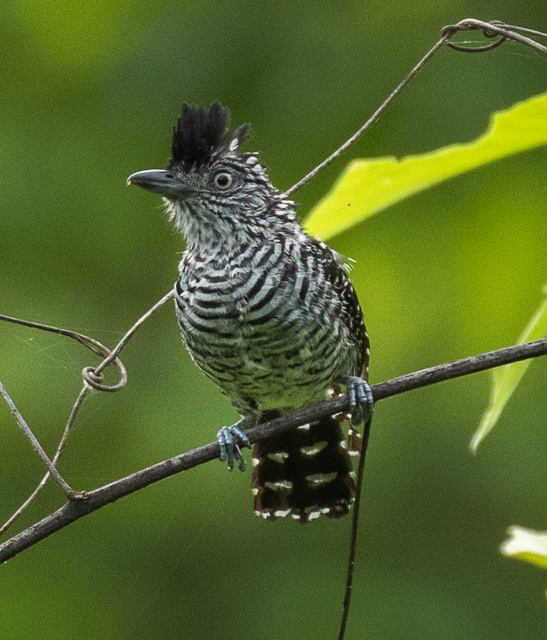 Barred AntshrikeThamnophilus doliatus
-
 Great AntshrikeTaraba major
-
 Black-crowned AntshrikeThamnophilus atrinucha
-
 Ocellated AntbirdPhaenostictus mcleannani
-
 Bicolored AntbirdGymnopithys bicolor
-
 Fasciated AntshrikeCymbilaimus lineatus
-
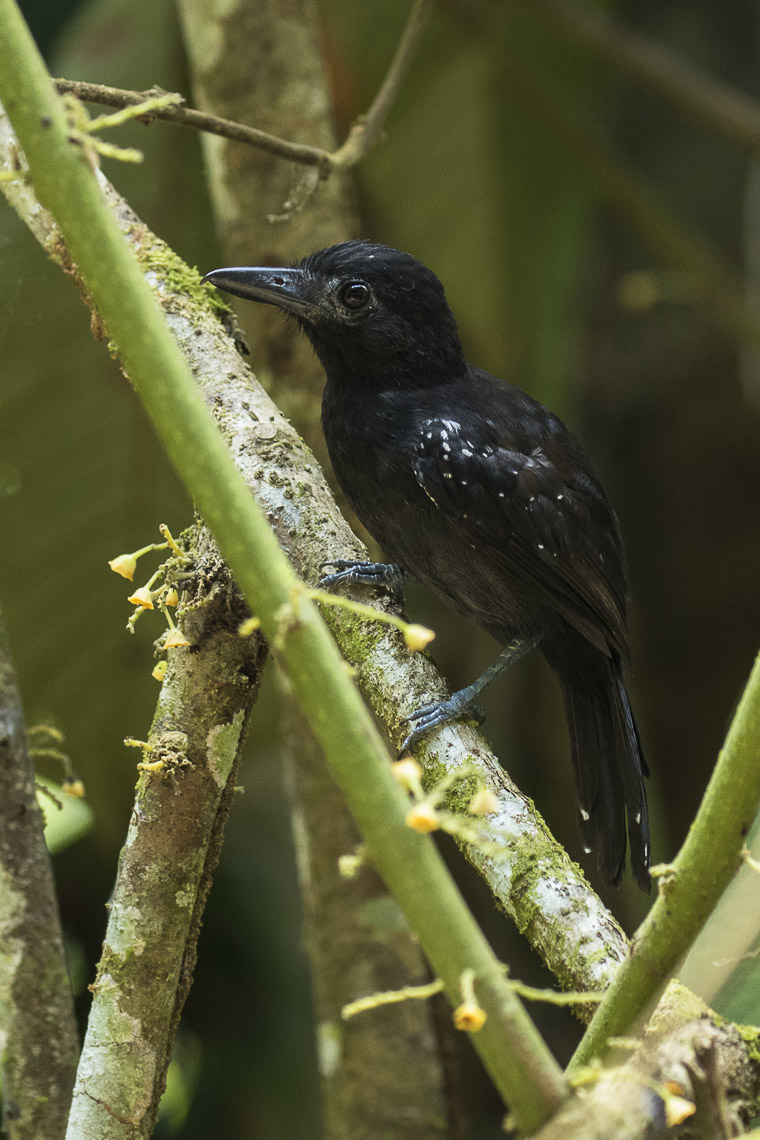 Black-hooded AntshrikeThamnophilus bridgesi
-
 Black-crested AntshrikeSakesphorus canadensis
Compare
Questions and answers
What is the scientific name of the White-bellied Antbird?
The scientific name of the White-bellied Antbird is Myrmeciza longipes. Written with its author, the full name is Myrmeciza longipes (Swainson, 1825).
Which family does the White-bellied Antbird belong to?
Myrmeciza longipes belongs to the family Thamnophilidae, in the order Passeriformes and the class Aves.
Where is the White-bellied Antbird found?
Checklists and occurrence records place Myrmeciza longipes in 8 countries, including Colombia, Panama, Venezuela, Trinidad and Tobago, Guyana and Brazil.
What is the conservation status of the White-bellied Antbird?
The IUCN Red List category recorded for Myrmeciza longipes is Least Concern (LC).
What other names does the White-bellied Antbird have?
Myrmeciza longipes is also known in English as Swainson's Antcatcher.
Where does the White-bellied Antbird occur?
Its distribution is geographically discontinuous. The subspecies panamensis occurs in Panama and northern Colombia; the nominate subspecies occurs in northeastern Colombia, northern Venezuela, and Trinidad; boucardi occurs in the upper Magdalena River Valley of central Colombia; and griseipectus occurs in central Colombia, southern and eastern Venezuela, Guyana, Suriname, and northeastern Brazil north of the Amazon.[39][40][41][42][43]
Does the White-bellied Antbird depend on army ants?
No. It regularly follows army ant swarms but does not depend on them for feeding.[24]
What does the White-bellied Antbird eat?
It feeds on various insects and probably also consumes spiders.[21]
When does the White-bellied Antbird breed?
The breeding season varies geographically but extends across at least March through June overall.[27]
How many eggs does the White-bellied Antbird typically lay?
The typical clutch appears to contain two eggs. They are white to creamy white with brown, lilac, or purple markings.[29][30]
What is the conservation status of the White-bellied Antbird?
It was assessed as Least Concern by the IUCN in 2020. Its population is believed to be decreasing, although no immediate threats have been identified.[31][32][38][33]
What is the estimated population of the White-bellied Antbird?
The global population is estimated at between 500,000 and 4,999,999 mature individuals.[36]
Sources
Passages the profile rests on
- Adult males of the nominate subspecies have cinnamon-rufous crowns, upperparts, wings, and tails. Source passage: “Adult males of the nominate subspecies M. l. longipes have a cinnamon rufous crown, upperparts, wings, and tail.” — English Wikipedia
- Adult males of the nominate subspecies have a concealed white patch between their scapulars. Source passage: “They have a hidden white patch between their scapulars.” — English Wikipedia
- Adult males of the nominate subspecies have black sides of the head, throat, and upper breast bordered by slate gray. Source passage: “The sides of their head, their throat, and their upper breast are black and bordered with slate gray.” — English Wikipedia
- Adult males of the nominate subspecies have white lower breasts and bellies, with tawny or buffy flanks. Source passage: “Their lower breast and belly are white, their flanks tawny or buffy” — English Wikipedia
- Adult females have upperparts similar to males but possess black bars near the ends of their wing coverts. Source passage: “Adult females have similar upperparts to males with the addition of black bars near the end of their wing coverts.” — English Wikipedia
- Adult females have dark brown sides of the head and a white chin. Source passage: “The sides of their head are dark brown. Their chin is white” — English Wikipedia
- Adult females have ochraceous-buff throats and upper breasts, with white lower breasts and bellies. Source passage: “their throat and upper breast ochraceous buff, their lower breast and belly white” — English Wikipedia
- Both sexes have pinkish-gray legs and feet. Source passage: “Both sexes' legs and feet are pinkish gray.” — English Wikipedia
- Males of the subspecies panamensis have more black and less white on their underparts than the nominate subspecies. Source passage: “Males of subspecies M. l. panamensis have more black and less white on their underparts than the nominate.” — English Wikipedia
- Males of the subspecies boucardi have gray crowns. Source passage: “M. l. boucardi males have a gray crown” — English Wikipedia
- Females of the subspecies boucardi have richer ochraceous coloration on their throats and breasts than nominate females. Source passage: “females are richer ochraceous on their throat and breast than the nominate.” — English Wikipedia
- Males of the subspecies griseipectus have black coloration extending only slightly onto the breast and large black spots on their wing coverts. Source passage: “M. l. griseipectus males have black extending only slightly onto their breast and also large black spots on their wing coverts.” — English Wikipedia
- Females of the subspecies griseipectus have more white on their bellies than nominate females. Source passage: “Females have more white on their belly than the nominate.” — English Wikipedia
- The species primarily inhabits the forest floor and understory of moderately humid semideciduous forests. Source passage: “The white-bellied antbird primarily inhabits the floor and understorey of moderately humid semi-deciduous forest.” — English Wikipedia
- The species also occurs in deciduous forests, humid rainforest patches, gallery forests, and shrubby secondary forests. Source passage: “It also occurs in deciduous forest, small tracts of more humid rainforest, gallery forest, and shrubby secondary forest.” — English Wikipedia
- In Panama, the species occurs at elevations up to approximately 500 m. Source passage: “500 m (1,600 ft) in Panama” — English Wikipedia
- In Colombia, the species occurs at elevations up to approximately 1,800 m. Source passage: “1,800 m (5,900 ft) in Colombia” — English Wikipedia
- In Venezuela, the species occurs at elevations up to approximately 1,300 m. Source passage: “1,300 m (4,300 ft) in Venezuela” — English Wikipedia
- In Brazil, the species occurs at elevations up to approximately 700 m. Source passage: “700 m (2,300 ft) in Brazil.” — English Wikipedia
- The species is common in secondary-growth habitats and forest-edge habitats. Source passage: “the White-bellied Antbird. (Myrmeciza longipes) is common in second growth and edge habitat” — repository.si.edu
- The species feeds on various insects and probably also consumes spiders. Source passage: “The white-bellied antbird feeds on a variety of insects and probably also spiders.” — English Wikipedia
- Individuals, pairs, and family groups forage mainly on the ground in dense vegetation and occasionally up to approximately 1 m above ground. Source passage: “Individuals, pairs, and family groups forage in dense vegetation mostly on the ground and also up to about 1 m (3 ft) above it.” — English Wikipedia
- The species obtains prey by moving aside leaf litter, gleaning vegetation, and jumping to the undersides of overhanging vegetation. Source passage: “It captures prey by tossing aside and picking from leaf litter, by reaching to glean vegetation, or by jumping up to the underside of overhanging vegetation.” — English Wikipedia
- The species regularly follows army ant swarms but does not depend on them for feeding. Source passage: “It regularly follows army ant swarms but is not dependent on them.” — English Wikipedia
- The species rarely participates in mixed-species feeding flocks. Source passage: “It seldom joins mixed-species feeding flocks.” — English Wikipedia
- The species produces calls including a short liquid rattle and a long, thin, descending whistle. Source passage: “The species' calls include "a short, liquid rattle" and a "long...thin, downslurred whistle, sometimes abbreviated".” — English Wikipedia
- The breeding season varies geographically but extends across at least March through June overall. Source passage: “it overall spans at least March to June.” — English Wikipedia
- The species constructs cup-shaped nests from twigs and rootlets, lining them with finer fibers. Source passage: “It builds a cup nest of twigs and rootlets lined with finer fibers.” — English Wikipedia
- The typical clutch appears to contain two eggs. Source passage: “Its clutch size appears to be two eggs” — English Wikipedia
- The eggs are white to creamy white and bear brown, lilac, or purple markings. Source passage: “they are white to creamy white with brown, lilac, or purple markings.” — English Wikipedia
- The species was assessed as Least Concern by the IUCN. Source passage: “The IUCN has assessed the white-bellied antbird as being of Least Concern.” — English Wikipedia
- The species' population is believed to be decreasing. Source passage: “Its population is believed to be decreasing.” — English Wikipedia
- The species was assessed for the IUCN Red List in 2020. Source passage: “White-bellied Antbird Myrmeciza longipes has most recently been assessed for The IUCN Red List of Threatened Species in 2020.” — iucnredlist.org
- The species has an estimated population of at least 500,000 mature individuals. Source passage: “an estimated population of at least 500,000 mature individuals.” — English Wikipedia
- The species is considered common across its range, which includes numerous protected parks and reserves. Source passage: “It is considered fairly common to common across its range, which includes "numerous parks and reserves in nearly every country".” — English Wikipedia
- The global population is estimated at between 500,000 and 4,999,999 mature individuals. Source passage: “The global population is estimated to number 500,000-4,999,999 mature individuals (Partners in Flight 2019).” — datazone.birdlife.org
- BirdLife describes the species as common. Source passage: “The species is described as 'common'” — datazone.birdlife.org
- No immediate threats have been identified for the species. Source passage: “No immediate threats have been identified.” — English Wikipedia
- The species has a geographically discontinuous distribution. Source passage: “The white-bellied antbird has a disjunct distribution.” — English Wikipedia
- The subspecies panamensis occurs in Panama and northern Colombia. Source passage: “Caribbean slope of Panama from Colón Province east, Pacific slope of Panama from Coclé Province east, and northern Colombia from extreme northern Chocó Department east to La Guajira Department” — English Wikipedia
- The nominate subspecies occurs in northeastern Colombia, northern Venezuela, and Trinidad. Source passage: “from east slope of northeastern Colombia's Eastern Andes east through northern Venezuela to Sucre state; Trinidad” — English Wikipedia
- The subspecies boucardi occurs in the upper Magdalena River Valley of central Colombia. Source passage: “upper Magdalena River Valley in central Colombia” — English Wikipedia
- The subspecies griseipectus occurs in central Colombia, southern and eastern Venezuela, Guyana, Suriname, and northeastern Brazil north of the Amazon. Source passage: “east of the Andes in central Colombia's Meta Department, southern and eastern Venezuela, Guyana, Suriname, and northeastern Brazil north of the Amazon from Roraima east” — English Wikipedia
Data
- Catalogue of Life, 2026-10-16 XR cc by
- Global Biodiversity Information Facility CC BY 4.0
- Wikidata CC0
- GeoNames CC BY 4.0
- Wikimedia Commons per image; credit shown with each image
- Within the Catalogue of Life, this name comes from The Integrated Taxonomic Information System cc0
References
- Gill, Frank, & and Minturn Wright. (2006). Birds of the World: Recommended English Names.
This species in other databases
Page built on 29 November 2026. See how the catalog is made and all sources and licences.
Cite this page
ScientificNames.org. (2026). Myrmeciza longipes (White-bellied Antbird). Retrieved November 29, 2026, from https://scientificnames.org/species/myrmeciza-longipes
“Myrmeciza longipes (White-bellied Antbird).” ScientificNames.org, 2026, scientificnames.org/species/myrmeciza-longipes. Accessed 29 Nov. 2026.
ScientificNames.org. “Myrmeciza longipes (White-bellied Antbird).” Accessed November 29, 2026. https://scientificnames.org/species/myrmeciza-longipes.
@misc{scientificnames_myrmeciza_longipes_white_bellied_antbird,
  author = {{ScientificNames.org}},
  title = {Myrmeciza longipes (White-bellied Antbird)},
  year = {2026},
  url = {https://scientificnames.org/species/myrmeciza-longipes},
  note = {Accessed 2026-11-29}
}