Species · Reptiles
Anchieta's Cobra Naja anchietae
The scientific name of the Anchieta's Cobra is Naja anchietae. It is a species of reptile in the family Elapidae (cobras), order Squamata. The name dates from 1879.
- Scientific name
- Naja anchietae Bocage, 1879
- Common name
- Anchieta's Cobra
- Genus
- Naja
- Family
- Elapidae (Cobras)
- Order
- Squamata
- Class
- Reptilia
- Red List category
- LC Least Concern
- Recorded in
- 6 countries
- Name status
- accepted in the Catalogue of Life
Overview
Anchieta's Cobra is an oviparous cobra species. It occurs in southern Angola, central and northern Namibia, northern Botswana, western Zambia and northwestern Zimbabwe.
Written 26 November 2026 from the sources listed below. Each statement was checked against the passage it cites; statements that could not be supported were removed.
Appearance
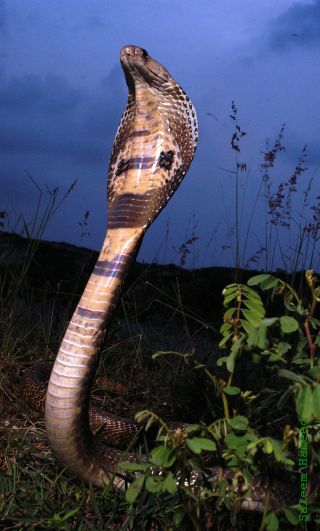
Adults average approximately 1.0 metre in total length. Adult specimens measuring between 1.2 and 1.8 metres are not uncommon, while the species can rarely exceed 2.0 metres. The longest recorded male measured 2.31 metres and was captured in Windhoek, Namibia, while the longest recorded female measured 2.18 metres and was found south of Shakawe, Botswana.[1][2][3][4][5]
Males and females generally grow to similar sizes. Young individuals are yellowish to light brown above and below, with dark scale margins forming irregular transverse lines and a black neck band. Adults gradually become darker brown as they mature, while their black neck band fades.[6][7][8]
The banded colour phase has been recorded in approximately 13% of males and up to 22% of females. Its smooth, shiny dorsal scales lack pits and are oblique. It has 17 rows of midbody scales and between 179 and 200 ventral scales.[9][10][11]
It has between 51 and 56 paired subcaudal scales and an entire anal shield. It usually has seven upper labial scales, occasionally eight, which do not enter the eye. It typically has eight or nine lower labial scales, rarely ten.[12][13][14]
Habitat
Anchieta's Cobra occurs in southern Angola, central and northern Namibia, northern Botswana, western Zambia and northwestern Zimbabwe. One occurrence has been recorded in Katanga, Democratic Republic of the Congo.[15][16]
Its preferred habitat is mesic savanna grassland, particularly bushveld and lowveld. It also occurs in semi-deserts and rocky areas and sometimes shelters under houses in or near human settlements.[17][18][19]
It is abundant in wooded areas, especially near rivers and wetlands. The species is not found in forest or desert regions. Although generally occurring at low altitudes, it has been observed at elevations of up to 2,000 metres.[20][21][22]
Behaviour
Anchieta's Cobra is primarily terrestrial but occasionally occurs in small shrubs. It is nocturnal and emerges at dusk to forage. It sometimes enters poultry runs while foraging.[23][24][25]
During daylight, it often basks near a preferred retreat. Its daytime retreats include abandoned termite mounds, rock holes, hollow trees, shrubs and dense vegetation.[26][27]
It tends to remain engaged with threats longer than the closely related snouted cobra. When provoked, it raises its forebody, spreads its hood and adopts a defensive posture. It flees when given an opportunity.[28][29][30]
It sometimes feigns death when threatened by predators or cornered.[31]
Diet
It eats birds, including poultry, and bird eggs. It also preys on mammals such as rats and mice.[32][33]
Reproduction and life cycle
Anchieta's Cobra is oviparous. Females lay between 47 and 60 eggs in early summer.[34][35]
Hatchlings measure approximately 220–340 millimetres in length and are independent from birth.[36][37]
Similar species
Anchieta's Cobra is closely related to the snouted cobra. The two species are similar in behaviour, morphology and habits.[38][39]
Classification of the Anchieta's Cobra
| Kingdom | Animalia |
|---|---|
| Phylum | Chordata |
| Subphylum | Vertebrata |
| Infraphylum | Gnathostomata |
| Parvphylum | Osteichthyes |
| Megaclass | Tetrapoda |
| Class | Reptilia (Reptile) |
| Order | Squamata (Snakes) |
| Suborder | Serpentes (Snakes) |
| Infraorder | Alethinophidia |
| Family | Elapidae (Cobras) |
| Genus | Naja (Cobras) |
| Species | Naja anchietae Bocage, 1879 |
Where the Anchieta's Cobra is found
Checklists and occurrence records place Naja anchietae in 6 countries across Africa. GBIF holds 143 georeferenced records of it.
Countries
Regions and cities with the most records
- Western Province, Zambia 20
- Khomas Region, Namibia 11
- North-West, Botswana 11
- Katima Mulilo, Namibia 7
- Oshikoto Region, Namibia 7
- Sesheke, Zambia 7
- Chobe, Botswana 6
- Ghanzi, Botswana 6
- Matabeleland North, Zimbabwe 6
- Zambezi Region, Namibia 6
- Maun, Botswana 5
- Otjozondjupa Region, Namibia 5
- Erongo Region, Namibia 4
- Kunene Region, Namibia 4
- Livingstone, Zambia 4
- Southern Province, Zambia 4
- Huíla, Angola 3
- Lubango, Angola 3
- Victoria Falls, Zimbabwe 3
Range as the checklists state it
S Angola, W Zambia, N Namibia, N Botswana, NW Zimbabwe, Malawi
A number beside a place is its count of GBIF occurrence records. A place without a number comes from a checklist alone. Records show where a species has been observed or collected, which can include escapes and vagrants.
Common names
English
- Anchieta's Cobra
Names in 8 other languages
- Afrikaans
- Anchieta se Kobra
- Chinese
- 南非眼鏡蛇
- Czech
- kobra Anchietova
- Danish
- Sydvestafrikansk Kobra
- German
- Angola-Kobra
- Italian
- Cobra dell'Angola, Cobra di Anchieta
- Russian
- Ангольская кобра
- Tswana
- kake wa botlhodi
Synonyms
3 other scientific names have been used for this species and are now treated as synonyms of Naja anchietae.
- Naia anchietae Boulenger, 1896
- Naja annulifera anchietae Bocage, 1879
- Naja haje Boettger, 1887 ambiguous synonym
Related species
-
 Indian CobraNaja naja
-
 Egyptian CobraNaja haje
-
 Monocled CobraNaja kaouthia
-
 Caspian CobraNaja oxiana
-
 Forest CobraNaja melanoleuca
-
 Cape CobraNaja nivea
-
 Philippine CobraNaja philippinensis
-
 Red Spitting CobraNaja pallida
Compare
Questions and answers
What is the scientific name of the Anchieta's Cobra?
The scientific name of the Anchieta's Cobra is Naja anchietae. Written with its author, the full name is Naja anchietae Bocage, 1879.
Which family does the Anchieta's Cobra belong to?
Naja anchietae belongs to the family Elapidae, in the order Squamata and the class Reptilia.
Where is the Anchieta's Cobra found?
Checklists and occurrence records place Naja anchietae in 6 countries: Namibia, Zambia, Zimbabwe, Botswana, Angola and Malawi.
What is the conservation status of the Anchieta's Cobra?
The IUCN Red List category recorded for Naja anchietae is Least Concern (LC).
Sources
Passages the profile rests on
- Adults average approximately 1.0 metre in total length. Source passage: “Adults average around 1.0 metre (3.3 ft) in total length (including tail)” — English Wikipedia
- Adult specimens measuring between 1.2 and 1.8 metres in length are not uncommon. Source passage: “it is not uncommon to find specimens measuring between 1.2 metres (3.9 ft) and 1.8 metres (5.9 ft) in length.” — English Wikipedia
- The species can rarely exceed 2.0 metres in total length. Source passage: “Maximum size attained by this species is just a bit over 2.0 metres (6.6 ft), but these are rare cases.” — English Wikipedia
- The longest recorded male measured 2.31 metres and was captured in Windhoek, Namibia. Source passage: “The longest recorded male was 2.31 metres (7.6 ft) long and was caught in Windhoek, Namibia.” — English Wikipedia
- The longest recorded female measured 2.18 metres and was found south of Shakawe, Botswana. Source passage: “The longest recorded female was slightly shorter at 2.18 metres (7.2 ft) and was found 25 kilometres (16 mi) south of Shakawe, Botswana.” — English Wikipedia
- Males and females generally grow to similar sizes. Source passage: “There is no sexual dimorphism in this species of cobra, with males and females growing to similar sizes.” — English Wikipedia
- Young individuals are yellowish to light brown above and below, with dark scale margins forming irregular transverse lines and a black neck band. Source passage: “Young specimens are yellowish to light brown in colour, above and below, dorsally with dark scale margins forming a pattern of irregular transverse lines and a black band that circles the neck.” — English Wikipedia
- Adults gradually become darker brown as they mature, while their black neck band fades. Source passage: “As they mature into adulthood, this species gradually darkens to a darker brown colour, while the band on the neck fades away.” — English Wikipedia
- The banded colour phase has been recorded in approximately 13% of males and up to 22% of females. Source passage: “This banded phase has been noted in roughly 13% of males and up to 22% of females.” — English Wikipedia
- Its smooth, shiny dorsal scales lack pits and are oblique. Source passage: “Dorsal scales are smooth, shiny, without pits and oblique.” — English Wikipedia
- It has 17 rows of midbody scales and between 179 and 200 ventral scales. Source passage: “Midbody scales are in 17 rows with 179–200 ventrals.” — English Wikipedia
- It has between 51 and 56 paired subcaudal scales and an entire anal shield. Source passage: “There are 51–56 paired subcaudals and the anal shield is entire.” — English Wikipedia
- It usually has seven upper labial scales, occasionally eight, which do not enter the eye. Source passage: “There are 7 (sometimes 8) upper labials that do not enter the eye” — English Wikipedia
- It typically has eight or nine lower labial scales, rarely ten. Source passage: “8 or 9 (rarely 10) lower labials” — English Wikipedia
- The species occurs in southern Angola, central and northern Namibia, northern Botswana, western Zambia and northwestern Zimbabwe. Source passage: “It can be found in southern Angola, central and northern Namibia, northern Botswana, western Zambia and parts of northwestern Zimbabwe” — English Wikipedia
- One occurrence has been recorded in Katanga, Democratic Republic of the Congo. Source passage: “with one record from Katanga, Democratic Republic of the Congo.” — English Wikipedia
- Its preferred habitat is mesic savanna grassland, particularly bushveld and lowveld. Source passage: “The preferred habitat of N. anchietae is mesic savanna grasslands, particularly bushveld and lowveld.” — English Wikipedia
- It also occurs in semi-deserts and rocky areas. Source passage: “It occurs in semi-deserts and rocky areas” — English Wikipedia
- It sometimes shelters under houses in or near human settlements. Source passage: “as well as in or close to humans settlements, where they may shelter under houses.” — English Wikipedia
- It is abundant in wooded areas, especially near rivers and wetlands. Source passage: “It is abundant in wooded areas, especially along rivers and wetlands.” — English Wikipedia
- The species is not found in forest or desert regions. Source passage: “This cobra is never found in forest or desert regions.” — English Wikipedia
- Although generally occurring at low altitudes, it has been observed at elevations of up to 2,000 metres. Source passage: “Although usually found at low altitudes, it has on occasion been observed at elevations of 2,000 metres (6,600 ft) above sea level.” — English Wikipedia
- Anchieta's cobra is primarily terrestrial but occasionally occurs in small shrubs. Source passage: “The Anchieta's cobra is a terrestrial or ground-dwelling species, but it may occasionally be found in small shrubs.” — English Wikipedia
- It is nocturnal and emerges at dusk to forage. Source passage: “A nocturnal species, this cobra species emerges at dusk to forage for food” — English Wikipedia
- It sometimes enters poultry runs while foraging. Source passage: “often getting into poultry runs.” — English Wikipedia
- During daylight, it often basks near a preferred retreat. Source passage: “During the day it is often seen basking in the sun near a preferred retreat” — English Wikipedia
- Its daytime retreats include abandoned termite mounds, rock holes, hollow trees, shrubs and dense vegetation. Source passage: “usually an abandoned termite mound, a hole in a rock, hollow tree, and shrubs or under dense vegetation.” — English Wikipedia
- It tends to remain engaged with threats longer than the closely related snouted cobra. Source passage: “the Anchieta's cobra tends to be more aggressive when confronted by a threat, showing a tendency to engage threats longer than its close relative, the snouted cobra.” — English Wikipedia
- When provoked, it raises its forebody, spreads its hood and adopts a defensive posture. Source passage: “will lift its forebody off the ground, spread its impressively broad 10 to 12 centimetres (3.9 to 4.7 in) hood and assume a defensive posture when provoked” — English Wikipedia
- It flees when given an opportunity. Source passage: “however, it will flee when given the chance.” — English Wikipedia
- It sometimes feigns death when threatened by predators or cornered. Source passage: “This species has been known to feign death as defence mechanism against possible predators or when it is cornered” — English Wikipedia
- It eats birds, including poultry, and bird eggs. Source passage: “birds (including poultry), birds eggs” — English Wikipedia
- It also preys on mammals such as rats and mice. Source passage: “and mammals such as rats and mice.” — English Wikipedia
- Anchieta's cobra is oviparous. Source passage: “Like other cobras, N. anchietae is oviparous” — English Wikipedia
- Females lay between 47 and 60 eggs in early summer. Source passage: “laying between 47 and 60 eggs in early summer.” — English Wikipedia
- Hatchlings measure approximately 220–340 millimetres in length. Source passage: “Hatchlings average between 220 to 340 millimetres (22 to 34 cm; 8.7 to 13.4 in) in length” — English Wikipedia
- Hatchlings are independent from birth. Source passage: “and are completely independent at birth.” — English Wikipedia
- Anchieta's cobra is closely related to the snouted cobra. Source passage: “The Anchieta's cobra is closely related to the Snouted cobra” — English Wikipedia
- Anchieta's cobra and the snouted cobra are similar in behaviour, morphology and habits. Source passage: “the two species are very similar in behaviour, morphology and habits” — English Wikipedia
- Anchieta's cobra is a generalist predator that eats toads and frogs. Source passage: “preying on amphibians such as toads and frogs” — English Wikipedia
- Its reptilian prey includes lizards and other snakes. Source passage: “other reptiles including lizards and other snakes” — English Wikipedia
Data
- Catalogue of Life, 2026-10-16 XR cc by
- Global Biodiversity Information Facility CC BY 4.0
- Wikidata CC0
- GeoNames CC BY 4.0
- Within the Catalogue of Life, this name comes from The Reptile Database cc by
References
- Bocage, & du, J. V. B. (1879). Reptiles et batraciens nouveaux d’Angola. J. Acad. Sci. Lisbon 7: 97-99.
- Boettger, O. (1887). Zweiter Beitrag zur Herpetologie Südwest- und Südafrikas. Ber. Senckenb. Naturf. Ges., Frankfurt Am Main, 1887:135-173.
- Boulenger, G. A. (1896). Catalogue of the snakes in the British Museum, Vol. 3. London (Taylor & Francis), Xiv + 727 Pp.
- Sternfeld, R. (1910). Zur Schlangenfauna Deutsch-Südwestafrikas. Mehrere Fälle von Mimikry bei afrikanischen Schlangen. Mitt. Zool. Mus. Berlin, 5: 51-60.
- Mertens, R. (1937). Reptilien und Amphibien aus dem südlichen Inner-Afrika. Abh. Senckenberg. Naturf. Ges. 435: 1-23.
- Bogert, Charles M. (1943). Dentitional phenomena in cobras and other elapids with notes on adaptive modifications of fangs. Bull. Amer. Mus. Nat. Hist. 81 (3): 285-260.
- Broadley, D. G. (1959). The herpetology of Southern Rhodesia. Part I--the snakes. Bull. Mus. Comp. Zool. Harvard 120 (1): 1-100 [Reprint 1972].
- Broadley, D. G. (1962). On some reptile collections from the North-Western and North-Eastern Districts of Southern Rhodesia 1958-1961, with descriptions of four new lizards. Occ. Pap. Nat. Mus. South. Rhodesia 26 (B): 787-843.
- Broadley, D. G. (1968). A review of the African cobras of the genus Naja (Serpentes: Elapinae). Arnoldia (Rhodesia) (Ser. 3) 29: 1-14.
- Branch, W. R. (1981). The venomous snakes of southern Africa 2. Elapidae and Hydrophidae. Bull. Maryland Herp. Soc. 17 (1): 1-47.
- Auerbach, R. D. (1987). The Amphibians and Reptiles of Botswana. Mokwepa Consultants, Botswana, 295 Pp.
- Spawls, S., & Branch, B. (1995). The Dangerous Snakes of Africa. Blandford, London, 192 Pp.
- Broadley, D. G. (1995). The snouted cobra, Naja annulifera, a valid species in southern Africa. J. Herp. Assoc. Africa 44: 26-32.
- Broadley, D.G.; Doria, C.T. & Wigge, J. (2003). Snakes of Zambia. An Atlas and Field Guide. Edition Chimaira, Frankfurt, 280 Pp. [Review in Sauria 26 (3): 21].
- BROADLEY, D.G. & W. WÜSTER. (2004). A review of the southern African ‘non-spitting’ cobras (Serpentes: Elapidae: Naja). African Journal of Herpetology 53 (2):101-122.
- Broadley, Donald G. and F. P. D. Cotterill. (2004). The reptiles of southeast Katanga, an overlooked ‘hot spot’. [Congo]. African Journal of Herpetology 53 (1): 35-61.
- Dobiey, M., & Vogel, G. (2007). Venomous Snakes of Africa - Giftschlangen Afrikas. Edition Chimaira, Terralog 15, 150 Pp.
- Cimatti, E. (2007). Namibia - Introduction to a vast territory. Reptilia (GB) (50): 58-67.
- Wallach, V.; Wüster, W. & Broadley, D.G. (2009). In praise of subgenera: taxonomic status of cobras of the genus Naja Laurenti (Serpentes: Elapidae). Zootaxa 2236: 26–36.
- Trape, J.F.; Chirio, L.; Broadley, D.G. & Wüster, W. (2009). Phylogeography and systematic revision of the Egyptian cobra (Serpentes: Elapidae: Naja haje) species complex, with the description of a new species from West Africa. Zootaxa 2236: 1–25.
- Beolens, B., & Michael Watkins, a. M. G. (2011). The Eponym Dictionary of Reptiles. Johns Hopkins University Press, Baltimore, USA.
- Sindaco, R.; Alberto Venchi & Cristina Grieco. (2013). The Reptiles of the Western Palearctic, Volume 2: Annotated Checklist and Distributional Atlas of the Snakes of Europe, North Africa, Middle East and Central Asia, with an Update to Volume 1. Edizioni Belvedere, Latina (Italy), 543 Pp.
- Broadley, D. & Blaylock. (2013). The Snakes of Zimbabwe and Botswana. Chimaira, Frankfurt, 387 Pp. [Book Review in Sauria 35 (2): 59 and Copeia 2014: 388].
- Herrmann, H.-W.; W.R. Branch. (2013). Fifty years of herpetological research in the Namib Desert and Namibia with an updated and annotated species checklist. Journal of Arid Environments 93: 94–115.
- Wallach, Van; Kenneth L. Williams, Jeff Boundy. (2014). Snakes of the World: A Catalogue of Living and Extinct Species. [type catalogue]. Taylor and Francis, CRC Press, 1237 Pp.
This species in other databases
Page built on 28 November 2026. See how the catalog is made and all sources and licences.
Cite this page
ScientificNames.org. (2026). Naja anchietae (Anchieta's Cobra). Retrieved November 28, 2026, from https://scientificnames.org/species/naja-anchietae
“Naja anchietae (Anchieta's Cobra).” ScientificNames.org, 2026, scientificnames.org/species/naja-anchietae. Accessed 28 Nov. 2026.
ScientificNames.org. “Naja anchietae (Anchieta's Cobra).” Accessed November 28, 2026. https://scientificnames.org/species/naja-anchietae.
@misc{scientificnames_naja_anchietae_anchietas_cobra,
  author = {{ScientificNames.org}},
  title = {Naja anchietae (Anchieta's Cobra)},
  year = {2026},
  url = {https://scientificnames.org/species/naja-anchietae},
  note = {Accessed 2026-11-28}
}