Species · Reptiles
Ringed Water Cobra Naja annulata
The scientific name of the Ringed Water Cobra is Naja annulata. It is a species of reptile in the family Elapidae (cobras), order Squamata. The name dates from 1876.
- Scientific name
- Naja annulata Peters, 1876
- Common name
- Ringed Water Cobra
- Genus
- Naja
- Family
- Elapidae (Cobras)
- Order
- Squamata
- Class
- Reptilia
- Red List category
- LC Least Concern
- Recorded in
- 13 countries
- Name status
- accepted in the Catalogue of Life

Overview
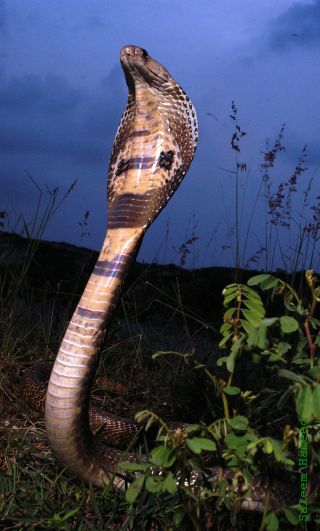
Naja annulata inhabits lakes, rivers, and streams in forested and well-wooded savanna environments. It has a glossy, banded brown body, a pale yellow belly, an entirely black tail, and a narrow, prominent hood.
Written 26 November 2026 from the sources listed below. Each statement was checked against the passage it cites; statements that could not be supported were removed.
Appearance
The Ringed Water Cobra has a large, heavy-bodied form and a short, broad, flat head distinct from its neck. Its eyes are medium-sized and dark, with round pupils.[1][2]
Its body is cylindrical and its tail is long. Its smooth, glossy scales form 21–23 rows around the middle of its body.[3][4]
Its body is generally glossy brown, grayish-brown, or reddish-brown, with black bands running along its length. Its belly is pale yellow, its entire tail is black, and it can spread a narrow but prominent hood.[5][6][7]
Adults typically measure between 1.4 and 2.2 metres in length. The species can reach a maximum length of 2.8 metres.[8][9]
Habitat
The Ringed Water Cobra is largely aquatic and is rarely found far from water. It inhabits lakes and rivers in forested and well-wooded savanna environments where sufficient cover is available.[10][11]
It is commonly found along lowland forested, bushy, or wooded banks of lakes, rivers, and streams.[12]
Diet
Fish constitute almost the entire diet of the Ringed Water Cobra. It may also eat frogs, toads, and other amphibians.[13][14]
Behaviour
The Ringed Water Cobra is secretive and is rarely encountered by humans. It is active during both daytime and nighttime, although it is generally more active during the day.[15][16]
It spends most of its time in water and can remain underwater for up to 10 minutes. It can dive to depths of 25 metres.[17][18][19]
It is slow-moving when travelling on land. It hides among rocks, in holes, and beneath overhanging tree roots along shorelines, and also uses man-made structures such as bridges and jetties as hiding places.[20][21][22]
The species is generally not aggressive and usually swims away when approached in water. When approached on land, it attempts to escape into the water.[23][24]
When threatened on land, it raises its body and spreads its hood. It may hiss loudly without usually making forward movements, and it bites only when provoked.[25][26][27]
Similar species
The Congo water cobra (Naja christyi) is identified as the other species of water cobra.[28]
Classification of the Ringed Water Cobra
| Kingdom | Animalia |
|---|---|
| Phylum | Chordata |
| Subphylum | Vertebrata |
| Infraphylum | Gnathostomata |
| Parvphylum | Osteichthyes |
| Megaclass | Tetrapoda |
| Class | Reptilia (Reptile) |
| Order | Squamata (Snakes) |
| Suborder | Serpentes (Snakes) |
| Infraorder | Alethinophidia |
| Family | Elapidae (Cobras) |
| Genus | Naja (Cobras) |
| Species | Naja annulata Peters, 1876 |
Where the Ringed Water Cobra is found
Checklists and occurrence records place Naja annulata in 13 countries across Africa. GBIF holds 202 georeferenced records of it.
Countries
- Angola 1
- Burundi
- Cameroon 21
- Central African Republic 7
- Democratic Republic of the Congo 74
- Equatorial Guinea
- Gabon 29
- Malawi 2
- Republic of the Congo 28
- Rwanda
- South Sudan
- Tanzania 34
- Zambia 6
Regions and cities with the most records
- Likouala, Republic of the Congo 17
- Tshopo, Democratic Republic of the Congo 8
- Impfondo, Republic of the Congo 6
- Yangambi, Democratic Republic of the Congo 6
- Kigoma, Tanzania 5
- Ogooué-Ivindo, Gabon 5
- Katavi, Tanzania 4
- Mwandiga, Tanzania 4
- Sangha, Republic of the Congo 4
- Singida, Tanzania 4
- Kigoma, Tanzania 3
- Makokou, Gabon 3
- Northern Province, Zambia 3
- Rukwa, Tanzania 3
- Tshuapa, Democratic Republic of the Congo 3
Range as the checklists state it
Cameroon, Gabon, Democratic Republic of the Congo (Zaire), Congo (Brazzaville), Central African Republic, Tanzania, Equatorial Guinea, Rwanda, Burundi, Zambia, Angola, Republic of South Sudan (RSS), Malawi
A number beside a place is its count of GBIF occurrence records. A place without a number comes from a checklist alone. Records show where a species has been observed or collected, which can include escapes and vagrants.
Common names
English
- Ringed Water Cobra
Names in 1 other language
- German
- Wasserkobra
Synonyms
3 other scientific names have been used for this species and are now treated as synonyms of Naja annulata.
- Aspidelaps bocagei Sauvage, 1884
- Boulengerina annulata (Buchholz & Peters in Peters, 1876)
- Boulengerina stormsi Dollo, 1886
Subspecies and varieties
- Naja annulata annulata (Banded Water Cobra) subspecies
- Naja annulata stormsi (Storm's Water Cobra) subspecies
Related species
-
 Indian CobraNaja naja
-
 Egyptian CobraNaja haje
-
 Monocled CobraNaja kaouthia
-
 Caspian CobraNaja oxiana
-
 Forest CobraNaja melanoleuca
-
 Cape CobraNaja nivea
-
 Philippine CobraNaja philippinensis
-
 Red Spitting CobraNaja pallida
Compare
Questions and answers
What is the scientific name of the Ringed Water Cobra?
The scientific name of the Ringed Water Cobra is Naja annulata. Written with its author, the full name is Naja annulata Peters, 1876.
Which family does the Ringed Water Cobra belong to?
Naja annulata belongs to the family Elapidae, in the order Squamata and the class Reptilia.
Where is the Ringed Water Cobra found?
Checklists and occurrence records place Naja annulata in 13 countries, including Democratic Republic of the Congo, Tanzania, Gabon, Republic of the Congo, Cameroon and Central African Republic.
What is the conservation status of the Ringed Water Cobra?
The IUCN Red List category recorded for Naja annulata is Least Concern (LC).
Sources
Passages the profile rests on
- The Ringed Water Cobra has a large, heavy-bodied form with a short, broad, flat head that is distinct from its neck. Source passage: “It is a large, heavy-bodied snake with a short, broad and flat head with an indistinct canthus and distinct from the neck.” — English Wikipedia
- Its eyes are medium-sized, dark, and have round pupils. Source passage: “It has medium-sized dark eyes with round pupils.” — English Wikipedia
- Its body is cylindrical and its tail is long. Source passage: “The body is cylindrical; the tail is long.” — English Wikipedia
- Its scales are smooth and glossy, with 21–23 rows around the middle of its body. Source passage: “The scales are smooth and glossy, in 21–23 rows at midbody.” — English Wikipedia
- Its body is generally glossy brown, grayish-brown, or reddish-brown, with black bands running along its length. Source passage: “Body colors are mostly glossy brown, grayish-brown, or reddish-brown with black bands all along the body.” — English Wikipedia
- Its belly is pale yellow and its entire tail is black. Source passage: “The belly is pale yellow, while the tail is wholly black.” — English Wikipedia
- It can spread a narrow but prominent hood. Source passage: “It is capable of spreading a narrow, yet impressive hood.” — English Wikipedia
- Adults typically measure between 1.4 and 2.2 metres in length. Source passage: “Adults grow to an average of 1.4 to 2.2 metres (4.6 to 7.2 ft) in length” — English Wikipedia
- The species can reach a maximum length of 2.8 metres. Source passage: “they can grow to a maximum of 2.8 metres (9.2 ft).” — English Wikipedia
- The species is largely aquatic and is rarely found far from water. Source passage: “It is largely an aquatic species and rarely is found far away from water.” — English Wikipedia
- It inhabits lakes and rivers in forested and well-wooded savanna environments where sufficient cover is available. Source passage: “It can be found along lakes and rivers in forested and well-wooded savanna terrain where cover is sufficient” — English Wikipedia
- It is commonly found along lowland forested, bushy, or wooded banks of lakes, rivers, and streams. Source passage: “most commonly along lowland forested, bushy or wooded banks of lakes, rivers, and streams.” — English Wikipedia
- Fish constitute almost the entire diet of the Ringed Water Cobra. Source passage: “It preys almost exclusively on fish.” — English Wikipedia
- It may also eat frogs, toads, and other amphibians. Source passage: “It may also prey on frogs, toads, and other amphibians.” — English Wikipedia
- The species is secretive and is rarely encountered by humans. Source passage: “It is a secretive species and is seldom encountered by humans.” — English Wikipedia
- It is active during both daytime and nighttime, although it is generally more active during the day. Source passage: “It is active by day and night, though it is usually more active by day.” — English Wikipedia
- It spends most of its time in water. Source passage: “This largely aquatic snake spends most of its time in the water.” — English Wikipedia
- It can remain underwater for up to 10 minutes. Source passage: “capable of remaining underwater for up to 10 minutes” — English Wikipedia
- It can dive to depths of 25 metres. Source passage: “diving to depths of 25 m (82 ft).” — English Wikipedia
- It is a slow-moving snake when travelling on land. Source passage: “It is a slow mover on land” — English Wikipedia
- On land, it hides among rocks, in holes, and beneath overhanging tree roots along shorelines. Source passage: “it tends to hide among rocks, in holes, or overhanging tree roots at the shoreline.” — English Wikipedia
- It also uses man-made structures such as bridges and jetties as hiding places. Source passage: “It also makes use of any man-made structures, such as bridges and jetties, to hide.” — English Wikipedia
- It is generally not aggressive and usually swims away when approached in water. Source passage: “It is generally not aggressive, and if approached in water, it will swim away swiftly” — English Wikipedia
- When approached on land, it attempts to escape into the water. Source passage: “on land will attempt to escape into water.” — English Wikipedia
- When threatened on land, it raises its body and spreads its hood. Source passage: “If threatened on land, it will rear up and spread its narrow, yet prominent hood” — English Wikipedia
- When threatened, it may hiss loudly without usually making forward movements. Source passage: “it may hiss loudly, but it tends not to make any forward movements.” — English Wikipedia
- It bites only when provoked. Source passage: “It will only bite when provoked.” — English Wikipedia
- The Congo water cobra (Naja christyi) is identified as the other species of water cobra. Source passage: “the other one being the Congo water cobra (Naja christyi).” — English Wikipedia
- The venom of the species has not been extensively studied. Source passage: “The venom of this species is not well studied” — English Wikipedia
- Its venom is believed to be dangerously neurotoxic. Source passage: “it is believed that the venom is dangerously neurotoxic” — English Wikipedia
Data
- Catalogue of Life, 2026-10-16 XR cc by
- Global Biodiversity Information Facility CC BY 4.0
- Wikidata CC0
- GeoNames CC BY 4.0
- Wikimedia Commons per image; credit shown with each image
- Within the Catalogue of Life, this name comes from The Reptile Database cc by
References
- Peters, & Wilhem Carl Hartwig. (1876). Eine zweite Mittheilung über die von Hrn. Professor Dr. R. Buchholz in Westafrica gesammelten Amphibien. Monatsber. Königl. Akad. Wiss. Berlin 1876 (Februar): 117-123.
- Dollo, L. (1886). Notice sure les reptiles et batraciens. Bull. Mus. Roy. Hist. Nat. Belgique 4: 151-160.
- Günther, A. (1888). Contribution to the knowledge of snakes of tropical Africa. Ann. Mag. Nat. Hist. (6) 1: 322-335.
- Boulenger, G. A. (1895). On the Type Specimen of Boulengerina stormsi, an Elapoid Snake from Central Africa. Proc. Zool. Soc. London 1895: 865-866.
- Werner, F. (1899). Ueber Reptilien und Batrachier aus Togoland, Kamerun und Deutsch-Neu-Guinea grösstentheils aus dem k. Museum für Naturkunde in Berlin. Verhandlungen Der Kaiserlich-Königlichen Zoologisch-Botanischen Gesellschaft in Wien 49: 132-157.
- Schmidt, K. P. (1923). Contributions to the herpetology of the Belgian Congo based on the collection of the American Museum Congo Expedition, 1909-1915. Part II. Snakes, with field notes by Herbert Lang and James P. Chapin. Bull. Amer. Mus. Nat. Hist. 49 (1): 1-146.
- Loveridge, & Arthur. (1929). East African reptiles and amphibians in the United States National Museum. Bull. US Natl. Mus. (151): 1-135.
- Witte, & de, G. F. (1933). Reptiles récoltés au Conge Belge par le Dr. H. Schouteden et par M. G.-F. Witte. Ann. Mus. Conge Belge Zool. Ser. 1 Tome III: 53-100.
- Mertens, R. (1956). Das Problem der Mimikry bei Korallenschlangen. English Translation by Andrew Durso. Smithsonian Herpetological Information Service 160 (2023).
- Mertens, R. (1956). Das Problem der Mimikry bei Korallenschlangen. Zool. Jahrb., Abt Syst. Ökol. Geogr. Tiere 84: 541-576 + Plates 6-14.
- Perret, J. L. (1961). Études herpétologiques africaines III. 1. La faune ophidienne de la région camerounaise. Bull. Soc. Neuchâtel. Sci. Nat., 84: 133-138.
- Kratzer, H. (1965). Über die Tanganyika-Wasserkobra (Boulengerina annulata stormsi). Salamandra 1 (3): 61-67.
- Hughes, B. (1983). African snake faunas. Bonner Zoologische Beiträge 34: 311-356.
- Gotch, A. F. (1986). Reptiles - Their Latin Names Explained. Blandford Press, 176 Pp.
- Chifundera, K. (1990). Snakes of Zaire and their bites. Afr. Stud. Monogr. (Kyoto) 10(3): 137-157.
- Trape, J.F. & R. ROUX-ESTÈVE. (1995). Les serpents du Congo: liste commentée et clé de détermination. Journal of African Zoology 109 (1): 31-50.
- Spawls, S., & Branch, B. (1995). The Dangerous Snakes of Africa. Blandford, London, 192 Pp.
- Pauwels, O.S.G.; Kamdem Toham, A. & Chimsunchart, C. (2002). Recherches sur l’herpétofaune du Massif du Chaillu, Gabon. Bull. Inst. Roy. Sci. Nat. Belgique (Biologie) 72: 47-57.
- Spawls, S.; Howell, K.; Drewes, R.C. & Ashe, J. (2002). A field guide to the reptiles of East Africa. Academic Press, 543 Pp. [Reviews in HR 34: 396 and Afr. J. Herp. 51; 147].
- Broadley, D.G.; Doria, C.T. & Wigge, J. (2003). Snakes of Zambia. An Atlas and Field Guide. Edition Chimaira, Frankfurt, 280 Pp. [Review in Sauria 26 (3): 21].
- Ogawa, Y., Yanoshita, R., Kuch, U., Samejima, Y., & Mebs, D. (2004). Complete amino acid sequence and phylogenetic analysis of a long-chain neurotoxin from the venom of the African banded water cobra, Boulengerina annulata. Toxicon 43(7):855-858.
- Broadley, Donald G. and F. P. D. Cotterill. (2004). The reptiles of southeast Katanga, an overlooked ‘hot spot’. [Congo]. African Journal of Herpetology 53 (1): 35-61.
- Chirio, & Laurent and Ivan Ineich. (2006). Biogeography of the reptiles of the Central African Republic. African Journal of Herpetology 55(1):23-59.
- Jackson, K., & Blackburn, D. C. (2007). The amphibians and reptiles of Nouabale-Ndoki National Park, Republic of Congo (Brazzaville). Salamandra 43 (3): 149-164.
- Dobiey, M., & Vogel, G. (2007). Venomous Snakes of Africa - Giftschlangen Afrikas. Edition Chimaira, Terralog 15, 150 Pp.
This species in other databases
Page built on 27 November 2026. See how the catalog is made and all sources and licences.
Cite this page
ScientificNames.org. (2026). Naja annulata (Ringed Water Cobra). Retrieved November 27, 2026, from https://scientificnames.org/species/naja-annulata
“Naja annulata (Ringed Water Cobra).” ScientificNames.org, 2026, scientificnames.org/species/naja-annulata. Accessed 27 Nov. 2026.
ScientificNames.org. “Naja annulata (Ringed Water Cobra).” Accessed November 27, 2026. https://scientificnames.org/species/naja-annulata.
@misc{scientificnames_naja_annulata_ringed_water_cobra,
  author = {{ScientificNames.org}},
  title = {Naja annulata (Ringed Water Cobra)},
  year = {2026},
  url = {https://scientificnames.org/species/naja-annulata},
  note = {Accessed 2026-11-27}
}