Species · Reptiles
Snouted Cobra Naja annulifera
The scientific name of the Snouted Cobra is Naja annulifera. It is a species of reptile in the family Elapidae (cobras), order Squamata. The name dates from 1854.
- Scientific name
- Naja annulifera Peters, 1854
- Common name
- Snouted Cobra
- Genus
- Naja
- Family
- Elapidae (Cobras)
- Order
- Squamata
- Class
- Reptilia
- Red List category
- LC Least Concern
- Recorded in
- 8 countries
- Name status
- accepted in the Catalogue of Life

Overview
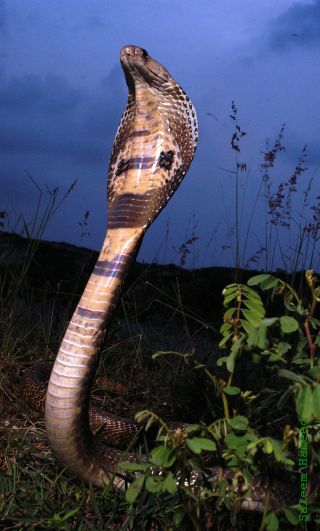
Naja annulifera occurs in northeastern South Africa and parts of Eswatini, inhabiting arid and moist savanna environments. It has neurotoxic venom and may have a banded colour phase with 7–11 yellow to yellow-brown crossbars on a blue-black background.
Written 26 November 2026 from the sources listed below. Each statement was checked against the passage it cites; statements that could not be supported were removed.
Appearance
The dorsal scales range in colour from yellowish to greyish-brown, dark brown or blue-black. The ventral scales are yellow with darker mottling.[1][2]
A banded colour phase has a blue-black background with 7–11 yellow to yellow-brown crossbars. The lighter crossbars are approximately half as wide as the darker bands, and this colour phase is more common in males.[3][4][5]
The ventral surface of banded individuals is yellow mottled with black. A darker throat band is usually more prominent in juveniles.[6][7]
The species usually has 19 midbody scale rows, although 21 occur rarely, and between 51 and 65 paired subcaudal scales. The anal shield is entire.[8][9][10]
The species usually has seven upper labial scales, occasionally eight, which do not enter the eye. It usually has eight or nine lower labial scales, with ten occurring rarely.[11][12]
The species usually has one preocular scale, occasionally two. It most commonly has two postocular scales, although one or three may occur.[13][14]
Habitat
The Snouted Cobra inhabits both arid and moist savanna environments, particularly bushveld and lowveld areas. It is not found in forests.[15][16][17]
It occurs in northeastern South Africa and parts of Eswatini. When undisturbed, it may use abandoned termite mounds as permanent lairs for several years.[18][19][20]
Diet
The Snouted Cobra eats birds and their eggs, lizards and other snakes. Puff adders are among the snake species it preys upon.[21][22][23]
Behaviour
The Snouted Cobra is nocturnal and begins foraging at dusk. During the day, it basks in sunlight near its lair or retreat.[24][25]
When disturbed, it usually raises the front third of its body, spreads its hood and hisses. It may strike defensively when threatened.[26][27]
The species may escape into the nearest hole or crevice when given the opportunity. It may also feign death when threatened, although this behaviour is rare.[28][29]
The species sometimes raids poultry enclosures. It is preyed upon by birds of prey and other snakes.[30][31]
Reproduction and life cycle
The Snouted Cobra is oviparous. Females lay between 8 and 33 eggs in early summer.[32][33]
Hatchlings average between 22 and 34 centimetres in length.[34]
Similar species
The Snouted Cobra was formerly classified as a subspecies of the Egyptian cobra.[35]
Classification of the Snouted Cobra
| Kingdom | Animalia |
|---|---|
| Phylum | Chordata |
| Subphylum | Vertebrata |
| Infraphylum | Gnathostomata |
| Parvphylum | Osteichthyes |
| Megaclass | Tetrapoda |
| Class | Reptilia (Reptile) |
| Order | Squamata (Snakes) |
| Suborder | Serpentes (Snakes) |
| Infraorder | Alethinophidia |
| Family | Elapidae (Cobras) |
| Genus | Naja (Cobras) |
| Species | Naja annulifera Peters, 1854 |
Where the Snouted Cobra is found
Checklists and occurrence records place Naja annulifera in 8 countries across Africa. GBIF holds 1,286 georeferenced records of it.
Countries
Regions and cities with the most records
- Limpopo, South Africa 193
- Gauteng, South Africa 101
- Mpumalanga, South Africa 64
- KwaZulu-Natal, South Africa 58
- North West, South Africa 55
- Pretoria, South Africa 36
- Cullinan, South Africa 34
- Moloto South, South Africa 27
- Centurion, South Africa 20
- Ga-Rankuwa, South Africa 20
- Harare, Zimbabwe 19
- Harare, Zimbabwe 17
- Ekangala, South Africa 15
- eSikhaleni, South Africa 14
- Hartbeespoort, South Africa 13
- Midstream, South Africa 13
- Polokwane, South Africa 13
- Brits, South Africa 12
- Mabopane, South Africa 12
- Ruwa, Zimbabwe 11
- White River, South Africa 11
- Mashonaland West, Zimbabwe 10
- Mbombela, South Africa 10
- Mookgophong, South Africa 10
- Phalaborwa, South Africa 10
- Hammanskraal, South Africa 9
- Louis Trichardt, South Africa 9
- Manicaland, Zimbabwe 9
- Masvingo Province, Zimbabwe 8
- Midrand, South Africa 8
- Soshanguve, South Africa 8
- Bulawayo, Zimbabwe 7
- Calcutta, South Africa 7
- Central, Botswana 7
- Maputo Province, Mozambique 7
- Mkhuhlu, South Africa 7
Range as the checklists state it
Zambia (Gwembe valley = middle Zambezi), S Malawi,
A number beside a place is its count of GBIF occurrence records. A place without a number comes from a checklist alone. Records show where a species has been observed or collected, which can include escapes and vagrants.
Common names
English
- Snouted Cobra
- Banded Cobra
- Noga Ya Bothodi
Names in 16 other languages
- Afrikaans
- Bosveldkapel, Egiptiese Kobra, Wipneuskobra
- Arabic
- ناشر مُخطَّم
- Chinese
- 喙眼鏡蛇
- Czech
- kobra kroužkovaná
- Danish
- Snudekobra
- French
- Cobra annelé
- German
- Gebänderte Kobra
- Hungarian
- örvös kobra
- Italian
- Cobra a bande egiziano, Cobra fasciato egiziano
- Japanese
- ハナナガコブラ
- Portuguese
- Cobra-focinhuda
- Spanish
- Cobra, Cobra hocicuda
- Tswana
- Kake, leso la mae
- Xhosa
- isiKhotsholo
- Zulu
- uNomphemphethwayo, uPhempethwane
- sna
- Makure?, Mungu?, Nyamafingu
Synonyms
3 other scientific names have been used for this species and are now treated as synonyms of Naja annulifera.
- Naja annulifera annulifera W. C. H. Peters, 1854
- Naja haje annulifera W. C. H. Peters, 1854
- Naja haje var. annulifera Peters, 1854
Related species
-
 Indian CobraNaja naja
-
 Egyptian CobraNaja haje
-
 Monocled CobraNaja kaouthia
-
 Caspian CobraNaja oxiana
-
 Forest CobraNaja melanoleuca
-
 Cape CobraNaja nivea
-
 Philippine CobraNaja philippinensis
-
 Red Spitting CobraNaja pallida
Compare
Questions and answers
What is the scientific name of the Snouted Cobra?
The scientific name of the Snouted Cobra is Naja annulifera. Written with its author, the full name is Naja annulifera Peters, 1854.
Which family does the Snouted Cobra belong to?
Naja annulifera belongs to the family Elapidae, in the order Squamata and the class Reptilia.
Where is the Snouted Cobra found?
Checklists and occurrence records place Naja annulifera in 8 countries, including South Africa, Zimbabwe, Mozambique, Botswana, Eswatini and Namibia.
What is the conservation status of the Snouted Cobra?
The IUCN Red List category recorded for Naja annulifera is Least Concern (LC).
What other names does the Snouted Cobra have?
Naja annulifera is also known in English as Banded Cobra and Noga Ya Bothodi.
Is cobra hemotoxic or neurotoxic?
The Snouted Cobra has neurotoxic venom.[36]
Sources
Passages the profile rests on
- The species has dorsal scales ranging in colour from yellowish to greyish-brown, dark brown or blue-black. Source passage: “Colouration of dorsal scales may vary from yellowish to greyish-brown, dark brown or blue-black.” — English Wikipedia
- The ventral scales are yellow with darker mottling. Source passage: “Ventral scale colouration is yellow with darker mottles.” — English Wikipedia
- A banded colour phase has a blue-black background with 7–11 yellow to yellow-brown crossbars. Source passage: “blue-black with 7-11 yellow to yellow-brown cross bars” — English Wikipedia
- The lighter crossbars in the banded colour phase are approximately half as wide as the darker bands. Source passage: “the lighter bands being half the width of the darker bands.” — English Wikipedia
- The banded colour phase is more common in males. Source passage: “The latter colour phase is more common in males.” — English Wikipedia
- The ventral surface of banded individuals is yellow mottled with black. Source passage: “Ventrally, it is yellow mottled with black.” — English Wikipedia
- The species has a darker throat band that is usually more prominent in juveniles. Source passage: “A darker throat band is present and is usually more prominent in juveniles.” — English Wikipedia
- The species usually has 19 midbody scale rows, although 21 rows occur rarely. Source passage: “Midbody scales are in 19 rows (rarely 21)” — English Wikipedia
- The species has between 51 and 65 paired subcaudal scales. Source passage: “There are 51-65 paired subcaudals” — English Wikipedia
- The species has an entire anal shield. Source passage: “the anal shield is entire.” — English Wikipedia
- The species usually has seven upper labial scales, occasionally eight, which do not enter the eye. Source passage: “There are seven (sometimes eight) upper labials that do not enter the eye” — English Wikipedia
- The species usually has eight or nine lower labial scales, with ten occurring rarely. Source passage: “eight or 9 (rarely 10) lower labials” — English Wikipedia
- The species usually has one preocular scale, occasionally two. Source passage: “one preocular (sometimes two)” — English Wikipedia
- The species has two postocular scales most commonly, although one or three may occur. Source passage: “two (sometimes one or three) postoculars.” — English Wikipedia
- The species inhabits both arid and moist savanna environments. Source passage: “Snouted cobras inhabit arid and moist savanna” — English Wikipedia
- The species particularly inhabits bushveld and lowveld areas. Source passage: “particularly in bushveld and lowveld areas.” — English Wikipedia
- The species is not found in forests. Source passage: “It is not found in forests.” — English Wikipedia
- The species may use abandoned termite mounds as permanent lairs for several years when undisturbed. Source passage: “in an abandoned termite mound, where it will reside for years if left undisturbed.” — English Wikipedia
- The species occurs in northeastern South Africa. Source passage: “northeast South Africa” — English Wikipedia
- The species occurs in parts of Eswatini. Source passage: “and parts of Eswatini.” — English Wikipedia
- The species eats birds and their eggs. Source passage: “birds and their eggs” — English Wikipedia
- The species feeds on lizards and other snakes. Source passage: “lizards and other snakes” — English Wikipedia
- Puff adders are among the snake species preyed upon by the snouted cobra. Source passage: “especially puff adders (Bitis arietans).” — English Wikipedia
- The species is nocturnal and begins foraging at dusk. Source passage: “It is a nocturnal species, foraging for food from dusk onwards.” — English Wikipedia
- The species basks in sunlight during the day near its lair or retreat. Source passage: “It enjoys basking in the sun during the day near its lair or retreat.” — English Wikipedia
- The species may strike defensively when threatened. Source passage: “This species can be quite nervous and will strike to defend itself if threatened.” — English Wikipedia
- When disturbed, the species usually raises the front third of its body, spreads its hood and hisses. Source passage: “it usually raises the front-third of its body when extending its hood and hissing.” — English Wikipedia
- The species may feign death when threatened, although this behaviour is rare. Source passage: “Like the rinkhals, it may sham death if threatened, but this is rare.” — English Wikipedia
- The species may escape into the nearest hole or crevice when given the opportunity. Source passage: “given the opportunity, it will escape to the nearest hole or crevice.” — English Wikipedia
- The species sometimes raids poultry enclosures. Source passage: “It often raids poultry runs and can become a nuisance.” — English Wikipedia
- The species is preyed upon by birds of prey and other snakes. Source passage: “It is preyed upon by birds of prey and other snakes.” — English Wikipedia
- The species is oviparous. Source passage: “This is an oviparous species” — English Wikipedia
- Females lay between 8 and 33 eggs in early summer. Source passage: “laying between 8 and 33 eggs in early summer.” — English Wikipedia
- Hatchlings average between 22 and 34 centimetres in length. Source passage: “The young average 22 to 34 cm (8.7 to 13.4 in) in length.” — English Wikipedia
- The species was formerly classified as a subspecies of the Egyptian cobra. Source passage: “It was formerly considered a subspecies of the Egyptian cobra (Naja haje)” — English Wikipedia
- The species has neurotoxic venom. Source passage: “It is a highly venomous species with neurotoxic venom.” — English Wikipedia
Data
- Catalogue of Life, 2026-10-16 XR cc by
- Global Biodiversity Information Facility CC BY 4.0
- Wikidata CC0
- GeoNames CC BY 4.0
- Wikimedia Commons per image; credit shown with each image
- Within the Catalogue of Life, this name comes from The Reptile Database cc by
References
- Peters, W. C. H. (1854). Diagnosen neuer Batrachier, welche zusammen mit der früher (24. Juli und 17. August) gegebenen Übersicht der Schlangen und Eidechsen mitgetheilt werden. Ber. Bekanntmach. Geeignet. Verhandl. Königl.-Preuss. Akad. Wiss. Berlin 1854: 614-628.
- Bocage, & du, J. V. B. (1879). Reptiles et batraciens nouveaux d’Angola. J. Acad. Sci. Lisbon 7: 97-99.
- Boulenger, G. A. (1896). Catalogue of the snakes in the British Museum, Vol. 3. London (Taylor & Francis), Xiv + 727 Pp.
- CURTIS, H. (1911). Notes on two specimens of spitting snakes from southern Rhodesia. Rep. Wellcome Res. Lab. Kharoum 4: 195-200.
- Bogert, Charles M. (1943). Dentitional phenomena in cobras and other elapids with notes on adaptive modifications of fangs. Bull. Amer. Mus. Nat. Hist. 81 (3): 285-260.
- Broadley, D. G. (1958). Snakes of Southern Rhodesia. 6. The Egyptian cobra (Naja haje haje). Afr. Wild Life 12: 125-128.
- Broadley, D. G. (1968). A review of the African cobras of the genus Naja (Serpentes: Elapinae). Arnoldia (Rhodesia) (Ser. 3) 29: 1-14.
- Branch, W. R. (1981). The venomous snakes of southern Africa 2. Elapidae and Hydrophidae. Bull. Maryland Herp. Soc. 17 (1): 1-47.
- Auerbach, R. D. (1987). The Amphibians and Reptiles of Botswana. Mokwepa Consultants, Botswana, 295 Pp.
- Broadley D G. (1990). The herpetofaunas of the islands off the coast of south Mocambique. Arnoldia Zimbabwe 9 (35): 469-493.
- Boycott, R. C. (1992). An Annotated Checklist of the Amphibians and Reptiles of Swaziland. The Conservation Trust of Swaziland.
- Branch, William R. (1993). A Photographic Guide to Snakes and Other Reptiles of Southern Africa. Cape Town: Struik Publishers, 144 S.
- Spawls, S., & Branch, B. (1995). The Dangerous Snakes of Africa. Blandford, London, 192 Pp.
- Broadley, D. G. (1995). The snouted cobra, Naja annulifera, a valid species in southern Africa. J. Herp. Assoc. Africa 44: 26-32.
- Slowinski, Joseph B. and Wolfgang Wüster. (2000). A new cobra (Elapidae: Naja) from Myanmar (Burma). Herpetologica 56 (2): 257-270.
- Haagner,G.V.; Branch,W.R. & Haagner,A.J.F. (2000). Notes on a collection of reptiles from Zambia and adjacent areas of the Democratic Republic of the Congo. Annals of the Eastern Cape Museum 1: 1 – 25.
- Broadley, D.G.; Doria, C.T. & Wigge, J. (2003). Snakes of Zambia. An Atlas and Field Guide. Edition Chimaira, Frankfurt, 280 Pp. [Review in Sauria 26 (3): 21].
- Schmidt, A. D., & Gruschwitz, M. (2004). Neues vom Blouberg Conservation Project - ein Beispiel für praktische Naturschutzarbeit im neuen Südafrika. Elaphe 12 (2): 55-59.
- Dobiey, M., & Vogel, G. (2007). Venomous Snakes of Africa - Giftschlangen Afrikas. Edition Chimaira, Terralog 15, 150 Pp.
- Wallach, V.; Wüster, W. & Broadley, D.G. (2009). In praise of subgenera: taxonomic status of cobras of the genus Naja Laurenti (Serpentes: Elapidae). Zootaxa 2236: 26–36.
- Trape, J.F.; Chirio, L.; Broadley, D.G. & Wüster, W. (2009). Phylogeography and systematic revision of the Egyptian cobra (Serpentes: Elapidae: Naja haje) species complex, with the description of a new species from West Africa. Zootaxa 2236: 1–25.
- Jacobsen, Niels H.G.; Errol W. Pietersen & Darren W. Pietersen. (2010). A preliminary herpetological survey of the Vilanculos Coastal Wildlife Sanctuary on the San Sebastian Peninsula, Vilankulo, Mozambique. Herpetology Notes 3: 181-193.
- Mastenbroek, & Richard. (2011). Naja annulifera Peters 1854. Litteratura Serpentium 31 (2): 99-119.
- Winchell, S. (2011). Kobras. Reptilia (Münster) 16 (89): 16-22.
- Sindaco, R.; Alberto Venchi & Cristina Grieco. (2013). The Reptiles of the Western Palearctic, Volume 2: Annotated Checklist and Distributional Atlas of the Snakes of Europe, North Africa, Middle East and Central Asia, with an Update to Volume 1. Edizioni Belvedere, Latina (Italy), 543 Pp.
This species in other databases
Page built on 28 November 2026. See how the catalog is made and all sources and licences.
Cite this page
ScientificNames.org. (2026). Naja annulifera (Snouted Cobra). Retrieved November 28, 2026, from https://scientificnames.org/species/naja-annulifera
“Naja annulifera (Snouted Cobra).” ScientificNames.org, 2026, scientificnames.org/species/naja-annulifera. Accessed 28 Nov. 2026.
ScientificNames.org. “Naja annulifera (Snouted Cobra).” Accessed November 28, 2026. https://scientificnames.org/species/naja-annulifera.
@misc{scientificnames_naja_annulifera_snouted_cobra,
  author = {{ScientificNames.org}},
  title = {Naja annulifera (Snouted Cobra)},
  year = {2026},
  url = {https://scientificnames.org/species/naja-annulifera},
  note = {Accessed 2026-11-28}
}