Overview
Christy's Water Cobra is a reptile in the family Elapidae, order Squamata, and class Reptilia. It inhabits areas along the lower Congo River and nearby wet forested areas. It is a semi-aquatic snake with a blackish brown upper body and a neck that can expand into a hood.
Written 26 November 2026 from the sources listed below. Each statement was checked against the passage it cites; statements that could not be supported were removed.
Similar species
The species was formerly classified in the genus Boulengerina. Boulengerina christyi is treated as a synonym of Naja christyi.[1][2]
Appearance
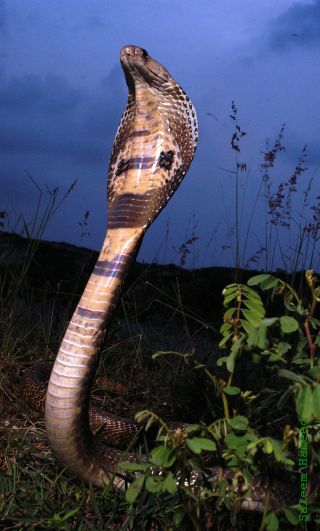
Christy's Water Cobra has a moderately slender but heavily built body that is somewhat compressed. Its head is short and distinct from the neck, which can expand into a hood.[3][4][5]
Its eyes are relatively small and have round pupils. Its dorsal scales are smooth and shiny.[6][7]
Its upper body is blackish brown, while its nape and front third of the body have irregular pale brown and black crossbars. Its belly and the underside of its tail are blackish.[8][9][10]
Adult specimens average approximately 1.1 metres in total length, including the tail. The species can grow to lengths exceeding 2.3 metres.[11][12]
Its dorsal scales occur in 19 rows around the neck and 17 rows at midbody.[13]
Habitat
Christy's Water Cobra commonly inhabits areas in or near water. It occurs in lowland bushy or wooded areas along the banks of lakes, rivers, and streams.[14][15]
Its habitat is restricted to the lower Congo River and nearby wet forested areas.[16]
Diet
Fish and amphibians are its principal prey. It also eats small lizards and rodents when opportunities arise.[17][18]
Behaviour
Christy's Water Cobra is semi-aquatic and spends much of its time in water. It is an excellent swimmer and is believed to be active both during the day and at night.[19][20][21]
It commonly hides among rocks, in holes, or beneath overhanging shoreline tree roots. It also uses human-made structures such as bridges and jetties as hiding places.[22][23]
It is generally not aggressive, and bites are consequently rare. When approached in water, it quickly swims away.[24][25]
When threatened on land, it raises its body, spreads its narrow hood, and hisses. It may strike when extensively provoked.[26][27]
Reproduction and life cycle
Christy's Water Cobra is oviparous. Its mating season and clutch size have not been established.[28][29]
Conservation
Christy's Water Cobra has a small geographic range. It has no known subspecies.[30][31]
Classification of the Christy's Water Cobra
| Kingdom | Animalia |
|---|---|
| Phylum | Chordata |
| Subphylum | Vertebrata |
| Infraphylum | Gnathostomata |
| Parvphylum | Osteichthyes |
| Megaclass | Tetrapoda |
| Class | Reptilia (Reptile) |
| Order | Squamata (Snakes) |
| Suborder | Serpentes (Snakes) |
| Infraorder | Alethinophidia |
| Family | Elapidae (Cobras) |
| Genus | Naja (Cobras) |
| Species | Naja christyi (Boulenger, 1904) |
Where the Christy's Water Cobra is found
Checklists and occurrence records place Naja christyi in 1 country across Africa. GBIF holds 18 georeferenced records of it.
Countries
Range as the checklists state it
W Democratic Republic of the Congo (Zaire), Congo (Brazzaville)
A number beside a place is its count of GBIF occurrence records. A place without a number comes from a checklist alone. Records show where a species has been observed or collected, which can include escapes and vagrants.
Common names
English
- Christy's Water Cobra
Names in 2 other languages
- Czech
- kobra konžská
- Russian
- Водяная кобра Кристи
Synonyms
2 other scientific names have been used for this species and are now treated as synonyms of Naja christyi.
- Boulengerina christyi Boulenger, 1904
- Limnonaja christyi Schmidt, 1923
Related species
-
 Indian CobraNaja naja
-
 Egyptian CobraNaja haje
-
 Monocled CobraNaja kaouthia
-
 Caspian CobraNaja oxiana
-
 Forest CobraNaja melanoleuca
-
 Cape CobraNaja nivea
-
 Philippine CobraNaja philippinensis
-
 Red Spitting CobraNaja pallida
Compare
Questions and answers
What is the scientific name of the Christy's Water Cobra?
The scientific name of the Christy's Water Cobra is Naja christyi. Written with its author, the full name is Naja christyi (Boulenger, 1904).
Which family does the Christy's Water Cobra belong to?
Naja christyi belongs to the family Elapidae, in the order Squamata and the class Reptilia.
Where is the Christy's Water Cobra found?
Checklists and occurrence records place Naja christyi in 1 country: Democratic Republic of the Congo.
What is the conservation status of the Christy's Water Cobra?
The IUCN Red List category recorded for Naja christyi is Least Concern (LC).
Sources
Passages the profile rests on
- The species was formerly classified in the genus Boulengerina. Source passage: “This species was formerly in the genus Boulengerina” — English Wikipedia
- Boulengerina christyi is treated as a synonym of Naja christyi. Source passage: “Boulengerina christyi is a synonym of Naja christyi.” — English Wikipedia
- The species has a moderately slender but heavily built body that is somewhat compressed. Source passage: “somewhat compressed, moderately slender-bodied, but heavily built snake” — English Wikipedia
- Its head is short and distinct from the neck. Source passage: “The head is short, with an indistinct canthus, and is distinct from the neck.” — English Wikipedia
- Its neck can expand into a hood. Source passage: “The neck is capable of being spread into a hood.” — English Wikipedia
- Its eyes are relatively small and have round pupils. Source passage: “The eyes are relatively small in size with round pupils.” — English Wikipedia
- Its dorsal scales are smooth and shiny. Source passage: “The dorsal scales are smooth and shiny.” — English Wikipedia
- Its upper body is blackish brown. Source passage: “Colouration is blackish brown above.” — English Wikipedia
- Its nape and front third of the body have irregular pale brown and black crossbars. Source passage: “The nape and the anterior third of the body have irregular pale brown and black cross bars” — English Wikipedia
- Its belly and the underside of its tail are blackish. Source passage: “The belly and the ventral surface of the tail are blackish.” — English Wikipedia
- Adult specimens average approximately 1.1 metres in total length, including the tail. Source passage: “The average total length (including tail) of an adult specimen is around 1.1 metres (3.6 ft)” — English Wikipedia
- The species can grow to lengths exceeding 2.3 metres. Source passage: “but it may grow to upwards of 2.3 metres (7.5 ft)” — English Wikipedia
- Its dorsal scales occur in 19 rows around the neck and 17 rows at midbody. Source passage: “The dorsal scales are in 19 rows on the neck, and in 17 rows at midbody.” — English Wikipedia
- The species commonly inhabits areas in or near water. Source passage: “N. christyi is found most commonly in or near water” — English Wikipedia
- It occurs in lowland bushy or wooded areas along the banks of lakes, rivers, and streams. Source passage: “in lowland bushy or wooded areas along banks of lakes, rivers, and streams.” — English Wikipedia
- Its habitat is restricted to the lower Congo River and nearby wet forested areas. Source passage: “It is limited to the lower Congo River and nearby wet forested areas.” — English Wikipedia
- Fish and amphibians are its principal prey. Source passage: “N. christyi predominately preys upon fish and amphibians” — English Wikipedia
- It also eats small lizards and rodents when opportunities arise. Source passage: “but it will also prey upon small lizards and rodents if the opportunity is there.” — English Wikipedia
- The species is semi-aquatic and spends much of its time in water. Source passage: “It is a semi-aquatic snake which spends much of its time in the water.” — English Wikipedia
- It is an excellent swimmer. Source passage: “An excellent swimmer.” — English Wikipedia
- It is believed to be active both during the day and at night. Source passage: “it is believed to be active by day and night.” — English Wikipedia
- It commonly hides among rocks, in holes, or beneath overhanging shoreline tree roots. Source passage: “It tends to hide amongst rocks, in holes or overhanging tree roots at the shore line.” — English Wikipedia
- It also uses human-made structures such as bridges and jetties as hiding places. Source passage: “It also makes use of any man-made structures such as bridges and jetties to hide.” — English Wikipedia
- It is generally not aggressive, and bites are consequently rare. Source passage: “Generally this is not an aggressive snake, so bites are rare.” — English Wikipedia
- When approached in water, it quickly swims away. Source passage: “If approached in water it will swim away swiftly.” — English Wikipedia
- When threatened on land, it raises its body, spreads its narrow hood, and hisses. Source passage: “If threatened on land it will rear up, spread its narrow hood and hiss.” — English Wikipedia
- It may strike when extensively provoked. Source passage: “It may strike if it's provoked extensively.” — English Wikipedia
- The species is oviparous. Source passage: “N. christyi is an oviparous species” — English Wikipedia
- Its mating season and clutch size have not been established. Source passage: “but mating season and number of eggs laid is not known.” — English Wikipedia
- The species has a small geographic range. Source passage: “N. christyi has a small geographic range.” — English Wikipedia
- The species has no known subspecies. Source passage: “This species has no known subspecies.” — English Wikipedia
Data
- Catalogue of Life, 2026-10-16 XR cc by
- Global Biodiversity Information Facility CC BY 4.0
- Wikidata CC0
- GeoNames CC BY 4.0
- Within the Catalogue of Life, this name comes from The Reptile Database cc by
References
- Boulenger, G. A. (1904). Descriptions of two new Elapine snakes from the Congo. Ann. Mag. Nat. Hist. (7) 14: 14.
- Schmidt, K. P. (1923). Contributions to the herpetology of the Belgian Congo based on the collection of the American Museum Congo Expedition, 1909-1915. Part II. Snakes, with field notes by Herbert Lang and James P. Chapin. Bull. Amer. Mus. Nat. Hist. 49 (1): 1-146.
- Witte, de, G. F., & Laurent, R. (1942). Contribution à la Faune Herpétologique du Congo belge. Rev. Zool. Bot. Afr. 36 (2): 101-115.
- Chifundera, K. (1990). Snakes of Zaire and their bites. Afr. Stud. Monogr. (Kyoto) 10(3): 137-157.
- Trape, J.F. & R. ROUX-ESTÈVE. (1990). Note sur une collection de serpents du Congo avec description d’une espèce nouvelle. Rev. Zool. Afr. (J. Afr. Zool.) 104: 375-383.
- Trape, J.F. & R. ROUX-ESTÈVE. (1995). Les serpents du Congo: liste commentée et clé de détermination. Journal of African Zoology 109 (1): 31-50.
- Spawls, S., & Branch, B. (1995). The Dangerous Snakes of Africa. Blandford, London, 192 Pp.
- Dobiey, M., & Vogel, G. (2007). Venomous Snakes of Africa - Giftschlangen Afrikas. Edition Chimaira, Terralog 15, 150 Pp.
- Wüster, Wolfgang; Steven Crookes, Ivan Ineich, Youssouph Mané, Catharine E. Pook, Jean-Francois Trape, Donald G. Broadley. (2007). The phylogeny of cobras inferred from mitochondrial DNA sequences: Evolution of venom spitting and the phylogeography of the African spitting cobras (Serpentes: Elapidae: Naja nigricollis complex). Molecular Phylogenetics and Evolution 45: 437–453.
- Wallach, V.; Wüster, W. & Broadley, D.G. (2009). In praise of subgenera: taxonomic status of cobras of the genus Naja Laurenti (Serpentes: Elapidae). Zootaxa 2236: 26–36.
- Beolens, B., & Michael Watkins, a. M. G. (2011). The Eponym Dictionary of Reptiles. Johns Hopkins University Press, Baltimore, USA.
- Wallach, Van; Kenneth L. Williams, Jeff Boundy. (2014). Snakes of the World: A Catalogue of Living and Extinct Species. [type catalogue]. Taylor and Francis, CRC Press, 1237 Pp.
- Spawls, S., & Branch, B. (2020). The Dangerous Snakes of Africa. Bloomsbury, London, 336 Pp.
- COLLET, Marcel, & Jean-Francois TRAPE. (2020). Une nouvelle et remarquable espèce de naja semi-aquatique (Elapidae, sous-genre Boulengerina Dollo, 1886) de la République Démocratique du Congo. Bull. Soc. Herp. France 173: 41-52.
- Trape, J.-F. (2023). Guide des serpents d’Afrique occidentale, centrale et d’Afrique du Nord. IRD Éditions, Marseille, 896 Pp.
This species in other databases
Page built on 27 November 2026. See how the catalog is made and all sources and licences.
Cite this page
ScientificNames.org. (2026). Naja christyi (Christy's Water Cobra). Retrieved November 27, 2026, from https://scientificnames.org/species/naja-christyi
“Naja christyi (Christy's Water Cobra).” ScientificNames.org, 2026, scientificnames.org/species/naja-christyi. Accessed 27 Nov. 2026.
ScientificNames.org. “Naja christyi (Christy's Water Cobra).” Accessed November 27, 2026. https://scientificnames.org/species/naja-christyi.
@misc{scientificnames_naja_christyi_christys_water_cobra,
  author = {{ScientificNames.org}},
  title = {Naja christyi (Christy's Water Cobra)},
  year = {2026},
  url = {https://scientificnames.org/species/naja-christyi},
  note = {Accessed 2026-11-27}
}