Species · Reptiles
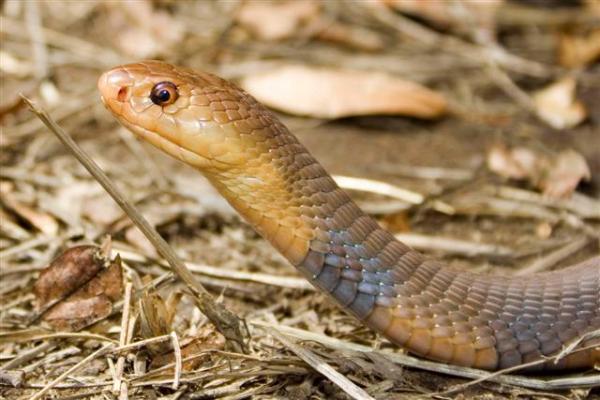
Mali Cobra Naja katiensis
The scientific name of the Mali Cobra is Naja katiensis. It is a species of reptile in the family Elapidae (cobras), order Squamata. The name dates from 1922.
- Scientific name
- Naja katiensis Angel, 1922
- Common name
- Mali Cobra
- Genus
- Naja
- Family
- Elapidae (Cobras)
- Order
- Squamata
- Class
- Reptilia
- Red List category
- LC Least Concern
- Recorded in
- 12 countries
- Name status
- accepted in the Catalogue of Life
Overview
Naja katiensis is found in West Africa, with a geographic range extending from Senegal to Cameroon. It is highly venomous and spits venom toward its opponents.
Written 26 November 2026 from the sources listed below. Each statement was checked against the passage it cites; statements that could not be supported were removed.
Habitat
The Mali Cobra inhabits tropical and subtropical grasslands, open forests, savannas, and shrublands.[1]
Behaviour
The Mali Cobra is predominantly diurnal and terrestrial, but it can be active during both daytime and nighttime. Juveniles are active only during daytime.[2][3][4]
The species sometimes climbs into small bushes. When inactive, it shelters under logs, rocks, or inside holes.[5][6]
When disturbed, the Mali Cobra rapidly escapes toward cover. When cornered, it raises its body and spreads its small, narrow hood.[7][8]
When further provoked, it spits venom. It may bite when handled or accidentally stepped on.[9][10]
Classification of the Mali Cobra
| Kingdom | Animalia |
|---|---|
| Phylum | Chordata |
| Subphylum | Vertebrata |
| Infraphylum | Gnathostomata |
| Parvphylum | Osteichthyes |
| Megaclass | Tetrapoda |
| Class | Reptilia (Reptile) |
| Order | Squamata (Snakes) |
| Suborder | Serpentes (Snakes) |
| Infraorder | Alethinophidia |
| Family | Elapidae (Cobras) |
| Genus | Naja (Cobras) |
| Species | Naja katiensis Angel, 1922 |
Where the Mali Cobra is found
Checklists and occurrence records place Naja katiensis in 12 countries across Africa. GBIF holds 26 georeferenced records of it.
Countries
- Burkina Faso 1
- Cameroon 1
- Gambia
- Ghana 3
- Guinea 3
- Ivory Coast
- Mali 9
- Mauritania
- Niger
- Nigeria 6
- Senegal 3
- Togo
Regions and cities with the most records
Range as the checklists state it
Burkina Faso, Cameroon, Ghana, Guinea (Conakry), Ivory Coast, Mali, Gambia, Mauritania, Niger ?, Nigeria, Senegal, Togo, possibly Benin (Hughes 2013)
A number beside a place is its count of GBIF occurrence records. A place without a number comes from a checklist alone. Records show where a species has been observed or collected, which can include escapes and vagrants.
Common names
English
- Mali Cobra
- Katian Spitting Cobra
Names in 6 other languages
- Arabic
- ناشر مالي
- Chinese
- 馬里眼鏡蛇
- Czech
- kobra kamerunská
- French
- Cobra cracheur de Kati
- Hungarian
- barna köpködőkobra
- Italian
- Cobra sputatore del Mali, Cobra sputatore dell'Africa occidentale
Synonyms
3 other scientific names have been used for this species and are now treated as synonyms of Naja katiensis.
- Naja nigricollis katiensis Angel, 1922
- Naja nigricollis var. katiensis Angel, 1922
- Naja trilepis Roman, 1968
Related species
-
 Indian CobraNaja naja
-
 Egyptian CobraNaja haje
-
 Monocled CobraNaja kaouthia
-
 Caspian CobraNaja oxiana
-
 Forest CobraNaja melanoleuca
-
 Cape CobraNaja nivea
-
 Philippine CobraNaja philippinensis
-
 Red Spitting CobraNaja pallida
Compare
Questions and answers
What is the scientific name of the Mali Cobra?
The scientific name of the Mali Cobra is Naja katiensis. Written with its author, the full name is Naja katiensis Angel, 1922.
Which family does the Mali Cobra belong to?
Naja katiensis belongs to the family Elapidae, in the order Squamata and the class Reptilia.
Where is the Mali Cobra found?
Checklists and occurrence records place Naja katiensis in 12 countries, including Mali, Nigeria, Ghana, Guinea, Senegal and Burkina Faso.
What is the conservation status of the Mali Cobra?
The IUCN Red List category recorded for Naja katiensis is Least Concern (LC).
What other names does the Mali Cobra have?
Naja katiensis is also known in English as Katian Spitting Cobra.
What is a cobra snake's habitat?
The Mali Cobra inhabits tropical and subtropical grasslands, open forests, savannas, and shrublands.[1]
Sources
Passages the profile rests on
- The Mali cobra inhabits tropical and subtropical grasslands, open forests, savannas, and shrublands. Source passage: “The Mali cobra occurs in both tropical and subtropical grasslands, open forests, savannas, and shrublands.” — English Wikipedia
- The species can be active during both daytime and nighttime. Source passage: “This species can be active both at day and night” — English Wikipedia
- Juvenile Mali cobras are active only during daytime. Source passage: “although juveniles are only active during daytime.” — English Wikipedia
- The species is predominantly diurnal and terrestrial. Source passage: “However, it is predominantly diurnal and terrestrial” — English Wikipedia
- Mali cobras sometimes climb into small bushes. Source passage: “but will often climb into small bushes.” — English Wikipedia
- When inactive, Mali cobras shelter under logs, rocks, or inside holes. Source passage: “Mali cobras will take shelter under logs, rocks or in holes when inactive.” — English Wikipedia
- When disturbed, the species rapidly escapes toward cover. Source passage: “If disturbed it will escape to cover with haste” — English Wikipedia
- When cornered, the Mali cobra raises its body and spreads its small, narrow hood. Source passage: “if cornered, will rear up and spread its small, narrow hood.” — English Wikipedia
- When further provoked, the species spits venom. Source passage: “If further provoked it will spit its venom.” — English Wikipedia
- Mali cobras may bite when handled or accidentally stepped on. Source passage: “These snakes will bite if handled or accidentally stepped on.” — English Wikipedia
Data
- Catalogue of Life, 2026-10-16 XR cc by
- Global Biodiversity Information Facility CC BY 4.0
- Wikidata CC0
- GeoNames CC BY 4.0
- Wikimedia Commons per image; credit shown with each image
- Within the Catalogue of Life, this name comes from The Reptile Database cc by
References
- Angel, F. (1922). Sur une collection de reptiles et de batraciens, recuillis au Soudan Francais par le mission, du Dr. Millet Horsin. Bull. Mus. Natn. Hist. Nat., Paris, 28: 40.
- Roman, B. (1968). Serpents du Haute-Volta. Une nouvelle espèce de Naja (cracheur) en Haute-Volta. Carrefour Africain 299: 273–274, 286, 310.
- Broadley, D. G. (1968). A review of the African cobras of the genus Naja (Serpentes: Elapinae). Arnoldia (Rhodesia) (Ser. 3) 29: 1-14.
- Hughes, B. (1983). African snake faunas. Bonner Zoologische Beiträge 34: 311-356.
- Spawls, S., & Branch, B. (1995). The Dangerous Snakes of Africa. Blandford, London, 192 Pp.
- Sinsin B, Bergmans W(eds). (1999). Rongeurs, ophidiens et relations avec l’environnement agricole du Bénin. Cotonou (Éd. Flamboyant), 199 Pp.
- Trape, J.-F., & Mané, Y. (2000). Les serpents des environs de Dielmo (Sine-Saloum, Sénégal). Bull. Soc. Herp. France 95: 19-35.
- Trape, J.-F. et al. (2001). High mortality from snakebite in south-eastern Senegal. Trans. Roy. Soc. Trop. Med. Hyg. 95: 420-423.
- Trape, J.-F. & Mané, Y. (2004). Les serpents des environs de Bandafassi (Sénégal oriental). Bull. Soc. Herp. France 109: 5-34.
- Padial, J. M. (2006). COMMENTED DISTRIBUTIONAL LIST OF THE REPTILES OF MAURITANIA (WEST AFRICA). Graellsia, 62(2): 159-178.
- Trape, J.-F. & Mané, Y. (2006). Guide des serpents d’Afrique occidentale. Savane et désert. [Senegal, Gambia, Mauritania, Mali, Burkina Faso, Niger]. IRD Editions, Paris, 226 Pp.
- Dobiey, M., & Vogel, G. (2007). Venomous Snakes of Africa - Giftschlangen Afrikas. Edition Chimaira, Terralog 15, 150 Pp.
- Wüster, Wolfgang; Steven Crookes, Ivan Ineich, Youssouph Mané, Catharine E. Pook, Jean-Francois Trape, Donald G. Broadley. (2007). The phylogeny of cobras inferred from mitochondrial DNA sequences: Evolution of venom spitting and the phylogeography of the African spitting cobras (Serpentes: Elapidae: Naja nigricollis complex). Molecular Phylogenetics and Evolution 45: 437–453.
- Wüster, W., & Broadley, D. G. (2007). Get an eyeful of this: a new species of giant spitting cobra from eastern and north-eastern Africa (Squamata: Serpentes: Elapidae: Naja). Zootaxa 1532: 51–68.
- Chirio, L., & Lebreton, M. (2007). Atlas des reptiles du Cameroun. MNHN, IRD, Paris 688 Pp.
- Chirio, L. (2009). Inventaire des reptiles de la région de la Réserve de Biosphère Transfrontalière du W (Niger/Bénin/Burkina Faso: Afrique de l’Ouest). [Herpetological survey of the W Transfrontier Biosphere Reserve area (Niger/Benin/Burkina Faso: West Africa]. Bull. Soc. Herp. France (132): 13-41.
- Wallach, V.; Wüster, W. & Broadley, D.G. (2009). In praise of subgenera: taxonomic status of cobras of the genus Naja Laurenti (Serpentes: Elapidae). Zootaxa 2236: 26–36.
- Segniagbeto GLazcano. H., Trape J. F., David P., Ohler A., Dubois A. & Glitho I. A. (2011). The snake fauna of Togo: systematics, distribution and biogeography, with remarks on selected taxonomic problems. Zoosystema 33 (3): 325-360. DOI: 10.5252/Z2011n3a4.
- Böhme, Wolfgang, Mark-Oliver Rödel, Christian Brede, & Philipp Wagner. (2011). The reptiles (Testudines, Squamata, Crocodylia) of the forested southeast of the Republic Guinea (Guinée forestière), with a country-wide checklist. Bonn Zoological Bulletin 60 (1): 35-61.
- Hughes, B. (2013). Snakes of Bénin, West Africa. Bull. Soc. Herp. France 144: 101-159.
- TRAPE, JEAN-FRANÇOIS, & CELLOU BALDÉ. (2014). A checklist of the snake fauna of Guinea, with taxonomic changes in the genera Philothamnus and Dipsadoboa (Colubridae) and a comparison with the snake fauna of some other West African countries. Zootaxa 3900 (3): 301–338.
- Wallach, Van; Kenneth L. Williams, Jeff Boundy. (2014). Snakes of the World: A Catalogue of Living and Extinct Species. [type catalogue]. Taylor and Francis, CRC Press, 1237 Pp.
- Trape, Jean-François, & Youssouph Mané. (2017). The snakes of Mali. Bonn Zoological Bulletin 66 (2): 107–133.
- Hörold, & Ralf. (2019). Die echten Kobras und ihre Gifte. Ophidia 13 (1): 18-26.
- Chippaux, Jean-Philippe, & Kate Jackson. (2019). Snakes of Central and Western Africa. Johns Hopkins University Press, 448 Pp. [Detaileld Review in HR 51 (1): 161].
This species in other databases
Page built on 29 November 2026. See how the catalog is made and all sources and licences.
Cite this page
ScientificNames.org. (2026). Naja katiensis (Mali Cobra). Retrieved November 29, 2026, from https://scientificnames.org/species/naja-katiensis
“Naja katiensis (Mali Cobra).” ScientificNames.org, 2026, scientificnames.org/species/naja-katiensis. Accessed 29 Nov. 2026.
ScientificNames.org. “Naja katiensis (Mali Cobra).” Accessed November 29, 2026. https://scientificnames.org/species/naja-katiensis.
@misc{scientificnames_naja_katiensis_mali_cobra,
  author = {{ScientificNames.org}},
  title = {Naja katiensis (Mali Cobra)},
  year = {2026},
  url = {https://scientificnames.org/species/naja-katiensis},
  note = {Accessed 2026-11-29}
}