Species · Reptiles
Many-banded Snake Naja multifasciata
The scientific name of the Many-banded Snake is Naja multifasciata. It is a species of reptile in the family Elapidae (cobras), order Squamata. The name dates from 1902.
- Scientific name
- Naja multifasciata (Werner, 1902)
- Common name
- Many-banded Snake
- Genus
- Naja
- Family
- Elapidae (Cobras)
- Order
- Squamata
- Class
- Reptilia
- Red List category
- LC Least Concern
- Recorded in
- 5 countries
- Name status
- accepted in the Catalogue of Life
Overview
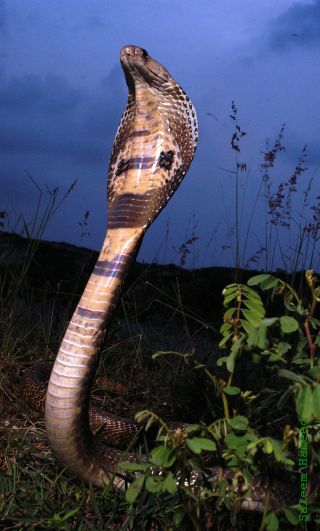
The Many-banded Snake is venomous. It primarily inhabits marshy areas within forests. Its neck cannot expand into a hood.
Written 26 November 2026 from the sources listed below. Each statement was checked against the passage it cites; statements that could not be supported were removed.
Appearance
The Many-banded Snake has a moderately slender body and a short tail that terminates in a blunt spike. Its head is short, flattened, and slightly distinct from the neck.[1][2]
Its eyes are medium to moderately large, with round pupils. Its dorsal scales are smooth and glossy.[3][4][5]
The maximum recorded length is approximately 81 cm.[6]
Habitat
The Many-banded Snake primarily inhabits marshy areas within forests. It occurs at elevations up to 800 metres.[7][8]
Similar species
The Many-banded Snake is closely related to the forest cobra (Naja melanoleuca).[9]
Reproduction and life cycle
The Many-banded Snake is oviparous.[10]
Classification of the Many-banded Snake
| Kingdom | Animalia |
|---|---|
| Phylum | Chordata |
| Subphylum | Vertebrata |
| Infraphylum | Gnathostomata |
| Parvphylum | Osteichthyes |
| Megaclass | Tetrapoda |
| Class | Reptilia (Reptile) |
| Order | Squamata (Snakes) |
| Suborder | Serpentes (Snakes) |
| Infraorder | Alethinophidia |
| Family | Elapidae (Cobras) |
| Genus | Naja (Cobras) |
| Species | Naja multifasciata (Werner, 1902) |
Where the Many-banded Snake is found
Checklists and occurrence records place Naja multifasciata in 5 countries across Africa. GBIF holds 27 georeferenced records of it.
Countries
Range as the checklists state it
W/C Democratic Republic of the Congo (Zaire), Congo (Brazzaville), Cameroon, Gabon, Angola, Equatorial Guinea
A number beside a place is its count of GBIF occurrence records. A place without a number comes from a checklist alone. Records show where a species has been observed or collected, which can include escapes and vagrants.
Common names
English
- Many-banded Snake
- Many-banded Cobra
Names in 3 other languages
- Czech
- kobra zemní
- French
- Cobra fouisseur
- Russian
- Многополосая паранайя
Synonyms
6 other scientific names have been used for this species and are now treated as synonyms of Naja multifasciata.
- Boulengerina multifasciata (Werner, 1902)
- Elapechis duttoni Boulenger, 1904
- Naia multifasciata Werner, 1902
- Naja anomala Sternfeld, 1917
- Paranaja multifasciata (Werner, 1902)
- Paranaja multifasciata anomala Sternfeld, 1917
Subspecies and varieties
- Naja multifasciata anomala subspecies
- Naja multifasciata duttoni subspecies
- Naja multifasciata multifasciata subspecies
Related species
-
 Indian CobraNaja naja
-
 Egyptian CobraNaja haje
-
 Monocled CobraNaja kaouthia
-
 Caspian CobraNaja oxiana
-
 Forest CobraNaja melanoleuca
-
 Cape CobraNaja nivea
-
 Philippine CobraNaja philippinensis
-
 Red Spitting CobraNaja pallida
Compare
Questions and answers
What is the scientific name of the Many-banded Snake?
The scientific name of the Many-banded Snake is Naja multifasciata. Written with its author, the full name is Naja multifasciata (Werner, 1902).
Which family does the Many-banded Snake belong to?
Naja multifasciata belongs to the family Elapidae, in the order Squamata and the class Reptilia.
Where is the Many-banded Snake found?
Checklists and occurrence records place Naja multifasciata in 5 countries: Cameroon, Democratic Republic of the Congo, Gabon, Equatorial Guinea and Angola.
What is the conservation status of the Many-banded Snake?
The IUCN Red List category recorded for Naja multifasciata is Least Concern (LC).
What other names does the Many-banded Snake have?
Naja multifasciata is also known in English as Many-banded Cobra.
Sources
Passages the profile rests on
- The species has a moderately slender body and a short tail that terminates in a blunt spike. Source passage: “The body is moderately slender with a short tail ending in a blunt spike.” — English Wikipedia
- Its head is short, flattened, and slightly distinct from the neck. Source passage: “The head is short, flattened, and slightly distinct from neck;” — English Wikipedia
- Its eyes are medium to moderately large in size. Source passage: “The eyes are medium to moderately large.” — English Wikipedia
- Its pupils are round. Source passage: “The pupils are round.” — English Wikipedia
- Its dorsal scales are smooth and glossy. Source passage: “The dorsal scales are smooth and glossy.” — English Wikipedia
- The maximum recorded length is approximately 81 cm. Source passage: “maximum size of about 81 cm (32 in).” — English Wikipedia
- The species primarily inhabits marshy areas within forests. Source passage: “The preferred natural habitat of N. multifasciata is marshy areas of forest,” — English Wikipedia
- The species occurs at elevations up to 800 metres. Source passage: “at elevations up to 800 m (2,600 ft).” — English Wikipedia
- The species is closely related to the forest cobra (Naja melanoleuca). Source passage: “this species is closely related to the forest cobra (Naja melanoleuca)” — English Wikipedia
- The species is oviparous. Source passage: “N. multifasciata is oviparous.” — English Wikipedia
Data
- Catalogue of Life, 2026-10-16 XR cc by
- Global Biodiversity Information Facility CC BY 4.0
- Wikidata CC0
- GeoNames CC BY 4.0
- Within the Catalogue of Life, this name comes from The Reptile Database cc by
References
- Werner, F. (1902) Uber westafrikanische Reptilien. Verhandlungen der Zoologisch-Botanischen Gesellschaft in Wien, 52, 332 - 348. where the name was published
- Werner, F. (1902). Über westafrikanische Reptilien. Verh. Zool. Bot. Ges. Wien 52: 332-348.
- Boulenger, G. A. (1904). Descriptions of two new Elapine snakes from the Congo. Ann. Mag. Nat. Hist. (7) 14: 14.
- Sternfeld, R. (1917). Reptilia und Amphibia. In: Schubotz, H. (Hrsg.): Wissenschaftliche Ergebnisse der Zweiten Deutschen Zentral-Afrika-Expedition, 1910-1911 unter Führung Adolph Friedrichs, Herzog zu Mecklenburg. Leipzig: Klinkhardt & Biermann, [Band] 1, Zoologie, Lieferung 11; S. 407-510.
- Werner, F. (1924). Neue oder wenig bekannte Schlangen aus dem Naturhistorischen Staatsmuseum in Wien. l. Teil. Sitzungsb. Ber. Akad. Wiss., Wien, Abt. L, 133: 29-56.
- Hughes, B. (1983). African snake faunas. Bonner Zoologische Beiträge 34: 311-356.
- Chifundera, K. (1990). Snakes of Zaire and their bites. Afr. Stud. Monogr. (Kyoto) 10(3): 137-157.
- Trape, J.F. & R. ROUX-ESTÈVE. (1990). Note sur une collection de serpents du Congo avec description d’une espèce nouvelle. Rev. Zool. Afr. (J. Afr. Zool.) 104: 375-383.
- Trape, J.F. & R. ROUX-ESTÈVE. (1995). Les serpents du Congo: liste commentée et clé de détermination. Journal of African Zoology 109 (1): 31-50.
- Spawls, S., & Branch, B. (1995). The Dangerous Snakes of Africa. Blandford, London, 192 Pp.
- Chirio, & Laurent and Ivan Ineich. (2006). Biogeography of the reptiles of the Central African Republic. African Journal of Herpetology 55(1):23-59.
- Dobiey, M., & Vogel, G. (2007). Venomous Snakes of Africa - Giftschlangen Afrikas. Edition Chimaira, Terralog 15, 150 Pp.
- Wüster, Wolfgang; Steven Crookes, Ivan Ineich, Youssouph Mané, Catharine E. Pook, Jean-Francois Trape, Donald G. Broadley. (2007). The phylogeny of cobras inferred from mitochondrial DNA sequences: Evolution of venom spitting and the phylogeography of the African spitting cobras (Serpentes: Elapidae: Naja nigricollis complex). Molecular Phylogenetics and Evolution 45: 437–453.
- Pauwels, O. S. G., & Vande Weghe, J. P. (2008). Les reptiles du Gabon. Smithsonian Institution, Washington: 272 Pp.
- Wallach, V.; Wüster, W. & Broadley, D.G. (2009). In praise of subgenera: taxonomic status of cobras of the genus Naja Laurenti (Serpentes: Elapidae). Zootaxa 2236: 26–36.
- Wallach, Van; Kenneth L. Williams, Jeff Boundy. (2014). Snakes of the World: A Catalogue of Living and Extinct Species. [type catalogue]. Taylor and Francis, CRC Press, 1237 Pp.
- O’Shea, M. (2018). The Book of Snakes. Ivy Press / Quarto Publishing, London,.
- Marques, Mariana P.; Luis M. P. Ceríaco , David C. Blackburn , and Aaron M. Bauer. (2018). Diversity and Distribution of the Amphibians and Terrestrial Reptiles of Angola -- Atlas of Historical and Bibliographic Records (1840–2017). Proc. Cal. Acad. Sci. (Ser. 4) 65: 1-501 (Supplement II).
- Chippaux, Jean-Philippe, & Kate Jackson. (2019). Snakes of Central and Western Africa. Johns Hopkins University Press, 448 Pp. [Detaileld Review in HR 51 (1): 161].
- Spawls, S., & Branch, B. (2020). The Dangerous Snakes of Africa. Bloomsbury, London, 336 Pp.
- Sánchez-Vialas, A., CALVO-REVUELTA, M., & DE LA RIVA, I. (2022). Synopsis of the terrestrial Reptiles of Equatorial Guinea. Zootaxa 5202 (1): 1-197.
- Pauwels, O. S. G., & Brecko, J. (2023). Book review: Guide des Serpents d’Afrique Occidentale, Centrale et d’Afrique du Nord. Jean-François Trape.IRD Editions, Marseille, France (www.editions.ird.fr). 896 pp. Herpetological Review 54 (4): 700-702.
- Trape, J.-F. (2023). Guide des serpents d’Afrique occidentale, centrale et d’Afrique du Nord. IRD Éditions, Marseille, 896 Pp.
This species in other databases
Page built on 28 November 2026. See how the catalog is made and all sources and licences.
Cite this page
ScientificNames.org. (2026). Naja multifasciata (Many-banded Snake). Retrieved November 28, 2026, from https://scientificnames.org/species/naja-multifasciata
“Naja multifasciata (Many-banded Snake).” ScientificNames.org, 2026, scientificnames.org/species/naja-multifasciata. Accessed 28 Nov. 2026.
ScientificNames.org. “Naja multifasciata (Many-banded Snake).” Accessed November 28, 2026. https://scientificnames.org/species/naja-multifasciata.
@misc{scientificnames_naja_multifasciata_many_banded_snake,
  author = {{ScientificNames.org}},
  title = {Naja multifasciata (Many-banded Snake)},
  year = {2026},
  url = {https://scientificnames.org/species/naja-multifasciata},
  note = {Accessed 2026-11-28}
}