Species · Reptiles
Nubian Spitting Cobra Naja nubiae
The scientific name of the Nubian Spitting Cobra is Naja nubiae. It is a species of reptile in the family Elapidae (cobras), order Squamata. The name dates from 2003.
- Scientific name
- Naja nubiae Wüster & Broadley, 2003
- Common name
- Nubian Spitting Cobra
- Genus
- Naja
- Family
- Elapidae (Cobras)
- Order
- Squamata
- Class
- Reptilia
- Red List category
- LC Least Concern
- Recorded in
- 9 countries
- Name status
- accepted in the Catalogue of Life

Overview
The Nubian Spitting Cobra is a relatively small spitting cobra. It has a scattered distribution in northeastern Africa, occurring in Sudan's Nile Valley and Darfur and the Aïr Mountains of Niger. It has a defensive ability to eject venom.
Written 26 November 2026 from the sources listed below. Each statement was checked against the passage it cites; statements that could not be supported were removed.
Similar species
The Nubian Spitting Cobra was previously confused with the red spitting cobra (Naja pallida). It was distinguished from that species through detailed morphological and mitochondrial DNA analysis.[1][2]
Appearance
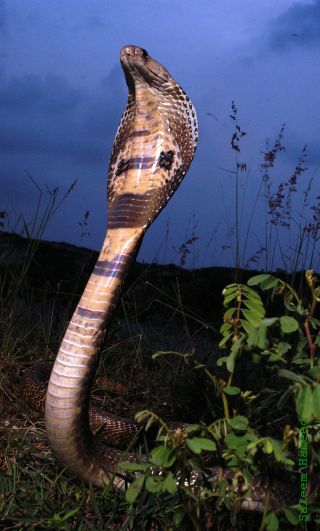
The Nubian Spitting Cobra has an overall brownish-grey coloration. Its scale bases and the skin between its scales are black, and its belly is slightly lighter in colour than the rest of its body.[3][4][5]
It has a dark band across the nape and a dark ring across its throat and neck. It usually has an additional dark band on its belly.[6][7][8]
Its dark body bands may become less distinct as it ages.[9]
Behaviour
The Nubian Spitting Cobra has a defensive ability to eject venom.[10]
Classification of the Nubian Spitting Cobra
| Kingdom | Animalia |
|---|---|
| Phylum | Chordata |
| Subphylum | Vertebrata |
| Infraphylum | Gnathostomata |
| Parvphylum | Osteichthyes |
| Megaclass | Tetrapoda |
| Class | Reptilia (Reptile) |
| Order | Squamata (Snakes) |
| Suborder | Serpentes (Snakes) |
| Infraorder | Alethinophidia |
| Family | Elapidae (Cobras) |
| Genus | Naja (Cobras) |
| Species | Naja nubiae Wüster & Broadley, 2003 |
Where the Nubian Spitting Cobra is found
Checklists and occurrence records place Naja nubiae in 9 countries across Africa. GBIF holds 57 georeferenced records of it.
Countries
Regions and cities with the most records
1 more country has a few records outside this range
These countries hold a few records of Naja nubiae but lie outside the range the checklists give for it. Such records are often zoo or garden specimens, museum material or vagrants, so the species is not counted as occurring there.
Range as the checklists state it
Egypt, Sudan (Jumhūriyyat), Chad, Niger, Eritrea, Djibouti
A number beside a place is its count of GBIF occurrence records. A place without a number comes from a checklist alone. Records show where a species has been observed or collected, which can include escapes and vagrants.
Common names
English
- Nubian Spitting Cobra
Names in 5 other languages
- Arabic
- الناشر النوبي البصَّاق
- Chinese
- 努比亞射毒眼鏡蛇
- Czech
- kobra núbijská
- German
- Nubische Speikobra
- Italian
- Cobra sputatore della Nubia, Cobra sputatore egiziano, Cobra sputatore nubiano
Synonyms
One other scientific name has been used for this species and is now treated as a synonym of Naja nubiae.
- Naja mossambica pallida
Related species
-
 Indian CobraNaja naja
-
 Egyptian CobraNaja haje
-
 Monocled CobraNaja kaouthia
-
 Caspian CobraNaja oxiana
-
 Forest CobraNaja melanoleuca
-
 Cape CobraNaja nivea
-
 Philippine CobraNaja philippinensis
-
 Red Spitting CobraNaja pallida
Compare
Questions and answers
What is the scientific name of the Nubian Spitting Cobra?
The scientific name of the Nubian Spitting Cobra is Naja nubiae. Written with its author, the full name is Naja nubiae Wüster & Broadley, 2003.
Which family does the Nubian Spitting Cobra belong to?
Naja nubiae belongs to the family Elapidae, in the order Squamata and the class Reptilia.
Where is the Nubian Spitting Cobra found?
Checklists and occurrence records place Naja nubiae in 9 countries, including Sudan, Egypt, Somalia, Djibouti, Kenya and Ethiopia.
What is the conservation status of the Nubian Spitting Cobra?
The IUCN Red List category recorded for Naja nubiae is Least Concern (LC).
Sources
Passages the profile rests on
- The Nubian spitting cobra was previously confused with the red spitting cobra (Naja pallida). Source passage: “It was previously confused with the red spitting cobra (Naja pallida)” — English Wikipedia
- The Nubian spitting cobra was distinguished from the red spitting cobra through detailed morphological and mitochondrial DNA analysis. Source passage: “but was distinguished based on detailed morphological and mitochondrial DNA analysis.” — English Wikipedia
- The Nubian spitting cobra has an overall brownish-grey coloration. Source passage: “Brownish-grey overall, scale bases and skin between scales black.” — English Wikipedia
- Its scale bases and the skin between its scales are black. Source passage: “scale bases and skin between scales black.” — English Wikipedia
- Its belly is slightly lighter in colour than the rest of its body. Source passage: “Belly slightly lighter.” — English Wikipedia
- It has a dark band across the nape. Source passage: “Dark band across nape” — English Wikipedia
- It has a dark ring across its throat and neck. Source passage: “dark ring across throat and neck” — English Wikipedia
- It usually has an additional dark band on its belly. Source passage: “usually an additional dark band on belly” — English Wikipedia
- Its dark body bands may become less distinct as it ages. Source passage: “bands may fade with age.” — English Wikipedia
- The species has a defensive ability to eject venom. Source passage: “known for its defensive ability to eject venom.” — britannica.com
- The Nubian spitting cobra has a scattered distribution in northeastern Africa. Source passage: “A scattered distribution in north-eastern Africa:” — English Wikipedia
- The species occurs in Sudan's Nile Valley and Darfur. Source passage: “Sudan (Nile Valley, Darfur)” — English Wikipedia
- The species occurs in the Aïr Mountains of Niger. Source passage: “Niger (Aïr Mountains).” — English Wikipedia
Data
- Catalogue of Life, 2026-10-16 XR cc by
- Global Biodiversity Information Facility CC BY 4.0
- Wikidata CC0
- GeoNames CC BY 4.0
- Wikimedia Commons per image; credit shown with each image
- Within the Catalogue of Life, this name comes from The Reptile Database cc by
References
- Wüster, Wolfgang & Donald G. Broadley. 2003. A new species of spitting cobra (Naja) from north-eastern Africa (Serpentes: Elapidae). Journal of Zoology, London 259: 345-359. Link where the name was published
- Geoffroy Saint-Hilaire, E. (1827). Description des Reptiles. In: Savigny, M. J. C. L. de, Description de l’Égypte ou recueil des observations et des recherches Quintana Roo ont été faites en Égypte pendant l’expedition de l’Armée Française, publié par les ordres de sa Majesté l’Empereur Napoléon Le Grand. Histoire Naturelle. Tome premier. Paris, L’imprimerie Impériale. Pp. 121-160 (115-184) [1809?].
- Boulenger, G. A. (1896). Catalogue of the snakes in the British Museum, Vol. 3. London (Taylor & Francis), Xiv + 727 Pp.
- Anderson, & John. (1896). A Contribution to the Herpetology of Arabia, with a preliminary list of the reptiles and batrachians of Egypt. London, R. H. Porter, 124 Pp.
- Andersson, L. G. (1904). List of reptiles and batrachians collected by the Swedish zoological expedition to Egypt, the Sudan and the Sinaitic Peninsula. In Results of the Swedish zoological expedition to Egypt, the Sudan and the Sinaitic Peninsula:1–12. Jägerskiöld, L. A. (Ed.). Uppsala.
- Werner, F. (1908). Ergebnisse der mit Subvention aus der Erbschaft Treitl unternommenen zoologischen Forschungsreise Dr. Franz Werner’s nach nach dem Ägyptischen Sudan und Norduganda. XII. die Reptilien und Amphibien. [Mabuia mongallensis, Leptodira attarensis]. Sitzungsber. Akad. Wiss. Wien 116 [1907]: 1823-1926.
- Boulenger, G. A. (1915). A list of the snakes of the Belgian and Portuguese Congo, northern Rhodesia, and Angola. Proc. Zool. Soc. London 1915: 193-223.
- Werner, F. (1919). Wissenschaftliche Ergebnisse der mit Unterstützung der Kaiserlichen Akademie der Wissenschaften in Wien aus der Erbschaft Treitl von F. Werner unternommenen zoologischen Expedition nach dem Anglo-Aegyptischen Sudan (Kordofan) 1914. IV. Bearbeitung der Fische, Amphibien und Reptilien. Denkschr. Akad. Wiss Wien, Math.-Naturw. Klasse 96: 437-509.
- Werner, F. (1927). Wissenschaftliche Ergebnisse der mit Unterstützung der Akademie der Wissenschaften in Wien aus der Erbschaft Treitl von F. Werner unternommen zoologischen Expedition nach dem Anglo–Ägyptischen Sudan (Kordofan) 1914. XXIV. Miscellanea Sudanica. G. Zur Kenntnis der Fauna der Nilinsel Atrun (Kitchener’s Island). Denkschr. Akad. Wiss. Wien, Math.-Natwiss. Kl. 101: 67–78.
- Scortecci, G. (1929). Rettili dell’Eritrea esistenti nelle Collezioni del Museo Civico de Milano. Atti Della Società Italiana Di Scienze Naturali, E Del Museo Civico Di Storia Naturale, Milano 67 (3-4): 290-339 [1928].
- Scortecci, & Giuseppe. (1930). Rettili ed Anfibi raccolti dal Prof. E. Zavattari in Eritrea. Atti. Soc. Ital. Sci. Nat. (Milano), 69: 193-217.
- Loveridge, & Arthur. (1945). On a collection of reptiles from Eriterea. Notulae Naturae (151): 1-4.
- Eiselt, J. (1962). Ergebnisse der zoologischen Nubien-Expedition 1962, Teil II, Amphibien und Reptilien. Ann. Naturhist. Mus. Wien 65: 281-296.
- Marx, & Hymen. (1968). Checklist of the reptiles and amphibians of Egypt. Spec. Publ. U.S. Nav. Med. Res. Unit 3: 1-91.
- Broadley, D. G. (1968). A review of the African cobras of the genus Naja (Serpentes: Elapinae). Arnoldia (Rhodesia) (Ser. 3) 29: 1-14.
- Branch, W. R. (1979). The venomous snakes of southern Africa Part 2. Elapidae and Hydrophidae. The Snake 11: 199–225.
- Harding, K.A., & Welch, K.R.G. (1980). Venomous snakes of the world; a checklist. Pergamon Press, Oxford 188 Pp.
- Hughes, B. (1983). African snake faunas. Bonner Zoologische Beiträge 34: 311-356.
- Broadley, D. G. (1983). FitzSimon’s snakes of Southern Africa (revised edition). Delta Books, Jahannesburg, 376 Pp.
- Golay, P. (1985). Checklist and keys to the terrestrial proteroglyphs of the world (Serpentes: Elapidae - Hydrophiidae). Elapsoidea, Geneva.
- Osman, H.E.S.I., & Sir, N.T.E. (1988). The snakes of the Sudan. 1. The snakes of Khartoum Province. The Snake 20 (1): 74-79.
- Meirte, D. (1992). Clés de détermination des serpents d’Afrique. Museum Royal d’Afrique Centrale, Tervuren Belgique Annual Series Octavo Science Zoologique 267:1-152.
- Largen, M. J., & Rasmussen, J. B. (1993). Catalogue of the snakes of Ethiopia (Reptilia Serpentes), including identification keys. Tropical Zoology 6: 313-434.
- Spawls, S., & Branch, B. (1995). The Dangerous Snakes of Africa. Blandford, London, 192 Pp.
- Largen, M. J. (1997). An annotated checklist of the amphibians and reptiles of Eritrea, with keys for their identification. Tropical Zoology 10: 63-115.
This species in other databases
Page built on 27 November 2026. See how the catalog is made and all sources and licences.
Cite this page
ScientificNames.org. (2026). Naja nubiae (Nubian Spitting Cobra). Retrieved November 27, 2026, from https://scientificnames.org/species/naja-nubiae
“Naja nubiae (Nubian Spitting Cobra).” ScientificNames.org, 2026, scientificnames.org/species/naja-nubiae. Accessed 27 Nov. 2026.
ScientificNames.org. “Naja nubiae (Nubian Spitting Cobra).” Accessed November 27, 2026. https://scientificnames.org/species/naja-nubiae.
@misc{scientificnames_naja_nubiae_nubian_spitting_cobra,
  author = {{ScientificNames.org}},
  title = {Naja nubiae (Nubian Spitting Cobra)},
  year = {2026},
  url = {https://scientificnames.org/species/naja-nubiae},
  note = {Accessed 2026-11-27}
}