Overview
Naja romani was an extinct reptile in the family Elapidae, order Squamata, and class Reptilia. It was a large cobra, with some specimens estimated to have exceeded 2 m in length.
Written 26 November 2026 from the sources listed below. Each statement was checked against the passage it cites; statements that could not be supported were removed.
Habitat
Naja romani is thought to have been thermophilous. The Solnechnodolsk locality associated with the species is estimated to have had a mean annual temperature of at least 15°C and is inferred to have had subtropical conditions.[1][2][3]
Similar species
Fossils previously classified as Naja austriaca were subsequently considered indistinguishable from Naja romani.[4]
Conservation
Naja romani is extinct. Cobras disappeared from central Europe by the latest Miocene, a decline associated with ongoing climatic change.[5][6]
Only one bone of Naja romani is known from the Solnechnodolsk region.[7]
Uses
Naja romani is assigned to the Asian lineage of the genus Naja and is considered likely to have been an early member of the Asian cobra group. The divergence between Naja and Hemachatus was calibrated using a mean age of 18 million years based on the occurrence of Naja romani.[8][9][10]
Classification of Naja romani
| Kingdom | Animalia |
|---|---|
| Phylum | Chordata |
| Subphylum | Vertebrata |
| Infraphylum | Gnathostomata |
| Parvphylum | Osteichthyes |
| Megaclass | Tetrapoda |
| Class | Reptilia (Reptile) |
| Order | Squamata (Snakes) |
| Suborder | Serpentes (Snakes) |
| Infraorder | Alethinophidia |
| Family | Elapidae (Cobras) |
| Genus | Naja (Cobras) |
| Species | Naja romani (Hoffstetter, 1939) |
This name was added to the Catalogue of Life from a contributing dataset by automated merging and has not yet been reviewed by its editors.
Where Naja romani is found
Checklists and occurrence records place Naja romani in 1 country. GBIF holds 3 georeferenced records of it.
Countries
Regions and cities with the most records
A number beside a place is its count of GBIF occurrence records. A place without a number comes from a checklist alone. Records show where a species has been observed or collected, which can include escapes and vagrants.
Related species
-
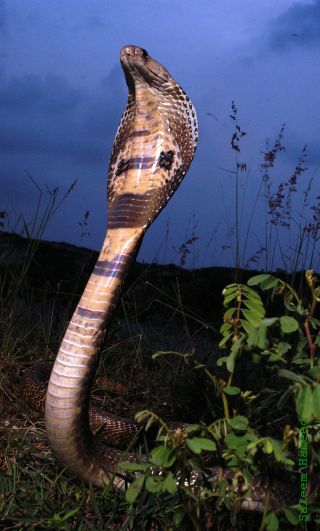 Indian CobraNaja naja
-
 Egyptian CobraNaja haje
-
 Monocled CobraNaja kaouthia
-
 Caspian CobraNaja oxiana
-
 Forest CobraNaja melanoleuca
-
 Cape CobraNaja nivea
-
 Philippine CobraNaja philippinensis
-
 Red Spitting CobraNaja pallida
Compare
Sources
Passages the profile rests on
- Naja romani is thought to have been thermophilous. Source passage: “the species is thought to be thermophilous like most other Asian Naja species” — English Wikipedia
- The Solnechnodolsk locality associated with Naja romani is estimated to have had a mean annual temperature of at least 15°C. Source passage: “a mean annual temperature of 15°C or more is estimated for the Solnechnodosk locality” — English Wikipedia
- The Solnechnodolsk locality is inferred to have had subtropical conditions. Source passage: “suggesting subtropical conditions.” — English Wikipedia
- Fossils previously classified as Naja austriaca were subsequently considered indistinguishable from Naja romani. Source passage: “Fossils from Austria had previously been considered to be their own species, Naja austriaca, but were later deemed to be indistinguishable from those of Naja romani.” — English Wikipedia
- Naja romani is extinct. Source passage: “Naja romani is an extinct species of cobra” — English Wikipedia
- Cobras disappeared from central Europe by the latest Miocene, a decline associated with ongoing climatic change. Source passage: “Ongoing climate change however likely lead to the extinction of cobras in central Europe by the latest Miocene” — English Wikipedia
- Only one bone of Naja romani is known from the Solnechnodolsk region. Source passage: “only a single bone of Naja romani is known from the region” — English Wikipedia
- Naja romani is assigned to the Asian lineage of the genus Naja. Source passage: “clearly placing it in the Asian branch of the genus.” — English Wikipedia
- Naja romani is considered likely to have been an early member of the Asian cobra group. Source passage: “Szyndlar and Zerova conclude that the species was likely an early member of the Asian group” — English Wikipedia
- The divergence between Naja and Hemachatus was calibrated using a mean age of 18 million years based on the occurrence of Naja romani. Source passage: “The third point of the calibration was the divergence between Naja and Hemachatus cobras using a mean of 18 Mya based on the occurrence of Naja romani” — pmc.ncbi.nlm.nih.gov
Data
- Catalogue of Life, 2026-10-16 XR cc by
- Global Biodiversity Information Facility CC BY 4.0
- Wikidata CC0
- GeoNames CC BY 4.0
- Within the Catalogue of Life, this name comes from Naja romani (Hoffstetter, 1939) (Serpentes: Elapidae) from the late Miocene of the Northern Caucasus: the last East European large cobra cc0
References
- HOFFSTETTER R. 1939. - Contribution a l'etude des Elapidae actuels et fossiles et de l'osteologie des Ophidiens. Archives du Museum d'Histoire naturelle de Lyon 15: 1 - 78. where the name was published
This species in other databases
Page built on 26 November 2026. See how the catalog is made and all sources and licences.
Cite this page
ScientificNames.org. (2026). Naja romani. Retrieved November 26, 2026, from https://scientificnames.org/species/naja-romani
“Naja romani.” ScientificNames.org, 2026, scientificnames.org/species/naja-romani. Accessed 26 Nov. 2026.
ScientificNames.org. “Naja romani.” Accessed November 26, 2026. https://scientificnames.org/species/naja-romani.
@misc{scientificnames_naja_romani,
  author = {{ScientificNames.org}},
  title = {Naja romani},
  year = {2026},
  url = {https://scientificnames.org/species/naja-romani},
  note = {Accessed 2026-11-26}
}