Species · Reptiles
Andaman Cobra Naja sagittifera
The scientific name of the Andaman Cobra is Naja sagittifera. It is a species of reptile in the family Elapidae (cobras), order Squamata. The name dates from 1913.

Overview
The species is endemic to the Andaman and Little Andaman Islands of India.
Written 26 November 2026 from the sources listed below. Each statement was checked against the passage it cites; statements that could not be supported were removed.
Habitat
The Andaman Cobra inhabits the Andaman Islands, which are described as protected.[1]
Forests cover more than 85% of the total land area of the Andaman and Nicobar Islands.[2]
Behaviour
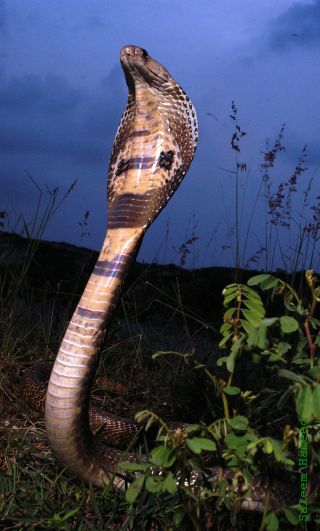
The Andaman Cobra can expand its hood when threatened. It can also eject venom defensively, although this behaviour is very rare.[3][4]
Its venom-spitting aim is relatively inaccurate compared with that of true spitting cobras.[5]
Similar species
Phylogenetic reconstructions indicate that Naja sagittifera originated from a common ancestor of the Southeast Asian monocled cobra (Naja kaouthia) and confirm a close evolutionary relationship between the two species.[6][7]
The Caspian cobra (Naja oxiana) and monocled cobra (Naja kaouthia) have been identified as sister clades to Naja sagittifera.[8]
Appearance
The body is compressed from top to bottom and becomes sub-cylindrical toward the rear. The head is broad and slightly distinct from the neck, and the eyes are medium-sized with round pupils.[9][10][11]
The light-brown or creamish form has indistinct black lines around its body and tail. The grayish form has distinct, narrow, irregular black crossbars on its body and tail.[12][13]
Juveniles are glossy black above and have narrow, irregular white crossbars along the body and tail. They also have broad black crossbands on the throat or underside of the neck.[14][15]
The juvenile hood marking is a distinct white monocle with a black centre. The white monocle becomes black as the snake ages, and the broad white band below it disappears with age.[16][17][18]
The scales are smooth and occur in 27–29 rows near the neck, 21–23 around the middle of the body, and 15–17 near the rear. There are seven supralabial scales, with the third and fourth contacting the eye.[19][20]
The paired subcaudal scales number between 60 and 64.[21]
The average total length is approximately 0.9 metres, and individuals regularly reach approximately 1.5 metres. The longest recorded specimen measured 1.8 metres.[22][23][24]
Classification of the Andaman Cobra
| Kingdom | Animalia |
|---|---|
| Phylum | Chordata |
| Subphylum | Vertebrata |
| Infraphylum | Gnathostomata |
| Parvphylum | Osteichthyes |
| Megaclass | Tetrapoda |
| Class | Reptilia (Reptile) |
| Order | Squamata (Snakes) |
| Suborder | Serpentes (Snakes) |
| Infraorder | Alethinophidia |
| Family | Elapidae (Cobras) |
| Genus | Naja (Cobras) |
| Species | Naja sagittifera Wall, 1913 |
Where the Andaman Cobra is found
Checklists and occurrence records place Naja sagittifera in 1 country. GBIF holds 9 georeferenced records of it.
Countries
Regions and cities with the most records
Range as the checklists state it
India: Andaman Islands
A number beside a place is its count of GBIF occurrence records. A place without a number comes from a checklist alone. Records show where a species has been observed or collected, which can include escapes and vagrants.
Common names
English
- Andaman Cobra
Names in 3 other languages
- Chinese
- 安達曼眼鏡蛇
- Czech
- kobra andamanská
- Italian
- Cobra delle Andamane
Synonyms
5 other scientific names have been used for this species and are now treated as synonyms of Naja sagittifera.
- Naja kaouthia sagittifera Deraniyagala, 1960
- Naja naja sagittifera Leviton, 1968
- Naja tripudians sagittifera Wall, 1913
- Naja tripudians var. sagittifera Wall, 1913
- Naja kaouthia Wüster & Thorpe, 1991 ambiguous synonym
Related species
-
 Indian CobraNaja naja
-
 Egyptian CobraNaja haje
-
 Monocled CobraNaja kaouthia
-
 Caspian CobraNaja oxiana
-
 Forest CobraNaja melanoleuca
-
 Cape CobraNaja nivea
-
 Philippine CobraNaja philippinensis
-
 Red Spitting CobraNaja pallida
Compare
Questions and answers
What is the scientific name of the Andaman Cobra?
The scientific name of the Andaman Cobra is Naja sagittifera. Written with its author, the full name is Naja sagittifera Wall, 1913.
Which family does the Andaman Cobra belong to?
Naja sagittifera belongs to the family Elapidae, in the order Squamata and the class Reptilia.
Where is the Andaman Cobra found?
Checklists and occurrence records place Naja sagittifera in 1 country: India.
What is the conservation status of the Andaman Cobra?
The IUCN Red List category recorded for Naja sagittifera is Endangered (EN).
Sources
Passages the profile rests on
- The species inhabits the Andaman Islands, which are described as protected. Source passage: “Their habitat is on the Andaman Islands, which are protected.” — inaturalist.org
- The Andaman and Nicobar Islands have forests covering more than 85% of their total land area. Source passage: “Over 85% of the total land area being covered by forests” — pmc.ncbi.nlm.nih.gov
- The species can eject venom defensively, although this behaviour is very rare. Source passage: “is capable of "spitting", although this defensive behavior is very rare” — English Wikipedia
- The species can expand its hood when threatened. Source passage: “capable of expansion to form a hood when threatened” — English Wikipedia
- Its venom-spitting aim is relatively inaccurate compared with that of true spitting cobras. Source passage: “the aim is poor and not as efficient as "true spitting cobras".” — English Wikipedia
- Phylogenetic reconstructions indicate that Naja sagittifera originated from a common ancestor of the Southeast Asian monocled cobra (Naja kaouthia). Source passage: “N. sagittifera was found to have originated from the common ancestor of Southeast Asian monocled cobra (N. kaouthia).” — pmc.ncbi.nlm.nih.gov
- Phylogenetic reconstructions confirmed a close evolutionary relationship between Naja sagittifera and Naja kaouthia. Source passage: “Phylogenetic reconstructions confirmed the close relationship between N. sagittifera and the Southeast Asian monocellate cobra (N. kaouthia).” — pmc.ncbi.nlm.nih.gov
- The Caspian cobra (Naja oxiana) and monocled cobra (Naja kaouthia) have been identified as sister clades to Naja sagittifera. Source passage: “The Caspian cobra (Naja oxiana) and Monocled cobra (Naja kaouthia) have been demonstrated to be sister clades to Naja sagittifera.” — English Wikipedia
- Its body is compressed from top to bottom and becomes sub-cylindrical toward the rear. Source passage: “Body is compressed dorsoventrally and sub-cylindrical posteriorly.” — English Wikipedia
- The species has a broad head that is slightly distinct from its neck. Source passage: “Head broad, slightly distinct from neck.” — English Wikipedia
- Its eyes are medium-sized and have round pupils. Source passage: “Eye medium, with round pupil” — English Wikipedia
- The light-brown or creamish adult colour form has indistinct black lines around its body and tail. Source passage: “Light brown or creamish above, with indistinct black lines round the body and tail” — English Wikipedia
- The grayish adult colour form has distinct, narrow, irregular black crossbars on its body and tail. Source passage: “Uniform grayish above, with distinct black narrow, irregular cross-bars on the body and tail” — English Wikipedia
- Juveniles have broad black crossbands on the throat or underside of the neck. Source passage: “Juveniles have broad black cross-band on throat or underside of neck.” — English Wikipedia
- Juveniles are glossy black above and have narrow, irregular white crossbars along the body and tail. Source passage: “Juveniles are glossy black above with a series of narrow, white, irregular cross-bars on body and tail” — English Wikipedia
- The juvenile hood marking is a distinct white monocle with a black centre. Source passage: “There is a distinct white monocle mark, with black centre.” — English Wikipedia
- The white juvenile monocle marking becomes black as the snake ages. Source passage: “Monocle mark becomes black with the age” — English Wikipedia
- The broad white band below the juvenile monocle marking disappears with age. Source passage: “also a broad white band below monocle mark disappears with age.” — English Wikipedia
- Its scales are smooth and occur in 27–29 rows near the neck, 21–23 around the middle of the body, and 15–17 near the rear. Source passage: “Scales smooth, in 27-29 : 21-23 : 15-17 rows” — English Wikipedia
- The species has seven supralabial scales, with the third and fourth contacting the eye. Source passage: “supralabials 7 ( 3rd and 4th in contact with the eye )” — English Wikipedia
- Its paired subcaudal scales number between 60 and 64. Source passage: “subcaudals 60–64, paired” — English Wikipedia
- The average total length of the species is approximately 0.9 metres. Source passage: “The average length of these snakes is about 0.9 metres (3.0 ft)” — English Wikipedia
- Individuals regularly reach approximately 1.5 metres in length. Source passage: “they can grow to about 1.5 metres (4.9 ft) regularly” — English Wikipedia
- The longest recorded specimen measured 1.8 metres. Source passage: “although the longest specimen found measured 1.8 metres (5.9 ft).” — English Wikipedia
Data
- Catalogue of Life, 2026-10-16 XR cc by
- Global Biodiversity Information Facility CC BY 4.0
- Wikidata CC0
- GeoNames CC BY 4.0
- Wikimedia Commons per image; credit shown with each image
- Within the Catalogue of Life, this name comes from The Reptile Database cc by
References
- Wall, F. (1913) A popular treatise on the common Indian snakes (part 2). Journal of the Bombay Natural History Society, 22, 243 - 25 where the name was published
- Wall, F. (1913). A popular treatise on the common Indian snakes (part 2). J. Bombay Nat. Hist. Soc. 22: 243-259.
- Wüster, W., Thorpe, R. S., Cox, M. J., Jintakune, P., & Nabhitabhata, J. (1995). Populuation systematics of the snake genus Naja (Reptilia: Serpentes: Elapidae) in Indochina: Multivariate morphometrics and comparative mitochondrial DNA sequencing (cytochrome oxidase I). J. Evol. Biol. 8: 493-510.
- Wüster, & Wolfgang. (1998). The cobras of the genus Naja in India. Hamadryad 23 (1): 15-32.
- Slowinski, Joseph B. and Wolfgang Wüster. (2000). A new cobra (Elapidae: Naja) from Myanmar (Burma). Herpetologica 56 (2): 257-270.
- Whitaker, & Romulus and Ashok Captain. (2004). Snakes of India. Draco Books, 500 Pp., Reprinted 2007.
- Wallach, V.; Wüster, W. & Broadley, D.G. (2009). In praise of subgenera: taxonomic status of cobras of the genus Naja Laurenti (Serpentes: Elapidae). Zootaxa 2236: 26–36.
- Murthy, T. S. N. (2010). The reptile fauna of India. B.R. Publishing, New Delhi, 332 Pp.
- Wallach, Van; Kenneth L. Williams, Jeff Boundy. (2014). Snakes of the World: A Catalogue of Living and Extinct Species. [type catalogue]. Taylor and Francis, CRC Press, 1237 Pp.
- Chandramouli, S. (2022). Snake fauna of the Andaman Islands, Bay of Bengal—A review of species richness, taxonomy, distribution, natural history and conservation status. Zootaxa 5209 (3): 301-331.
- Shi, S.‐C.; Vogel, G.; Ding, L.; Rao, D.‐Q.; Liu, S.; Zhang, L.; Wu, Z.‐J.; Chen, Z.‐N. (2022). Description of A New Cobra (Naja Laurenti, 1768; Squamata, Elapidae) from China with Designation of a Neotype for Naja atra. Animals 12, 3481.
- Chandramouli, S. R. (2023). Distribution Patterns of Snakes and Conservation Importance of Islands in the Andaman and Nicobar Archipelago, Bay of Bengal, India. In: Lillywhite & Martins, eds., Islands and snakes, vol. II. Oxford University Press, P. 121 Ff.
This species in other databases
Page built on 29 November 2026. See how the catalog is made and all sources and licences.
Cite this page
ScientificNames.org. (2026). Naja sagittifera (Andaman Cobra). Retrieved November 29, 2026, from https://scientificnames.org/species/naja-sagittifera
“Naja sagittifera (Andaman Cobra).” ScientificNames.org, 2026, scientificnames.org/species/naja-sagittifera. Accessed 29 Nov. 2026.
ScientificNames.org. “Naja sagittifera (Andaman Cobra).” Accessed November 29, 2026. https://scientificnames.org/species/naja-sagittifera.
@misc{scientificnames_naja_sagittifera_andaman_cobra,
  author = {{ScientificNames.org}},
  title = {Naja sagittifera (Andaman Cobra)},
  year = {2026},
  url = {https://scientificnames.org/species/naja-sagittifera},
  note = {Accessed 2026-11-29}
}