Species · Reptiles
West African Banded Cobra Naja savannula
The scientific name of the West African Banded Cobra is Naja savannula. It is a species of reptile in the family Elapidae (cobras), order Squamata. The name dates from 2018.
- Scientific name
- Naja savannula Broadley, Trape, Chirio & Wüster, 2018
- Common name
- West African Banded Cobra
- Genus
- Naja
- Family
- Elapidae (Cobras)
- Order
- Squamata
- Class
- Reptilia
- Red List category
- LC Least Concern
- Recorded in
- 11 countries
- Name status
- accepted in the Catalogue of Life

Overview
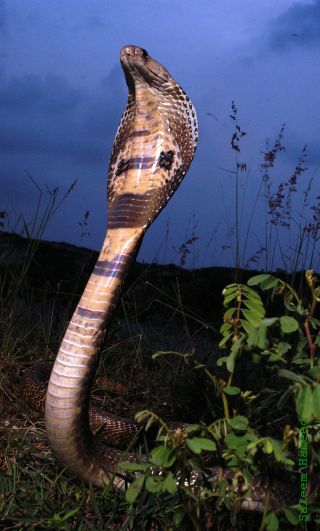
The West African Banded Cobra is a West African species of cobra in the genus Naja. It occurs in West Africa. It is distinguished by 3–8 broad, semi-divided light bands across the front portion of its body.
Written 26 November 2026 from the sources listed below. Each statement was checked against the passage it cites; statements that could not be supported were removed.
Similar species
The West African Banded Cobra was formerly considered identical to the forest cobra (Naja melanoleuca). Morphological and genetic differences established it as a separate species.[1]
Appearance
The dorsal coloration is brownish black or black. The body has 3–8 broad cream-coloured crossbands, each partly divided by a narrow black crossband.[2][3]
The species has 3–8 broad, semi-divided light bands across the front portion of its body, distinguishing it from Naja melanoleuca and other forest cobras.[4]
Habitat
The West African Banded Cobra primarily inhabits gallery forests within West African savannas and savanna woodlands.[5]
Classification of the West African Banded Cobra
| Kingdom | Animalia |
|---|---|
| Phylum | Chordata |
| Subphylum | Vertebrata |
| Infraphylum | Gnathostomata |
| Parvphylum | Osteichthyes |
| Megaclass | Tetrapoda |
| Class | Reptilia (Reptile) |
| Order | Squamata (Snakes) |
| Suborder | Serpentes (Snakes) |
| Infraorder | Alethinophidia |
| Family | Elapidae (Cobras) |
| Genus | Naja (Cobras) |
| Species | Naja savannula Broadley, Trape, Chirio & Wüster, 2018 |
Origin of the name. Etymology: ThE NAmE is dErivEd frOm thE cONtrActiON Of its sAvANNA hAbitAt ANd ANNulAtEd cOlOur pAttErN ANd wAs cOiNEd by BArry HughEs iN AN uNpublishEd 1968 mANuscript. WE hAvE rEtAiNEd this NAmE At thE rEquEst Of Our cOllEAguE BArry HughEs. Largest recorded: 1825 + 405 = 2230 mm, frOm MEdiNA DjikOyE, SENEgAl (IRD 6155. S).
Where the West African Banded Cobra is found
Checklists and occurrence records place Naja savannula in 11 countries across Africa. GBIF holds 40 georeferenced records of it.
Countries
Regions and cities with the most records
- Tambacounda, Senegal 10
- Atakora, Benin 7
- Natitingou, Benin 5
- Alibori, Benin 4
- Western, Gambia 4
- Brikama, Gambia 3
- Busumbala, Gambia 3
Range as the checklists state it
Benin, Cameroon, Ivory Coast, Gambia, Ghana, Guinea, Mali, Nigeria, Senegal, Togo, Chad
A number beside a place is its count of GBIF occurrence records. A place without a number comes from a checklist alone. Records show where a species has been observed or collected, which can include escapes and vagrants.
Common names
English
- West African Banded Cobra
Names in 3 other languages
- Danish
- Vestafrikansk Savannekobra
- Italian
- Cobra a bande dell'Africa occidentale
- Spanish
- Cobra Bandeada de África Occidental
Related species
-
 Indian CobraNaja naja
-
 Egyptian CobraNaja haje
-
 Monocled CobraNaja kaouthia
-
 Caspian CobraNaja oxiana
-
 Forest CobraNaja melanoleuca
-
 Cape CobraNaja nivea
-
 Philippine CobraNaja philippinensis
-
 Red Spitting CobraNaja pallida
Compare
Questions and answers
What is the scientific name of the West African Banded Cobra?
The scientific name of the West African Banded Cobra is Naja savannula. Written with its author, the full name is Naja savannula Broadley, Trape, Chirio & Wüster, 2018.
Which family does the West African Banded Cobra belong to?
Naja savannula belongs to the family Elapidae, in the order Squamata and the class Reptilia.
Where is the West African Banded Cobra found?
Checklists and occurrence records place Naja savannula in 11 countries, including Benin, Senegal, Gambia, Guinea, Nigeria and Cameroon.
What is the conservation status of the West African Banded Cobra?
The IUCN Red List category recorded for Naja savannula is Least Concern (LC).
What habitats do cobras live in?
The West African Banded Cobra primarily inhabits gallery forests within West African savannas and savanna woodlands.[5]
Sources
Passages the profile rests on
- Naja savannula was formerly considered identical to the forest cobra (Naja melanoleuca) before morphological and genetic differences established it as a separate species. Source passage: “This species was previously thought to be identical to the forest cobra (Naja melanoleuca), but morphological and genetic differences have led to its recognition as a separate species.” — English Wikipedia
- The dorsal coloration of Naja savannula is brownish black or black. Source passage: “Brownish black or black dorsally” — English Wikipedia
- Naja savannula has 3–8 broad cream-coloured crossbands, each partly divided by a narrow black crossband. Source passage: “with a series of 3–8 broad, cream-coloured crossbands, each partly divided by a narrow black crossband.” — English Wikipedia
- Naja savannula has 3–8 broad, semi-divided light bands across the front portion of its body, distinguishing it from Naja melanoleuca and other forest cobras. Source passage: “It differs from Naja melanoleuca and other forest cobras in having a series of 3–8 broad, semi-divided light bands across the anterior body.” — English Wikipedia
- Naja savannula primarily inhabits gallery forests within West African savannas and savanna woodlands. Source passage: “primarily gallery forests in West African savannas and savanna woodlands” — English Wikipedia
Data
- Catalogue of Life, 2026-10-16 XR cc by
- Global Biodiversity Information Facility CC BY 4.0
- Wikidata CC0
- GeoNames CC BY 4.0
- Wikimedia Commons per image; credit shown with each image
- Within the Catalogue of Life, this name comes from The Reptile Database cc by
References
- WÜSTER, WOLFGANG; LAURENT CHIRIO, JEAN-FRANÇOIS TRAPE, IVAN INEICH, KATE JACKSON, ELI GREENBAUM, CESAR BARRON, CHIFUNDERA KUSAMBA, ZOLTÁN T. NAGY, RICHARD STOREY, CARA HALL, CATHARINE E. WÜSTER, AXEL BARLOW, DONALD G. BROADLEY. (2018). Integration of nuclear and mitochondrial gene sequences and morphology reveals unexpected diversity in the forest cobra (Naja melanoleuca) species complex in Central and West Africa (Serpentes: Elapidae). Zootaxa 4455 (1): 068–098. Link where the name was published
- Hörold, & Ralf. (2019). Die echten Kobras und ihre Gifte. Ophidia 13 (1): 18-26.
- Spawls, S., & Branch, B. (2020). The Dangerous Snakes of Africa. Bloomsbury, London, 336 Pp.
- Trape, Jean-François; Israël Demba Kodindo, Ali Sougoudi Djiddi, Joseph Mad-Toïngué & Clément Hinzoumbé Kerah. (2020). The snakes of Chad: results of a field survey and annotated country-wide checklist. Bonn Zoological Bulletin 69 (2): 367–393.
- PAUWELS, OLIVIER; LAURENT CHIRIO & WOUTER DEKONINCK. (2022). Diet records for snakes from Guinea, West Africa. Bulletin of the Chicago Herpetological Society 57(6): 117–123.
- Trape, J.-F. (2023). Guide des serpents d’Afrique occidentale, centrale et d’Afrique du Nord. IRD Éditions, Marseille, 896 Pp.
- Bamogo, Rabila; Achille S. Nikièma, Lassane Koala, Massamba Thiam, Doubata D.M. Coulibaly, Youssouph Mané, Abdoul A. Millogo, Youssouph Diatta, and Roch K. Dabiré. (2025). Characterization of Human-snake Encounters in the Houet District of West Burkina Faso. Herpetological Conservation and Biology, 20 (2):
This species in other databases
Page built on 29 November 2026. See how the catalog is made and all sources and licences.
Cite this page
ScientificNames.org. (2026). Naja savannula (West African Banded Cobra). Retrieved November 29, 2026, from https://scientificnames.org/species/naja-savannula
“Naja savannula (West African Banded Cobra).” ScientificNames.org, 2026, scientificnames.org/species/naja-savannula. Accessed 29 Nov. 2026.
ScientificNames.org. “Naja savannula (West African Banded Cobra).” Accessed November 29, 2026. https://scientificnames.org/species/naja-savannula.
@misc{scientificnames_naja_savannula_west_african_banded_cobra,
  author = {{ScientificNames.org}},
  title = {Naja savannula (West African Banded Cobra)},
  year = {2026},
  url = {https://scientificnames.org/species/naja-savannula},
  note = {Accessed 2026-11-29}
}