Species · Reptiles
Siamese Spitting Cobra Naja siamensis
The scientific name of the Siamese Spitting Cobra is Naja siamensis. It is a species of reptile in the family Elapidae (cobras), order Squamata. The name dates from 1768.
- Scientific name
- Naja siamensis Laurenti, 1768
- Common name
- Siamese Spitting Cobra
- Genus
- Naja
- Family
- Elapidae (Cobras)
- Order
- Squamata
- Class
- Reptilia
- Red List category
- VU Vulnerable
- Recorded in
- 4 countries
- Name status
- accepted in the Catalogue of Life

Overview
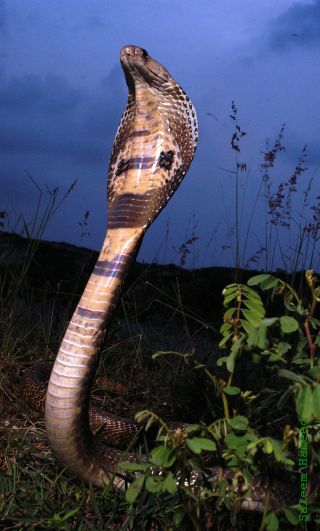
The Siamese Spitting Cobra (Naja siamensis Laurenti, 1768) is a reptile in the family Elapidae, order Squamata and class Reptilia. It occurs in Thailand, Cambodia, Vietnam and Laos. It has a relatively slender body, variable grey, brown or black coloration, and white spots or stripes that can cover most of its body.
Written 26 November 2026 from the sources listed below. Each statement was checked against the passage it cites; statements that could not be supported were removed.
Appearance
The Siamese Spitting Cobra has a medium-sized, relatively slender body compared with most other cobras in the genus Naja. Its body colour varies from grey through brown to black, with white spots or stripes that can cover most of its body.[1][2][3]
The black-and-white colour phase is common in central Thailand, while western Thai specimens are mostly black and specimens elsewhere are usually brown. The hood marking may be spectacle-shaped, irregular or entirely absent, particularly in adults.[4][5]
Habitat
The Siamese Spitting Cobra inhabits lowlands, hills, plains, woodland and jungle habitats. It is sometimes attracted to human settlements where rodents are abundant.[6][7][8]
Diet
Its usual prey includes rodents, toads and other snakes.[9]
Behaviour
The Siamese Spitting Cobra is primarily nocturnal, and its temperament varies depending on the time of day. When threatened during daylight, it is generally timid and seeks shelter in the nearest burrow.[10][11][12]
When threatened at night, it is more aggressive and more likely to stand its ground, raise its body, display its hood and spit venom. It ejects venom as a mist rather than as a stream, with a reported spitting range of approximately one metre.[13][14][15]
The species may strike and bite if spitting venom fails to deter a threat. When biting, it tends to maintain its grip and chew vigorously.[16][17]
Reproduction and life cycle
The Siamese Spitting Cobra is oviparous, and females lay between 13 and 19 eggs. Eggs hatch after an incubation period of 48 to 70 days, depending on temperature.[18][19][20]
Hatchlings become independent immediately after hatching. They typically measure between 12 and 20 centimetres in length, although some can reach 32 centimetres.[21][22][23]
Conservation
The Siamese Spitting Cobra's bites can be potentially lethal to adult humans.[24]
Similar species
The Indochinese spitting cobra has similar habitat, size and appearance to the monocled cobra. The Siamese Spitting Cobra was historically confused with the monocled cobra and Chinese cobra.[25][26]
Morphological and molecular analyses established the Siamese Spitting Cobra as distinct during the 1990s.[27]
Uses
The species has been reported in Taiwan following its release into the wild in connection with Buddhist folklore practices.[28]
Classification of the Siamese Spitting Cobra
| Kingdom | Animalia |
|---|---|
| Phylum | Chordata |
| Subphylum | Vertebrata |
| Infraphylum | Gnathostomata |
| Parvphylum | Osteichthyes |
| Megaclass | Tetrapoda |
| Class | Reptilia (Reptile) |
| Order | Squamata (Snakes) |
| Suborder | Serpentes (Snakes) |
| Infraorder | Alethinophidia |
| Family | Elapidae (Cobras) |
| Genus | Naja (Cobras) |
| Species | Naja siamensis Laurenti, 1768 |
Where the Siamese Spitting Cobra is found
Checklists and occurrence records place Naja siamensis in 4 countries across Asia. GBIF holds 165 georeferenced records of it.
Countries
Regions and cities with the most records
- Rayong, Thailand 27
- Chiang Rai, Thailand 23
- Ban Khoan, Laos 19
- Dong Nai, Vietnam 9
- Kanchanaburi, Thailand 8
- Nakhon Ratchasima, Thailand 7
- Chiang Mai, Thailand 6
- Phetchaburi, Thailand 6
- Udon Thani, Thailand 5
- Kanchanaburi, Thailand 4
- Tha Muang, Thailand 4
- Bang Pakong, Thailand 3
- Chachoengsao, Thailand 3
- Chachoengsao, Thailand 3
- Chiang Mai, Thailand 3
- Chiang Rai, Thailand 3
- Chon Buri, Thailand 3
- Hua Hin, Thailand 3
- Kaeng Khoi, Thailand 3
- Koh Kong, Cambodia 3
- Mae Chan, Thailand 3
- Nakhon Ratchasima, Thailand 3
- Phetchaburi, Thailand 3
- Prachuap Khiri Khan, Thailand 3
- Saraburi, Thailand 3
- Saraburi, Thailand 3
- Siem Reap, Cambodia 3
- Tha Yang, Thailand 3
Range as the checklists state it
Thailand, Cambodia, S Vietnam, Laos
A number beside a place is its count of GBIF occurrence records. A place without a number comes from a checklist alone. Records show where a species has been observed or collected, which can include escapes and vagrants.
Common names
English
- Siamese Spitting Cobra
- Black And White Spitting Cobra
- Indo-Chinese Spitting Cobra
- Indochinese Spitting Cobra
- Siamese Cobra
Names in 15 other languages
- Arabic
- الناشر السيامي البصَّاق
- Chinese
- 泰國眼鏡蛇
- Czech
- kobra siamská
- Finnish
- Sylkeväindokiinankobra
- French
- Cobra cracheur d'Indochine
- German
- Indochinesische Speikobra, Indonesische Speikobra, Schwarzweiße Kobra, Siamesische Speikobra, Siamkobra
- Hungarian
- sziámi kobra
- Italian
- Cobra sputatore indo-cinese, Cobra sputatore indocinese
- Khmer
- ពស់ វែកដំបូក
- Polish
- kobra syjamska
- Russian
- Сиамская Кобра
- Slovenian
- siamska pljuvajoča kobra
- Spanish
- Cobra del Sudeste asiático
- Thai
- งูเห่าพ่นพิษสยาม
- Vietnamese
- Ran Ho Mang Thai Lan, Ran Ho Mang Xien
Synonyms
5 other scientific names have been used for this species and are now treated as synonyms of Naja siamensis.
- Naja isanensis Nutaphand, 1982
- Naja naja isanensis Nutaphand, 1982
- Naja naja kaouthia Smith, 1943
- Naja sputatrix isanensis Nutaphand, 1982
- Naja tripudians Nootpand, 1971
Related species
-
 Indian CobraNaja naja
-
 Egyptian CobraNaja haje
-
 Monocled CobraNaja kaouthia
-
 Caspian CobraNaja oxiana
-
 Forest CobraNaja melanoleuca
-
 Cape CobraNaja nivea
-
 Philippine CobraNaja philippinensis
-
 Red Spitting CobraNaja pallida
Compare
Questions and answers
What is the scientific name of the Siamese Spitting Cobra?
The scientific name of the Siamese Spitting Cobra is Naja siamensis. Written with its author, the full name is Naja siamensis Laurenti, 1768.
Which family does the Siamese Spitting Cobra belong to?
Naja siamensis belongs to the family Elapidae, in the order Squamata and the class Reptilia.
Where is the Siamese Spitting Cobra found?
Checklists and occurrence records place Naja siamensis in 4 countries: Thailand, Cambodia, Vietnam and Laos.
What is the conservation status of the Siamese Spitting Cobra?
The IUCN Red List category recorded for Naja siamensis is Vulnerable (VU).
What other names does the Siamese Spitting Cobra have?
Naja siamensis is also known in English as Black And White Spitting Cobra, Indo-Chinese Spitting Cobra, Indochinese Spitting Cobra and Siamese Cobra.
What happens if a spitting cobra spits on you?
The Siamese Spitting Cobra ejects venom as a mist rather than as a stream. Its reported venom-spitting range is approximately one metre.[14][15]
Are spitting cobras actually cobras?
The Siamese Spitting Cobra belongs to the genus Naja and the family Elapidae.[29]
What is a cobra's habitat?
The Siamese Spitting Cobra inhabits lowlands, hills, plains, woodland and jungle habitats. It is sometimes attracted to human settlements where rodents are abundant.[6][7][8]
Can a spitting cobra bite you?
The Siamese Spitting Cobra may strike and bite if spitting venom fails to deter a threat. Its bites can be potentially lethal to adult humans.[16][24]
What is a cobra's favorite food?
The Siamese Spitting Cobra's usual prey includes rodents, toads and other snakes.[9]
Sources
Passages the profile rests on
- The species has a medium-sized, relatively slender body compared with most other cobras in the genus Naja. Source passage: “This is a medium-sized elapid, with a more slender build compared to most other cobras within the genus Naja.” — English Wikipedia
- Its body colour varies from grey through brown to black, with white spots or stripes. Source passage: “The body colour of this species is variable from grey to brown to black, with white spots or stripes.” — English Wikipedia
- Its white markings can cover most of its body. Source passage: “The white patterning can be so prolific that it covers the majority of the snake.” — English Wikipedia
- The black-and-white colour phase is common in central Thailand, while western Thai specimens are mostly black and specimens elsewhere are usually brown. Source passage: “The highly distinctive black and white colour phase is common in central Thailand, specimens from western Thailand are mostly black, whereas individuals from elsewhere are usually brown.” — English Wikipedia
- Its hood marking may be spectacle-shaped, irregular or entirely absent, particularly in adults. Source passage: “The hood mark can be spectacle-shaped, irregular or missing altogether, especially in adults.” — English Wikipedia
- The species inhabits lowlands, hills, plains and woodland. Source passage: “It occupies a range of habitats including lowlands, hills, plains, and woodland.” — English Wikipedia
- The species also occurs in jungle habitats. Source passage: “It can also be found in jungle habitat” — English Wikipedia
- The species is sometimes attracted to human settlements where rodents are abundant. Source passage: “it is sometimes attracted to human settlements because of the abundant populations of rodents in and around these areas.” — English Wikipedia
- Its usual prey includes rodents, toads and other snakes. Source passage: “It usually feeds on rodents, toads, and other snakes.” — English Wikipedia
- The species is primarily nocturnal. Source passage: “It is a primarily nocturnal species.” — English Wikipedia
- Its temperament varies depending on the time of day. Source passage: “It shows variable temperament depending on the time of day it is encountered.” — English Wikipedia
- When threatened during daylight, the species is generally timid and seeks shelter in the nearest burrow. Source passage: “When threatened during daylight hours, the snake is generally timid and seeks refuge in the nearest burrow.” — English Wikipedia
- When threatened at night, the species is more aggressive and more likely to stand its ground, raise its body, display its hood and spit venom. Source passage: “However, when the snake is threatened at night, it is more aggressive and is more likely to stand its ground, rear up and display its hood and spit out its venom.” — English Wikipedia
- The species ejects venom as a mist rather than as a stream. Source passage: “this species ejects a "mist" rather than a "stream".” — English Wikipedia
- Its reported venom-spitting range is approximately one metre. Source passage: “the reported spitting range of this species is approximately 1 metre (3.3 ft)” — English Wikipedia
- The species may strike and bite if spitting venom fails to deter a threat. Source passage: “If spitting venom doesn't work, it will strike and bite as a last resort.” — English Wikipedia
- When biting, the species tends to maintain its grip and chew vigorously. Source passage: “When biting, this species tends to hold on and chew savagely.” — English Wikipedia
- The species is oviparous. Source passage: “The snake is oviparous.” — English Wikipedia
- Females lay between 13 and 19 eggs. Source passage: “The female will lay 13-19 eggs” — English Wikipedia
- Eggs hatch after an incubation period of 48 to 70 days, depending on temperature. Source passage: “Eggs will hatch after 48 to 70 days depending on the temperature of incubation.” — English Wikipedia
- Hatchlings become independent immediately after hatching. Source passage: “Offspring are independent as soon as they have hatched.” — English Wikipedia
- Hatchlings typically measure between 12 and 20 centimetres in length. Source passage: “Hatchlings are anywhere from 12 to 20 cm long” — English Wikipedia
- Some hatchlings can reach 32 centimetres in length. Source passage: “Some hatchlings can be as long as 32 cm.” — English Wikipedia
- The species' bites can be potentially lethal to adult humans. Source passage: “The bite of this snake is potentially lethal to an adult human.” — English Wikipedia
- The Indochinese spitting cobra has similar habitat, size and appearance to the monocled cobra. Source passage: “This species should not be confused with the monocled cobra (Naja kaouthia), which has similar habitat, size and appearance.” — English Wikipedia
- The species was historically confused with the monocled cobra and Chinese cobra. Source passage: “This species was long confused with the monocled cobra (Naja kaouthia) and the Chinese cobra (Naja atra)” — English Wikipedia
- Morphological and molecular analyses established the species as distinct during the 1990s. Source passage: “Detailed morphological and molecular analyses revealed it to be a distinct species during the 1990s.” — English Wikipedia
- The species has been reported in Taiwan following its release into the wild in connection with Buddhist folklore practices. Source passage: “It has been reported from Taiwan where it was released to the wild based on folklore Buddhist practices.” — English Wikipedia
- The species belongs to the genus Naja and the family Elapidae. Source passage: “Naja siamensis is classified under the genus Naja of the family Elapidae.” — English Wikipedia
Data
- Catalogue of Life, 2026-10-16 XR cc by
- Global Biodiversity Information Facility CC BY 4.0
- Wikidata CC0
- GeoNames CC BY 4.0
- Wikimedia Commons per image; credit shown with each image
- Within the Catalogue of Life, this name comes from The Reptile Database cc by
References
- Laurenti, Joseph N. 1768. Specimen medicum, exhibens synopsin reptilium emendatam cum experimentis circa venena et antidota reptilium austriacorum. Joan Thomae, Viennae.: 1–214; Pls. 1–5. where the name was published
- Laurenti, J. N. (1768). Specimen medicum, exhibens synopsin reptilium emendatam cum experimentis circa venena et antidota reptilium austracorum, quod authoritate et consensu. Vienna, Joan. Thomae, 217 Pp.
- Smith, M. A. (1943). The Fauna of British India, Ceylon and Burma, Including the Whole of the Indo-Chinese Sub-Region. Reptilia and Amphibia. 3 (Serpentes). Taylor and Francis, London. 583 Pp.
- Golay, P. (1985). Checklist and keys to the terrestrial proteroglyphs of the world (Serpentes: Elapidae - Hydrophiidae). Elapsoidea, Geneva.
- Lingenhöle, S., & Trutnau, L. (1989). Über die Kobras der Gattung Naja LAURENTI 1758 in Thailand. Herpetofauna 11 (58): 6-13.
- Wuster, W., & Thorpe, R. S. (1994). Naja siamensis, a cryptic species of venomous snake revealed by mtDNA sequencing. Experientia 50 (1): 75-79.
- Wüster, W., Thorpe, R. S., Cox, M. J., Jintakune, P., & Nabhitabhata, J. (1995). Populuation systematics of the snake genus Naja (Reptilia: Serpentes: Elapidae) in Indochina: Multivariate morphometrics and comparative mitochondrial DNA sequencing (cytochrome oxidase I). J. Evol. Biol. 8: 493-510.
- Wüster, W. (1996). Taxonomic changes and toxinology: Systematic revisions of the asiatic cobras (Naja naja complex). Toxicon 34 (4): 399-406.
- Wuster, W., Warrell, D. A., & Jintakune, P. (1997). Redescription of Naja siamensis (Serpentes: Elapidae), a widely overlooked spitting cobra from S.E. Asia: geographic variation, medical importance and designation of a neotype. Journal of Zoology 243 (4): 771-.
- Cox, Merel J.; Van Dijk, Peter Paul; Jarujin Nabhitabhata & Thirakhupt,Kumthorn. (1998). A Photographic Guide to Snakes and Other Reptiles of Peninsular Malaysia, Singapore and Thailand. Ralph Curtis Publishing, 144 Pp.
- Chan-ard,T.; Grossmann,W.; Gumprecht,A. & Schulz,K. D. (1999). Amphibians and reptiles of peninsular Malaysia and Thailand - an illustrated checklist [bilingual English and German]. Bushmaster Publications, Würselen, Gemany, 240 Pp. [Book Review in Russ. J Herp. 7: 87].
- Chan-ard, T., Stuart, B. L., & Wüster, W. (2000). First record of Indochinese Spitting Cobra Naja siamensis Laurenti (Serpentes, Elapidae) from Laos, with comments on the genus in the country. Nat. Hist. Bull. Siam Soc. 48: 149-152.
- Pauwels, O.S.G.; David, P.; Chimsunchart, C. & Thirakhupt, K. (2003). Reptiles of Phetchaburi Province, Western Thailand: a list of species, with natural history notes, and a discussion on the biogeography at the Isthmus of Kra. Natural History Journal of Chulalongkorn University 3 (1): 23-53.
- Orlov, N. L., S. A. Ryabov, N. Van Sang and N. Q. Truong. (2003). New records and data on the poorly known snakes of Vietnam. Russ. J. Herpetol. 10: 217-240.
- Teynié, Alexandre and Patrick David. (2007). Additions to the snake fauna of southern Laos, with the second Laotian specimen of Naja siamensis (Laurenti, 1768) and the forst country record of Oligodon taeniatus (Günther, 1861) (Squamata, Serpentes). Russ. J. Herpetol. 14 (1):39-44.
- Grismer, L. L., Neang, T., Chav, T., & Grismer, J. L. (2008). Checklist of the amphibians and reptiles of the Cardamom region of Southwestern Cambodia. Cambodian Journal of Natural History 2008(1): 12–28.
- Vonk, F.J. et al. (2008). Evolutionary origin and development of snake fangs. Nature 454: 630-633.
- Nguyen, S.V., Ho, C.T. and Nguyen, T.Q. (2009). Herpetofauna of Vietnam. Chimaira, Frankfurt, 768 Pp.
- Wallach, V.; Wüster, W. & Broadley, D.G. (2009). In praise of subgenera: taxonomic status of cobras of the genus Naja Laurenti (Serpentes: Elapidae). Zootaxa 2236: 26–36.
- Geissler, Peter, Truong Quang Nguyen, Nikolay A. Poyarkov & Wolfgang Böhme. (2011). New records of snakes from Cat Tien National Park, Dong Nai and Lam Dong provinces, southern Vietnam. Bonn Zoological Bulletin 60 (1): 9-16.
- Das, I. (2012). A Naturalist’s Guide to the Snakes of South-East Asia: Malaysia, Singapore, Thailand, Myanmar, Borneo, Sumatra, Java and Bali. Oxford J, Ohn Beaufoy Publishing.
- Laita, & Mark. (2013). Serpentine. Abrams and PQ Blackwell, Auckland, New Zealand, 200 Unnumbered Pages.
- Wallach, Van; Kenneth L. Williams, Jeff Boundy. (2014). Snakes of the World: A Catalogue of Living and Extinct Species. [type catalogue]. Taylor and Francis, CRC Press, 1237 Pp.
- Lillywhite, Harvey B. (2014). How Snakes Work: Structure, Function and Behavior of the World’s Snakes. Oxford University Press, New York, 256 Pp.
- Chan-ard, T., Parr, J. W. K., & Nabhitabhata, J. (2015). A field guide to the reptiles of Thailand. Oxford University Press, NY, 352 Pp. [See Book Reviews by Pauwels & Grismer 2015 and Hikida 2015 for Corrections].
This species in other databases
Page built on 28 November 2026. See how the catalog is made and all sources and licences.
Cite this page
ScientificNames.org. (2026). Naja siamensis (Siamese Spitting Cobra). Retrieved November 28, 2026, from https://scientificnames.org/species/naja-siamensis
“Naja siamensis (Siamese Spitting Cobra).” ScientificNames.org, 2026, scientificnames.org/species/naja-siamensis. Accessed 28 Nov. 2026.
ScientificNames.org. “Naja siamensis (Siamese Spitting Cobra).” Accessed November 28, 2026. https://scientificnames.org/species/naja-siamensis.
@misc{scientificnames_naja_siamensis_siamese_spitting_cobra,
  author = {{ScientificNames.org}},
  title = {Naja siamensis (Siamese Spitting Cobra)},
  year = {2026},
  url = {https://scientificnames.org/species/naja-siamensis},
  note = {Accessed 2026-11-28}
}