Species · Reptiles
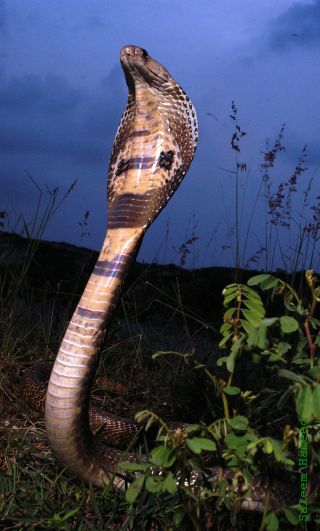
Brown Forest Cobra Naja subfulva
The scientific name of the Brown Forest Cobra is Naja subfulva. It is a species of reptile in the family Elapidae (cobras), order Squamata. The name dates from 1955.
- Scientific name
- Naja subfulva Laurent, 1955
- Common name
- Brown Forest Cobra
- Genus
- Naja
- Family
- Elapidae (Cobras)
- Order
- Squamata
- Class
- Reptilia
- Red List category
- LC Least Concern
- Recorded in
- 17 countries
- Name status
- accepted in the Catalogue of Life
Overview
The brown forest cobra (Naja subfulva) is a species of cobra in the genus Naja that is found in Central and East Africa.
Classification of the Brown Forest Cobra
| Kingdom | Animalia |
|---|---|
| Phylum | Chordata |
| Subphylum | Vertebrata |
| Infraphylum | Gnathostomata |
| Parvphylum | Osteichthyes |
| Megaclass | Tetrapoda |
| Class | Reptilia (Reptile) |
| Order | Squamata (Snakes) |
| Suborder | Serpentes (Snakes) |
| Infraorder | Alethinophidia |
| Family | Elapidae (Cobras) |
| Genus | Naja (Cobras) |
| Species | Naja subfulva Laurent, 1955 |
Where the Brown Forest Cobra is found
Checklists and occurrence records place Naja subfulva in 17 countries across Africa. GBIF holds 739 georeferenced records of it.
Countries
- Angola 5
- Burundi 4
- Cameroon 5
- Central African Republic 3
- Chad
- Democratic Republic of the Congo 156
- Ethiopia 4
- Kenya 76
- Malawi 16
- Mozambique 30
- Republic of the Congo 8
- Rwanda 2
- South Africa 157
- Tanzania 36
- Uganda 41
- Zambia 170
- Zimbabwe 26
Regions and cities with the most records
- KwaZulu-Natal, South Africa 145
- North-Western, Zambia 75
- Solwezi, Zambia 55
- Copperbelt, Zambia 42
- eSikhaleni, South Africa 34
- Kwale County, Kenya 33
- Kitwe, Zambia 21
- Zanzibar North, Tanzania 21
- Central Province, Zambia 20
- Kalulushi, Zambia 15
- Richards Bay, South Africa 15
- Lualaba, Democratic Republic of the Congo 11
- Luapula Province, Zambia 10
- Kajansi, Uganda 9
- Mkushi, Zambia 9
- Northern Province, Zambia 9
- Rutshuru, Democratic Republic of the Congo 8
- Entebbe, Uganda 7
- Katabi, Uganda 7
- KwaDukuza, South Africa 7
- Impfondo, Republic of the Congo 6
- Inhambane Province, Mozambique 6
- Kakamega, Kenya 6
- Kakamega County, Kenya 6
- Kisumu County, Kenya 6
- Likouala, Republic of the Congo 6
- Limpopo, South Africa 6
- Tanganyika, Democratic Republic of the Congo 6
- Bunamwaya, Uganda 5
- Chingola, Zambia 5
- Kampala, Uganda 5
- Kasangati, Uganda 5
- Kira, Uganda 5
- Kisumu, Kenya 5
- Mukono, Uganda 5
- Ndola, Zambia 5
Range as the checklists state it
Central African Republic, Chad, Cameroon, SE Nigeria, Republic of Congo (Brazzaville), Democratic Republic of the Congo (Kinshasa), Ethiopia, Kenya, Uganda, (South ?) Sudan, Tanzania, Mozambique, Zambia, Angola, Republic of South Africa, Zimbabwe, Rwanda, Burundi (all based on Wüster et al. 2018: 81), Malawi
A number beside a place is its count of GBIF occurrence records. A place without a number comes from a checklist alone. Records show where a species has been observed or collected, which can include escapes and vagrants.
Common names
English
- Brown Forest Cobra
Names in 2 other languages
- German
- Braune Waldkobra
- Italian
- Cobra bruno della foresta
Synonyms
2 other scientific names have been used for this species and are now treated as synonyms of Naja subfulva.
- Naja melanoleuca subfulva Laurent, 1955
- Naja melonoleuca subfulva Laurent, 1955
Related species
-
 Indian CobraNaja naja
-
 Egyptian CobraNaja haje
-
 Monocled CobraNaja kaouthia
-
 Caspian CobraNaja oxiana
-
 Forest CobraNaja melanoleuca
-
 Cape CobraNaja nivea
-
 Philippine CobraNaja philippinensis
-
 Red Spitting CobraNaja pallida
Compare
Questions and answers
What is the scientific name of the Brown Forest Cobra?
The scientific name of the Brown Forest Cobra is Naja subfulva. Written with its author, the full name is Naja subfulva Laurent, 1955.
Which family does the Brown Forest Cobra belong to?
Naja subfulva belongs to the family Elapidae, in the order Squamata and the class Reptilia.
Where is the Brown Forest Cobra found?
Checklists and occurrence records place Naja subfulva in 17 countries, including Zambia, South Africa, Democratic Republic of the Congo, Kenya, Uganda and Tanzania.
What is the conservation status of the Brown Forest Cobra?
The IUCN Red List category recorded for Naja subfulva is Least Concern (LC).
Sources
Data
- Catalogue of Life, 2026-10-16 XR cc by
- Global Biodiversity Information Facility CC BY 4.0
- Wikidata CC0
- English Wikipedia CC BY-SA 4.0
- GeoNames CC BY 4.0
- Within the Catalogue of Life, this name comes from The Reptile Database cc by
References
- Laurent, R. F. (1955) Diagnoses preliminaires de quelques serpents venimeux. Revue de Zoologie et Botanique Africaine, 51, 127 - 139. where the name was published
- Laurent, R. F. (1955). Diagnoses preliminaires des quelques Serpents venimeux. Rev. Zool. Bot. Afr., 51: 127-139.
- Broadley, D. G. (1962). On some reptile collections from the North-Western and North-Eastern Districts of Southern Rhodesia 1958-1961, with descriptions of four new lizards. Occ. Pap. Nat. Mus. South. Rhodesia 26 (B): 787-843.
- Chirio, & Laurent and Ivan Ineich. (2006). Biogeography of the reptiles of the Central African Republic. African Journal of Herpetology 55(1):23-59.
- Chirio, L., & Lebreton, M. (2007). Atlas des reptiles du Cameroun. MNHN, IRD, Paris 688 Pp.
- Broadley, D. & Blaylock. (2013). The Snakes of Zimbabwe and Botswana. Chimaira, Frankfurt, 387 Pp. [Book Review in Sauria 35 (2): 59 and Copeia 2014: 388].
- Böhme, & Wolfgang. (2014). Herpetology in Bonn. Mertensiella 21. Vi + 256 Pp.
- Conradie, Werner; Gabriela B. Bittencourt-Silva, Hanlie M. Engelbrecht, Simon P. Loader, Michele Menegon, Cristóvão Nanvonamuquitxo, Michael Scott, Krystal A. Tolley. (2016). Exploration into the hidden world of Mozambique’s sky island forests: new discoveries of reptiles and amphibians. Zoosyst. Evol. 92 (2): 163–180, DOI 10.3897/Zse.92.9948.
- Marques, Mariana P.; Luis M. P. Ceríaco , David C. Blackburn , and Aaron M. Bauer. (2018). Diversity and Distribution of the Amphibians and Terrestrial Reptiles of Angola -- Atlas of Historical and Bibliographic Records (1840–2017). Proc. Cal. Acad. Sci. (Ser. 4) 65: 1-501 (Supplement II).
- WÜSTER, WOLFGANG; LAURENT CHIRIO, JEAN-FRANÇOIS TRAPE, IVAN INEICH, KATE JACKSON, ELI GREENBAUM, CESAR BARRON, CHIFUNDERA KUSAMBA, ZOLTÁN T. NAGY, RICHARD STOREY, CARA HALL, CATHARINE E. WÜSTER, AXEL BARLOW, DONALD G. BROADLEY. (2018). Integration of nuclear and mitochondrial gene sequences and morphology reveals unexpected diversity in the forest cobra (Naja melanoleuca) species complex in Central and West Africa (Serpentes: Elapidae). Zootaxa 4455 (1): 068–098. Link
- Harport, V. (2019). Familienurlaub mal anders – Südafrikas Norden. Reptilia (Münster) 24 (135): 70-79.
- Hörold, & Ralf. (2019). Die echten Kobras und ihre Gifte. Ophidia 13 (1): 18-26.
- Behangana, Mathias; Richard Magala, Raymond Katumba, David Ochanda, Stephen Kigoolo, Samuel Mutebi, Daniele Dendi,, Luca Luiselli, and Daniel F. Hughes. (2020). Herpetofaunal diversity and community structure in the Murchison Falls-Albert Delta Ramsar site, Uganda: Herpetofaunal diversity. European Journal of Ecology, 6(2).
- Shine, R., & Spawls, S. (2020). An ecological analysis of snakes captured by C.J.P. Ionides in eastern Africa in the mid-1900s. Sci Rep 10: 5096.
- Bittencourt-Silva GB, Bayliss J, Conradie W. (2020). First herpetological surveys of Mount Lico and Mount Socone, Mozambique. Amphibian & Reptile Conservation 14(2) [General Section]: 198–217 (E247).
- Spawls, S., & Branch, B. (2020). The Dangerous Snakes of Africa. Bloomsbury, London, 336 Pp.
- Trape, Jean-François; Israël Demba Kodindo, Ali Sougoudi Djiddi, Joseph Mad-Toïngué & Clément Hinzoumbé Kerah. (2020). The snakes of Chad: results of a field survey and annotated country-wide checklist. Bonn Zoological Bulletin 69 (2): 367–393.
- Harport, V., & Reissig, J. (2020). Herpetofauna-Tour im Osten Südafrikas. Elaphe 2020 (5): 34-44.
- Kazandjian, T. D.; D. Petras, S. D. Robinson, J. van Thiel, H. W. Greene, K. Arbuckle, A. Barlow, D. A. Carter, R. M. Wouters, G. Whiteley, S. C. Wagstaff, A. S. Arias, L.-O. Albulescu, A. Plettenberg Laing, C. Hall, A. Heap, S. Penrhyn-Lowe, C. V. McCabe, S. Ainsworth, R. R. da Silva, P. C. Dorrestein, M. K. Richardson, J. M. Gutiérrez, J. J. Calvete, R. A. Harrison, I. Vetter, E. A. B. Undheim, W. Wüster and N. R. Casewell. (2021). Convergent evolution of pain-inducing defensive venom components in spitting cobras. Science 371 (6527), 386-390.
- TRAPE, Jean-François, & Marcel COLLET. (2021). Nouvelles données sur les serpents du sud-est du Katanga (République démocratique du Congo). Bull. Soc. Herp. Fr. (2021) 179 | 11-26.
- Pietersen, Darren, Verburgt, Luke, Davies, & John. (2021). Snakes and other reptiles of Zambia and Malawi. Struik Nature / Penguin Random House South Africa, 376 Pp., ISBN 9781775847373.
- Trape, J.-F. (2023). Guide des serpents d’Afrique occidentale, centrale et d’Afrique du Nord. IRD Éditions, Marseille, 896 Pp.
- Tolley, K.A., Conradie, W., Pietersen, D.W., Weeber, J., Burger, M. & Alexander, G.J. (eds). (2023). Conservation status of the reptiles of South Africa, Eswatini and Lesotho. Suricata 10. South African National Biodiversity Institute, Pretoria.
- Spawls, Stephen; Tomáš Mazuch & Abubakr Mohammad. (2023). Handbook of Amphibians and Reptiles of North-east Africa. Bloomsbury, 640 Pp.
- Stander, R. I. (2023). The Reptiles of the Limpopo Province and Kruger National Park. Herp Nomad, Polokwane, South Africa, 367 Pp.
This species in other databases
Page built on 26 November 2026. See how the catalog is made and all sources and licences.
Cite this page
ScientificNames.org. (2026). Naja subfulva (Brown Forest Cobra). Retrieved November 26, 2026, from https://scientificnames.org/species/naja-subfulva
“Naja subfulva (Brown Forest Cobra).” ScientificNames.org, 2026, scientificnames.org/species/naja-subfulva. Accessed 26 Nov. 2026.
ScientificNames.org. “Naja subfulva (Brown Forest Cobra).” Accessed November 26, 2026. https://scientificnames.org/species/naja-subfulva.
@misc{scientificnames_naja_subfulva_brown_forest_cobra,
  author = {{ScientificNames.org}},
  title = {Naja subfulva (Brown Forest Cobra)},
  year = {2026},
  url = {https://scientificnames.org/species/naja-subfulva},
  note = {Accessed 2026-11-26}
}