Species · Birds
Black Bushbird Neoctantes niger
The scientific name of the Black Bushbird is Neoctantes niger. It is a species of bird in the family Thamnophilidae (antbird), order Passeriformes. The name dates from 1859.
- Scientific name
- Neoctantes niger (Pelzeln, 1859)
- Common name
- Black Bushbird
- Genus
- Neoctantes
- Family
- Thamnophilidae (Antbird)
- Order
- Passeriformes
- Class
- Aves
- Red List category
- LC Least Concern
- Recorded in
- 4 countries
- Name status
- accepted in the Catalogue of Life

Overview
Neoctantes niger inhabits lowland terra firme and várzea evergreen forests, more commonly occurring in várzea evergreen forest. It has a stocky body, a short tail, and an unusually upturned bill.
Written 27 November 2026 from the sources listed below. Each statement was checked against the passage it cites; statements that could not be supported were removed.
Appearance
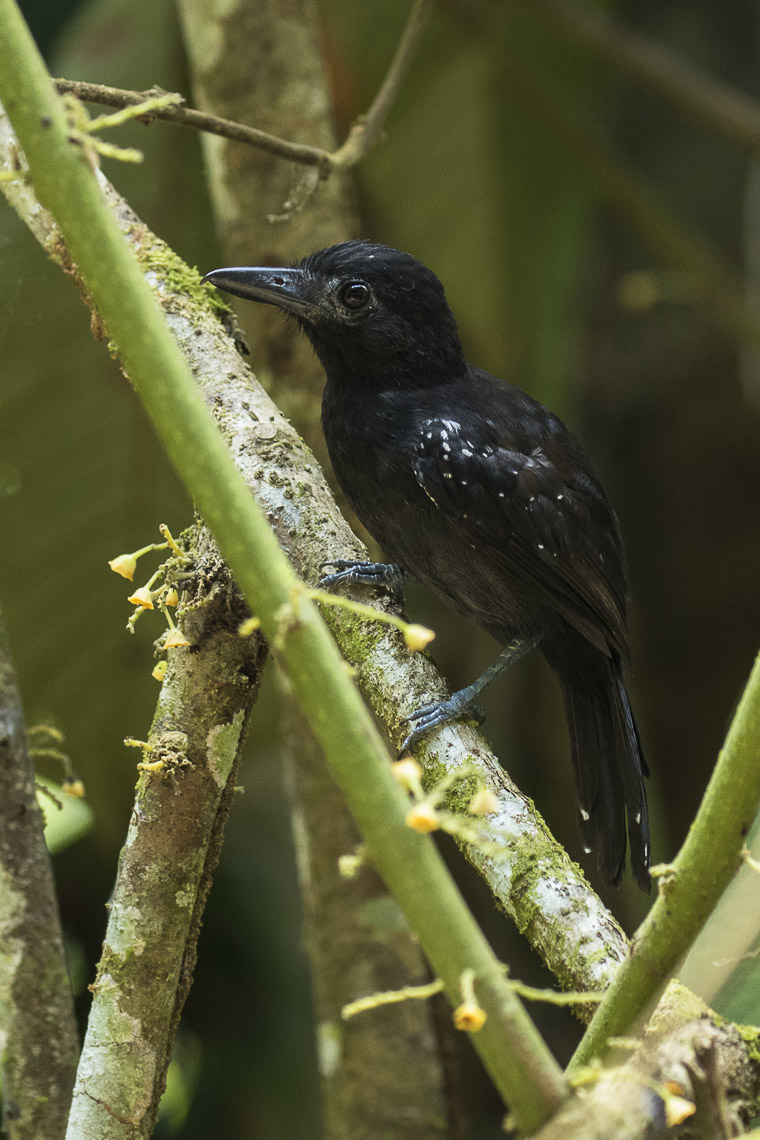
Adult males have entirely black plumage except for a small, mostly concealed white patch between the shoulders. Their bill is silvery-black.[1][2]
The species has a stocky body, a short tail, and an unusually upturned bill. It measures 15–16 cm in length and weighs between 29 and 32 g.[3][4][5]
Habitat
The Black Bushbird inhabits lowland terra firme and várzea evergreen forests. It is more commonly found in várzea evergreen forest than in terra firme forest.[6][7]
It favors dense undergrowth along forest edges, treefalls, and swampy streams.[8]
Diet
The Black Bushbird is thought to feed on insects and other arthropods.[9]
Behaviour
The Black Bushbird forages alone or in pairs in dense vegetation, from ground level to approximately 10 m above the ground. It occasionally joins mixed-species feeding flocks passing through its territory but does not travel with them.[10][11]
It forages mainly by picking, hammering, and digging into branches, woody vines, and rotten wood. Its unusual bill is used to wedge or flake off bark and pieces of substrate.[12][13]
The species remains in its range throughout the year and is not highly vocal.[14][15]
Its song consists of a slightly rising series of semimusical notes that may continue for a minute or longer at approximately one note per second. Its call is a distinctive, continuous, two-part squeal with a lower-pitched second part.[16][17]
Reproduction and life cycle
One studied nest was discovered in September in Peru. It was a bulky, untidy cup made of leaves and other plant material, suspended in a fork of a shrub branch.[18][19]
The male was incubating the single egg in the studied nest. The nest failed the day after discovery because of predation or a storm.[20][21]
The incubation period and time to fledging have not been determined for the species.[22]
Conservation
The Black Bushbird is listed as Least Concern by the IUCN. It was most recently assessed for the IUCN Red List in 2016.[23][24][25]
The species has a very large geographical range. Its population size is unknown and is believed to be decreasing.[26][27]
No immediate threats to the species have been identified. It is considered rare to locally uncommon, and its population numbers may be underestimated because of its secretive habits.[28][29][30]
The species occurs in several protected areas.[31]
Classification of the Black Bushbird
| Kingdom | Animalia |
|---|---|
| Phylum | Chordata |
| Subphylum | Vertebrata |
| Infraphylum | Gnathostomata |
| Parvphylum | Osteichthyes |
| Megaclass | Tetrapoda |
| Class | Aves (Bird) |
| Order | Passeriformes (Passerine) |
| Family | Thamnophilidae (Antbird) |
| Genus | Neoctantes |
| Species | Neoctantes niger (Pelzeln, 1859) |
Where the Black Bushbird is found
Checklists and occurrence records place Neoctantes niger in 4 countries across South America. GBIF holds 1,033 georeferenced records of it.
Countries
Regions and cities with the most records
- Vaupés, Colombia 232
- Mitú, Colombia 164
- Loreto, Peru 153
- Madre de Dios, Peru 120
- Guainía Department, Colombia 106
- Orellana Province, Ecuador 77
- Napo, Ecuador 70
- Sucumbíos, Ecuador 53
- Amazonas, Brazil 51
- Tena, Ecuador 42
- Rondônia, Brazil 33
- Atalaia do Norte, Brazil 31
- Amazonas, Peru 21
- Pastaza Province, Ecuador 19
- Porto Velho, Brazil 19
- Guaviare Department, Colombia 15
- San José del Guaviare, Colombia 15
- Amazonas Department, Colombia 14
- Puerto Maldonado, Peru 10
- Putumayo Department, Colombia 8
- Ucayali, Peru 8
- Morona-Santiago Province, Ecuador 7
- Acre, Brazil 5
- Iquitos, Peru 5
- Meta Department, Colombia 5
- Puerto Francisco de Orellana, Ecuador 3
- San Juan, Peru 3
- Tambopata, Peru 3
Range as the checklists state it
South America
A number beside a place is its count of GBIF occurrence records. A place without a number comes from a checklist alone. Records show where a species has been observed or collected, which can include escapes and vagrants.
Common names
English
- Black Bushbird
Names in 23 other languages
- Catalan
- batarà bec de falca
- Chinese
- 黑丛蚁鵙, 黑叢鳥
- Croatian
- crna mravarica
- Czech
- mravenčík rudoprsý
- Danish
- Sort Myretornskade
- Dutch
- Zwarte Dikbekmiervogel
- Esperanto
- nigra formikulo
- Finnish
- pikipuumuura
- French
- Alapi des fourrés, Batara des fourrés
- German
- Buschameisenwürger, Mohrenwürgerling, Schwarzer Bodenameisenwürger
- Italian
- Frascarolo nero
- Japanese
- クロヤブアリドリ
- Lithuanian
- juodoji skruzdlesė
- Norwegian
- svartgrovnebb
- Polish
- łódkodziób czarny
- Portuguese
- choca-preta, formigueiro-cinzel-preto
- Russian
- Чёрная муравьеловка, Чёрный копьеклюв
- Slovak
- horezob člnkozobý, pralesníček člnkozobý
- Spanish
- Batará arbustero
- Swedish
- helikoniamyrfågel, helikoniamyrtörnskata
- Turkish
- Çalıcıl Siyah Karıncaavcısı
- Ukrainian
- кущівник чорний
- Welsh
- cambig prysgdir du
Synonyms
One other scientific name has been used for this species and is now treated as a synonym of Neoctantes niger.
- Xenops niger Pelzeln, 1859
Related species
-
 Barred AntshrikeThamnophilus doliatus
-
 Great AntshrikeTaraba major
-
 Black-crowned AntshrikeThamnophilus atrinucha
-
 Ocellated AntbirdPhaenostictus mcleannani
-
 Bicolored AntbirdGymnopithys bicolor
-
 Fasciated AntshrikeCymbilaimus lineatus
-
 Black-hooded AntshrikeThamnophilus bridgesi
-
 Black-crested AntshrikeSakesphorus canadensis
Compare
Questions and answers
What is the scientific name of the Black Bushbird?
The scientific name of the Black Bushbird is Neoctantes niger. Written with its author, the full name is Neoctantes niger (Pelzeln, 1859).
Which family does the Black Bushbird belong to?
Neoctantes niger belongs to the family Thamnophilidae, in the order Passeriformes and the class Aves.
Where is the Black Bushbird found?
Checklists and occurrence records place Neoctantes niger in 4 countries: Colombia, Peru, Ecuador and Brazil.
What is the conservation status of the Black Bushbird?
The IUCN Red List category recorded for Neoctantes niger is Least Concern (LC).
Where does the Black Bushbird occur?
It occurs in Brazil, Colombia, Ecuador, and Peru. Its distribution is disjunct, with its largest range including south-central and southeastern Colombia, eastern Ecuador, northeastern and southeastern Peru, and western Brazil, as well as additional isolated populations across central Amazonian Brazil.[32][33][34][35]
How many subspecies does the Black Bushbird have?
The Black Bushbird has no recognized subspecies and is monotypic within the genus Neoctantes.[36][37]
Is the Black Bushbird the only species in its genus?
Yes. Neoctantes niger is the sole member of the genus Neoctantes.[36]
Sources
Passages the profile rests on
- Adult male Black Bushbirds have entirely black plumage except for a small, mostly concealed white patch between the shoulders. Source passage: “Adult males are entirely black except for a small, mostly hidden, patch of white between the shoulders.” — English Wikipedia
- Male Black Bushbirds have entirely black plumage and a silvery-black bill. Source passage: “Males are entirely black with a silvery-black bill” — ebird.org
- The species has a stocky body, a short tail, and an unusually upturned bill. Source passage: “It is rather stocky with a short tail and an unusual upturned bill.” — English Wikipedia
- The Black Bushbird measures 15–16 cm in length. Source passage: “The black bushbird is 15 to 16 cm (5.9 to 6.3 in) long” — English Wikipedia
- The Black Bushbird weighs between 29 and 32 g. Source passage: “weighs 29 to 32 g (1.0 to 1.1 oz).” — English Wikipedia
- The species inhabits lowland terra firme and várzea evergreen forests. Source passage: “The species inhabits lowland terra firme and várzea evergreen forest” — English Wikipedia
- The species is more commonly found in várzea evergreen forest than in terra firme forest. Source passage: “it is more common in the latter.” — English Wikipedia
- The Black Bushbird favors dense undergrowth along forest edges, treefalls, and swampy streams. Source passage: “It favors dense undergrowth along edges, in treefalls, and along swampy streams.” — English Wikipedia
- The Black Bushbird is thought to feed on insects and other arthropods. Source passage: “The black bushbird is thought to feed on insects and other arthropods.” — English Wikipedia
- The species forages alone or in pairs in dense vegetation, from ground level to approximately 10 m above the ground. Source passage: “It forages singly or in pairs in dense vegetation from the ground up to about 10 m (35 ft) above it.” — English Wikipedia
- The Black Bushbird occasionally joins mixed-species feeding flocks passing through its territory but does not travel with them. Source passage: “It occasionally joins mixed-species feeding flocks that pass through its territory but does not travel with them.” — English Wikipedia
- The species forages mainly by picking, hammering, and digging into branches, woody vines, and rotten wood. Source passage: “It forages mostly by picking, hammering, and digging into branches, woody vines, and rotten wood.” — English Wikipedia
- The Black Bushbird uses its unusual bill to wedge or flake off bark and pieces of substrate. Source passage: “It uses its unusual bill to wedge or flake off bark or pieces of the substrate.” — English Wikipedia
- The Black Bushbird remains in its range throughout the year. Source passage: “The black bushbird is a year-round resident throughout its range.” — English Wikipedia
- The species is not highly vocal. Source passage: “The black bushbird is not highly vocal.” — English Wikipedia
- Its song consists of a slightly rising series of semimusical notes that may continue for a minute or longer at approximately one note per second. Source passage: “Its song is an "often slightly rising series of semimusical 'werk' notes" given for a minute or more at about one note per second.” — English Wikipedia
- Its call is a distinctive, continuous, two-part squeal with a lower-pitched second part. Source passage: “Its call is "distinctive, squealing, two-parted but continuous, with second part lower-pitched"” — English Wikipedia
- One studied nest was discovered in September in Peru. Source passage: “It was found in September in Peru” — English Wikipedia
- The studied nest was a bulky, untidy cup made of leaves and other plant material, suspended in a fork of a shrub branch. Source passage: “a messy, bulky cup of leaves and other plant material suspended in a shrub's branch fork.” — English Wikipedia
- The male was incubating the single egg in the studied nest. Source passage: “The male was incubating the single egg.” — English Wikipedia
- The only studied nest failed the day after discovery because of predation or a storm. Source passage: “The nest failed the next day due to predation or a storm” — English Wikipedia
- The incubation period and time to fledging have not been determined for the species. Source passage: “the incubation period, time to fledging, and other details of parental care could not be determined.” — English Wikipedia
- The Black Bushbird was assessed as Least Concern by the IUCN. Source passage: “The IUCN has assessed the black bushbird as being of Least Concern.” — English Wikipedia
- The species was most recently assessed for the IUCN Red List in 2016. Source passage: “has most recently been assessed for The IUCN Red List of Threatened Species in 2016.” — iucnredlist.org
- The IUCN Red List lists the Black Bushbird as Least Concern. Source passage: “Neoctantes niger is listed as Least ...” — iucnredlist.org
- The species has a very large geographical range. Source passage: “It has a very large range;” — English Wikipedia
- The population size of the Black Bushbird is unknown and is believed to be decreasing. Source passage: “its population size is not known and is believed to be decreasing.” — English Wikipedia
- No immediate threats to the species have been identified. Source passage: “No immediate threats have been identified.” — English Wikipedia
- The species is considered rare to locally uncommon. Source passage: “it is not well known and considered rare to locally uncommon” — English Wikipedia
- Its population numbers may be underestimated because of its secretive habits. Source passage: “its numbers may be underestimated due to its secretive habits.” — English Wikipedia
- The species occurs in several protected areas. Source passage: “and it occurs in several protected areas.” — English Wikipedia
- The Black Bushbird occurs in Brazil, Colombia, Ecuador, and Peru. Source passage: “It is found in Brazil, Colombia, Ecuador, and Peru.” — English Wikipedia
- The species has a disjunct geographical distribution. Source passage: “The black bushbird has a disjunct distribution.” — English Wikipedia
- Its largest range includes south-central and southeastern Colombia, eastern Ecuador, northeastern and southeastern Peru, and western Brazil. Source passage: “The largest range encompasses south-central and southeastern Colombia, eastern Ecuador, northeastern and southeastern Peru, and western Brazil.” — English Wikipedia
- Additional isolated populations occur across central Amazonian Brazil. Source passage: “Isolated ranges are scattered throughout central Amazonian Brazil.” — English Wikipedia
- Neoctantes niger is the sole member of its genus and has no recognized subspecies. Source passage: “The black bushbird is the only member of genus Neoctantes and has no subspecies.” — English Wikipedia
- The species is monotypic within the genus Neoctantes. Source passage: “It is monotypic within the genus Neoctantes.” — inaturalist.org
- The Black Bushbird was originally described by August von Pelzeln in 1859 under the scientific name Xenops niger. Source passage: “The black bushbird was described by the Austrian ornithologist August von Pelzeln in 1859 and given the binomial name Xenops niger.” — English Wikipedia
- The genus Neoctantes was established by Philip Sclater in 1869. Source passage: “The current genus Neoctantes was erected by the English zoologist Philip Sclater in 1869.” — English Wikipedia
Data
- Catalogue of Life, 2026-10-16 XR cc by
- Global Biodiversity Information Facility CC BY 4.0
- Wikidata CC0
- GeoNames CC BY 4.0
- Wikimedia Commons per image; credit shown with each image
- Within the Catalogue of Life, this name comes from The Integrated Taxonomic Information System cc0
References
- Gill, Frank, & and Minturn Wright. (2006). Birds of the World: Recommended English Names.
This species in other databases
Page built on 30 November 2026. See how the catalog is made and all sources and licences.
Cite this page
ScientificNames.org. (2026). Neoctantes niger (Black Bushbird). Retrieved November 30, 2026, from https://scientificnames.org/species/neoctantes-niger
“Neoctantes niger (Black Bushbird).” ScientificNames.org, 2026, scientificnames.org/species/neoctantes-niger. Accessed 30 Nov. 2026.
ScientificNames.org. “Neoctantes niger (Black Bushbird).” Accessed November 30, 2026. https://scientificnames.org/species/neoctantes-niger.
@misc{scientificnames_neoctantes_niger_black_bushbird,
  author = {{ScientificNames.org}},
  title = {Neoctantes niger (Black Bushbird)},
  year = {2026},
  url = {https://scientificnames.org/species/neoctantes-niger},
  note = {Accessed 2026-11-30}
}