Species · Birds
Banded Martin Neophedina cincta
The scientific name of the Banded Martin is Neophedina cincta. It is a species of bird in the family Hirundinidae (swallow), order Passeriformes. The name dates from 1783.
- Scientific name
- Neophedina cincta (Boddaert, 1783)
- Common name
- Banded Martin
- Genus
- Neophedina
- Family
- Hirundinidae (Swallow)
- Order
- Passeriformes
- Class
- Aves
- Red List category
- LC Least Concern
- Recorded in
- 24 countries
- Name status
- accepted in the Catalogue of Life

Overview
The Banded Martin is the only species classified in the genus Neophedina. It has white underparts and underwing coverts and a dark brown band across its breast.
Written 26 November 2026 from the sources listed below. Each statement was checked against the passage it cites; statements that could not be supported were removed.
Appearance
The Banded Martin is a large brown-and-white swallow with a band across its chest and a pale mark above its eye. Its underparts and underwing coverts are white, and its breast has a dark brown band. Some individuals have a thin dark line across the vent.[1][2][3][4]
Juveniles have a paler breast band and golden tips on their upperpart feathers. The nominate subspecies from southern Africa has the palest plumage.[5][6]
The species measures 15–17 cm in length. It can be distinguished from the smaller Sand Martin by its square tail and white underwings, and from the Brown-throated Sand Martin by its white throat.[7][8][9]
Habitat
The Banded Martin inhabits open farmland, grassland and savannah, generally near water.[10]
Diet
The Banded Martin feeds on insects, which it usually catches while flying over grassland.[11]
Behaviour
The Banded Martin has a slow and erratic flight and frequently perches. It is less gregarious than the Sand Martin and Brown-throated Sand Martin and is usually observed in pairs or small flocks.[12][13][14]
Its flight call is a repeated che-che-che sound. Its song consists of a twittering mixture of chip and choop sounds.[15][16]
The southern nominate subspecies occurring in South Africa and Zimbabwe migrates northward for the winter and sometimes winters as far north as Gambia. The subspecies Neophedina cincta xerica leaves its drier breeding grounds in Botswana and northern Namibia during the southern winter.[17][18][19]
Other subspecies make local or altitudinal movements that often depend on rainfall patterns.[20]
Similar species
The Banded Martin can be distinguished from the smaller Sand Martin by its square tail and white underwings. It differs from the Brown-throated Sand Martin by having a white throat.[7][8]
Reproduction and life cycle
Unlike other members of its genus, the Banded Martin does not nest colonially. It nests at the end of a tunnel measuring 60–90 cm in length, usually excavated in natural sand banks or earth mounds.[21][22][23]
The nest lining consists of straw and feathers placed in a chamber at the end of the burrow. The species lays clutches of two to five white eggs, and both parents incubate them.[24][25][26]
Classification of the Banded Martin
| Kingdom | Animalia |
|---|---|
| Phylum | Chordata |
| Subphylum | Vertebrata |
| Infraphylum | Gnathostomata |
| Parvphylum | Osteichthyes |
| Megaclass | Tetrapoda |
| Class | Aves (Bird) |
| Order | Passeriformes (Passerine) |
| Family | Hirundinidae (Swallow) |
| Genus | Neophedina |
| Species | Neophedina cincta (Boddaert, 1783) |
Where the Banded Martin is found
Checklists and occurrence records place Neophedina cincta in 24 countries across Africa. GBIF holds 42,174 georeferenced records of it.
Countries
- Angola 234
- Benin 3
- Botswana 1,587
- Burundi 7
- Cameroon 34
- Central African Republic 5
- Chad 4
- Democratic Republic of the Congo 193
- Eswatini 112
- Ethiopia 189
- Gabon 195
- Kenya 3,172
- Lesotho 100
- Malawi 76
- Mozambique 210
- Namibia 1,358
- Nigeria 440
- Republic of the Congo 462
- Rwanda 90
- South Africa 30,428
- Tanzania 1,243
- Uganda 1,159
- Zambia 557
- Zimbabwe 316
Regions and cities with the most records
- Mpumalanga, South Africa 6,831
- KwaZulu-Natal, South Africa 5,809
- Gauteng, South Africa 5,000
- Free State, South Africa 4,390
- Western Cape, South Africa 3,039
- Thembisa, South Africa 2,189
- Centurion, South Africa 2,188
- Midstream, South Africa 2,179
- Pretoria, South Africa 2,053
- North West, South Africa 1,726
- Eastern Cape, South Africa 1,535
- North-West, Botswana 1,252
- Limpopo, South Africa 1,063
- Narok County, Kenya 1,048
- Mlolongo, Kenya 942
- Imara Daima Estate, Kenya 917
- Nairobi, Kenya 897
- Ongata Rongai, Kenya 874
- Nairobi County, Kenya 864
- Githunguri, Kenya 786
- Midrand, South Africa 752
- Ngong, Kenya 750
- Kiserian, Kenya 749
- Daggakraal, South Africa 745
- Arusha, Tanzania 635
- Heidelberg, South Africa 525
- Verena, South Africa 524
- Zambezi Region, Namibia 517
- Belfast, South Africa 427
- Ekangala, South Africa 405
- Bronkhorstspruit, South Africa 381
- Phuthaditjhaba, South Africa 377
- Harrismith, South Africa 356
- Northern Cape, South Africa 349
- Plateau State, Nigeria 348
- Vredenburg, South Africa 342
Range as the checklists state it
Africa
A number beside a place is its count of GBIF occurrence records. A place without a number comes from a checklist alone. Records show where a species has been observed or collected, which can include escapes and vagrants.
Common names
English
- Banded Martin
- BAMA
- Banded Sand Martin
Names in 33 other languages
- Afrikaans
- Gebande Oewerswael
- Arabic
- خطاف الرمال المخطط, خطاف مخطط
- Bulgarian
- Беловежда лястовица
- Catalan
- Oreneta de ribera cellablanca, oreneta de ribera de collar
- Chinese
- 斑沙燕
- Croatian
- velika bregunica
- Czech
- břehule africká
- Danish
- Stor Digesvale
- Dutch
- Witbrauwzwaluw
- Esperanto
- benda hirundo
- Estonian
- suur-kaldapääsuke
- Finnish
- isotörmäpääsky
- French
- Hirondelle à collier
- German
- Bindenschwalbe, Weißbrauen-Uferschwalbe, Weißbrauenschwalbe, Weißbrauenuferschwalbe
- Hebrew
- כוכית אתיופית
- Hungarian
- szalagos partifecske
- Icelandic
- Barðsvala
- Italian
- Topino dai sopraccigli bianchi, Topino fasciato
- Japanese
- マユジロショウドウツバメ
- Latvian
- lielā čurkste
- Lithuanian
- dryžoji urvinė kregždė
- Northern Sami
- Stuorraderpmoš
- Norwegian
- hvitbrynsandsvale
- Polish
- pasmówka
- Portuguese
- andorinha-das-barreiras-grande, andorinha-de-colar
- Russian
- Белобровая береговая ласточка, Белобровая береговушка
- Slovak
- brehuľa goliernatá
- Slovenian
- afriška breguljka
- Spanish
- Avión cinchado
- Swedish
- Större backsvala, bandsvala
- Turkish
- Kuşaklı Kum Kırlangıcı
- Ukrainian
- ластівка білоброва
- Vietnamese
- Én dải
Synonyms
3 other scientific names have been used for this species and are now treated as synonyms of Neophedina cincta.
- Hirundo cincta Boddaert, 1783
- Phedina cincta Boddaert, P, 1783
- Riparia cincta (Boddaert, 1783)
Subspecies and varieties
- Neophedina cincta cincta subspecies
- Neophedina cincta erlangeri subspecies
- Neophedina cincta parvula subspecies
- Neophedina cincta suahelica subspecies
- Neophedina cincta xerica subspecies
Related species
-
 Barn SwallowHirundo rustica
-
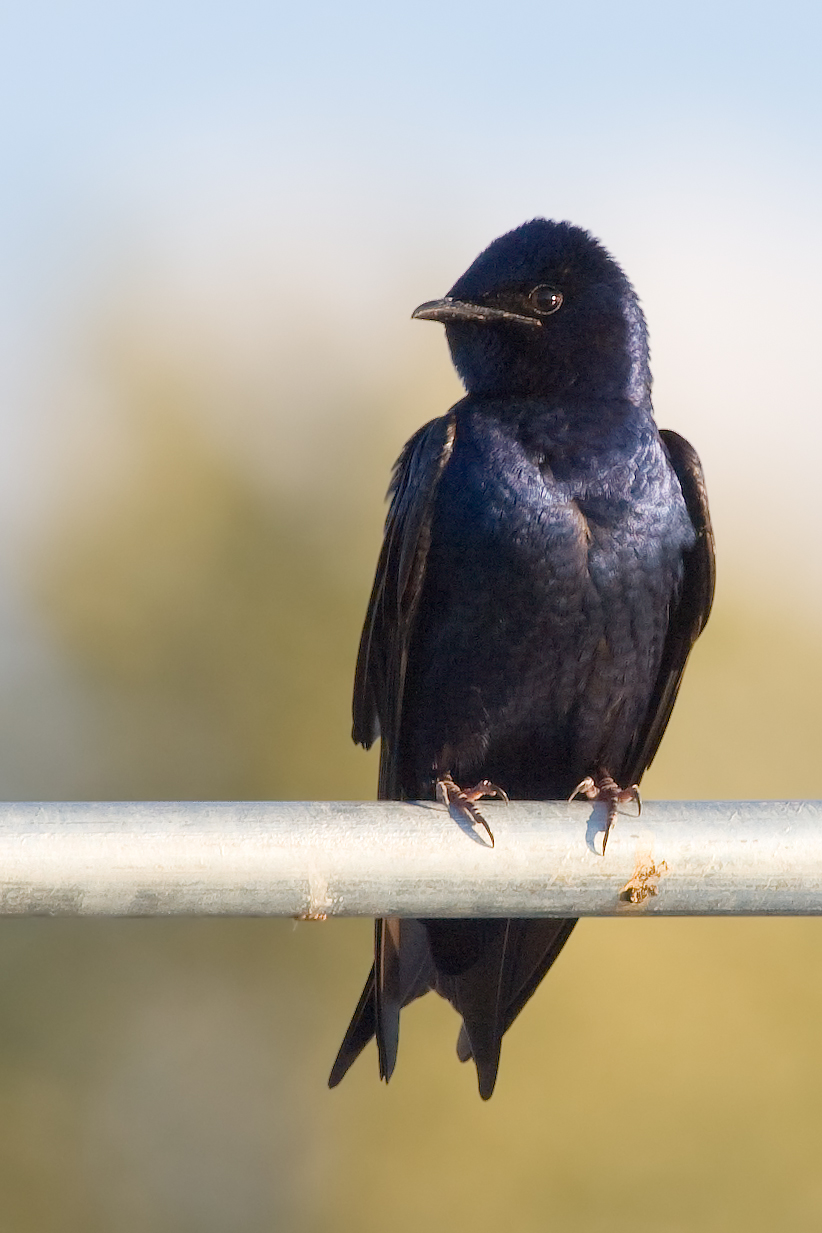 Purple MartinProgne subis
-
 Welcome SwallowHirundo neoxena
-
 Western House MartinDelichon urbicum
-
 Tree SwallowTachycineta bicolor
-
 Sand MartinRiparia riparia
-
 Cliff SwallowPetrochelidon pyrrhonota
-
 Eurasian Crag MartinPtyonoprogne rupestris
Compare
Questions and answers
What is the scientific name of the Banded Martin?
The scientific name of the Banded Martin is Neophedina cincta. Written with its author, the full name is Neophedina cincta (Boddaert, 1783).
Which family does the Banded Martin belong to?
Neophedina cincta belongs to the family Hirundinidae, in the order Passeriformes and the class Aves.
Where is the Banded Martin found?
Checklists and occurrence records place Neophedina cincta in 24 countries, including South Africa, Kenya, Botswana, Namibia, Tanzania and Uganda.
What is the conservation status of the Banded Martin?
The IUCN Red List category recorded for Neophedina cincta is Least Concern (LC).
What other names does the Banded Martin have?
Neophedina cincta is also known in English as BAMA and Banded Sand Martin.
Is there a bird named Martin?
Yes. The Banded Martin is a large brown-and-white swallow with a band across its chest and a pale mark above its eye.[4]
Sources
Passages the profile rests on
- Its underparts and underwing coverts are white. Source passage: “Its underparts are white, as are the underwing coverts” — English Wikipedia
- The species has a dark brown band across its breast. Source passage: “and it has a dark brown breast band” — English Wikipedia
- Some individuals have a thin dark line across the vent. Source passage: “and sometimes a thin dark line across the vent.” — English Wikipedia
- The Banded Martin is described as a large brown-and-white swallow with a band across its chest and a pale mark above its eye. Source passage: “Large brown-and-white swallow with a band across the chest and a pale mark above the.” — ebird.org
- Juveniles have a paler breast band and golden tips on their upperpart feathers. Source passage: “the young have a paler breast band and golden tips to the upper part feathers.” — English Wikipedia
- The nominate subspecies from southern Africa is the palest plumage form. Source passage: “The nominate R. c. cincta of southern Africa is the palest form.” — English Wikipedia
- The species can be distinguished from the smaller Sand Martin by its square tail and white underwings. Source passage: “It is easily distinguished from the smaller sand martin by its square tail and white on the underwings” — English Wikipedia
- The Banded Martin differs from the Brown-throated Sand Martin by having a white throat. Source passage: “and from the brown-throated sand martin by its white throat.” — English Wikipedia
- The Banded Martin measures 15–17 cm in length. Source passage: “The 15–17 cm (5.9–6.7 in) long banded martin” — English Wikipedia
- The Banded Martin inhabits open farmland, grassland and savannah, generally near water. Source passage: “The banded martin is found in open habitats such as farmland, grassland and savannah, usually near water.” — English Wikipedia
- The Banded Martin feeds on insects, which it usually catches while flying over grassland. Source passage: “Its diet consists of insects, usually taken in flight over grassland.” — English Wikipedia
- The species has a slow and erratic flight. Source passage: “This species has a slow erratic flight” — English Wikipedia
- The Banded Martin frequently perches. Source passage: “and frequently perches.” — English Wikipedia
- The species is less gregarious than the Sand Martin and Brown-throated Sand Martin and is usually observed in pairs or small flocks. Source passage: “It is less gregarious than those species, and is typically seen in pairs or small flocks.” — English Wikipedia
- The Banded Martin's flight call is a repeated che-che-che sound. Source passage: “The flight call is che-che-che” — English Wikipedia
- Its song consists of a twittering mixture of chip and choop sounds. Source passage: “and the song is a twittering jumble of chip choop sounds.” — English Wikipedia
- The southern nominate subspecies occurring in South Africa and Zimbabwe migrates northward for the winter. Source passage: “The southern nominate subspecies of South Africa and Zimbabwe, is migratory, wintering further north” — English Wikipedia
- The southern nominate subspecies sometimes winters as far north as Gambia. Source passage: “where it can move sometimes as far as Gambia.” — English Wikipedia
- The subspecies Neophedina cincta xerica leaves its drier breeding grounds in Botswana and northern Namibia during the southern winter. Source passage: “N. c. xerica also leaves its drier breeding grounds in Botswana and northern Namibia in the southern winter.” — English Wikipedia
- Other subspecies make local or altitudinal movements that often depend on rainfall patterns. Source passage: “Other subspecies undertake local or altitudinal movements often dependent on the rainfall pattern.” — English Wikipedia
- Unlike other members of its genus, the Banded Martin does not nest colonially. Source passage: “The banded martin, unlike the other members of its genus, is not colonial in its nesting habits.” — English Wikipedia
- The species nests at the end of a tunnel measuring 60–90 cm in length. Source passage: “Its nest is at the end of a 60–90 cm (24–35 in) long tunnel” — English Wikipedia
- The birds usually excavate their nesting tunnels in natural sand banks or earth mounds. Source passage: “usually excavated by the birds in a natural sand bank or earth mound.” — English Wikipedia
- The nest lining consists of straw and feathers placed in a chamber at the end of the burrow. Source passage: “The actual nest is a litter of straw and feathers in a chamber at the end of the burrow.” — English Wikipedia
- The Banded Martin lays clutches of two to five white eggs. Source passage: “The two to five white eggs” — English Wikipedia
- Both parents incubate the eggs. Source passage: “are incubated by both parents.” — English Wikipedia
Data
- Catalogue of Life, 2026-10-16 XR cc by
- Global Biodiversity Information Facility CC BY 4.0
- Wikidata CC0
- GeoNames CC BY 4.0
- Wikimedia Commons per image; credit shown with each image
- Within the Catalogue of Life, this name comes from The Integrated Taxonomic Information System cc0
This species in other databases
Page built on 28 November 2026. See how the catalog is made and all sources and licences.
Cite this page
ScientificNames.org. (2026). Neophedina cincta (Banded Martin). Retrieved November 28, 2026, from https://scientificnames.org/species/neophedina-cincta
“Neophedina cincta (Banded Martin).” ScientificNames.org, 2026, scientificnames.org/species/neophedina-cincta. Accessed 28 Nov. 2026.
ScientificNames.org. “Neophedina cincta (Banded Martin).” Accessed November 28, 2026. https://scientificnames.org/species/neophedina-cincta.
@misc{scientificnames_neophedina_cincta_banded_martin,
  author = {{ScientificNames.org}},
  title = {Neophedina cincta (Banded Martin)},
  year = {2026},
  url = {https://scientificnames.org/species/neophedina-cincta},
  note = {Accessed 2026-11-28}
}