Species · Reptiles
Salt Marsh Snake Nerodia clarkii
The scientific name of the Salt Marsh Snake is Nerodia clarkii. It is a species of reptile in the family Colubridae (colubrid), order Squamata. The name dates from 1853.
- Scientific name
- Nerodia clarkii (Baird & Girard, 1853)
- Common name
- Salt Marsh Snake
- Genus
- Nerodia
- Family
- Colubridae (Colubrid)
- Order
- Squamata
- Class
- Reptilia
- Red List category
- LC Least Concern
- Recorded in
- 3 countries
- Name status
- accepted in the Catalogue of Life

Overview
Nerodia clarkii inhabits coastal tidal marshes, mangroves, and mud flats in saltwater and estuarine environments. It is the only snake native to United States saltwater habitats.
Written 26 November 2026 from the sources listed below. Each statement was checked against the passage it cites; statements that could not be supported were removed.
Appearance
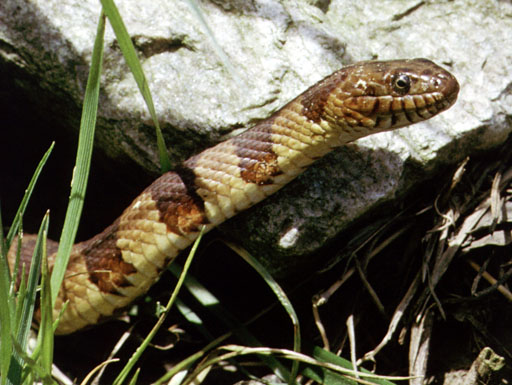
Adults exhibit highly variable coloration, including gray, grayish-olive, brown, tan, rusty orange, and nearly black. Some individuals have no body stripes, while others are almost entirely black. Juveniles have coloration similar to that of adults.[1][2][3]
The species has keeled scales and 21–23 dorsal scale rows at midbody.[4]
Habitat
The species inhabits coastal tidal marshes, mangroves, and mud flats in saltwater and estuarine environments. It occupies brackish and saltwater habitats.[5][6]
Individuals frequently shelter in tidal wrack along shorelines and in crab burrows in sand or mud. Salt Marsh Snakes have been reported as common on coastal barrier islands without freshwater.[7][8]
The species occurs in the southeastern United States and has an additional population in northern Cuba. In Florida, it occurs along much of the coastal perimeter, including the Florida Keys and most surrounding barrier islands.[9][10]
In Florida, Gulf salt marsh snakes occur in Escambia and Santa Rosa counties and from Gulf County to Levy County. Mangrove salt marsh snakes occur from Levy County to Brevard County, with a likely gap along coastal Palm Beach County.[11][12]
The Atlantic salt marsh snake subspecies is restricted to Florida.[13]
Diet
The species feeds primarily on small fish caught in shallow water. Occasional prey includes small frogs and fiddler crabs.[14][15]
Gulf salt marsh snakes consume small fish, crabs, shrimp, and other invertebrates.[16]
The species captures prey with its jaws and swallows it alive rather than constricting it.[17]
Behaviour
The species is generally secretive and docile and avoids direct contact with people and pets. When approached, individuals may flee to shelter or remain motionless to avoid detection.[18][19]
When grabbed or pinned, individuals may bite and release foul-smelling musk from glands at the base of the tail.[20]
The species is typically nocturnal. Gulf salt marsh snakes may bask and forage during daylight in cool weather, while mangrove salt marsh snakes may bask in mangrove branches during the day.[21][22][23]
Salt Marsh Snakes lack specialized salt glands for removing salt ingested with food. The species obtains freshwater from rain, shifting tides, and potentially the body fluids of its prey.[24][25]
Reproduction and life cycle
The species reproduces by giving birth to live young. Female Salt Marsh Snakes in Florida typically give birth to 3–9 young between July and October.[26][27]
Gulf salt marsh snakes reach sexual maturity at approximately three years of age.[28]
Conservation
The Atlantic salt marsh snake is threatened by habitat destruction associated with waterfront development. It is listed as threatened by both federal and Florida wildlife authorities.[29][30]
The Atlantic salt marsh snake received federal threatened status in 1977.[31]
Similar species
Salt Marsh Snakes interbreed with southern watersnakes (Nerodia fasciata) where their ranges overlap. Hybridization is associated with disturbed or altered habitats where freshwater and saltwater environments meet.[32][33]
Classification of the Salt Marsh Snake
| Kingdom | Animalia |
|---|---|
| Phylum | Chordata |
| Subphylum | Vertebrata |
| Infraphylum | Gnathostomata |
| Parvphylum | Osteichthyes |
| Megaclass | Tetrapoda |
| Class | Reptilia (Reptile) |
| Order | Squamata (Snakes) |
| Suborder | Serpentes (Snakes) |
| Infraorder | Alethinophidia |
| Family | Colubridae (Colubrid) |
| Subfamily | Natricinae |
| Genus | Nerodia (Water Snakes) |
| Species | Nerodia clarkii (Baird & Girard, 1853) |
Where the Salt Marsh Snake is found
Checklists and occurrence records place Nerodia clarkii in 3 countries across North America. GBIF holds 4,140 georeferenced records of it.
Countries
Regions and cities with the most records
- Florida, United States 1,367
- Texas, United States 669
- Pinellas Park, United States 240
- Lealman, United States 238
- West and East Lealman, United States 238
- St. Petersburg, United States 218
- Seminole, United States 211
- Largo, United States 186
- La Marque, United States 167
- Galveston, United States 154
- Texas City, United States 148
- Clearwater, United States 141
- Safety Harbor, United States 138
- La Porte, United States 120
- Dunedin, United States 118
- Deer Park, United States 98
- Baytown, United States 97
- Town 'n' Country, United States 90
- Iona, United States 78
- Palm Harbor, United States 78
- Westchase, United States 78
- Vero Beach, United States 77
- Channelview, United States 76
- Pasadena, United States 75
- East Lake, United States 63
- Vero Beach South, United States 63
- Edgewater, United States 59
- Florida Ridge, United States 59
- Cape Coral, United States 58
- Fort Pierce, United States 58
- Palmetto Bay, United States 58
- Cutler, United States 56
- Louisiana, United States 54
- Egypt Lake-Leto, United States 52
- Coconut Grove, United States 51
- Coral Gables, United States 51
Range as the checklists state it
USA (coastal Florida, Louisiana, Mississippi, Alabama, SE Texas),
A number beside a place is its count of GBIF occurrence records. A place without a number comes from a checklist alone. Records show where a species has been observed or collected, which can include escapes and vagrants.
Common names
English
- Salt Marsh Snake
- Salt Marsh Water Snake
Names in 2 other languages
- Portuguese
- Cobra-das-salinas
- Spanish
- catibo de mar
Synonyms
11 other scientific names have been used for this species and are now treated as synonyms of Nerodia clarkii.
- Natrix compressicauda bivillata Cope, 1889
- Natrix compressicauda bivittata Cope, 1889
- Natrix compressicauda obscura Lönnberg, 1894
- Natrix compressicauda taeniata Cope, 1895
- Natrix compressicauda walkeri Yarrow, 1883
- Natrix fasciata clarki
- Nerodia compressicauda Kennicott, 1860
- Regina clarkii Baird & Girard, 1853
- Tropidonotus compressicaudus walkeri Yarrow, 1883
- Tropidonotus compsolaemus Cope, 1861
- Tropidonotus ustus Cope, 1860
Subspecies and varieties
- Nerodia clarkii clarkii (Gulf Salt Marsh Snake) subspecies
- Nerodia clarkii compressicauda (Mangrove Saltmarsh Watersnake) subspecies
- Nerodia clarkii taeniata (Atlantic Salt Marsh Snake) subspecies
Related species
-
 Common WatersnakeNerodia sipedon
-
 Banded Water SnakeNerodia fasciata
-
 Diamond-backed WatersnakeNerodia rhombifer
-
 Plain-bellied Water SnakeNerodia erythrogaster
-
 Green Water SnakeNerodia cyclopion
-
 Brown Water SnakeNerodia taxispilota
-
 Florida Green Water SnakeNerodia floridana
- Concho Water SnakeNerodia paucimaculata
Compare
Questions and answers
What is the scientific name of the Salt Marsh Snake?
The scientific name of the Salt Marsh Snake is Nerodia clarkii. Written with its author, the full name is Nerodia clarkii (Baird & Girard, 1853).
Which family does the Salt Marsh Snake belong to?
Nerodia clarkii belongs to the family Colubridae, in the order Squamata and the class Reptilia.
Where is the Salt Marsh Snake found?
Checklists and occurrence records place Nerodia clarkii in 3 countries: United States, Cuba and Mexico.
What is the conservation status of the Salt Marsh Snake?
The IUCN Red List category recorded for Nerodia clarkii is Least Concern (LC).
What other names does the Salt Marsh Snake have?
Nerodia clarkii is also known in English as Salt Marsh Water Snake.
Sources
Passages the profile rests on
- Adults exhibit highly variable coloration, including gray, grayish-olive, brown, tan, rusty orange, and nearly black. Source passage: “Adults can be gray, grayish-olive, brown, tan, or rusty orange, with variable patterns of dark stripes or bands down the body.” — floridamuseum.ufl.edu
- Some individuals have no body stripes, while others are almost entirely black. Source passage: “However, some individuals may lack stripes entirely, and some individuals may be almost entirely black.” — floridamuseum.ufl.edu
- Juveniles have coloration similar to that of adults. Source passage: “Juvenile coloration is similar to that described for adults.” — floridamuseum.ufl.edu
- The species has keeled scales and 21–23 dorsal scale rows at midbody. Source passage: “The scales are keeled (each scale has a prominent raised ridge), and there are 21-23 dorsal scale rows at midbody.” — floridamuseum.ufl.edu
- The species inhabits coastal tidal marshes, mangroves, and mud flats in saltwater and estuarine environments. Source passage: “Saltmarsh Snakes are primarily found in coastal habitats such as tidal marshes, mangroves, and mud flats in both saltwater and estuarine areas.” — floridamuseum.ufl.edu
- The species occupies brackish and saltwater habitats. Source passage: “this snake inhabits brackish and saltwater habitats;” — English Wikipedia
- Individuals frequently shelter in tidal wrack along shorelines and in crab burrows in sand or mud. Source passage: “These snakes can frequently be found hiding in tidal wrack along the shoreline and they often inhabit crab burrows in the sand or mud.” — floridamuseum.ufl.edu
- Salt Marsh Snakes have been reported as common on coastal barrier islands without freshwater. Source passage: “being reported as common on coastal barrier islands without freshwater (Allen 1932).” — English Wikipedia
- The species occurs in the southeastern United States and has an additional population in northern Cuba. Source passage: “found in the southeastern United States. Their range extends along the tidal salt marshes of the Gulf of Mexico and the Atlantic Coast from Texas to Florida, with an additional population in northern Cuba.” — English Wikipedia
- The species occurs along much of Florida's coastal perimeter, including the Florida Keys and most surrounding barrier islands. Source passage: “They are also found throughout the Florida Keys and on most barrier islands around the state.” — floridamuseum.ufl.edu
- In Florida, Gulf salt marsh snakes occur in Escambia and Santa Rosa counties and from Gulf County to Levy County. Source passage: “In Florida, Gulf Saltmarsh Watersnakes are found in coastal habitats in Escambia and Santa Rosa counties and from Gulf County to Levy County.” — floridamuseum.ufl.edu
- In Florida, mangrove salt marsh snakes occur from Levy County to Brevard County, with a likely gap along coastal Palm Beach County. Source passage: “In Florida, Mangrove Saltmarsh Watersnakes are found in coastal habitats from Levy County on the west coast to Brevard County on the east coast, with a likely gap through coastal Palm Beach County.” — floridamuseum.ufl.edu
- The Atlantic salt marsh snake subspecies is restricted to Florida. Source passage: “They are not found outside of Florida.” — floridamuseum.ufl.edu
- The species feeds primarily on small fish caught in shallow water. Source passage: “Saltmarsh Snakes are typically nocturnal (active at night) and feed almost exclusively on small fishes, which they catch in shallow water.” — floridamuseum.ufl.edu
- Occasional prey includes small frogs and fiddler crabs. Source passage: “However, they occasionally feed on small frogs and fiddler crabs.” — floridamuseum.ufl.edu
- Gulf salt marsh snakes consume small fish, crabs, shrimp, and other invertebrates. Source passage: “Small fish, crabs, shrimp, and other invertebrates make up the diet of the gulf salt marsh snake.” — tpwd.texas.gov
- The species captures prey with its jaws and swallows it alive rather than constricting it. Source passage: “Saltmarsh Snakes are not constrictors and overpower their prey by simply grabbing it in their jaws and quickly swallowing it alive.” — floridamuseum.ufl.edu
- The species is generally secretive and docile and avoids direct contact with people and pets. Source passage: “These secretive and generally docile snakes are not aggressive and avoid direct contact with people and pets.” — floridamuseum.ufl.edu
- When approached, individuals may flee to shelter or remain motionless to avoid detection. Source passage: “When approached, Saltmarsh Snakes may either flee for shelter or, more commonly, remain motionless to avoid detection.” — floridamuseum.ufl.edu
- When grabbed or pinned, individuals may bite and release foul-smelling musk from glands at the base of the tail. Source passage: “If grabbed or pinned, they may bite the attacker and release a foul-smelling musk from a pair of glands in the base of the tail.” — floridamuseum.ufl.edu
- The species is typically nocturnal. Source passage: “Saltmarsh Snakes are typically nocturnal (active at night)” — floridamuseum.ufl.edu
- Gulf salt marsh snakes may bask and forage during daylight in cool weather. Source passage: “but may be found basking and foraging during daylight hours in cool weather.” — English Wikipedia
- Mangrove salt marsh snakes may bask in mangrove branches during the day. Source passage: “but may be seen basking in the branches of mangrove trees during the day.” — English Wikipedia
- Salt Marsh Snakes lack specialized salt glands for removing salt ingested with food. Source passage: “Saltmarsh Snakes do not have salt glands to help remove the incidental salt ingested with their food.” — floridamuseum.ufl.edu
- The species obtains freshwater from rain, shifting tides, and potentially the body fluids of its prey. Source passage: “Therefore, these snakes must obtain freshwater from rain, shifting tides, and potentially body fluids of their prey to help flush out the excess salt.” — floridamuseum.ufl.edu
- The species reproduces by giving birth to live young. Source passage: “All members of this species reproduce via live birth,” — English Wikipedia
- Female Salt Marsh Snakes in Florida typically give birth to 3–9 young between July and October. Source passage: “In Florida, female Saltmarsh Snakes typically give live birth to 3-9 young between July and October.” — floridamuseum.ufl.edu
- Gulf salt marsh snakes reach sexual maturity at approximately three years of age. Source passage: “Sexual maturity is reached at three years.” — English Wikipedia
- The Atlantic salt marsh snake is threatened by habitat destruction associated with waterfront development. Source passage: “Atlantic Saltmarsh Watersnakes have become increasingly rare as waterfront development has destroyed much of their habitat.” — floridamuseum.ufl.edu
- The Atlantic salt marsh snake is listed as threatened by both federal and Florida wildlife authorities. Source passage: “They are listed as a “Threatened Species” by both the U.S. Fish and Wildlife Service and the Florida Fish and Wildlife Conservation Commission.” — floridamuseum.ufl.edu
- The Atlantic salt marsh snake received federal threatened status in 1977. Source passage: “having received this designation in 1977.” — English Wikipedia
- Salt Marsh Snakes interbreed with southern watersnakes (Nerodia fasciata) where their ranges overlap. Source passage: “Saltmarsh Snakes and Southern Watersnakes (Nerodia fasciata) are known to interbreed in areas around the state.” — floridamuseum.ufl.edu
- Hybridization with southern watersnakes is associated with disturbed or altered habitats where freshwater and saltwater environments meet. Source passage: “Hybrid populations are often in disturbed or altered habitats where the freshwater-saltwater ecotone has been disrupted” — English Wikipedia
Data
- Catalogue of Life, 2026-10-16 XR cc by
- Global Biodiversity Information Facility CC BY 4.0
- Wikidata CC0
- GeoNames CC BY 4.0
- Wikimedia Commons per image; credit shown with each image
- Within the Catalogue of Life, this name comes from The Reptile Database cc by
References
- Baird, S. F. and C. Girard. (1853). Catalogue of North American Reptiles in the Museum of the Smithsonian Institution. Part 1.-Serpents. Smithsonian Inst., Washington, Xvi + 172 Pp.
- Kennicott, R. (1860). Descriptions of new species of North American serpents in the museum of the Smithsonian Institution, Washington. Proc. Acad. Nat. Sci. Philadelphia 12: 328-338.
- Garman, & Samuel. (1884). The reptiles and batrachians of North America. Mem. Mus. Comp. Zool, Cambridge (Massachusetts), 8 (3): Xxxiv + 185 Pp. [1883] [CNAH Reprint 10].
- Boulenger, G. A. (1893). Catalogue of the snakes in the British Museum (Nat. Hist.) I. London (Taylor & Francis), 448 Pp.
- Lönnberg, & Einar. (1894). Notes on reptiles and batrachians collected in Florida in 1892 and 1893. Proc. US Natl. Mus. 17 (1003): 317-339.
- Cope, E. D. (1895). On some North American Snakes. American Naturalist 29: 676-680.
- Cope, E. D. (1900). The crocodilians, lizards and snakes of North America. Ann. Rep. U.S. Natl. Mus. 1898: 153-1270.
- Barbour, T., & Noble, G. K. (1915). Notes on the water snake Natrix compressicauda. Proceedings of the Academy of Natural Sciences of Philadelphia 1915 (January): 29-35.
- Allen, Morrow J. (1932). A survey of the Amphibians and reptiles of Harrison County, Mississippi. American Museum Novitates (542): 1-20.
- Wright, A. H., & Wright, A. A. (1957). Handbook of Snakes of the United States and Canada 1. Constable, London, Xviii + 564 Pp.
- Pettus, D. (1963). Salinity and subspeciation in Natrix sipedon. Copeia 1963:449–504.
- Neill, W. T. (1965). Notes on aquatic snakes, Natrix and Tretanorhi nus, in Cuba. Herpetologica 21 (1): 62-67.
- Dunson, William A. (1979). Occurrence of partially striped forms of the mangrove snake Nerodia fasciata compressicauda Kenicott and comments on the status of N. f. taeniata Cope. Florida Scientist 42: 102-112.
- Dunson, W. A. (1980). The relation of sodium and water balance to survival in sea water of estuarine and freshwater races of the snakes Nerodia fasciata, N. sipedon and N. valida. Copeia 1980:268–280.
- Ashton, R.E., Jr., and Ashton, P.S. (1982). Handbook of reptiles and amphibians of Florida. Pt. I. Snakes. Windward PubI., Inc., Miami: 176 Pp.
- Mehrtens, J. M. (1987). Living snakes of the world in color. Sterling Publ. Co., Hic., New York, NY: 480 Pp.
- Lawson, R. (1987). Molecular studies of Thamnophiine snakes: 1. The phylogeny of the genus Nerodia. Journal of Herpetology 21 (2): 140-157.
- Lawson, Robin; Meier, Albert J.; Frank, Phillip G.; Moler, Paul E. (1991). Allozyme variation and systematics of the Nerodia fasciata-Nerodia clarkii complex of water snakes (Serpentes: Colubridae). Copeia 1991 (3): 638-659.
- Conant, R., & Collins, J. T. (1991). A Field Guide to Reptiles and Amphibians of Eastern/Central North America, 3rd ed. Houghton Mifflin (Boston/New York), Xx + 450 P.
- Schwartz, A., & Henderson, R. W. (1991). Amphibians and Reptiles of the West Indies. University of Florida Press, Gainesville, 720 Pp.
- Mullin, S. J. (1994). Life History Characteristics of Nerodia clarkii compressicauda at Placido Bayou, Florida. Journal of Herpetology 28 (3): 371-374.
- Mullin, S.J. & H.R. Mushinsky. (1995). Foraging ecology of the mangrove salt marsh snake, Nerodia clarkii compressicauda: effects of vegetational density. Amphibia-Reptilia 16(2): 167-175.
- Mullin, S.J. & H.R. Mushinsky. (1997). Use of Experimental Enclosures to Examine Foraging Success in Water Snakes: A Case Study. Journal of Herpetology 31 (4): 565-569.
- Dixon, James R. (2000). Amphibians and reptiles of Texas, second edition. Texas A&M University Press, 421 Pp.
- Werler, John E. & James R. Dixon. (2000). Texas Snakes. University of Texas Press, 544 Pages.
This species in other databases
- Catalogue of Life 476BD
- Wikidata Q589568
- iNaturalist 29323
- WoRMS urn:lsid:marinespecies.org:taxname:405991
- ITIS 209370
Page built on 26 November 2026. See how the catalog is made and all sources and licences.
Cite this page
ScientificNames.org. (2026). Nerodia clarkii (Salt Marsh Snake). Retrieved November 26, 2026, from https://scientificnames.org/species/nerodia-clarkii
“Nerodia clarkii (Salt Marsh Snake).” ScientificNames.org, 2026, scientificnames.org/species/nerodia-clarkii. Accessed 26 Nov. 2026.
ScientificNames.org. “Nerodia clarkii (Salt Marsh Snake).” Accessed November 26, 2026. https://scientificnames.org/species/nerodia-clarkii.
@misc{scientificnames_nerodia_clarkii_salt_marsh_snake,
  author = {{ScientificNames.org}},
  title = {Nerodia clarkii (Salt Marsh Snake)},
  year = {2026},
  url = {https://scientificnames.org/species/nerodia-clarkii},
  note = {Accessed 2026-11-26}
}