Species · Reptiles
Brown Water Snake Nerodia taxispilota
The scientific name of the Brown Water Snake is Nerodia taxispilota. It is a species of reptile in the family Colubridae (colubrid), order Squamata. The name dates from 1838.
- Scientific name
- Nerodia taxispilota (Holbrook, 1838)
- Common name
- Brown Water Snake
- Genus
- Nerodia
- Family
- Colubridae (Colubrid)
- Order
- Squamata
- Class
- Reptilia
- Red List category
- LC Least Concern
- Recorded in
- 1 country
- Name status
- accepted in the Catalogue of Life

Overview
Nerodia taxispilota inhabits swamps, streams, rivers, canals, reservoirs, and lakes in the southeastern United States. It is distinguished by its heavy body, narrower neck, brown coloration, and dark square blotches along its back.
Written 26 November 2026 from the sources listed below. Each statement was checked against the passage it cites; statements that could not be supported were removed.
Appearance
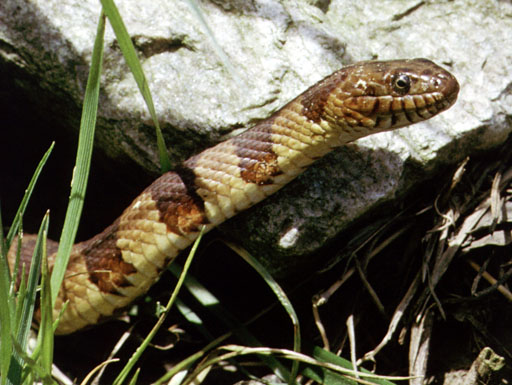
The Brown Water Snake has a heavy-bodied build and a head visibly wider than its neck, giving it a slightly triangular appearance. Its eyes are positioned high on its head and close to the tip of its nose.[1][2][3]
Its dorsal coloration ranges from brown to rusty brown. Approximately 25 black or dark brown square blotches typically mark its back, with smaller alternating blotches along its sides.[4][5][6]
Its underside is yellow and heavily marked with black or dark brown. The belly is generally light-colored, with brown blotches and black crescent-shaped markings.[7][8]
Its dorsal scales occur in 27–33 rows and are strongly keeled. It has two to four anterior temporal scales.[9][10][11]
Adults typically measure 76–152 cm in total length. Females are larger than males, and the largest recorded individual measured approximately 177.8 cm.[12][13][14]
Similar species
The Brown Water Snake is frequently mistaken for the venomous cottonmouth. The closely related diamondback watersnake replaces it west of eastern Alabama.[15][16]
Habitat
The Brown Water Snake inhabits swamps and streams and commonly occurs in flowing waters, including rivers, canals, and blackwater cypress creeks. It also occurs in large water reservoirs and lakes.[17][18][19]
Its preferred habitat includes backwater areas, steep riverbanks, and the outside bends of rivers. Branches, logs, and vines hanging approximately 2–4 meters above water provide suitable basking and hunting locations.[20][21]
The species is largely restricted to permanent water bodies because of its preference for fish prey. It is seldom observed far from the water's edge.[22][23]
Diet
The Brown Water Snake has a predominantly fish-based diet. Small catfish are among its particularly important prey items.[24][25]
Behaviour
The Brown Water Snake is an excellent swimmer. It captures fish through ambush or active foraging along river and lake edges or bottoms.[26][27]
The species is proficient at climbing and frequently basks on vegetation or emergent snags as high as 20 feet above the water. When startled while perched, individuals drop into the water.[28][29][30]
When cornered, individuals may strike and inflict a painful bite.[31]
Reproduction and life cycle
The Brown Water Snake reproduces by giving birth to live young. Mating takes place during spring, when groups of males may be observed courting females.[32][33]
Females typically give birth to 20–60 young, usually in August. Typical reported brood sizes are 30–40 young, within a broader range of 14–58.[34][35][36]
Newborn individuals measure approximately 18–27 cm in length and become independent immediately after birth.[37][38]
Females can store sperm after mating until ovulation and reproduce once annually.[39][40]
Male individuals reach sexual maturity at approximately three years of age. Females reach sexual maturity at approximately five to six years of age.[41][42]
Conservation
The Brown Water Snake is common in its southeastern United States range. It is protected throughout Georgia but is not protected throughout most of its regional range.[43][44][45]
Uses
The Brown Water Snake has been proposed as a subject for investigating human impacts on aquatic ecosystems through movement studies. It is also being used as a bioindicator of mercury accumulation in wetland ecosystems.[46][47]
Classification of the Brown Water Snake
| Kingdom | Animalia |
|---|---|
| Phylum | Chordata |
| Subphylum | Vertebrata |
| Infraphylum | Gnathostomata |
| Parvphylum | Osteichthyes |
| Megaclass | Tetrapoda |
| Class | Reptilia (Reptile) |
| Order | Squamata (Snakes) |
| Suborder | Serpentes (Snakes) |
| Infraorder | Alethinophidia |
| Family | Colubridae (Colubrid) |
| Subfamily | Natricinae |
| Genus | Nerodia (Water Snakes) |
| Species | Nerodia taxispilota (Holbrook, 1838) |
Where the Brown Water Snake is found
Checklists and occurrence records place Nerodia taxispilota in 1 country across North America. GBIF holds 8,566 georeferenced records of it.
Countries
Regions and cities with the most records
- Georgia, United States 3,033
- Florida, United States 2,464
- South Carolina, United States 694
- North Carolina, United States 690
- Virginia, United States 659
- Hopewell, United States 424
- Colonial Heights, United States 406
- Chester, United States 401
- Petersburg, United States 372
- Greenacres City, United States 191
- Boynton Beach, United States 190
- Lake Worth Beach, United States 190
- Lake Worth Corridor, United States 190
- Palm Springs, United States 190
- Sandalfoot Cove, United States 183
- Boca Del Mar, United States 182
- Delray Beach, United States 179
- Boca Raton, United States 165
- Deerfield Beach, United States 163
- Apopka, United States 123
- Temple Terrace, United States 123
- Northdale, United States 119
- Wesley Chapel, United States 119
- Martinez, United States 118
- University, United States 117
- Lake Magdalene, United States 116
- Lutz, United States 116
- Brandon, United States 115
- East Lake-Orient Park, United States 114
- Carrollwood, United States 111
- Carrollwood Village, United States 108
- Greater Northdale, United States 107
- Palm River-Clair Mel, United States 106
- Citrus Park, United States 101
- Land O' Lakes, United States 101
- Egypt Lake-Leto, United States 100
Range as the checklists state it
USA (Florida, SE Alabama, Georgia, South Carolina, E North Carolina, W Virginia)
A number beside a place is its count of GBIF occurrence records. A place without a number comes from a checklist alone. Records show where a species has been observed or collected, which can include escapes and vagrants.
Common names
English
- Brown Water Snake
Names in 4 other languages
- Czech
- užovka chřestýší
- German
- Braune Schwimmnatter, Braune Wassernatter, Braune Wasserschlange
- Portuguese
- Cobra-d'água-marrom
- Russian
- Коричневый американский уж
Synonyms
3 other scientific names have been used for this species and are now treated as synonyms of Nerodia taxispilota.
- Coluber taxispilotus Holbrook, 1838
- Natrix taxispilota (Holbrook, 1838)
- Tropidonotus taxispilotus Holbrook, 1843
Related species
-
 Common WatersnakeNerodia sipedon
-
 Banded Water SnakeNerodia fasciata
-
 Diamond-backed WatersnakeNerodia rhombifer
-
 Plain-bellied Water SnakeNerodia erythrogaster
-
 Green Water SnakeNerodia cyclopion
-
 Salt Marsh SnakeNerodia clarkii
-
 Florida Green Water SnakeNerodia floridana
- Concho Water SnakeNerodia paucimaculata
Compare
Questions and answers
What is the scientific name of the Brown Water Snake?
The scientific name of the Brown Water Snake is Nerodia taxispilota. Written with its author, the full name is Nerodia taxispilota (Holbrook, 1838).
Which family does the Brown Water Snake belong to?
Nerodia taxispilota belongs to the family Colubridae, in the order Squamata and the class Reptilia.
Where is the Brown Water Snake found?
Checklists and occurrence records place Nerodia taxispilota in 1 country: United States.
What is the conservation status of the Brown Water Snake?
The IUCN Red List category recorded for Nerodia taxispilota is Least Concern (LC).
What does a brown water snake eat?
The Brown Water Snake has a predominantly fish-based diet. Small catfish are particularly important prey items.[24][25]
Sources
Passages the profile rests on
- The brown water snake has a heavy-bodied build and a neck distinctly narrower than its head. Source passage: “The brown water snake is very heavy-bodied, and its neck is distinctly narrower than its head.” — English Wikipedia
- Its eyes are positioned high on its head and close to the tip of its nose. Source passage: “Additionally, the eyes are high on the head and close to the tip of the nose.” — srelherp.uga.edu
- Its head is visibly wider than its neck, producing a slightly triangular appearance. Source passage: “head visibly wider than neck, giving it a slightly triangular appearance.” — srelherp.uga.edu
- Its dorsal coloration ranges from brown to rusty brown. Source passage: “Dorsally, it is brown or rusty brown” — English Wikipedia
- Its back typically has approximately 25 black or dark brown square blotches. Source passage: “with a row of about 25 black or dark brown, square blotches down its back.” — English Wikipedia
- Smaller blotches alternate along the sides of its body. Source passage: “Smaller similar blotches alternate on the sides.” — English Wikipedia
- Its underside is yellow and heavily marked with black or dark brown. Source passage: “Ventrally, it is yellow, heavily marked with black or dark brown.” — English Wikipedia
- Its belly is generally light-colored with brown blotches and black crescent-shaped markings. Source passage: “The belly is usually light with brown splotches and black crescents.” — srelherp.uga.edu
- Its dorsal scales occur in 27–33 rows. Source passage: “Dorsal scales are in 27–33 rows (more than any other North American water snake)” — English Wikipedia
- It has two to four anterior temporal scales. Source passage: “and it has two to four anterior temporals (usually one in others).” — English Wikipedia
- Its dorsal scales are strongly keeled. Source passage: “Like all natricine watersnakes, brown watersnakes have strongly keeled scales” — srelherp.uga.edu
- Adults typically measure 76–152 cm in total length. Source passage: “Adults measure 30–60 in. (76–152 cm) in total length” — English Wikipedia
- Females are larger than males. Source passage: “Females are much larger than males.” — srelherp.uga.edu
- A specimen measuring approximately 177.8 cm is reported as the largest recorded individual. Source passage: “The largest specimen ever recorded was roughly 177.8 centimeters long.” — animaldiversity.org
- The brown water snake is frequently mistaken for the venomous cottonmouth. Source passage: “this species is often mistaken for the venomous cottonmouth because of their coloring, habitat, and slightly triangular head.” — srelherp.uga.edu
- The closely related diamondback watersnake replaces the brown water snake west of eastern Alabama. Source passage: “West of eastern Alabama this species is replaced by the closely-related diamondback watersnake (Nerodia rhombifer).” — srelherp.uga.edu
- The species inhabits swamps and streams. Source passage: “Nerodia taxispilota is found in swamps and streams” — English Wikipedia
- It commonly inhabits flowing waters, including rivers, canals, and blackwater cypress creeks. Source passage: “More commonly found in flowing water such as rivers, canals, and black water cypress creeks” — English Wikipedia
- It also occurs in large water reservoirs and lakes. Source passage: “N. taxispilota can also be found in large water reservoirs and lakes.” — English Wikipedia
- Its preferred habitat includes backwater areas, steep riverbanks, and the outside bends of rivers. Source passage: “Capture records indicate these snakes remain close to backwater habitats and choose steep banks and the outside bends of rivers” — animaldiversity.org
- Suitable basking and hunting habitats include branches, logs, and vines hanging approximately 2–4 meters above water. Source passage: “including branches, logs, or vines that hang roughly 2 tp 4 meters above water level.” — animaldiversity.org
- The species is largely restricted to permanent water bodies because of its preference for fish prey. Source passage: “the brown watersnake’s preference for fish as prey makes them largely restricted to permanent water bodies” — srelherp.uga.edu
- It is seldom observed far from the water's edge. Source passage: “they travel less over land than other watersnakes and are seldom observed far from the water’s edge.” — srelherp.uga.edu
- The brown water snake has a predominantly fish-based diet. Source passage: “feed primarily on fish” — srelherp.uga.edu
- Small catfish are among its particularly important prey items. Source passage: “particularly small catfish” — srelherp.uga.edu
- The species is an excellent swimmer. Source passage: “They are excellent swimmers” — srelherp.uga.edu
- It captures fish through ambush or active foraging along river and lake edges or bottoms. Source passage: “which they capture either by ambush or by actively foraging along the edges or bottom of rivers and lakes.” — srelherp.uga.edu
- The species is proficient at climbing. Source passage: “Brown watersnakes are also proficient climbers” — srelherp.uga.edu
- Individuals frequently bask on vegetation or emergent snags as high as 20 feet above the water. Source passage: “often bask on vegetation or emergent snags up to 20 ft above the water.” — srelherp.uga.edu
- When startled while perched, individuals drop into the water. Source passage: “If startled, they will drop from their perch into the water” — srelherp.uga.edu
- When cornered, individuals may strike and inflict a painful bite. Source passage: “brown watersnakes do not hesitate to strike if cornered and can inflict a painful bite.” — srelherp.uga.edu
- The species reproduces by giving birth to live young. Source passage: “Females give birth to 20 � 60 live young in the late summer.” — srelherp.uga.edu
- Mating takes place during spring, when groups of males may be observed courting females. Source passage: “Brown watersnakes mate in the spring when groups of males can often be observed courting females.” — srelherp.uga.edu
- Females typically give birth to 20–60 young. Source passage: “Females give birth to 20 � 60 live young” — srelherp.uga.edu
- Births usually occur in August. Source passage: “The young are born alive, usually in August” — English Wikipedia
- Typical reported brood sizes are 30–40 young, within a broader range of 14–58. Source passage: “in broods of 14–58, more commonly 30–40.” — English Wikipedia
- Newborn individuals measure approximately 18–27 cm in length. Source passage: “The newborns are 7–10¾ in (18–27 cm) long” — English Wikipedia
- Newborn individuals become independent immediately after birth. Source passage: “All neonates are immediately independent following birth.” — animaldiversity.org
- Females can store sperm after mating until ovulation. Source passage: “After they mate, females can store the sperm until they ovulate.” — animaldiversity.org
- Female brown water snakes reproduce once annually. Source passage: “Female brown water snakes breed once a year.” — animaldiversity.org
- Male individuals reach sexual maturity at approximately three years of age. Source passage: “Male brown water snakes reach sexual maturity at 3 years of age” — animaldiversity.org
- Females reach sexual maturity at approximately five to six years of age. Source passage: “females do not reach sexual maturity until roughly 5 or 6 years of age.” — animaldiversity.org
- The species is common in its southeastern United States range. Source passage: “Brown watersnakes are common in our region” — srelherp.uga.edu
- The species is protected throughout Georgia. Source passage: “This species is protected throughout the state of Georgia.” — srelherp.uga.edu
- The species is not protected throughout most of its regional range. Source passage: “and are not protected throughout most of it.” — srelherp.uga.edu
- The species has been proposed as a subject for investigating human impacts on aquatic ecosystems through movement studies. Source passage: “this species could be used to investigate anthropogenic impacts on aquatic ecosystems by studying their movements.” — English Wikipedia
- The species is being used as a bioindicator of mercury accumulation in wetland ecosystems. Source passage: “These snakes are beginning to be used as a bioindicator of Mercury(Hg) accumulation in wetland ecosystems.” — English Wikipedia
Data
- Catalogue of Life, 2026-10-16 XR cc by
- Global Biodiversity Information Facility CC BY 4.0
- Wikidata CC0
- GeoNames CC BY 4.0
- Wikimedia Commons per image; credit shown with each image
- Within the Catalogue of Life, this name comes from The Reptile Database cc by
References
- Holbrook, John E. (1838). North American Herpetology, Vol. 2 (1st ed.). J. Dobson, Philadelphia, 130 Pp.
- Baird, S. F. and C. Girard. (1853). Catalogue of North American Reptiles in the Museum of the Smithsonian Institution. Part 1.-Serpents. Smithsonian Inst., Washington, Xvi + 172 Pp.
- Garman, & Samuel. (1884). The reptiles and batrachians of North America. Mem. Mus. Comp. Zool, Cambridge (Massachusetts), 8 (3): Xxxiv + 185 Pp. [1883] [CNAH Reprint 10].
- Boulenger, G. A. (1893). Catalogue of the snakes in the British Museum (Nat. Hist.) I. London (Taylor & Francis), 448 Pp.
- Lönnberg, & Einar. (1894). Notes on reptiles and batrachians collected in Florida in 1892 and 1893. Proc. US Natl. Mus. 17 (1003): 317-339.
- Cope, E. D. (1900). The crocodilians, lizards and snakes of North America. Ann. Rep. U.S. Natl. Mus. 1898: 153-1270.
- Clay, William M. (1938). A synopsis of the North American Water Snakes of the genus Natrix. Copeia 1938 (4): 173-182.
- Cliburn, J. W. (1956). The taxonomic relations of the water snakes Natrix taxispilota and rhombifera. Herpetologica 12: 198-200.
- Camp, C.D., W.D. Sprewell & V.N. Powders. (1980). Feeding Habits of Nerodia taxispilota with Comparative Notes on the Foods of Sympatric Congeners in Georgia. Journal of Herpetology 14 (3): 301-304.
- Linzey, D.W., & Clifford, M.J. (1981). Snakes of Virgina. Univ. Press of Virginia, Charlottesville 159 Pp.
- White, D.R., J.C. Mitchell & W.S. Woolcott. (1982). Reproductive Cycle and Embryonic Development of Nerodia taxispilota (Serpentes: Colubridae) at the Northeastern Edge of its Range. Copeia 1982 (3): 646-652.
- McCranie J R. (1983). Nerodia taxispilota (Holbrook). Brown water snake. Catalogue of American Amphibians and Reptiles ( 331: 1-2.
- Mitchell, J.C. & G.R. Zug. (1984). Spermatogenic Cycle of Nerodia taxispilota (Serpentes: Colubridae) in Southcentral Virginia. Herpetologica 40 (2): 200-204.
- Mehrtens, J. M. (1987). Living snakes of the world in color. Sterling Publ. Co., Hic., New York, NY: 480 Pp.
- Lawson, R. (1987). Molecular studies of Thamnophiine snakes: 1. The phylogeny of the genus Nerodia. Journal of Herpetology 21 (2): 140-157.
- Ernst, C.H., & Barbour, R.W. (1989). Snakes of eastern North America. George Mason Univ. Press, Fairfax, VA 282 Pp.
- Conant, R., & Collins, J. T. (1991). A Field Guide to Reptiles and Amphibians of Eastern/Central North America, 3rd ed. Houghton Mifflin (Boston/New York), Xx + 450 P.
- Mitchell, J. C. (1994). The reptiles of Virginia. Virginia Department of Game and Inland Fisheries, ca. 350 Pp.
- Mills, M.S., C.J. Hudson & H.J. Berna. (1995). Spatial Ecology and Movements of the Brown Water Snake (Nerodia taxispilota). Herpetologica 51 (4): 412-423.
- Palmer, W. M., & Braswell, A. L. (1995). Reptiles of North Carolina. Univ. North Carolina Press.
- Gosser, Allen L.;Kennamer, Lee F.;Dobie, James L. (1996). Distribution of Nerodia taxispilota and Nerodia rhombifer in Alabama. Herpetological Review 27 (4): 217.
- Serb, Jeanne M.;Petzing, John E. (1998). Geographic Distribution. Nerodia taxispilota. Herpetological Review 29 (1): 54.
- Mitchell, J. C., & Reay, K. K. (1999). Atlas of amphibians and reptiles in Virginia. Specialty Publication 1, VA Dept of Game and Fisheries, 122 Pp.
- Tennant, A., & Bartlett, R. D. (2000). Snakes of North America - Eastern and Central Regions. Gulf Publishing, Houston, TX, 588 Pp.
- Tennant, A. (2003). Snakes of North America - Eastern and Central Regions, revised edition. Lone Star Books, 605 Pp.
This species in other databases
Page built on 29 November 2026. See how the catalog is made and all sources and licences.
Cite this page
ScientificNames.org. (2026). Nerodia taxispilota (Brown Water Snake). Retrieved November 29, 2026, from https://scientificnames.org/species/nerodia-taxispilota
“Nerodia taxispilota (Brown Water Snake).” ScientificNames.org, 2026, scientificnames.org/species/nerodia-taxispilota. Accessed 29 Nov. 2026.
ScientificNames.org. “Nerodia taxispilota (Brown Water Snake).” Accessed November 29, 2026. https://scientificnames.org/species/nerodia-taxispilota.
@misc{scientificnames_nerodia_taxispilota_brown_water_snake,
  author = {{ScientificNames.org}},
  title = {Nerodia taxispilota (Brown Water Snake)},
  year = {2026},
  url = {https://scientificnames.org/species/nerodia-taxispilota},
  note = {Accessed 2026-11-29}
}