Species · Insects
Oecanthus henryi
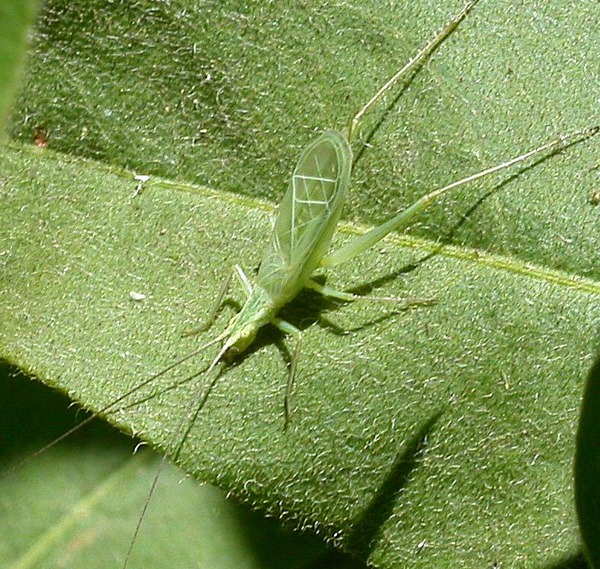
Oecanthus henryi has no English name on record in the checklists used here. It is a species of insect in the family Oecanthidae (tree and bush crickets), order Orthoptera. The name dates from 1936.
- Scientific name
- Oecanthus henryi Chopard, 1936
- Genus
- Oecanthus
- Family
- Oecanthidae (Tree and Bush Crickets)
- Order
- Orthoptera
- Class
- Insecta
- Environment
- terrestrial
- Recorded in
- 2 countries
- Name status
- accepted in the Catalogue of Life

Overview
Oecanthus henryi inhabits dry scrubland in southern India and bushes of Hyptis suaveolens. It uses acoustic communication during mate searching, and males can move towards green lynx spiders rather than away from them.
Written 28 November 2026 from the sources listed below. Each statement was checked against the passage it cites; statements that could not be supported were removed.
Habitat
Oecanthus henryi inhabits dry scrubland in southern India. It also inhabits bushes of Hyptis suaveolens.[1][2]
Behaviour
Males remain immobile while producing acoustic mating signals. Females move towards males in response to their acoustic signals.[3][4]
Males can move towards green lynx spiders rather than away from them. Females exhibit predator avoidance when moving towards acoustic signals.[5][6]
In the absence of spiders, individuals are spatially anchored to particular types of bushes. They are not uniformly distributed across their landscape.[7][8]
Green lynx spiders are more likely to occur on bushes occupied by female Oecanthus henryi than on other bushes. They also show an increased likelihood of occurring on bushes occupied by calling males.[9][10]
Reproduction and life cycle
Oecanthus henryi uses acoustic communication during mate searching.[11]
Classification of Oecanthus henryi
| Kingdom | Animalia |
|---|---|
| Phylum | Arthropoda |
| Subphylum | Hexapoda |
| Class | Insecta (Insect) |
| Order | Orthoptera |
| Suborder | Ensifera |
| Infraorder | Gryllidea |
| Superfamily | Grylloidea |
| Family | Oecanthidae (Tree and Bush Crickets) |
| Subfamily | Oecanthinae (Tree Crickets) |
| Supertribe | Oecanthidi |
| Tribe | Oecanthini |
| Genus | Oecanthus (Tree Crickets) |
| Species | Oecanthus henryi Chopard, 1936 |
Where Oecanthus henryi is found
Checklists and occurrence records place Oecanthus henryi in 2 countries across Asia. GBIF holds 8 georeferenced records of it.
Countries
Regions and cities with the most records
A number beside a place is its count of GBIF occurrence records. A place without a number comes from a checklist alone. Records show where a species has been observed or collected, which can include escapes and vagrants.
Related species
-
 Snowy Tree CricketOecanthus fultoni
-
 Narrow-winged Tree CricketOecanthus niveus
-
 European Tree-cricketOecanthus pellucens
-
 Large Tree-cricketOecanthus dulcisonans
-
 Broad-winged Tree CricketOecanthus latipennis
-
 Black-horned Tree CricketOecanthus nigricornis
-
 Tamarack Tree CricketOecanthus laricis
-
 Pine Tree CricketOecanthus pini
Compare
Sources
Passages the profile rests on
- Oecanthus henryi inhabits dry scrubland in southern India. Source passage: “The tree cricket species Oecanthus henryi is found in the dry scrubland of southern India” — pmc.ncbi.nlm.nih.gov
- Oecanthus henryi inhabits bushes of Hyptis suaveolens. Source passage: “inhabits the Hyptis suaveolens bushes” — pmc.ncbi.nlm.nih.gov
- Male Oecanthus henryi remain immobile while producing acoustic mating signals. Source passage: “mate searching involves acoustic signalling by immobile males” — pmc.ncbi.nlm.nih.gov
- Female Oecanthus henryi move towards males in response to their acoustic signals. Source passage: “phonotactic movement by females” — pmc.ncbi.nlm.nih.gov
- Male Oecanthus henryi can move towards green lynx spiders rather than away from them. Source passage: “calling and non-calling males moved towards the spider instead of away” — pmc.ncbi.nlm.nih.gov
- Female Oecanthus henryi exhibit predator avoidance when moving towards acoustic signals. Source passage: “Phonotactic females showed clear predator avoidance” — pmc.ncbi.nlm.nih.gov
- Individuals of Oecanthus henryi are spatially anchored to particular types of bushes in the absence of spiders. Source passage: “all crickets, independent of sex or male calling status, were found to be spatially anchored to specific types of bushes” — pmc.ncbi.nlm.nih.gov
- Oecanthus henryi individuals are not uniformly distributed across their landscape. Source passage: “and not uniformly distributed on the landscape” — pmc.ncbi.nlm.nih.gov
- Green lynx spiders are more likely to occur on bushes occupied by female Oecanthus henryi than on other bushes. Source passage: “spiders were more likely to be found on bushes with female crickets” — pmc.ncbi.nlm.nih.gov
- Green lynx spiders also show an increased likelihood of occurring on bushes occupied by calling male Oecanthus henryi. Source passage: “and, to a lesser degree, calling male crickets” — pmc.ncbi.nlm.nih.gov
- Oecanthus henryi uses acoustic communication during mate searching. Source passage: “Mate searching involves acoustic signalling by immobile males” — pmc.ncbi.nlm.nih.gov
Data
- Catalogue of Life, 2026-10-16 XR cc by
- Global Biodiversity Information Facility CC BY 4.0
- Wikidata CC0
- GeoNames CC BY 4.0
- Wikimedia Commons per image; credit shown with each image
- Within the Catalogue of Life, this name comes from Orthoptera Species File cc by
References
- Chopard, L. (1936) The Tridactylidae and Gryllidae of Ceylon. Ceylon Journal of Science Biological Science), 20, 9–87. Available at http://archive.org/details/in.ernet.dli.2015.7321 where the name was published
This species in other databases
Page built on 29 November 2026. See how the catalog is made and all sources and licences.
Cite this page
ScientificNames.org. (2026). Oecanthus henryi. Retrieved November 29, 2026, from https://scientificnames.org/species/oecanthus-henryi
“Oecanthus henryi.” ScientificNames.org, 2026, scientificnames.org/species/oecanthus-henryi. Accessed 29 Nov. 2026.
ScientificNames.org. “Oecanthus henryi.” Accessed November 29, 2026. https://scientificnames.org/species/oecanthus-henryi.
@misc{scientificnames_oecanthus_henryi,
  author = {{ScientificNames.org}},
  title = {Oecanthus henryi},
  year = {2026},
  url = {https://scientificnames.org/species/oecanthus-henryi},
  note = {Accessed 2026-11-29}
}