Species · Mammals
Black-eared Mouse Peromyscus melanotis
The scientific name of the Black-eared Mouse is Peromyscus melanotis. It is a species of mammal in the family Cricetidae (new world mice and rats), order Rodentia. The name dates from 1897.
- Scientific name
- Peromyscus melanotis J. A. Allen & Chapman, 1897
- Common name
- Black-eared Mouse
- Genus
- Peromyscus
- Family
- Cricetidae (New World Mice and Rats)
- Order
- Rodentia
- Class
- Mammalia
- Red List category
- LC Least Concern
- Recorded in
- 2 countries
- Name status
- accepted in the Catalogue of Life

Overview
The Black-eared Mouse (Peromyscus melanotis J. A. Allen & Chapman, 1897) is a mammal in the family Cricetidae, order Rodentia, and class Mammalia. It inhabits coniferous forests and mixed grasslands in the central mountains of Mexico. Its dark brown to black ears have white edges.
Written 26 November 2026 from the sources listed below. Each statement was checked against the passage it cites; statements that could not be supported were removed.
Appearance
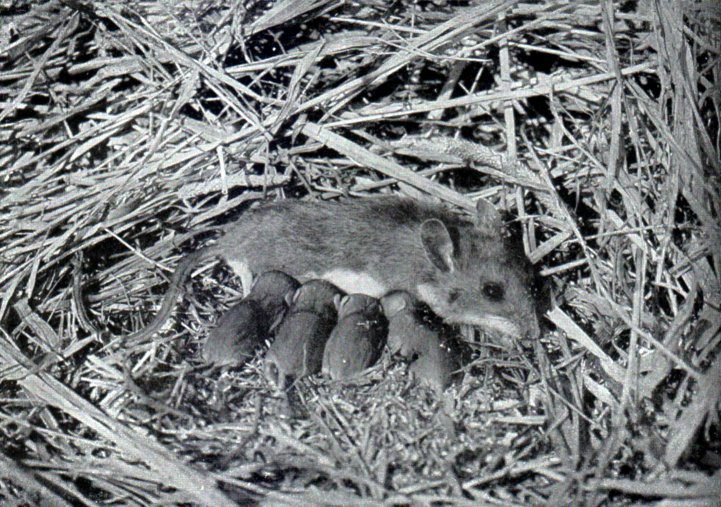
The Black-eared Mouse has tawny to yellow-brown fur over most of its body, with darker coloring on the back and paler coloring on the flanks. Its underparts and feet are pure white, with a distinct boundary separating them from the tawny fur.[1][2]
It has a narrow ring of dusky fur around its eyes. Its ears are dark brown to black with white edges, and its tail is furred, tawny on top and white underneath.[3][4][5]
In some localities, its coat is slightly paler during winter than during summer.[6]
The species measures 14–18 cm in total length, including its tail, which measures 5–7 cm. It is among the smaller members of the genus Peromyscus.[7][8][9]
Habitat
The Black-eared Mouse inhabits coniferous forests and mixed grasslands in the central mountains of Mexico. Its habitats include rocky and marshy environments.[10][11]
It also occurs among forest undergrowth at elevations of 2,600–2,900 m.[12]
Diet
The Black-eared Mouse is omnivorous and feeds mainly on seeds and insects.[13]
It can consume relatively large quantities of monarch butterflies because it tolerates bitter cardenolide chemicals.[14]
Behaviour
The Black-eared Mouse is nocturnal. Individuals spend the daytime in burrows with nest chambers approximately 7 cm across.[15][16]
The nest chambers connect to the surface through vertical tunnels approximately 60 cm long.[17]
The species reportedly defends the territory surrounding its nests against other species. When it coexists with Mexican volcano mice, it reportedly drives them away from these territories.[18][19]
Reproduction and life cycle
The Black-eared Mouse breeds throughout the year. Litters contain up to five young, with three or four being typical.[20][21]
Similar species
The Black-eared Mouse is virtually identical in appearance to Peromyscus sonoriensis. Differences in fur and skull shape between the two species are too overlapping to reliably distinguish individuals by appearance.[22][23]
Genetic analysis can distinguish the Black-eared Mouse from Peromyscus sonoriensis. The two species cannot successfully interbreed.[24][25]
Classification of the Black-eared Mouse
| Kingdom | Animalia |
|---|---|
| Phylum | Chordata |
| Subphylum | Vertebrata |
| Infraphylum | Gnathostomata |
| Parvphylum | Osteichthyes |
| Megaclass | Tetrapoda |
| Class | Mammalia (Mammal) |
| Subclass | Theria |
| Infraclass | Eutheria |
| Order | Rodentia (Rodent) |
| Suborder | Myomorpha (Mice) |
| Superfamily | Muroidea |
| Family | Cricetidae (New World Mice and Rats) |
| Subfamily | Neotominae |
| Genus | Peromyscus (Deer Mice) |
| Species | Peromyscus melanotis J. A. Allen & Chapman, 1897 |
Where the Black-eared Mouse is found
Checklists and occurrence records place Peromyscus melanotis in 2 countries across North America. GBIF holds 10,280 georeferenced records of it.
Countries
Regions and cities with the most records
- Puebla, Mexico 2,524
- México, Mexico 1,585
- San Rafael Tlanalapan, Mexico 1,310
- San Martin Texmelucan de Labastida, Mexico 1,308
- Moyotzingo, Mexico 1,307
- Santa Ana Xalmimilulco, Mexico 1,307
- Huejotzingo, Mexico 1,296
- Durango, Mexico 1,037
- Tlaxcala, Mexico 894
- San Miguel Ajusco, Mexico 817
- Huamantla, Mexico 815
- Xalatlaco, Mexico 770
- Magdalena Contreras, Mexico 767
- Ozumba de Alzate, Mexico 764
- Ciudad Serdán, Mexico 761
- Amecameca, Mexico 752
- Tlalpan, Mexico 711
- Contla, Mexico 703
- La Magdalena Tlaltelulco, Mexico 703
- Santa Ana Chiautempan, Mexico 703
- Teolocholco, Mexico 703
- San Rafael, Mexico 666
- Jesús del Monte, Mexico 635
- Huixquilucan, Mexico 634
- Delegación Cuajimalpa de Morelos, Mexico 611
- San Miguel Topilejo, Mexico 573
- Coyoacán, Mexico 567
- Acajete, Mexico 553
- Veracruz, Mexico 541
- San Pablo Oztotepec, Mexico 526
- Xochimilco, Mexico 522
- Santiago Tlacotepec, Mexico 504
- San Antonio Acahualco, Mexico 503
- San Miguel Zinacantepec, Mexico 475
- San Francisco Tlalcilalcalpan, Mexico 470
- San Martín Cuautlalpan, Mexico 360
1 more country has a few records outside this range
These countries hold a few records of Peromyscus melanotis but lie outside the range the checklists give for it. Such records are often zoo or garden specimens, museum material or vagrants, so the species is not counted as occurring there.
Range as the checklists state it
Middle America
North America
A number beside a place is its count of GBIF occurrence records. A place without a number comes from a checklist alone. Records show where a species has been observed or collected, which can include escapes and vagrants.
Common names
English
- Black-eared Mouse
- Black-eared Deermouse
Names in 5 other languages
- Finnish
- pimanpeurahiiru
- Japanese
- クロミミシロアシマウス
- Polish
- myszak czarnouchy
- Russian
- Черноухий хомячок
- Spanish
- Ratón orejas negras
Synonyms
2 other scientific names have been used for this species and are now treated as synonyms of Peromyscus melanotis.
- Peromyscus cecilii Thomas, 1903
- Peromyscus melanotis zamelas Osgood, 1904
Related species
-
 White-footed MousePeromyscus leucopus
-
 Eastern Deer MousePeromyscus maniculatus
-
 Oldfield MousePeromyscus polionotus
-
 Cactus MousePeromyscus eremicus
-
 California DeermousePeromyscus californicus
-
 Brush MousePeromyscus boylii
- Angel Island MousePeromyscus guardia
-
 Cotton MousePeromyscus gossypinus
Compare
Questions and answers
What is the scientific name of the Black-eared Mouse?
The scientific name of the Black-eared Mouse is Peromyscus melanotis. Written with its author, the full name is Peromyscus melanotis J. A. Allen & Chapman, 1897.
Which family does the Black-eared Mouse belong to?
Peromyscus melanotis belongs to the family Cricetidae, in the order Rodentia and the class Mammalia.
Where is the Black-eared Mouse found?
Checklists and occurrence records place Peromyscus melanotis in 2 countries: Mexico and United States.
What is the conservation status of the Black-eared Mouse?
The IUCN Red List category recorded for Peromyscus melanotis is Least Concern (LC).
What other names does the Black-eared Mouse have?
Peromyscus melanotis is also known in English as Black-eared Deermouse.
Sources
Passages the profile rests on
- The species has tawny to yellow-brown fur over most of its body, with darker coloring on the back and paler coloring on the flanks. Source passage: “The fur is tawny to yellow-brown over most of the body, fading from a darker shade on the back to paler on the flanks.” — English Wikipedia
- The underparts and feet are pure white, with a distinct boundary separating them from the tawny fur. Source passage: “The under parts and feet are pure white, with a clear dividing line from the tawny fur elsewhere.” — English Wikipedia
- The species has a narrow ring of dusky fur around its eyes. Source passage: “A narrow ring of dusky fur is found around the eyes,” — English Wikipedia
- Its ears are dark brown to black and have white edges. Source passage: “the ears are dark brown to black, with white edges.” — English Wikipedia
- The tail is furred and tawny on top and white underneath. Source passage: “The tail is furred, and has the same color as the body, being tawny above and white below.” — English Wikipedia
- In some localities, its coat is slightly paler during winter than during summer. Source passage: “In at least some localities, the mouse has a slightly paler coat in winter than in summer.” — English Wikipedia
- The species measures 14–18 cm in total length, including its tail. Source passage: “measuring 14 to 18 cm (5.5 to 7.1 in) in total length, including a relatively short tail,” — English Wikipedia
- Its tail measures 5–7 cm in length. Source passage: “5 to 7 cm (2.0 to 2.8 in) long.” — English Wikipedia
- The species is among the smaller members of the genus Peromyscus. Source passage: “The black-eared mouse is one of the smaller species in the genus Peromyscus,” — English Wikipedia
- The species inhabits coniferous forests and mixed grasslands in the central mountains of Mexico. Source passage: “Black-eared mice are found in regions of coniferous forest and mixed grassland throughout much of the central mountains of Mexico.” — English Wikipedia
- Its habitats include rocky and marshy environments. Source passage: “they may be found in rocky or marshy habitats” — English Wikipedia
- The species also occurs among forest undergrowth at elevations of 2,600–2,900 m. Source passage: “or among forest undergrowth between 2,600 and 2,900 m (8,500 and 9,500 ft) in elevation.” — English Wikipedia
- The species is omnivorous and feeds mainly on seeds and insects. Source passage: “Black-eared mice are nocturnal and omnivorous, feeding mainly on seeds and insects.” — English Wikipedia
- The species can consume relatively large quantities of monarch butterflies because it tolerates bitter cardenolide chemicals. Source passage: “Unusually, they are able to tolerate very bitter cardenolide chemicals, allowing them to consume relatively large quantities of monarch butterflies.” — English Wikipedia
- The species is nocturnal. Source passage: “Black-eared mice are nocturnal” — English Wikipedia
- Individuals spend the daytime in burrows with nest chambers approximately 7 cm across. Source passage: “They spend the day in burrows consisting of a nest chamber about 7 cm (2.8 in) across,” — English Wikipedia
- Its burrow nest chambers connect to the surface through vertical tunnels approximately 60 cm long. Source passage: “connected to the surface by a vertical tunnel about 60 cm (2.0 ft) in length.” — English Wikipedia
- The species reportedly defends the territory surrounding its nests against other species. Source passage: “They reportedly defend the territory around their nests from other species,” — English Wikipedia
- It reportedly drives Mexican volcano mice away from territories surrounding its nests when the two species coexist. Source passage: “in particular driving away Mexican volcano mice, where the two species are found together.” — English Wikipedia
- The species breeds throughout the year. Source passage: “The mice breed throughout the year,” — English Wikipedia
- Litters contain up to five young, with three or four being typical. Source passage: “giving birth to litters of up to five young, with three or four being typical.” — English Wikipedia
- The species is virtually identical in appearance to Peromyscus sonoriensis. Source passage: “The mouse is virtually identical in appearance to the closely related species Peromyscus sonoriensis” — English Wikipedia
- Differences in fur and skull shape between this species and Peromyscus sonoriensis are too overlapping to reliably distinguish individuals by appearance. Source passage: “Although subtle differences in the fur and shape of the skull occur between the species, the considerable overlap in the appearance of individuals means even these features cannot reliably be used to distinguish them.” — English Wikipedia
- Genetic analysis can distinguish the species from Peromyscus sonoriensis. Source passage: “The two species can, however, be distinguished using genetic analysis.” — English Wikipedia
- The species cannot successfully interbreed with Peromyscus sonoriensis. Source passage: “and are unable to successfully interbreed.” — English Wikipedia
Data
- Catalogue of Life, 2026-10-16 XR cc by
- Global Biodiversity Information Facility CC BY 4.0
- Wikidata CC0
- GeoNames CC BY 4.0
- Wikimedia Commons per image; credit shown with each image
- Within the Catalogue of Life, this name comes from The Integrated Taxonomic Information System cc0
References
- Bull. Am. Mus. Nat. Hist. vol.9 p.203 where the name was published
- Hall, & Raymond, E. (1981). The Mammals of North America, 2nd Ed., Vol. 2.
- Banks, R. C., R. W. McDiarmid, and A. L. Gardner. (1987). Checklist of Vertebrates of the United States, the U.S. Territories, and Canada. Resource Publication, No. 166.
- Wilson, Don E., and DeeAnn M. Reeder, eds. (1993). Mammal Species of the World: A Taxonomic and Geographic Reference, 2nd Ed., 3rd Printing.
- Wilson, Don E., and F. Russell Cole. (2000). Common Names of Mammals of the World.
- Musser, Guy G., and Michael D. Carleton / Wilson, Don E., and DeeAnn M. Reeder, eds. (2005). Superfamily Muroidea. Mammal Species of the World: A Taxonomic and Geographic Reference, 3rd Ed., Vol. 2.
This species in other databases
Page built on 27 November 2026. See how the catalog is made and all sources and licences.
Cite this page
ScientificNames.org. (2026). Peromyscus melanotis (Black-eared Mouse). Retrieved November 27, 2026, from https://scientificnames.org/species/peromyscus-melanotis
“Peromyscus melanotis (Black-eared Mouse).” ScientificNames.org, 2026, scientificnames.org/species/peromyscus-melanotis. Accessed 27 Nov. 2026.
ScientificNames.org. “Peromyscus melanotis (Black-eared Mouse).” Accessed November 27, 2026. https://scientificnames.org/species/peromyscus-melanotis.
@misc{scientificnames_peromyscus_melanotis_black_eared_mouse,
  author = {{ScientificNames.org}},
  title = {Peromyscus melanotis (Black-eared Mouse)},
  year = {2026},
  url = {https://scientificnames.org/species/peromyscus-melanotis},
  note = {Accessed 2026-11-27}
}