Species · Birds
Sooty Albatross Phoebetria fusca
The scientific name of the Sooty Albatross is Phoebetria fusca. It is a species of bird in the family Diomedeidae (albatross), order Procellariiformes. The name dates from 1822.
- Scientific name
- Phoebetria fusca (Hilsenberg, 1822)
- Common name
- Sooty Albatross
- Genus
- Phoebetria
- Family
- Diomedeidae (Albatross)
- Order
- Procellariiformes
- Class
- Aves
- Red List category
- EN Endangered
- Environment
- marine, terrestrial
- Recorded in
- 10 countries
- Name status
- accepted in the Catalogue of Life

Overview
Phoebetria fusca occurs in the southern Atlantic Ocean, southern Indian Ocean and Southern Ocean. It is distinguished by sooty-brown to sooty-black plumage, a white ring around almost the entire eye and a glossy black bill with a yellow-to-orange line along the lower jaw.
Written 26 November 2026 from the sources listed below. Each statement was checked against the passage it cites; statements that could not be supported were removed.
Appearance
The Sooty Albatross has plumage ranging from sooty-brown to sooty-black. Its head and sometimes its tail are darker than the rest of its body.[1][2]
A white ring surrounds almost the entire eye, except at the inner corner. The otherwise glossy black bill has a yellow-to-orange line along the lower jaw.[3][4]
Immature birds look nearly identical to adults after losing their down feathers.[5]
The Sooty Albatross measures approximately 85 cm from head to tail and has a wingspan of approximately 2 m. Average adult body mass is approximately 2.5 kg, and adult males weigh more than adult females.[6][7][8][9]
Habitat
The Sooty Albatross generally forages over deep ocean waters. It builds nests on ledges of coastal and inland cliffs.[10][11]
The species occurs in the southern Atlantic Ocean, southern Indian Ocean and Southern Ocean. Its approximate latitudinal range extends from 20°S to 65°S, and its approximate longitudinal range extends from 75°W to 160°E.[12][13][14]
It nests on Gough Island and in the Tristan da Cunha group in the southern Atlantic Ocean. Southern Indian Ocean nesting locations include Prince Edward Island, Marion Island, the Crozet Islands, Amsterdam Island and the Kerguelen Islands.[15][16]
Diet
Squid forms the principal component of the Sooty Albatross's diet. The species also consumes fish, other seabirds, crustaceans and carrion.[17][18]
The Sooty Albatross obtains nearly all its food through surface-seizing and scavenges for floating prey that is already dead. It is not known to dive deeply for food.[19][20][21]
Behaviour
The species spends most of its non-breeding life over the ocean, and non-breeding adults generally remain within their native oceans. Juvenile birds tend to remain in subtropical waters.[22][23][24]
Breeding adults generally forage within 600 km of their breeding sites. The species generally feeds alone at sea.[25][26]
The Sooty Albatross forages during daylight, with feeding activity peaking three hours before dusk.[27]
The species exhibits synchronized flight patterns in which birds change their flight angles and patterns to fly together. Colonies produce loud, repeated pee-oo calls.[28][29]
The species has been observed associating with yellow-nosed mollymawks and whales.[30]
Reproduction and life cycle
The Sooty Albatross normally breeds every other year. Pairs may attempt breeding again the following year if they fail to rear a chick successfully, and generally return to the same nesting location each mating season.[31][32][33]
The species typically breeds in colonies containing between five and sixty nests. Pairs generally arrive at their breeding colonies in mid-July.[34][35]
Egg laying generally occurs between mid-September and the end of October. Eggs measure approximately 9.5–10.8 cm in length and 5.9–6.9 cm in width, with a mass ranging from 185 to 265 g.[36][37][38]
Egg incubation lasts approximately 70 days. Parents brood their chicks for approximately three months before departing.[39][40]
Chicks remain at the breeding site until the end of May before fledging.[41]
Conservation
Long-line fisheries are among the major threats to the species. Pollution from plastics, oils and chemicals also affects the Sooty Albatross.[42][43]
Chicks are subject to predation by giant petrels and mice on islands. Fishing techniques designed to reduce seabird bycatch are being used as a conservation measure.[44][45]
The species is protected on Tristan da Cunha and Gough Island. Prince Edward Island is designated as a nature reserve for the species.[46][47]
Classification of the Sooty Albatross
| Kingdom | Animalia |
|---|---|
| Phylum | Chordata |
| Subphylum | Vertebrata |
| Infraphylum | Gnathostomata |
| Parvphylum | Osteichthyes |
| Megaclass | Tetrapoda |
| Class | Aves (Bird) |
| Order | Procellariiformes (Petrels) |
| Family | Diomedeidae (Albatross) |
| Genus | Phoebetria (Sooty Albatrosses) |
| Species | Phoebetria fusca (Hilsenberg, 1822) |
Where the Sooty Albatross is found
Checklists and occurrence records place Phoebetria fusca in 10 countries across Africa. GBIF holds 9,477 georeferenced records of it.
Countries
- Antarctica 46
- Australia 846
- Bouvet Island 3
- French Southern Territories 1,792
- Heard Island and McDonald Islands 8
- New Zealand 12
- Reunion 3
- Saint Helena 621
- South Africa 6,099
- South Georgia and the South Sandwich Islands 47
Regions and cities with the most records
- Tristan da Cunha, Saint Helena 145
- New South Wales, Australia 39
- Victoria, Australia 36
- Wollongong, Australia 23
- Tasmania, Australia 19
- South Australia, Australia 17
- Kerguelen, French Southern Territories 15
- Queensland, Australia 15
- Western Australia, Australia 12
- North West, South Africa 6
- Warrnambool, Australia 6
- Newcastle, Australia 4
- Grytviken, South Georgia and the South Sandwich Islands 3
- Kwinana, Australia 3
- Torquay, Australia 3
5 more countries have a few records outside this range
These countries hold a few records of Phoebetria fusca but lie outside the range the checklists give for it. Such records are often zoo or garden specimens, museum material or vagrants, so the species is not counted as occurring there.
Range as the checklists state it
Antarctica/Southern Ocean
Africa
A number beside a place is its count of GBIF occurrence records. A place without a number comes from a checklist alone. Records show where a species has been observed or collected, which can include escapes and vagrants.
Common names
English
- Sooty Albatross
- Dark-mantled Albatross
- Dark-mantled Sooty Albatross
- Dusky Albatross
Names in 31 other languages
- Afrikaans
- Bruinalbatros, Bruinmalmok (Bruinalbatros)
- Arabic
- قطرس داكن
- Belarusian
- Альбатрос дымчаты
- Bulgarian
- Северен тъмен албатрос
- Catalan
- albatros fumat
- Chinese
- 乌信天翁, 烏黑信天翁
- Croatian
- mrki albatros
- Czech
- albatros hnědý
- Danish
- Mørk Sodalbatros
- Dutch
- zwarte albatros
- Esperanto
- fulga albatroso
- Estonian
- nõgialbatross
- Finnish
- nokialbatrossi
- French
- Albatros brun, Albatros fuligineux à dos sombre
- German
- Dunkelalbatros, Rußalbatros
- Hungarian
- füstös albatrosz
- Irish
- Alabatras súicheach
- Italian
- Albatro fuligginoso, Albatros fuligginoso
- Japanese
- ススイロアホウドリ
- Lithuanian
- paprastasis tamsusis albatrosas
- Norwegian
- sotalbatross
- Polish
- albatros brunatny
- Portuguese
- albatroz-preto, piau-preto
- Russian
- Дымчатый альбатрос, Темноспинный дымчатый альбатрос
- Serbian
- Čađavi albatros
- Slovak
- albatros sadzový
- Slovenian
- sajasti albatros
- Spanish
- Albatros ahumado, Albatros oscuro
- Turkish
- Kara Albatros, İsli albatros
- Ukrainian
- альбатрос бурий
- Welsh
- albatros du
Synonyms
3 other scientific names have been used for this species and are now treated as synonyms of Phoebetria fusca.
- Diomedea fusca Hilsenberg, 1822
- Phoebetria fusca campbelli Mathews, GM, 1912
- Phoebetria fusca fusca Hilsenberg, CT, 1822
Related species
-
 Light-mantled AlbatrossPhoebetria palpebrata
-
 Snowy AlbatrossDiomedea exulans
-
 Laysan AlbatrossPhoebastria immutabilis
-
 Southern Royal AlbatrossDiomedea epomophora
-
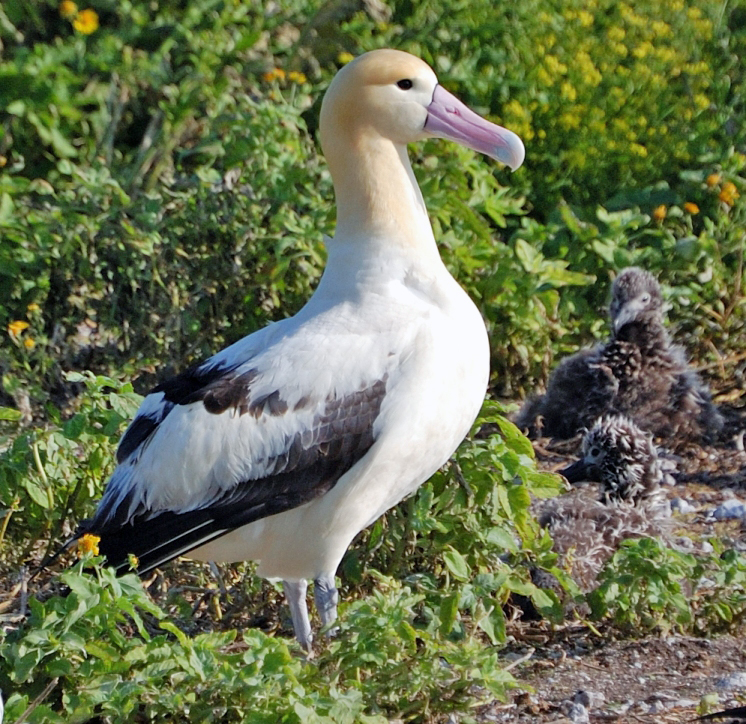 Short-tailed AlbatrossPhoebastria albatrus
-
 Black-browed AlbatrossThalassarche melanophris
-
 Black-footed AlbatrossPhoebastria nigripes
-
 Waved AlbatrossPhoebastria irrorata
Compare
Questions and answers
What is the scientific name of the Sooty Albatross?
The scientific name of the Sooty Albatross is Phoebetria fusca. Written with its author, the full name is Phoebetria fusca (Hilsenberg, 1822).
Which family does the Sooty Albatross belong to?
Phoebetria fusca belongs to the family Diomedeidae, in the order Procellariiformes and the class Aves.
Where is the Sooty Albatross found?
Checklists and occurrence records place Phoebetria fusca in 10 countries, including South Africa, French Southern Territories, Australia, Saint Helena, South Georgia and the South Sandwich Islands and Antarctica.
What is the conservation status of the Sooty Albatross?
The IUCN Red List category recorded for Phoebetria fusca is Endangered (EN).
What other names does the Sooty Albatross have?
Phoebetria fusca is also known in English as Dark-mantled Albatross, Dark-mantled Sooty Albatross and Dusky Albatross.
Sources
Passages the profile rests on
- The Sooty Albatross has plumage ranging from sooty-brown to sooty-black. Source passage: “Plumage ranges from a sooty-brown to a sooty-black color depending on the individual” — English Wikipedia
- The bird's head and sometimes its tail are darker than the rest of its body. Source passage: “the head and sometimes tail are typically darker than the rest of the body.” — English Wikipedia
- The Sooty Albatross has a white ring around almost the entire eye, except at the inner corner. Source passage: “Around almost the entire eye, excluding the inner corner, a white ring is present.” — English Wikipedia
- Its otherwise glossy black bill has a yellow-to-orange line along the lower jaw. Source passage: “On the lower jaw, a yellow to orange line is present on the beak, which is otherwise a uniform glossy black.” — English Wikipedia
- Immature birds look nearly identical to adults after losing their down feathers. Source passage: “Juvenile or immature sooty albatrosses look nearly identical after losing their down feathers.” — English Wikipedia
- The Sooty Albatross measures approximately 85 cm from head to tail. Source passage: “measuring about 85 cm (33 in) from head to tail” — English Wikipedia
- Its wingspan is approximately 2 m. Source passage: “with a 2 m (6.6 ft) wingspan.” — English Wikipedia
- The average adult body mass is approximately 2.5 kg. Source passage: “Average adult body mass is about 2.5 kg (5.5 lbs)” — English Wikipedia
- Adult males weigh more than adult females. Source passage: “with males weighing more than females.” — English Wikipedia
- The species generally forages over deep ocean waters. Source passage: “In general, the sooty albatross can be found foraging over deep ocean.” — English Wikipedia
- The Sooty Albatross builds nests on ledges of coastal and inland cliffs. Source passage: “Sooty albatrosses build their nests on ledges of coastal and inland cliffs.” — English Wikipedia
- The species occurs in the southern Atlantic Ocean, southern Indian Ocean and Southern Ocean. Source passage: “The sooty albatross can be found in the South Atlantic Ocean, the southern Indian Ocean, and the Southern Ocean” — English Wikipedia
- Its approximate latitudinal range extends from 20°S to 65°S. Source passage: “Its northern and southern limits are approximately 20°S and 65°S, respectively” — English Wikipedia
- Its approximate longitudinal range extends from 75°W to 160°E. Source passage: “and an eastern and western limit of approximately 160°E and 75°W.” — English Wikipedia
- The species nests on Gough Island and in the Tristan da Cunha group in the southern Atlantic Ocean. Source passage: “Gough Island and the Tristan da Cunha group” — English Wikipedia
- Its southern Indian Ocean nesting locations include Prince Edward Island, Marion Island, the Crozet Islands, Amsterdam Island and the Kerguelen Islands. Source passage: “Prince Edward Island, Marion Island, the Crozet Islands, Amsterdam Island, and the Kerguelen Islands.” — English Wikipedia
- Squid forms the principal component of the Sooty Albatross's diet. Source passage: “Their diet consists of cephalopods (mainly squid)” — English Wikipedia
- The species also consumes fish, other seabirds, crustaceans and carrion. Source passage: “Their diet consists of cephalopods (mainly squid), fish, other seabirds, crustaceans, and carrion.” — English Wikipedia
- The Sooty Albatross obtains nearly all its food through surface-seizing. Source passage: “The sooty albatross feeds almost exclusively by surface-seizing” — English Wikipedia
- The species scavenges for floating prey that is already dead. Source passage: “scavenge at the surface of the ocean for already-deceased and floating prey” — English Wikipedia
- The Sooty Albatross is not known to dive deeply for food. Source passage: “They are not known to deep dive” — English Wikipedia
- The species spends most of its non-breeding life over the ocean. Source passage: “The sooty albatross is a marine bird that spends more of its non-breeding life over the ocean.” — English Wikipedia
- Non-breeding adults generally remain within their native oceans. Source passage: “Non-breeding adults do not often venture out of their native oceans” — English Wikipedia
- Juvenile birds tend to remain in subtropical waters. Source passage: “juvenile birds tend to be confined to subtropical waters.” — English Wikipedia
- Breeding adults generally forage within 600 km of their breeding sites. Source passage: “breeding adults forage closer to their breeding sites, within 600 km (370 mi)” — English Wikipedia
- The species generally feeds alone at sea. Source passage: “typically feeding in solitude at sea” — English Wikipedia
- The Sooty Albatross forages during daylight, with feeding activity peaking three hours before dusk. Source passage: “This bird species forages during the daytime, with peak feeding activity being 3 hours before dusk.” — English Wikipedia
- The species exhibits synchronized flight patterns in which birds change their flight angles and patterns to fly together. Source passage: “they switch flight patterns and angles during active flight so that the birds may fly in unison.” — English Wikipedia
- Sooty Albatross colonies produce loud, repeated pee-oo calls. Source passage: “Sooty Albatross colonies can be marked by their distinctive sky calls, which are loud and repeating pee-oo’s.” — English Wikipedia
- The species has been observed associating with yellow-nosed mollymawks and whales. Source passage: “have been seen associating with yellow-nosed mollymawks and whales.” — English Wikipedia
- The Sooty Albatross normally breeds every other year. Source passage: “The sooty albatross is a biennial breeder, meaning they breed every other year” — English Wikipedia
- Pairs may attempt breeding again the following year if they fail to rear a chick successfully. Source passage: “with the exception of a mating pair unsuccessfully rearing a chick, in which case they will try again the following year.” — English Wikipedia
- Breeding pairs generally return to the same nesting location each mating season. Source passage: “often return to the exact same location each mating season.” — English Wikipedia
- The species typically breeds in colonies containing between five and sixty nests. Source passage: “They typically breed in groups of 5-60 nests” — English Wikipedia
- Pairs generally arrive at their breeding colonies in mid-July. Source passage: “Pairs typically arrive at their mating colony or location in mid July” — English Wikipedia
- Egg laying generally occurs between mid-September and the end of October. Source passage: “they will lay their egg between mid September to the end of October.” — English Wikipedia
- The eggs measure approximately 9.5–10.8 cm in length and 5.9–6.9 cm in width. Source passage: “The egg measures 9.5–10.8 cm (3.7–4.3 in) in length and 5.9–6.9 cm (2.3–2.7 in) in width” — English Wikipedia
- Egg mass ranges from 185 to 265 g. Source passage: “with a mass of 185–265 g (6.5–9.3 oz).” — English Wikipedia
- Egg incubation lasts approximately 70 days. Source passage: “they will incubate their egg for approximately 70 days until hatching.” — English Wikipedia
- Parents brood their chicks for approximately three months before departing. Source passage: “Parents will brood their chicks for roughly three months” — English Wikipedia
- Chicks remain at the breeding site until the end of May before fledging. Source passage: “The chicks remain at the breeding site until the end of May when they are ready to fledge.” — English Wikipedia
- Long-line fisheries are among the major threats to the species. Source passage: “Long-line fishing is one of the biggest threats to albatrosses across the world, and the sooty albatross is not an exception.” — English Wikipedia
- Pollution from plastics, oils and chemicals affects the Sooty Albatross. Source passage: “the sooty albatross is affected by pollution of plastics, oils, and chemicals.” — English Wikipedia
- Chicks are subject to predation by giant petrels and mice on islands. Source passage: “the predation of chicks by giant petrels and mice on islands” — English Wikipedia
- Fishing techniques designed to reduce seabird bycatch are being used as a conservation measure. Source passage: “the use of fishing techniques that are specifically designed to decrease the amount of seabird-bycatch of long-line fishing vessels.” — English Wikipedia
- The species is protected on Tristan da Cunha and Gough Island. Source passage: “the sooty albatross is protected on Tristan da Cunha, Gough Island in a nature preserve and a World Heritage Site” — English Wikipedia
- Prince Edward Island is designated as a nature reserve for the species. Source passage: “Price Edward Island is also a nature reserve.” — English Wikipedia
Data
- Catalogue of Life, 2026-10-16 XR cc by
- Global Biodiversity Information Facility CC BY 4.0
- Wikidata CC0
- GeoNames CC BY 4.0
- Wikimedia Commons per image; credit shown with each image
- Within the Catalogue of Life, this name comes from The Integrated Taxonomic Information System cc0
References
- Gill, Frank, & and Minturn Wright. (2006). Birds of the World: Recommended English Names.
This species in other databases
- Catalogue of Life 4GKHX
- Wikidata Q1265896
- iNaturalist 4192
- WoRMS urn:lsid:marinespecies.org:taxname:212632
- Avibase sooalb1
Page built on 28 November 2026. See how the catalog is made and all sources and licences.
Cite this page
ScientificNames.org. (2026). Phoebetria fusca (Sooty Albatross). Retrieved November 28, 2026, from https://scientificnames.org/species/phoebetria-fusca
“Phoebetria fusca (Sooty Albatross).” ScientificNames.org, 2026, scientificnames.org/species/phoebetria-fusca. Accessed 28 Nov. 2026.
ScientificNames.org. “Phoebetria fusca (Sooty Albatross).” Accessed November 28, 2026. https://scientificnames.org/species/phoebetria-fusca.
@misc{scientificnames_phoebetria_fusca_sooty_albatross,
  author = {{ScientificNames.org}},
  title = {Phoebetria fusca (Sooty Albatross)},
  year = {2026},
  url = {https://scientificnames.org/species/phoebetria-fusca},
  note = {Accessed 2026-11-28}
}