Species · Reptiles
Roundtail Horned Lizard Phrynosoma modestum
The scientific name of the Roundtail Horned Lizard is Phrynosoma modestum. It is a species of reptile in the family Phrynosomatidae (north american spiny lizards), order Squamata. The name dates from 1852.
- Scientific name
- Phrynosoma modestum Girard, 1852
- Common name
- Roundtail Horned Lizard
- Genus
- Phrynosoma
- Family
- Phrynosomatidae (North American Spiny Lizards)
- Order
- Squamata
- Class
- Reptilia
- Red List category
- LC Least Concern
- Recorded in
- 2 countries
- Name status
- accepted in the Catalogue of Life

Overview
Phrynosoma modestum is native to western Texas, New Mexico, eastern Arizona, and southeastern Colorado in the United States, and eight states in north-central Mexico. It has a short, flat, round body and a distinctive head crest consisting of nearly equal-length horns.
Written 26 November 2026 from the sources listed below. Each statement was checked against the passage it cites; statements that could not be supported were removed.
Appearance
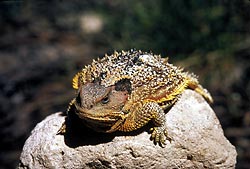
The Roundtail Horned Lizard has a short, flat, round body, short limbs, and a small head. Its distinctive head crest consists of nearly equal-length horns.[1][2]
Its coloration usually resembles the soil in its native habitat. Most individuals are uniformly gray, although some are light brown or pale yellow.[3][4]
Darker coloration often occurs around the neck and groin, and some individuals have tail stripes. Unlike other horned lizards, it lacks a fringe of lateral scales.[5][6]
The maximum snout-to-vent length is 7 cm (2.7 inches), and the maximum total length, including the tail, is 10.5 cm (4.3 inches).[7][8]
Habitat
The Roundtail Horned Lizard prefers rocky and sandy semiarid habitats with sparse vegetation. It occurs near harvester ant colonies or, especially, honeypot ant colonies.[9][10]
It is native to western Texas, New Mexico, eastern Arizona, and southeastern Colorado in the United States, and eight states in north-central Mexico.[11][12]
Behaviour
The Roundtail Horned Lizard camouflages itself by hunching its body into a rock-like shape rather than flattening itself against the ground. It casts a visible shadow while using this posture for camouflage.[13][14]
Reproduction and life cycle
The Roundtail Horned Lizard is oviparous and reproduces by laying eggs. It breeds and lays eggs in early summer.[15][16]
Similar species
The Roundtail Horned Lizard is among the smaller members of the horned lizard genus Phrynosoma and is also described as one of the smaller horned lizard species.[17][18]
Classification of the Roundtail Horned Lizard
| Kingdom | Animalia |
|---|---|
| Phylum | Chordata |
| Subphylum | Vertebrata |
| Infraphylum | Gnathostomata |
| Parvphylum | Osteichthyes |
| Megaclass | Tetrapoda |
| Class | Reptilia (Reptile) |
| Order | Squamata (Snakes) |
| Suborder | Iguania (Iguanas) |
| Family | Phrynosomatidae (North American Spiny Lizards) |
| Genus | Phrynosoma (Horned Lizard) |
| Species | Phrynosoma modestum Girard, 1852 |
Where the Roundtail Horned Lizard is found
Checklists and occurrence records place Phrynosoma modestum in 2 countries across North America. GBIF holds 5,622 georeferenced records of it.
Countries
Regions and cities with the most records
- New Mexico, United States 1,970
- Texas, United States 1,073
- Chihuahua, Mexico 455
- Coahuila, Mexico 413
- Albuquerque, United States 411
- South Valley, United States 386
- Rio Rancho, United States 373
- San Luis Potosí, Mexico 170
- Arizona, United States 161
- Las Cruces, United States 134
- Nuevo León, Mexico 128
- Enchanted Hills, United States 114
- Durango, Mexico 96
- Zacatecas, Mexico 77
- Sunland Park, United States 73
- Agua Prieta, Mexico 71
- Douglas, United States 71
- Sonora, Mexico 71
- El Paso, United States 67
- Ciudad Juárez, Mexico 59
- Los Lunas, United States 49
- Chihuahua, Mexico 48
- Parque Industrial Ciudad Mitras, Mexico 47
- García, Mexico 45
- Mitras Poniente, Mexico 42
- Saltillo, Mexico 42
- Carlsbad, United States 34
- Ramos Arizpe, Mexico 31
- Matamoros, Mexico 26
- Socorro, United States 26
- Socorro Mission Number 1 Colonia, United States 23
- Horizon City, United States 22
- Santa Catarina, Mexico 21
- San Pedro, Mexico 18
- Frontera, Mexico 15
- Monclova, Mexico 15
Range as the checklists state it
USA (SE Arizona, New Mexico, W Texas, Colorado, Oklahoma),
A number beside a place is its count of GBIF occurrence records. A place without a number comes from a checklist alone. Records show where a species has been observed or collected, which can include escapes and vagrants.
Common names
English
- Roundtail Horned Lizard
- Round-tailed Horned Lizard
Names in 6 other languages
- Chinese
- 圓尾角蜥
- Danish
- Rundhalet Tudseleguan
- German
- Rundschwanz-Krötenechse
- Japanese
- マルオツノトカゲ
- Portuguese
- Lagarto-de-chifre-de-cauda-redonda
- Spanish
- Lagartija-cornuda cola redonda, Tapayatxin, Tapayaxin, camaleón de cola redonda
Related species
-
 Texas Horned LizardPhrynosoma cornutum
-
 Desert Horned LizardPhrynosoma platyrhinos
-
 Greater Short-horned LizardPhrynosoma hernandesi
-
 Regal Horned LizardPhrynosoma solare
-
 Giant Horned LizardPhrynosoma asio
-
 San Diego Horned LizardPhrynosoma blainvillii
-
 Coast Horned LizardPhrynosoma coronatum
-
 Pygmy Short-horned LizardPhrynosoma douglasii
Compare
Questions and answers
What is the scientific name of the Roundtail Horned Lizard?
The scientific name of the Roundtail Horned Lizard is Phrynosoma modestum. Written with its author, the full name is Phrynosoma modestum Girard, 1852.
Which family does the Roundtail Horned Lizard belong to?
Phrynosoma modestum belongs to the family Phrynosomatidae, in the order Squamata and the class Reptilia.
Where is the Roundtail Horned Lizard found?
Checklists and occurrence records place Phrynosoma modestum in 2 countries: United States and Mexico.
What is the conservation status of the Roundtail Horned Lizard?
The IUCN Red List category recorded for Phrynosoma modestum is Least Concern (LC).
What other names does the Roundtail Horned Lizard have?
Phrynosoma modestum is also known in English as Round-tailed Horned Lizard.
Sources
Passages the profile rests on
- The species has a short, flat, round body, short limbs, and a small head. Source passage: “Phrynosoma modestum is a short, flat, round-bodied lizard with short limbs, and a small head” — English Wikipedia
- The species has a distinctive head crest consisting of nearly equal-length horns. Source passage: “which has a distinctive crest of nearly equal-length horns.” — English Wikipedia
- The species usually has coloration resembling the soil in its native habitat. Source passage: “The coloration of the roundtail horned lizard usually reflects the color of the soil in its native habitat.” — English Wikipedia
- Most individuals are uniformly gray, although some are light brown or pale yellow. Source passage: “Most specimens are uniformly gray in color, but can also be light brown, or even a pale yellow.” — English Wikipedia
- Darker coloration often occurs around the neck and groin, and some individuals have tail stripes. Source passage: “Often, darker-colored regions occur around the neck and groin, and sometimes striping on the tail.” — English Wikipedia
- Unlike other horned lizards, the species lacks a fringe of lateral scales. Source passage: “Unlike other horned lizards, it lacks a fringe of lateral scales” — English Wikipedia
- The maximum snout-to-vent length of the species is 7 cm (2.7 inches). Source passage: “Maximum size is 7 cm (2.7 in) snout-to-vent length (SVL)” — English Wikipedia
- The maximum total length, including the tail, is 10.5 cm (4.3 inches). Source passage: “and 10.5 cm (4.3 in) total length (tail included).” — English Wikipedia
- The species prefers rocky and sandy semiarid habitats with sparse vegetation. Source passage: “The roundtail horned lizard prefers rocky and sandy, semiarid habitat with sparse vegetation” — English Wikipedia
- The species occurs near harvester ant colonies or, especially, honeypot ant colonies. Source passage: “near harvester ant or especially honeypot ant colonies” — English Wikipedia
- The species is native to western Texas, New Mexico, eastern Arizona, and southeastern Colorado in the United States. Source passage: “The species is native to the United States, in western Texas, New Mexico, eastern Arizona, and southeastern Colorado;” — English Wikipedia
- The species is native to eight states in north-central Mexico. Source passage: “and eight states in northcentral Mexico” — English Wikipedia
- The species camouflages itself by hunching its body into a rock-like shape rather than flattening itself against the ground. Source passage: “instead, it hunches its body into the shape of a rock for camouflage” — English Wikipedia
- The species casts a visible shadow while using its rock-like body posture for camouflage. Source passage: “boldly casting a shadow.” — English Wikipedia
- The species is oviparous and reproduces by laying eggs. Source passage: “The roundtail horned lizard is oviparous, breeding and laying eggs in early summer.” — English Wikipedia
- The species breeds and lays eggs in early summer. Source passage: “breeding and laying eggs in early summer.” — English Wikipedia
- The species is among the smaller members of the horned lizard genus Phrynosoma. Source passage: “It is one of the smaller species of the horned lizards (genus Phrynosoma).” — English Wikipedia
- The species is also described as one of the smaller horned lizard species. Source passage: “The roundtail horned lizard (Phrynosoma modestum) is one of the smaller species of horned lizard.” — inaturalist.org
Data
- Catalogue of Life, 2026-10-16 XR cc by
- Global Biodiversity Information Facility CC BY 4.0
- Wikidata CC0
- GeoNames CC BY 4.0
- Wikimedia Commons per image; credit shown with each image
- Within the Catalogue of Life, this name comes from The Reptile Database cc by
References
- Baird and Girard, 1852 where the name was published
- Baird,S.F. and Girard,C. (1852). Reptiles. in: Stansbury’s Exploration and survey of the valley of the Great Salt Lake of Utah, 1852, including a Reconnoissance of a new Route through the Rocky Mountains. Philadelphia, Lippincott & Co., Pp. 336-365.
- Baird, S.F. and Girard,C. (1852). Characteristics of some new reptiles in the Museum of the Smithsonian Institution. Proc. Acad. Nat. Sci. Philadelphia 6: 68-70.
- Boulenger, G. A. (1885). Catalogue of the lizards in the British Museum (Natural History). Vol. 2, Second edition. London, Xiii+497 Pp.
- Gentry, A. F. (1885). A review of the genus Phrynosoma. Proc. Acad. Nat. Sci. Philad. (Ser. 3) 37: 138-148.
- Cope, E. D. (1900). The crocodilians, lizards and snakes of North America. Ann. Rep. U.S. Natl. Mus. 1898: 153-1270.
- Van Denburgh, John and Joseph R. Slevin. (1913). A list of the amphibians and reptiles of Arizona, with notes on the species in the collection of the Academy. Proc. Cal. Acad. Sci. 3 (13): 391-454.
- Smith, Hobart M. (1934). Notes on some lizards of the genus Phrynosoma from Mexico. Transactions of the Kansas Academy of Science 37: 287-297.
- Smith, H. M. (1935). Miscellaneous notes on Mexican lizards. Univ. Kansas Sci. Bull. 22: 119-156.
- Burt, Charles E. (1935). Further records of the ecology and distribution of amphibians and reptiles in the middle west. American Midland Naturalist 16 (3): 311-336.
- Gloyd, Howard K. (1937). A herpetological consideration of faunal areas in Southern Arizona. Bulletin of the Chicago Academy of Sciences 5 (5): 77-136.
- Marr, John C. (1944). Notes on amphibians and reptiles from the Central United States. American Midland Naturalist 32: 478-490.
- Schmidt, K.P., and D. Owens. (1944). Amphibians and reptiles of northern Coahuila, Mexico. Field Museum of Natural History, Zoological Series. Chicago. 29: 97-115.
- Smith, Hobart M. (1946). Handbook of Lizards: Lizards of the United States and of Canada. Comstock, Ithaca, NY, Xxii + 557 Pp.
- Jameson, David H.;Flury, Alvin G. (1949). The reptiles and amphibians of the Sierra Vieja Range of southwestern Texas. Texas Journal of Science 1 (2): 54-77.
- Taylor, Edward H. (1952). Third contribution of the herpetology of the Mexican state of San Luis Potosí. Univ. Kansas Sci. Bull. 34 (13): 793-815.
- Tanner, Wilmer W. (1958). Herpetological range extensions. Herpetologica 14: 195-196.
- Axtell, Ralph W. (1959). AMPHIBIANS AND REPTILES OF THE BLACK GAP WILDLIFE MANAGEMENT AREA, BREWSTER COUNTY, TEXAS. Southwestern Naturalist 4 (2): 88-109.
- Williams, Kenneth L.;Smith, Hobart M.;Chrapliwy, Pete S. (1960). Turtles and lizards from Northern Mexico. Transactions of the Illinois State Academy of Science 53 (1/2): 36-45.
- Presch, W. (1969). Evolutionary osteology and relationships of the horned lizard genus Phrynosoma (family Iguanidae). Copeia 1969 (2): 250-275.
- Parker, W. S. (1973). Notes on reproduction of some lizards from Arizona, New Mexico, Texas, and Utah. Herpetologica 29 (3): 258-264.
- Liner, Ernest A.;Johnson, Richard M.;Chaney, Alan H. (1977). A contribution to the herpetology of Northern Coahuila, Mexico. Transactions of the Kansas Academy of Science 80 (1-2): 47-53.
- Vitt, L. J. (1977). Observations on clutch and egg size and evidence for multiple clutches in some lizards of southwestern United States [with data for many species]. Herpetologica 33 (3): 333-338.
- Stebbins, R. C. (1985). A Field Guide to Western Reptiles and Amphibians, 2nd ed. Houghton Mifflin, Boston.
- Baur, B. E. (1986). Longevity of horned lizards of the genus Phrynosoma. Bull. Maryland Herp. Soc. 22 (3): 149-151.
This species in other databases
Page built on 29 November 2026. See how the catalog is made and all sources and licences.
Cite this page
ScientificNames.org. (2026). Phrynosoma modestum (Roundtail Horned Lizard). Retrieved November 29, 2026, from https://scientificnames.org/species/phrynosoma-modestum
“Phrynosoma modestum (Roundtail Horned Lizard).” ScientificNames.org, 2026, scientificnames.org/species/phrynosoma-modestum. Accessed 29 Nov. 2026.
ScientificNames.org. “Phrynosoma modestum (Roundtail Horned Lizard).” Accessed November 29, 2026. https://scientificnames.org/species/phrynosoma-modestum.
@misc{scientificnames_phrynosoma_modestum_roundtail_horned_lizard,
  author = {{ScientificNames.org}},
  title = {Phrynosoma modestum (Roundtail Horned Lizard)},
  year = {2026},
  url = {https://scientificnames.org/species/phrynosoma-modestum},
  note = {Accessed 2026-11-29}
}