Species · Reptiles
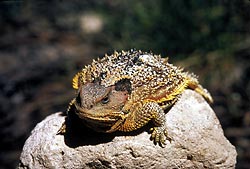
Mexican Horned Lizard Phrynosoma taurus
The scientific name of the Mexican Horned Lizard is Phrynosoma taurus. It is a species of reptile in the family Phrynosomatidae (north american spiny lizards), order Squamata. The name dates from 1870.
- Scientific name
- Phrynosoma taurus Bocourt, 1870
- Common name
- Mexican Horned Lizard
- Genus
- Phrynosoma
- Family
- Phrynosomatidae (North American Spiny Lizards)
- Order
- Squamata
- Class
- Reptilia
- Red List category
- LC Least Concern
- Recorded in
- 1 country
- Name status
- accepted in the Catalogue of Life

Overview
The Mexican horned lizard (Phrynosoma taurus) is a horned lizard species native to Mexico. Horned lizards are sometimes referred to as "horned toads" or "horny toads", although they are not toads. Compared to other members of the horned lizards (genus Phrynosoma), little is known about this species.
Classification of the Mexican Horned Lizard
| Kingdom | Animalia |
|---|---|
| Phylum | Chordata |
| Subphylum | Vertebrata |
| Infraphylum | Gnathostomata |
| Parvphylum | Osteichthyes |
| Megaclass | Tetrapoda |
| Class | Reptilia (Reptile) |
| Order | Squamata (Snakes) |
| Suborder | Iguania (Iguanas) |
| Family | Phrynosomatidae (North American Spiny Lizards) |
| Genus | Phrynosoma (Horned Lizard) |
| Species | Phrynosoma taurus Bocourt, 1870 |
Where the Mexican Horned Lizard is found
Checklists and occurrence records place Phrynosoma taurus in 1 country across North America. GBIF holds 312 georeferenced records of it.
Countries
Regions and cities with the most records
- Puebla, Mexico 118
- Oaxaca, Mexico 55
- Altepexi, Mexico 53
- Ajalpan, Mexico 39
- Tehuacán, Mexico 39
- Zinacatepec, Mexico 36
- Guerrero, Mexico 33
- Chilpancingo, Mexico 26
- Zumpango del Río, Mexico 26
- Tixtla de Guerrero, Mexico 24
- Morelos, Mexico 16
- Acatlán de Osorio, Mexico 11
- Emiliano Zapata, Mexico 11
- Jiutepec, Mexico 11
- Santa Rosa Treinta, Mexico 11
- Yautepec, Mexico 11
- Atlixco, Mexico 10
- Xochitepec, Mexico 10
- Temixco, Mexico 9
- Tlaquiltenango, Mexico 9
- Tres de Mayo, Mexico 9
- Zacatepec de Hidalgo, Mexico 9
- Ciudad de Huajuapan de León, Mexico 8
- Cuautla, Mexico 8
- Xoxocotla, Mexico 8
- Cuernavaca, Mexico 7
- Jojutla, Mexico 6
- Axochiapan, Mexico 5
- Izúcar de Matamoros, Mexico 5
Range as the checklists state it
Mexico (Morelos, Puebla, Oaxaca, Guerrero)
A number beside a place is its count of GBIF occurrence records. A place without a number comes from a checklist alone. Records show where a species has been observed or collected, which can include escapes and vagrants.
Common names
English
- Mexican Horned Lizard
Names in 6 other languages
- Chinese
- 墨西哥角蜥
- German
- Büffelhorn-Krötenechse
- Japanese
- メキシコツノトカゲ
- Portuguese
- Lagarto-de-chifre-mexicano
- Russian
- Мексиканская рогатая ящерица
- Spanish
- Camaleón Toro, Lagartija-cornuda toro o mexicana
Related species
-
 Texas Horned LizardPhrynosoma cornutum
-
 Desert Horned LizardPhrynosoma platyrhinos
-
 Greater Short-horned LizardPhrynosoma hernandesi
-
 Regal Horned LizardPhrynosoma solare
-
 Giant Horned LizardPhrynosoma asio
-
 San Diego Horned LizardPhrynosoma blainvillii
-
 Coast Horned LizardPhrynosoma coronatum
-
 Pygmy Short-horned LizardPhrynosoma douglasii
Compare
Questions and answers
What is the scientific name of the Mexican Horned Lizard?
The scientific name of the Mexican Horned Lizard is Phrynosoma taurus. Written with its author, the full name is Phrynosoma taurus Bocourt, 1870.
Which family does the Mexican Horned Lizard belong to?
Phrynosoma taurus belongs to the family Phrynosomatidae, in the order Squamata and the class Reptilia.
Where is the Mexican Horned Lizard found?
Checklists and occurrence records place Phrynosoma taurus in 1 country: Mexico.
What is the conservation status of the Mexican Horned Lizard?
The IUCN Red List category recorded for Phrynosoma taurus is Least Concern (LC).
Sources
Data
- Catalogue of Life, 2026-10-16 XR cc by
- Global Biodiversity Information Facility CC BY 4.0
- Wikidata CC0
- English Wikipedia CC BY-SA 4.0
- GeoNames CC BY 4.0
- Wikimedia Commons per image; credit shown with each image
- Within the Catalogue of Life, this name comes from The Reptile Database cc by
References
- A. M. C. Duméril and Bocourt, 1870 where the name was published
- Dugès, & ALFREDO. (1873). Estudio sobre una nueva especie de camaleon. La Naturaleza 1873: 302-305.
- Boulenger, G. A. (1885). Catalogue of the lizards in the British Museum (Natural History). Vol. 2, Second edition. London, Xiii+497 Pp.
- Gentry, A. F. (1885). A review of the genus Phrynosoma. Proc. Acad. Nat. Sci. Philad. (Ser. 3) 37: 138-148.
- Smith, H. M., & Taylor, E. H. (1950). An annotated checklist and key to the reptiles of Mexico exclusive of the snakes. Bull. US Natl. Mus. 199: 1-253.
- Presch, W. (1969). Evolutionary osteology and relationships of the horned lizard genus Phrynosoma (family Iguanidae). Copeia 1969 (2): 250-275.
- Castro-Franco, Rubén, & María Guasalupe Bustos-Zagal. (1994). List of reptiles of Morelos, Mexico, and their distribution in relation to vegetation types. Southwestern Naturalist 39 (2): 171-175.
- Zamudio, K. R., & Parra-Olea, G. (2000). Reproductive mode and female reproductive cycles of two endemic Mexican horned lizards (Phrynosoma taurus and Phrynosoma braconnieri). Copeia 2000 (1): 222–229.
- Reeder, T. W., & Montanucci, R. R. (2001). Phylogenetic analysis of the horned lizards (Phrynomomatidae: Phrynosoma): evidence from mitochondrial DNA and morphology. Copeia 2001 (2): 309-323.
- Sherbrooke, Wade C. (2003). Introduction to Horned Lizards of North America. University of California Press, Berkeley, 178 Pp.
- Castro Franco, R. & M. G. Bustos-Zagal. (2003). Lagartijas de Morelos, México: distribución, hábitat y conservación. Acta Zoológica Mexicana (N.S.) 88:123-142.
- Casas-Andreu, G., F.R. Méndez-De la Cruz and X. Aguilar-Miguel. (2004). Anfibios y Reptiles; pp. 375–390, in A.J.M. García-Mendoza, J. Ordoñez and M. Briones-Salas (ed.). Biodiversidad de Oaxaca. Instituto de Biología, UNAM-Fondo Oaxaqueño Para La Conservación de La Naturaleza-World Wildlife Fund, México, D. F.
- Hodges, W.L. and Kelly R. Zamudio. (2004). Horned lizard (Phrynosoma) phylogeny inferred from mitochondrial genes and morphological characters: understanding conflicts using multiple approaches. Molecular Phylogenetics and Evolution 31 (3): 961-971.
- Meyers, J.J.; Herrel, A. & Nishikawa, K. (2006). Morphological correlates of ant eating in horned lizards (Phrynosoma). Biological Journal of the Linnean Society 89: 13–24.
- Leaché, Adam D. and Jimmy A. McGuire. (2006). Phylogenetic relationships of horned lizards (Phrynosoma ) based on nuclear and mitochondrial data: Evidence for a misleading mitochondrial gene tree. Molecular Phylogenetics and Evolution 39 (3): 628-644.
- Liner, Ernest A. (2007). A CHECKLIST OF THE AMPHIBIANS AND REPTILES OF MEXICO. Louisiana State University Occasional Papers of the Museum of Natural Science 80: 1-60.
- Canseco-Márquez, L., & Gutiérrrez-Mayén, M.G. (2010). Anfibios y reptiles del Valle de Tehuacán-Cuicatlán. Comisión Nacional Para El Conocimiento Y Uso de La Biodiversidad, México D.F., Mexico, 302 Pp.
- Bergmann PJ, Irschick DJ. (2012). Vertebral evolution and the diversification of squamate reptiles. Evolution 66(4):1044-58. Doi: 10.1111/J.1558-5646.2011.01491.X.
- López-Vargas, M. R., & Lemos-Espinal, J. A. (2012). Phrynosoma taurus (bull horned lizard) prey. Herpetological Review 43: 337-338.
- Lambert, Shea M. and John J. Wiens. (2013). EVOLUTION OF VIVIPARITY: A PHYLOGENETIC TEST OF THE COLD-CLIMATE HYPOTHESIS IN PHRYNOSOMATID LIZARDS. Evolution 67 (9): 2614–2630.
- Nieto-Montes de Oca, Adrián; Diego Arenas-Moreno, Elizabeth Beltrán-Sánchez, and Adam D. Leaché. (2014). A New Species of Horned Lizard (Genus Phrynosoma) from Guerrero, México, with an Updated Multilocus Phylogeny. Herpetologica Jun 2014, Vol. 70, No. 2: 241-257.
- Werning, H. (2014). Krötenechsen – eine (sehr gute) Laune der Natur. Reptilia (Münster) 19 (107): 16-23.
- Mata-Silva, Vicente, Jerry D. Johnson, Larry David Wilson and Elí García-Padilla. (2015). The herpetofauna of Oaxaca, Mexico: composition, physiographic distribution, and conservation status. Mesoamerican Herpetology 2 (1): 6–62.
- Lara-Reséndiz Rafael A., Arenas-Moreno Diego M., Beltrán-Sánchez Elizabeth, Gramajo Weendii, Verdugo-Molina Javier, Sherbrooke Wade C. et al. (2015). Selected body temperature of nine species of Mexican horned lizards (Phrynosoma). Rev. Mex. Biodiv. 86 (1): 275-278.
- FLORES-VILLELA, OSCAR; CÉSAR A. RÍOS-MUÑOZ, GLORIA E. MAGAÑA-COTA & NÉSTOR L. QUEZADAS-TAPIA. (2016). Alfredo Dugès’ type specimens of amphibians and reptiles revisited. Zootaxa 4092 (1): 033–054.
This species in other databases
Page built on 26 November 2026. See how the catalog is made and all sources and licences.
Cite this page
ScientificNames.org. (2026). Phrynosoma taurus (Mexican Horned Lizard). Retrieved November 26, 2026, from https://scientificnames.org/species/phrynosoma-taurus
“Phrynosoma taurus (Mexican Horned Lizard).” ScientificNames.org, 2026, scientificnames.org/species/phrynosoma-taurus. Accessed 26 Nov. 2026.
ScientificNames.org. “Phrynosoma taurus (Mexican Horned Lizard).” Accessed November 26, 2026. https://scientificnames.org/species/phrynosoma-taurus.
@misc{scientificnames_phrynosoma_taurus_mexican_horned_lizard,
  author = {{ScientificNames.org}},
  title = {Phrynosoma taurus (Mexican Horned Lizard)},
  year = {2026},
  url = {https://scientificnames.org/species/phrynosoma-taurus},
  note = {Accessed 2026-11-26}
}