Species · Flowering plants
Lesser Butterfly Orchid Platanthera bifolia
The scientific name of the Lesser Butterfly Orchid is Platanthera bifolia. It is a species of flowering plant in the family Orchidaceae (orchid), order Asparagales.
- Scientific name
- Platanthera bifolia (L.) Rich.
- Common name
- Lesser Butterfly Orchid
- Genus
- Platanthera
- Family
- Orchidaceae (Orchid)
- Order
- Asparagales
- Class
- Liliopsida
- Recorded in
- 56 countries
- Name status
- accepted in the Catalogue of Life

Overview
The Lesser Butterfly Orchid is a flowering plant in the orchid genus Platanthera, family Orchidaceae, order Asparagales and class Liliopsida. It grows in grasslands, woodlands, hill pastures, heaths, moorland and tussocky marshy ground. It has two shining green basal leaves and a slim spike typically bearing approximately 25 white flowers tinged with yellow-green.
Written 26 November 2026 from the sources listed below. Each statement was checked against the passage it cites; statements that could not be supported were removed.
Appearance
The plant has two shining green basal leaves. In the hill form, these leaves are shorter and broader.[1][2]
The flowers have an upper sepal and petals forming a loose triangular hood above the pollinia. The pollinia lie parallel and close together, and the flowers have a long, almost straight spur.[3][4][5]
The plant typically bears approximately 25 white flowers tinged with yellow-green, arranged in a slim flower spike. It is approximately the same size as the greater butterfly-orchid.[6][7][8]
Habitat
The species occurs in grassland habitats, woodlands, heaths and moorland. It is found particularly in beech woods in southern England.[9][10][11]
It grows in hill pastures at elevations of up to 400 metres and in tussocky marshy ground. It tolerates acidic conditions better than the greater butterfly-orchid.[12][13][14]
Behaviour
The flowers release their scent at night, attracting sphingid moths. The moths tend to hover in front of the flowers while resting their forelegs on the lip.[15][16][17]
Reproduction and life cycle
The orchid is pollinated by pine hawk-moths, small elephant hawk-moths and, less frequently, elephant hawk-moths. When a moth's proboscis enters the spur and pushes between the pollinia, the pollinia are dislodged.[18][19]
The sticky discs released during pollination adhere to the visiting moth's proboscis.[20]
Hybrids between the lesser and greater butterfly-orchids are rare. Hybridisation with other species is also rare.[21][22]
A hybrid with the frog orchid was recorded on South Uist in 1949. Hybrids have also been recorded with the common spotted-orchid and heath spotted-orchid.[23][24]
Conservation
The species has experienced a serious population decline, particularly in central and southern England. Woodland clearance has contributed to this decline.[25][26]
Overgrazing has affected upland populations in northern and western areas. The species was assessed for the IUCN Red List of Threatened Species in 2011.[27][28]
Similar species
The Lesser Butterfly Orchid can be distinguished from the greater butterfly-orchid by its basal leaves and the angle of its pollinia. Its scent differs chemically from that of the greater butterfly-orchid and attracts different pollinators.[29][30]
Classification of the Lesser Butterfly Orchid
| Kingdom | Plantae |
|---|---|
| Subkingdom | Pteridobiotina |
| Phylum | Tracheophyta |
| Class | Liliopsida |
| Order | Asparagales |
| Family | Orchidaceae (Orchid) |
| Genus | Platanthera (Bog Orchid) |
| Species | Platanthera bifolia (L.) Rich. |
Where the Lesser Butterfly Orchid is found
Checklists and occurrence records place Platanthera bifolia in 56 countries across Africa, Asia and Europe. GBIF holds 242,805 georeferenced records of it.
Countries
- Aland Islands 716
- Albania 4
- Algeria 8
- Andorra 9
- Armenia 3
- Austria 7,422
- Azerbaijan 5
- Belarus 261
- Belgium 1,023
- Bosnia and Herzegovina 23
- Bulgaria 14
- China 41
- Croatia 185
- Czechia 1,145
- Denmark 1,589
- Estonia 3,622
- Faroe Islands
- Finland 10,791
- France 74,494
- Georgia 50
- Germany 20,964
- Greece 45
- Hungary 246
- Iran 3
- Ireland 471
- Isle of Man 23
- Italy 2,050
- Japan 21
- Kazakhstan 3
- Kosovo 3
- Latvia 121
- Liechtenstein 101
- Lithuania 161
- Luxembourg 409
- Moldova 6
- Mongolia
- Montenegro 27
- Morocco 3
- North Korea 12
- Norway 7,934
- Poland 3,061
- Portugal 45
- Romania 207
- Russia 9,751
- Serbia 75
- Slovakia 4,592
- Slovenia 412
- South Korea 46
- Spain 3,640
- Sweden 39,151
- Switzerland 25,107
- The Netherlands 7,555
- Tunisia 4
- Turkey 8
- Ukraine 1,414
- United Kingdom 13,729
Regions and cities with the most records
- Auvergne-Rhône-Alpes, France 35,367
- Bavaria, Germany 14,766
- Provence-Alpes-Côte d'Azur, France 9,317
- Bourgogne-Franche-Comté, France 7,439
- Occitanie, France 6,764
- Scotland, United Kingdom 6,362
- Grand Est, France 5,252
- Bern, Switzerland 5,240
- England, United Kingdom 4,729
- Västra Götaland, Sweden 4,510
- Östergötland, Sweden 3,383
- Kalmar, Sweden 3,154
- Vaud, Switzerland 3,057
- Centre-Val de Loire, France 2,979
- Stockholm, Sweden 2,735
- Södermanland, Sweden 2,577
- Gotland, Sweden 2,434
- Upper Austria, Austria 2,368
- Nyon, Switzerland 2,294
- Thonon-les-Bains, France 2,281
- Uppsala, Sweden 2,174
- Gävleborg, Sweden 2,151
- Geneva, Switzerland 2,105
- Seynod, France 2,073
- Échirolles, France 2,054
- Cran-Gevrier, France 2,023
- Annecy, France 2,016
- Annemasse, France 1,960
- Saint-Martin-d'Hères, France 1,935
- Annecy-le-Vieux, France 1,904
- Västernorrland, Sweden 1,890
- Steffisburg, Switzerland 1,880
- Vernier, Switzerland 1,876
- Thun, Switzerland 1,871
- Baden-Wurttemberg, Germany 1,864
- Grenoble, France 1,840
1 more country has a few records outside this range
These countries hold a few records of Platanthera bifolia but lie outside the range the checklists give for it. Such records are often zoo or garden specimens, museum material or vagrants, so the species is not counted as occurring there.
A number beside a place is its count of GBIF occurrence records. A place without a number comes from a checklist alone. Records show where a species has been observed or collected, which can include escapes and vagrants.
Common names
English
- Lesser Butterfly Orchid
- Lesser Butterfly-Orchid
Names in 28 other languages
- Belarusian
- Чараўнік двухлісты
- Catalan
- platantera bifòlia
- Chinese
- 細距舌唇蘭
- Czech
- vemeník dvoulistý
- Danish
- Bakke-gøgelilje
- Dutch
- Welriekende nachtorchis
- Estonian
- kahelehine käokeel
- Finnish
- valkolehdokki
- French
- Orchis à deux feuilles, Platanthère bifoliée, Platanthère à deux feuilles, Platanthère à fleurs blanches
- German
- Kleinblütige Weiße Waldhyazinthe, Weiße Waldhyazinthe, Weiße Waldhyazinthe (i. e. S.), Zartblütige Waldhyazinthe, Zweiblättrige Kuckucksblume, Zweiblättrige Waldhyazinthe
- Hungarian
- Kétlevelű sarkvirág
- Italian
- Platantera comune
- Japanese
- エゾチドリ, フタバツレサギ
- Latvian
- Smaržīgā naktsvijole
- Lithuanian
- Dvilapė blandis
- Luxembourgish
- Wäiss Kräizblumm
- Northern Sami
- idjalieksi
- Norwegian Bokmål
- nattfiol
- Polish
- Podkolan biały
- Portuguese
- orquídea-borboleta
- Russian
- Любка двулистная
- Scottish Gaelic
- magairlean beag nan dealan, magairleanan beaga nan dealan
- Slovak
- vemenník dvojlistý
- Slovenian
- Dvolistni vimenjak
- Spanish
- compañón
- Swedish
- nattviol, nattyxne
- Ukrainian
- Любка дволиста
- Welsh
- Baladr Dwyddeiliog, Tegeirian Glöyn Byw Lleiaf, Tegeirian Llydanwyrdd Bach
Synonyms
12 other scientific names have been used for this species and are now treated as synonyms of Platanthera bifolia.
- Conopsidium sthenantherum Wallr.
- Gymnadenia bifolia (L.) G.Mey.
- Habenaria bifolia (L.) R.Br.
- Habenaria bifolia (L.) Rich.
- Lysias bifolia (L.) Salisb.
- Orchis alba Lam.
- Orchis bifolia L.
- Orchis sthenanthera E.H.L.Krause
- Platanthera bifolia f. trifoliata (Thielens) Paucă & A.Nyár.
- Platanthera solstitialis var. trifoliata Thielens
- Sieberia bifolia (L.) Spreng.
- Satyrium bifolium (L.) Wahlenb. ambiguous synonym
Subspecies and varieties
- Platanthera bifolia subsp. bifolia subspecies
- Platanthera bifolia subsp. osca subspecies
- Platanthera bifolia subsp. subalpina subspecies
Related species
-
 Blunt-leaved OrchidPlatanthera obtusata
-
 Greater Butterfly-OrchidPlatanthera chlorantha
-
 Western Prairie Fringed OrchidPlatanthera praeclara
-
 Yellow Fringed OrchidPlatanthera ciliaris
-
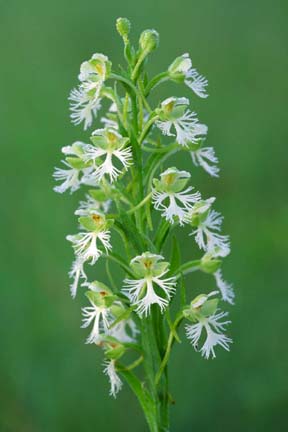 Eastern Prairie Fringed OrchidPlatanthera leucophaea
-
 Tall White Bog OrchidPlatanthera dilatata
-
 Northern Green OrchidPlatanthera hyperborea
-
 Lesser Purple Fringed OrchidPlatanthera psycodes
Compare
Questions and answers
What is the scientific name of the Lesser Butterfly Orchid?
The scientific name of the Lesser Butterfly Orchid is Platanthera bifolia. Written with its author, the full name is Platanthera bifolia (L.) Rich..
Which family does the Lesser Butterfly Orchid belong to?
Platanthera bifolia belongs to the family Orchidaceae, in the order Asparagales and the class Liliopsida.
Where is the Lesser Butterfly Orchid found?
Checklists and occurrence records place Platanthera bifolia in 56 countries, including France, Sweden, Switzerland, Germany, United Kingdom and Finland.
What other names does the Lesser Butterfly Orchid have?
Platanthera bifolia is also known in English as Lesser Butterfly-Orchid.
Sources
Passages the profile rests on
- The plant has two shining green basal leaves. Source passage: “their two shining green basal leaves” — English Wikipedia
- The hill form has basal leaves that are shorter and broader. Source passage: “especially of the hill form, which are shorter and broader” — English Wikipedia
- The flowers have an upper sepal and petals forming a loose triangular hood above the pollinia. Source passage: “The upper sepal and petals form a loose triangular hood above the pollinia” — English Wikipedia
- The plant's pollinia lie parallel and close together. Source passage: “which lie parallel and close together” — English Wikipedia
- The flowers have a long, almost straight spur. Source passage: “the spur, which is long and almost straight” — English Wikipedia
- The plant typically bears approximately 25 white flowers tinged with yellow-green. Source passage: “There are usually around 25 white flowers tinged with yellow-green” — English Wikipedia
- The flowers are arranged in a slim flower spike. Source passage: “in a slim flower spike” — English Wikipedia
- The lesser butterfly-orchid is approximately the same size as the greater butterfly-orchid. Source passage: “which are about the same size” — English Wikipedia
- The species occurs in grassland habitats. Source passage: “They are found in grasslands” — English Wikipedia
- The species occurs in woodlands, particularly beech woods in southern England. Source passage: “woodlands (especially beech woods in southern England)” — English Wikipedia
- The species occurs on heaths and moorland. Source passage: “on heaths and moorland” — English Wikipedia
- The species grows in hill pastures at elevations of up to 400 metres. Source passage: “in hill pastures up to 400m” — English Wikipedia
- The species grows in tussocky marshy ground. Source passage: “in tussocky marshy ground” — English Wikipedia
- The species tolerates acidic conditions better than the greater butterfly-orchid. Source passage: “being far more tolerant of acid conditions than the greater butterfly-orchid” — English Wikipedia
- The flowers release their scent at night. Source passage: “The flowers are night-scented” — English Wikipedia
- Sphingid moths are attracted to the orchid by its scent. Source passage: “Sphingid moths are attracted by the scent of this orchid” — English Wikipedia
- Attracted moths tend to hover in front of the flowers while resting their forelegs on the lip. Source passage: “tend to hover in front of the flowers, resting their forelegs on the lip” — English Wikipedia
- The orchid's pollinia are dislodged when a moth's proboscis enters the spur and pushes between them. Source passage: “As the proboscis enters the spur it pushes between the pollinia, dislodging the sticky discs” — English Wikipedia
- The species is pollinated by pine hawk-moths, small elephant hawk-moths and, less frequently, elephant hawk-moths. Source passage: “Pollinators include pine, small elephant and, to a lesser extent, elephant hawk-moths.” — English Wikipedia
- The sticky discs released during pollination adhere to the visiting moth's proboscis. Source passage: “the sticky discs which adhere to it” — English Wikipedia
- Hybrids between the lesser and greater butterfly-orchids are rare. Source passage: “Hybrids of the two butterfly-orchids are rare” — English Wikipedia
- Hybridisation between the lesser butterfly-orchid and other species is also rare. Source passage: “as are those between lesser butterfly-orchid and other species.” — English Wikipedia
- A hybrid with the frog orchid was recorded on South Uist in 1949. Source passage: “with frog orchid in South Uist (1949)” — English Wikipedia
- Hybrids have been recorded between this species and the common spotted-orchid and heath spotted-orchid. Source passage: “with the common spotted-orchid and the heath spotted-orchid.” — English Wikipedia
- The species has experienced a serious population decline, particularly in central and southern England. Source passage: “This species has suffered a serious decline, especially in central and southern England” — English Wikipedia
- Woodland clearance has contributed to the species' decline. Source passage: “as a result of woodland clearance.” — English Wikipedia
- Overgrazing has affected upland populations in northern and western areas. Source passage: “Upland populations in the north and west have suffered from overgrazing.” — English Wikipedia
- The species was assessed for the IUCN Red List of Threatened Species in 2011. Source passage: “Lesser Butterfly Orchid Platanthera bifolia has most recently been assessed for The IUCN Red List of Threatened Species in 2011.” — iucnredlist.org
- The lesser butterfly-orchid can be distinguished from the greater butterfly-orchid by its basal leaves and the angle of its pollinia. Source passage: “Lesser butterfly-orchids are distinguished by their two shining green basal leaves, especially of the hill form, which are shorter and broader and by the angle of the pollinia.” — English Wikipedia
- The scent of the lesser butterfly-orchid differs chemically from that of the greater butterfly-orchid and attracts different pollinators. Source passage: “the chemical components of the scent are different from those of greater butterfly-orchid and attract different pollinators.” — English Wikipedia
Data
- Catalogue of Life, 2026-10-16 XR cc by
- Global Biodiversity Information Facility CC BY 4.0
- Wikidata CC0
- GeoNames CC BY 4.0
- Wikimedia Commons per image; credit shown with each image
- Within the Catalogue of Life, this name comes from The World Checklist of Vascular Plants (WCVP) cc by
References
- De Orchid. Eur.: 35 (1817) where the name was published
This species in other databases
Page built on 29 November 2026. See how the catalog is made and all sources and licences.
Cite this page
ScientificNames.org. (2026). Platanthera bifolia (Lesser Butterfly Orchid). Retrieved November 29, 2026, from https://scientificnames.org/species/platanthera-bifolia
“Platanthera bifolia (Lesser Butterfly Orchid).” ScientificNames.org, 2026, scientificnames.org/species/platanthera-bifolia. Accessed 29 Nov. 2026.
ScientificNames.org. “Platanthera bifolia (Lesser Butterfly Orchid).” Accessed November 29, 2026. https://scientificnames.org/species/platanthera-bifolia.
@misc{scientificnames_platanthera_bifolia_lesser_butterfly_orchid,
  author = {{ScientificNames.org}},
  title = {Platanthera bifolia (Lesser Butterfly Orchid)},
  year = {2026},
  url = {https://scientificnames.org/species/platanthera-bifolia},
  note = {Accessed 2026-11-29}
}