Species · Flowering plants
Greater Butterfly-Orchid Platanthera chlorantha
The scientific name of the Greater Butterfly-Orchid is Platanthera chlorantha. It is a species of flowering plant in the family Orchidaceae (orchid), order Asparagales.
- Scientific name
- Platanthera chlorantha (Custer) Rchb.
- Common name
- Greater Butterfly-Orchid
- Genus
- Platanthera
- Family
- Orchidaceae (Orchid)
- Order
- Asparagales
- Class
- Liliopsida
- Recorded in
- 52 countries
- Name status
- accepted in the Catalogue of Life

Overview
The Greater Butterfly-Orchid is a temperate tuberous terrestrial orchid and a herbaceous perennial of medium height. It occurs in woods, open scrub and grassland, including chalk grassland, throughout Europe and Morocco. It is distinguished by greenish-white, vanilla-scented flowers arranged in a relatively loose spike, with a long spur and an undivided lip.
Written 26 November 2026 from the sources listed below. Each statement was checked against the passage it cites; statements that could not be supported were removed.
Appearance
The plant has broad, shiny, elliptical leaves, with a large pair at the base and smaller, lanceolate leaves higher up the stem. Its flowers are greenish-white and vanilla-scented, with spreading sepals and petals.[1][2]
The flowers are arranged in a relatively loose spike. Each flower has a long, narrow, undivided lip and a very long spur.[3][4]
Its pollen masses diverge so that they contact both sides of a pollinating insect.[5]
Habitat
The Greater Butterfly-Orchid occurs in woods, open scrub and grassland, including chalk grassland.[6]
Behaviour
Spring rainfall and sunlight exposure have no detectable effect on the morphological traits of plants flowering during the same June. These conditions influence the expression of morphological traits during the following year.[7][8]
Higher spring rainfall in one year is associated with greater leaf area and stem height in the following year. The number of flowering plants was highest in years following relatively dry or sunny spring conditions.[9][10]
The species' mean morphological trait values and coefficients of variation show relatively little variation between years.[11]
Reproduction and life cycle
In Britain, the species flowers from June to July, with flowering occurring earlier in southern Europe. The proportion of the population that flowers significantly affects its annual reproductive output.[12][13]
The decision to flower is made during the preceding summer, although subsequent abortion of above-ground organs during winter or spring can modify it.[14]
The length of the labellar spur is more developmentally constrained than flower number or stem height.[15]
Similar species
The Greater Butterfly-Orchid resembles the Lesser Butterfly-Orchid, Platanthera bifolia. The two species are approximately the same size, but the Lesser Butterfly-Orchid has smaller flowers.[16]
Classification of the Greater Butterfly-Orchid
| Kingdom | Plantae |
|---|---|
| Subkingdom | Pteridobiotina |
| Phylum | Tracheophyta |
| Class | Liliopsida |
| Order | Asparagales |
| Family | Orchidaceae (Orchid) |
| Genus | Platanthera (Bog Orchid) |
| Species | Platanthera chlorantha (Custer) Rchb. |
Where the Greater Butterfly-Orchid is found
Checklists and occurrence records place Platanthera chlorantha in 52 countries across Asia and Europe. GBIF holds 168,416 georeferenced records of it.
Countries
- Aland Islands 591
- Albania 12
- Andorra 41
- Armenia 42
- Austria 1,204
- Azerbaijan 23
- Belarus 303
- Belgium 1,259
- Bosnia and Herzegovina 12
- Bulgaria 41
- China 340
- Croatia 47
- Cyprus 3
- Czechia 268
- Denmark 2,432
- Estonia 2,406
- Finland 1,987
- France 62,631
- Georgia 222
- Germany 17,272
- Greece 87
- Hungary 17
- Iran 5
- Iraq
- Ireland 124
- Isle of Man 131
- Italy 1,180
- Japan 17
- Kosovo 3
- Latvia 53
- Liechtenstein 38
- Lithuania 78
- Luxembourg 757
- Montenegro 29
- North Korea 7
- North Macedonia 14
- Norway 6,529
- Poland 754
- Romania 90
- Russia 1,576
- Serbia 7
- Slovakia 430
- Slovenia 74
- South Korea 18
- Spain 2,252
- Sweden 24,387
- Switzerland 11,732
- Syria 3
- The Netherlands 1,722
- Turkey 33
- Ukraine 1,188
- United Kingdom 23,945
Regions and cities with the most records
- England, United Kingdom 14,654
- Île-de-France, France 12,847
- Auvergne-Rhône-Alpes, France 9,980
- Centre-Val de Loire, France 9,202
- Bavaria, Germany 8,676
- Étampes, France 6,912
- Hauts-de-France, France 5,681
- Scotland, United Kingdom 5,619
- Västra Götaland, Sweden 5,505
- Occitanie, France 5,228
- Grand Est, France 3,741
- Skåne, Sweden 3,472
- Jönköping, Sweden 2,419
- Kalmar, Sweden 2,332
- Brétigny-sur-Orge, France 2,280
- Saint-Michel-sur-Orge, France 2,085
- Wales, United Kingdom 2,057
- Vernon, France 1,994
- Pays de la Loire, France 1,970
- North Rhine-Westphalia, Germany 1,930
- Östergötland, Sweden 1,906
- Fontainebleau, France 1,833
- Avon, France 1,797
- Rheinland-Pfalz, Germany 1,745
- Bern, Switzerland 1,634
- Limay, France 1,617
- Dammarie-les-Lys, France 1,576
- Le Mée-sur-Seine, France 1,570
- Mantes-la-Jolie, France 1,522
- Mantes-la-Ville, France 1,500
- Møre og Romsdal, Norway 1,463
- Baden-Wurttemberg, Germany 1,448
- Örebro, Sweden 1,333
- Gotland, Sweden 1,278
- Sainte-Geneviève-des-Bois, France 1,272
- Bourgogne-Franche-Comté, France 1,251
4 more countries have a few records outside this range
These countries hold a few records of Platanthera chlorantha but lie outside the range the checklists give for it. Such records are often zoo or garden specimens, museum material or vagrants, so the species is not counted as occurring there.
A number beside a place is its count of GBIF occurrence records. A place without a number comes from a checklist alone. Records show where a species has been observed or collected, which can include escapes and vagrants.
Common names
English
- Greater Butterfly-Orchid
Names in 7 other languages
- Danish
- Skov-gøgelilje
- Dutch
- Bergnachtorchis
- Finnish
- keltalehdokki
- German
- Berg-Waldhyazinthe, Grünliche Waldhyazinthe
- Norwegian Bokmål
- grov nattfiol
- Swedish
- grönvit nattviol, storyxne
- Welsh
- Glöyn Byw y Rhos, Tegeirian Glöyn Byw Mwyaf, Tegeirian Iâr Fach yr Haf, Tegeirian Llydanwyrdd
Synonyms
39 other scientific names have been used for this species and are now treated as synonyms of Platanthera chlorantha.
- Conopsidium platantherum Wallr.
- Gymnadenia chlorantha (Custer) Ambrosi
- Habenaria bifolia subsp. chlorantha (Custer) Syme
- Orchis bifolia var. elatior Gaudin
- Orchis bifolia var. latissima Tinant
- Orchis bifolia var. macroglossa Wallr.
- Orchis chlorantha Custer
- Orchis montana F.W.Schmidt
- Orchis platanthera E.H.L.Krause
- Platanthera bifolia f. latissima (L.Marchand ex Tinant) Ruppert
- Platanthera bifolia subsp. chlorantha (Custer) Rouy
- Platanthera bifolia var. chlorantha Mayrhofer
- Platanthera bifolia var. chlorantha (Custer) Karsch
- Platanthera bifolia var. latissima (Tinant) Thielens
- Platanthera bifolia var. montana (F.W.Schmidt) Bolzon
- Platanthera bifolia var. montana Dumort.
- Platanthera chlorantha f. bracteata Zapał.
- Platanthera chlorantha f. grandiflora (M.Schulze) Soó
- Platanthera chlorantha f. robusta (Verm.) Verm.
- Platanthera chlorantha f. trifolia Zapał.
- Platanthera chlorantha var. angustata Zapał.
- Platanthera chlorantha var. bracteata Zapał.
- Platanthera chlorantha var. grandiflora M.Schulze
- Platanthera chlorantha var. gselliana (H.Baumann, Künkele & R.Lorenz) Perazza & R.Lorenz
- Platanthera chlorantha var. montana (F.W.Schmidt) Nyman
- Platanthera chlorantha var. robusta Verm.
- Platanthera chlorantha var. subalpina Gsell
- Platanthera chlorantha x Pseudorchis albida McKean
- Platanthera custeriana F.H.Wilms
- Platanthera montana (F.W.Schmidt) Rchb.f.
- Platanthera montana var. gselliana H.Baumann, Künkele & R.Lorenz
- Platanthera virescens K.Koch
- × Pseudanthera breadalbanensis McKean
- Habenaria chlorantha (Custer) Bab. ambiguous synonym
- Habenaria chloroleuca Ridl. ambiguous synonym
- Habenaria montana (F.W.Schmidt) T.Durand & Schinz ambiguous synonym
- Habenaria virescens (K.Koch) Druce ambiguous synonym
- Orchis ochroleuca Rchb. ambiguous synonym
- Orchis virescens Zollik. ex Gaud. ambiguous synonym
Related species
-
 Blunt-leaved OrchidPlatanthera obtusata
-
 Lesser Butterfly OrchidPlatanthera bifolia
-
 Western Prairie Fringed OrchidPlatanthera praeclara
-
 Yellow Fringed OrchidPlatanthera ciliaris
-
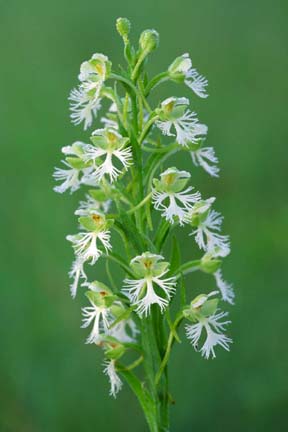 Eastern Prairie Fringed OrchidPlatanthera leucophaea
-
 Tall White Bog OrchidPlatanthera dilatata
-
 Northern Green OrchidPlatanthera hyperborea
-
 Lesser Purple Fringed OrchidPlatanthera psycodes
Compare
Questions and answers
What is the scientific name of the Greater Butterfly-Orchid?
The scientific name of the Greater Butterfly-Orchid is Platanthera chlorantha. Written with its author, the full name is Platanthera chlorantha (Custer) Rchb..
Which family does the Greater Butterfly-Orchid belong to?
Platanthera chlorantha belongs to the family Orchidaceae, in the order Asparagales and the class Liliopsida.
Where is the Greater Butterfly-Orchid found?
Checklists and occurrence records place Platanthera chlorantha in 52 countries, including France, Sweden, United Kingdom, Germany, Switzerland and Norway.
Sources
Passages the profile rests on
- The plant has broad, shiny, elliptical leaves, with a large pair at the base and smaller, lanceolate leaves higher up the stem. Source passage: “Its leaves are broad, shiny and elliptical, with a large pair at the base, and much smaller, more lanceolate leaves up the stem.” — English Wikipedia
- Its flowers are greenish-white and vanilla-scented, with spreading sepals and petals. Source passage: “The flowers are greenish-white, scented of vanilla, with spreading sepals and petals.” — English Wikipedia
- The flower has a long, narrow, undivided lip and a very long spur. Source passage: “The lip of the flower is long, narrow and undivided. The flower has a very long spur.” — English Wikipedia
- Its flowers are arranged in a relatively loose spike. Source passage: “The flowers form a rather loose spike.” — English Wikipedia
- Its pollen masses diverge so that they contact both sides of a pollinating insect. Source passage: “The pollen masses diverge to touch both sides of the pollinating insect.” — English Wikipedia
- The species occurs in woods, open scrub and grassland, including chalk grassland. Source passage: “The plant is found in woods, open scrub, and grassland including on chalk.” — English Wikipedia
- Spring rainfall and sunlight exposure have no detectable effect on the morphological traits of plants flowering during the same June. Source passage: “Spring rainfall and insolation had no detectable effect on traits of plants flowering that June;” — pmc.ncbi.nlm.nih.gov
- Spring rainfall and sunlight exposure influence the expression of morphological traits during the following year. Source passage: “instead, they impacted on trait expression during the following year,” — pmc.ncbi.nlm.nih.gov
- Higher spring rainfall in one year is associated with greater leaf area and stem height in the following year. Source passage: “High spring rainfall in year t–1 increased leaf area and stem height in year t,” — pmc.ncbi.nlm.nih.gov
- The number of flowering plants was highest in years following relatively dry or sunny spring conditions. Source passage: “the widely fluctuating number of flowering plants was highest in years immediately following those characterised by relatively dry and/or sunny springs.” — pmc.ncbi.nlm.nih.gov
- The species' mean morphological trait values and coefficients of variation showed relatively little variation between years. Source passage: “Mean values and coefficients of variation differed only modestly among years and showed few of any meaningful trends.” — pmc.ncbi.nlm.nih.gov
- The species flowers in Britain from June to July, with flowering occurring earlier in southern Europe. Source passage: “Flowering in Britain is in June to July, but earlier in the south of Europe.” — English Wikipedia
- The proportion of the population that flowers significantly affects its annual reproductive output. Source passage: “The proportion of the population electing to flower is the only measured parameter that impacts significantly on annual reproductive output,” — pmc.ncbi.nlm.nih.gov
- The decision to flower is made during the preceding summer, although subsequent abortion of above-ground organs during winter or spring can modify it. Source passage: “The “decision” to flower is taken during the previous summer, though it may be modified through winter/spring abortion of above-ground organs.” — pmc.ncbi.nlm.nih.gov
- The length of the labellar spur is more developmentally constrained than flower number or stem height. Source passage: “Labellar spur length proved to be more constrained than either flower number or stem height,” — pmc.ncbi.nlm.nih.gov
- The greater butterfly-orchid resembles the lesser butterfly-orchid, Platanthera bifolia, which is approximately the same size but has smaller flowers. Source passage: “Greater butterfly-orchid is similar to lesser butterfly-orchid, Platanthera bifolia, which is about the same size, but with smaller flowers.” — English Wikipedia
- The species occurs throughout Europe and Morocco. Source passage: “It can be found throughout Europe and Morocco.” — English Wikipedia
Data
- Catalogue of Life, 2026-10-16 XR cc by
- Global Biodiversity Information Facility CC BY 4.0
- Wikidata CC0
- GeoNames CC BY 4.0
- Wikimedia Commons per image; credit shown with each image
- Within the Catalogue of Life, this name comes from The World Checklist of Vascular Plants (WCVP) cc by
References
- J.C.Mössler, Handb. Gewächsk., ed. 2. 2: 1565 (1829) where the name was published
This species in other databases
Page built on 28 November 2026. See how the catalog is made and all sources and licences.
Cite this page
ScientificNames.org. (2026). Platanthera chlorantha (Greater Butterfly-Orchid). Retrieved November 28, 2026, from https://scientificnames.org/species/platanthera-chlorantha
“Platanthera chlorantha (Greater Butterfly-Orchid).” ScientificNames.org, 2026, scientificnames.org/species/platanthera-chlorantha. Accessed 28 Nov. 2026.
ScientificNames.org. “Platanthera chlorantha (Greater Butterfly-Orchid).” Accessed November 28, 2026. https://scientificnames.org/species/platanthera-chlorantha.
@misc{scientificnames_platanthera_chlorantha_greater_butterfly_orchid,
  author = {{ScientificNames.org}},
  title = {Platanthera chlorantha (Greater Butterfly-Orchid)},
  year = {2026},
  url = {https://scientificnames.org/species/platanthera-chlorantha},
  note = {Accessed 2026-11-28}
}