Species · Flowering plants
Blunt-leaved Orchid Platanthera obtusata
The scientific name of the Blunt-leaved Orchid is Platanthera obtusata. It is a species of flowering plant in the family Orchidaceae (orchid), order Asparagales.
- Scientific name
- Platanthera obtusata (Banks ex Pursh) Lindl.
- Common name
- Blunt-leaved Orchid
- Genus
- Platanthera
- Family
- Orchidaceae (Orchid)
- Order
- Asparagales
- Class
- Liliopsida
- Recorded in
- 3 countries
- Name status
- accepted in the Catalogue of Life

Overview
The blunt-leaved orchid is a small orchid belonging to the genus Platanthera and the family Orchidaceae. It occurs across the arctic regions of Asia, Europe, and North America. Its pollinia can approach the size of a mosquito's head and attach to visiting insects.
Written 26 November 2026 from the sources listed below. Each statement was checked against the passage it cites; statements that could not be supported were removed.
Appearance
The blunt-leaved orchid is a small plant with a flowering stalk that reaches only a few inches in height. Several flowers grow on each stalk, and individual flowers measure approximately 1/8 to 1/4 inch in length.[1][2][3][4]
Habitat
The species also occurs in the mossy coniferous understory of some white cedar-balsam fir-black spruce swamps.[5]
The blunt-leaved orchid occurs across the arctic regions of Asia, Europe, and North America. In the United States, it occurs in the Rocky Mountains, northern states bordering Canada, and Alaska.[6][7]
It is widespread across much of the colder regions of North America but is rare in some parts of its range. In the northern tier of United States states, it can be fairly common.[8][9]
Reproduction and life cycle
The orchid's pollinia attach to visiting insects and can be transferred when those insects visit another orchid. The pollinia can approach the size of a mosquito's head.[10][11]
Behaviour
Pollinia attached to visiting insects can interfere with and slow their flight.[12]
Similar species
Other orchids reported to share the blunt-leaved orchid's habitats include Calypso bulbosa, Amerorchis rotundifolia, Goodyera species, and Listera species. The blunt-leaved orchid can serve as an indicator of other orchid species sharing its habitat.[13][14]
Conservation
The wetland habitats occupied by the blunt-leaved orchid are important to protect because they support other orchids, plants, and at least one protected lichen species.[15]
Classification of the Blunt-leaved Orchid
| Kingdom | Plantae |
|---|---|
| Subkingdom | Pteridobiotina |
| Phylum | Tracheophyta |
| Class | Liliopsida |
| Order | Asparagales |
| Family | Orchidaceae (Orchid) |
| Genus | Platanthera (Bog Orchid) |
| Species | Platanthera obtusata (Banks ex Pursh) Lindl. |
Where the Blunt-leaved Orchid is found
Checklists and occurrence records place Platanthera obtusata in 3 countries across North America. GBIF holds 6,528 georeferenced records of it.
Countries
Regions and cities with the most records
- Quebec, Canada 626
- Yukon, Canada 390
- Ontario, Canada 385
- Alberta, Canada 366
- Alaska, United States 330
- British Columbia, Canada 285
- Manitoba, Canada 184
- Michigan, United States 161
- Northwest Territories, Canada 152
- Colorado, United States 145
- Wisconsin, United States 117
- Newfoundland and Labrador, Canada 104
- Minnesota, United States 103
- Nova Scotia, Canada 76
- Whitehorse, Canada 72
- Saskatchewan, Canada 71
- Nunavut, Canada 57
- New Brunswick, Canada 49
- Montana, United States 44
- Vermont, United States 36
- Maine, United States 29
- Wyoming, United States 29
- New Hampshire, United States 23
- Fairbanks, United States 21
- Badger, United States 20
- Salmon Arm, Canada 20
- New York, United States 19
- Rimouski, Canada 13
- Idaho, United States 11
- Prince Edward Island, Canada 8
- Barrie, Canada 7
- New Mexico, United States 7
- Yellowknife, Canada 7
- Amos, Canada 6
- Innisfil, Canada 6
- L'Ancienne-Lorette, Canada 6
4 more countries have a few records outside this range
These countries hold a few records of Platanthera obtusata but lie outside the range the checklists give for it. Such records are often zoo or garden specimens, museum material or vagrants, so the species is not counted as occurring there.
A number beside a place is its count of GBIF occurrence records. A place without a number comes from a checklist alone. Records show where a species has been observed or collected, which can include escapes and vagrants.
Common names
English
- Blunt-leaved Orchid
- Blunt Bog Orchid
- Northern Small Bog Orchid
- One-leaved Rein Orchid
Names in 2 other languages
- French
- habénaire obtuse, habénaire à feuille obtuse, platanthère à feuille obtuse
- Swedish
- lappfela
Synonyms
9 other scientific names have been used for this species and are now treated as synonyms of Platanthera obtusata.
- Habenaria obtusata (Banks ex Pursh) Richardson
- Habenaria obtusata var. collectanea Fernald
- Lysiella obtusata (Banks ex Pursh) Rydb.
- Orchis obtusata Banks ex Pursh
- Platanthera obtusata (Banks ex Pursh) Schur
- Platanthera obtusata f. collectanea (Fernald) P.M.Br.
- Platanthera obtusata f. foliosa P.M.Br.
- Platanthera obtusata subsp. obtusata
- Platanthera obtusata var. collectanea (Fernald) W.J.Schrenk
Related species
-
 Lesser Butterfly OrchidPlatanthera bifolia
-
 Greater Butterfly-OrchidPlatanthera chlorantha
-
 Western Prairie Fringed OrchidPlatanthera praeclara
-
 Yellow Fringed OrchidPlatanthera ciliaris
-
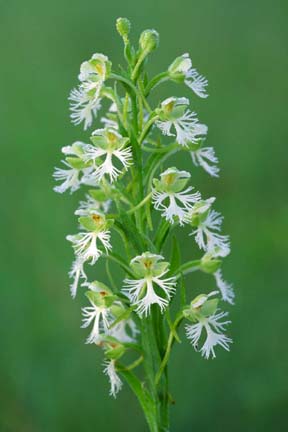 Eastern Prairie Fringed OrchidPlatanthera leucophaea
-
 Tall White Bog OrchidPlatanthera dilatata
-
 Northern Green OrchidPlatanthera hyperborea
-
 Lesser Purple Fringed OrchidPlatanthera psycodes
Compare
Questions and answers
What is the scientific name of the Blunt-leaved Orchid?
The scientific name of the Blunt-leaved Orchid is Platanthera obtusata. Written with its author, the full name is Platanthera obtusata (Banks ex Pursh) Lindl..
Which family does the Blunt-leaved Orchid belong to?
Platanthera obtusata belongs to the family Orchidaceae, in the order Asparagales and the class Liliopsida.
Where is the Blunt-leaved Orchid found?
Checklists and occurrence records place Platanthera obtusata in 3 countries: Canada, United States and Saint Pierre and Miquelon.
What other names does the Blunt-leaved Orchid have?
Platanthera obtusata is also known in English as Blunt Bog Orchid, Northern Small Bog Orchid and One-leaved Rein Orchid.
Sources
Passages the profile rests on
- Platanthera obtusata is a small orchid belonging to the genus Platanthera. Source passage: “is a small species of orchid in the genus Platanthera.” — English Wikipedia
- Individual flowers measure approximately 1/8 to 1/4 inch in length. Source passage: “This species has a diminutive flower that is just 1/8 inch to 1/4 inch long” — fs.usda.gov
- Several flowers grow on a single flowering stalk. Source passage: “with several flowers on a single stalk” — fs.usda.gov
- The flowering stalk reaches only a few inches in height. Source passage: “that is only a few inches tall.” — fs.usda.gov
- The species occurs in the mossy coniferous understory of some white cedar-balsam fir-black spruce swamps. Source passage: “in the mossy coniferous understory of some white cedar-balsam fir-black spruce swamps.” — fs.usda.gov
- The species occurs across the arctic regions of Asia, Europe, and North America. Source passage: “ranges all across the arctic regions of Asia, Europe, and North America.” — fs.usda.gov
- In the United States, the species occurs in the Rocky Mountains, northern states bordering Canada, and Alaska. Source passage: “In the United States, the blunt-leaf orchid occurs in the Rocky Mountains, along the northern tier of states that border Canada and into Alaska.” — fs.usda.gov
- The species is widespread across much of the colder regions of North America but is rare in some parts of its range. Source passage: “It widespread across much of the colder regions of the North America, though rare in some parts of its range.” — English Wikipedia
- In the northern tier of United States states, the species can be fairly common. Source passage: “In the northern tier of U.S. states this species can be fairly common” — fs.usda.gov
- Pollinia attach to visiting insects and can be transferred when those insects visit another orchid. Source passage: “the pollinia becomes attached to the insect. If the insect finds another orchid the pollen drops off at that time.” — fs.usda.gov
- The pollinia of this orchid can approach the size of a mosquito's head. Source passage: “The pollinia produced by the orchid can be almost as large as a mosquito head;” — fs.usda.gov
- The pollinia attached to visiting insects can interfere with and slow their flight. Source passage: “which, as you can imagine can interfere and slow down its flying” — fs.usda.gov
- The species can serve as an indicator of other orchid species sharing its habitat. Source passage: “it serves as an indicator of other orchid species” — fs.usda.gov
- Other orchids reported to share its habitats include Calypso bulbosa, Amerorchis rotundifolia, Goodyera species, and Listera species. Source passage: “such as calypso (Calypso bulbosa), round-leaved orchid (Amerorchis rotundifolia), the rattlesnake plantains (Goodyera spp.), and the twayblades (Listera spp.)” — fs.usda.gov
- The wetland habitats occupied by the species are important to protect because they support other orchids, plants, and at least one protected lichen species. Source passage: “its wetland habitat is important to protect for many reasons and include the fact that it often grows together with several other orchids, plants, and at least one species of lichen which are under state and or federal protection.” — fs.usda.gov
Data
- Catalogue of Life, 2026-10-16 XR cc by
- Global Biodiversity Information Facility CC BY 4.0
- Wikidata CC0
- GeoNames CC BY 4.0
- Wikimedia Commons per image; credit shown with each image
- Within the Catalogue of Life, this name comes from The World Checklist of Vascular Plants (WCVP) cc by
References
- Gen. Sp. Orchid. Pl.: 284 (1835) where the name was published
This species in other databases
Page built on 28 November 2026. See how the catalog is made and all sources and licences.
Cite this page
ScientificNames.org. (2026). Platanthera obtusata (Blunt-leaved Orchid). Retrieved November 28, 2026, from https://scientificnames.org/species/platanthera-obtusata
“Platanthera obtusata (Blunt-leaved Orchid).” ScientificNames.org, 2026, scientificnames.org/species/platanthera-obtusata. Accessed 28 Nov. 2026.
ScientificNames.org. “Platanthera obtusata (Blunt-leaved Orchid).” Accessed November 28, 2026. https://scientificnames.org/species/platanthera-obtusata.
@misc{scientificnames_platanthera_obtusata_blunt_leaved_orchid,
  author = {{ScientificNames.org}},
  title = {Platanthera obtusata (Blunt-leaved Orchid)},
  year = {2026},
  url = {https://scientificnames.org/species/platanthera-obtusata},
  note = {Accessed 2026-11-28}
}