Species · Flowering plants
Yellow Fringed Orchid Platanthera ciliaris
The scientific name of the Yellow Fringed Orchid is Platanthera ciliaris. It is a species of flowering plant in the family Orchidaceae (orchid), order Asparagales.
- Scientific name
- Platanthera ciliaris (L.) Lindl.
- Common name
- Yellow Fringed Orchid
- Genus
- Platanthera
- Family
- Orchidaceae (Orchid)
- Order
- Asparagales
- Class
- Liliopsida
- Recorded in
- 2 countries
- Name status
- accepted in the Catalogue of Life

Overview
The yellow fringed orchid is a perennial orchid that produces new growth each spring from overwintering buds on thick, fleshy roots. It grows in acidic wetlands, bogs, pine savannas, wet meadows, and other sunny, moist habitats. It is distinguished by its bright orange to yellow flowers with distinctive fringed lips.
Written 26 November 2026 from the sources listed below. Each statement was checked against the passage it cites; statements that could not be supported were removed.
Appearance
The yellow fringed orchid produces bright orange flowers with fringed petals. Its flowers are resupinate, with the lip facing downward.[1][2]
Its oval-shaped inflorescence contains approximately 20–60 flowers arranged in racemes. The flowers range from bright yellow to orange and have distinctive fringed lips.[3][4]
The lower petal has a hairy-looking appearance that gives the orchid its fringe-related common name. The species has an elongated nectar spur measuring approximately 20–35 mm.[5][6]
Its reproductive structures are fused into a compact column measuring approximately 3 × 3 mm. Its leaves are concentrated near the base of the stem and become progressively smaller toward the top.[7][8]
The plant typically reaches a height of 3–9 decimeters and can grow to approximately one meter tall.[9][10]
Habitat
The yellow fringed orchid occurs in acidic wetlands, bogs, pine savannas, wet meadows, and pitcher plant savannas. It also grows in swamps, seeps, prairies, flatwoods, and roadsides.[11][12][13]
Its habitats also include open pine woods and mountain slopes. The species typically grows in sunny, wet areas with acidic soils.[14][15]
The species generally prefers sunny, open habitats but can tolerate partial shade in moist or saturated soils.[16]
Behaviour
The yellow fringed orchid depends on sunny, open environmental conditions for successful growth. Periodic disturbances such as recurring fires can create the open habitats it requires.[17][18]
Reproduction and life cycle
The yellow fringed orchid is a perennial plant that produces new growth each spring from overwintering buds on thick, fleshy roots. Its blooming period extends from late June through September.[19][20]
The plant generally flowers in August. In Ohio, flowering occurs in late July and August.[21][22]
Its seeds are extremely small and can be dispersed by wind or water. Germination requires suitable mycorrhizal fungi because the seeds lack stored nutrients.[23][24]
Fungal partners can provide nutrients that allow seeds to survive underground for several years before emerging.[25]
The species is self-compatible, but natural self-fertilization is uncommon. It primarily reproduces through pollinator-mediated outcrossing.[26][27]
The yellow fringed orchid commonly hybridizes naturally with Platanthera blephariglottis.[28]
Conservation
Habitat loss associated with development, pollution, and climate change threatens populations occupying wetland ecosystems. Documented threats also include habitat shading caused by ecological succession, plant collection, roadside mowing, and hydrological changes.[29][30]
Herbivory by deer, rabbits, and rodents can damage flowering stalks and buds and sometimes kill the plant.[31]
Uses
Fishermen historically used pieces of the roots as bait.[32]
Classification of the Yellow Fringed Orchid
| Kingdom | Plantae |
|---|---|
| Subkingdom | Pteridobiotina |
| Phylum | Tracheophyta |
| Class | Liliopsida |
| Order | Asparagales |
| Family | Orchidaceae (Orchid) |
| Genus | Platanthera (Bog Orchid) |
| Species | Platanthera ciliaris (L.) Lindl. |
Where the Yellow Fringed Orchid is found
Checklists and occurrence records place Platanthera ciliaris in 2 countries across North America. GBIF holds 7,596 georeferenced records of it.
Countries
Regions and cities with the most records
- North Carolina, United States 793
- Tennessee, United States 502
- Florida, United States 303
- Alabama, United States 290
- Mississippi, United States 240
- Georgia, United States 217
- South Carolina, United States 165
- Virginia, United States 145
- Kentucky, United States 129
- Michigan, United States 115
- Pennsylvania, United States 109
- West Virginia, United States 108
- Louisiana, United States 93
- Indiana, United States 81
- Portage, United States 71
- Gautier, United States 66
- Maryland, United States 63
- Ocean Springs, United States 62
- Pascagoula, United States 52
- Arkansas, United States 50
- Texas, United States 47
- Illinois, United States 46
- Biloxi, United States 45
- Frederick, United States 44
- Hazleton, United States 42
- Sevierville, United States 42
- Asheville, United States 38
- Boone, United States 35
- Ohio, United States 35
- Kalamazoo, United States 34
- Ballenger Creek, United States 33
- Griffith, United States 32
- Highland, United States 32
- Connecticut, United States 30
- Dyer, United States 28
- Lansing, United States 28
1 more country has a few records outside this range
These countries hold a few records of Platanthera ciliaris but lie outside the range the checklists give for it. Such records are often zoo or garden specimens, museum material or vagrants, so the species is not counted as occurring there.
A number beside a place is its count of GBIF occurrence records. A place without a number comes from a checklist alone. Records show where a species has been observed or collected, which can include escapes and vagrants.
Common names
English
- Yellow Fringed Orchid
- Orange-fringed Orchid
- Yellow-fringed Orchid
Names in 2 other languages
- French
- habénaire ciliée, platanthère ciliée
- chr
- ᎠᏣᏗ ᎠᏂᏆᏔ
Synonyms
4 other scientific names have been used for this species and are now treated as synonyms of Platanthera ciliaris.
- Blephariglottis ciliaris (L.) Rydb.
- Blephariglottis flaviflora Raf.
- Habenaria ciliaris (L.) R.Br.
- Orchis ciliaris L.
Related species
-
 Blunt-leaved OrchidPlatanthera obtusata
-
 Lesser Butterfly OrchidPlatanthera bifolia
-
 Greater Butterfly-OrchidPlatanthera chlorantha
-
 Western Prairie Fringed OrchidPlatanthera praeclara
-
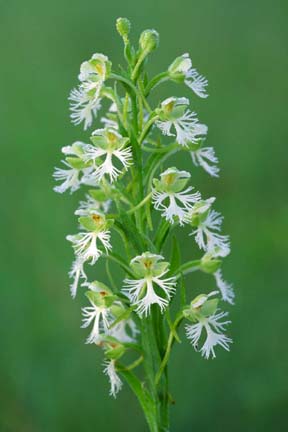 Eastern Prairie Fringed OrchidPlatanthera leucophaea
-
 Tall White Bog OrchidPlatanthera dilatata
-
 Northern Green OrchidPlatanthera hyperborea
-
 Lesser Purple Fringed OrchidPlatanthera psycodes
Compare
Questions and answers
What is the scientific name of the Yellow Fringed Orchid?
The scientific name of the Yellow Fringed Orchid is Platanthera ciliaris. Written with its author, the full name is Platanthera ciliaris (L.) Lindl..
Which family does the Yellow Fringed Orchid belong to?
Platanthera ciliaris belongs to the family Orchidaceae, in the order Asparagales and the class Liliopsida.
Where is the Yellow Fringed Orchid found?
Checklists and occurrence records place Platanthera ciliaris in 2 countries: United States and Canada.
What other names does the Yellow Fringed Orchid have?
Platanthera ciliaris is also known in English as Orange-fringed Orchid and Yellow-fringed Orchid.
Sources
Passages the profile rests on
- The species produces bright orange flowers with fringed petals. Source passage: “P. ciliaris produces unqiuely lacerate, fringed orange flower petals.” — English Wikipedia
- Its flowers are resupinate, with the lip facing downward. Source passage: “The flowers themselves are resupinate in nature, meaning they twist as they develop so that the lip (labellum) faces downward” — English Wikipedia
- Its inflorescence is oval-shaped and contains approximately 20–60 flowers. Source passage: “The inflorescence is generally oval in shape, with individual plants bearing anywhere from 20 to 60 flowers.” — English Wikipedia
- The species has bright yellow to orange flowers with distinctive fringed lips arranged in racemes. Source passage: “The flowers are showy, with bright yellow to orange flowers that have distinctive fringed lips and are clustered in racemes.” — fs.usda.gov
- The species has an elongated nectar spur measuring approximately 20–35 mm. Source passage: “Spur lengths generally range from 20 to 35 mm” — English Wikipedia
- The lower petal has a hairy-looking appearance that gives the orchid its fringe-related common name. Source passage: “The common name fringe orchid comes from the hairy looking lower petal” — plants.ces.ncsu.edu
- Its reproductive structures are fused into a compact column measuring approximately 3 × 3 mm. Source passage: “The column is compact, about 3x3 mm” — English Wikipedia
- Its leaves are concentrated near the base of the stem and become progressively smaller toward the top. Source passage: “with leaves concentrated basally and gradually reduced upward along the stem.” — English Wikipedia
- The plant can grow to approximately one meter tall. Source passage: “these plants can grow to around 1 meter tall” — English Wikipedia
- The species typically reaches a height of 3–9 decimeters. Source passage: “Herbaceous perennial, 3-9 dm.; flowering late July, August.” — ohiodnr.gov
- The species occurs in acidic wetlands, bogs, and pine savannas. Source passage: “this orchid can be found along the longleaf pine landscapes of the Gulf Coast of the United States, as well as in various acidic wetlands, bogs, and pine savannas.” — English Wikipedia
- Its habitats include wet meadows and pitcher plant savannas. Source passage: “It is commonly found in bogs, wet meadows, and pitcher plant savannas” — English Wikipedia
- Its documented habitats include swamps, seeps, wet meadows, prairies, boggy areas in pine savannas, flatwoods, and roadsides. Source passage: “Its habitats include swamps, seeps, wet meadows and prairies, boggy areas in pine savannas, flatwoods, and roadsides.” — fs.usda.gov
- The species also occurs in open pine woods and on mountain slopes. Source passage: “but it also occurs in more upland settings such as open pine woods and mountain slopes.” — English Wikipedia
- The species typically grows in sunny, wet areas with acidic soils. Source passage: “This plant is typically found in sunny, wet areas with acidic soils.” — fs.usda.gov
- The species generally prefers sunny, open habitats but can tolerate partial shade in moist or saturated soils. Source passage: “The species tends to prefer open, sunny environments but is tolerant of partial shade, particularly in moist or saturated soils.” — English Wikipedia
- The species depends on sunny, open environmental conditions for successful growth. Source passage: “Like many species in these habitats, it is dependent upon sunny, open conditions to thrive.” — English Wikipedia
- Periodic disturbances such as recurring fires can create the open habitats required by the species. Source passage: “Often, these environments are created from periodic disturbances such as recurring fires.” — English Wikipedia
- The species is a perennial orchid that produces new growth each spring from overwintering buds on thick, fleshy roots. Source passage: “begins growing each spring from overwintering buds formed on one of its thick, fleshy roots the prior growing season.” — English Wikipedia
- The species blooms from late June through September. Source passage: “Yellow fringed orchid is a perennial herb that blooms from late June to September.” — fs.usda.gov
- The plant generally flowers in August. Source passage: “that flowers in late summer, typically August.” — English Wikipedia
- In Ohio, flowering occurs in late July and August. Source passage: “flowering late July, August.” — ohiodnr.gov
- Its seeds are extremely small and can be dispersed by wind or water. Source passage: “The highly abundant seeds of Platanthera ciliaris are exceedingly small, allowing for easy dispersal by wind or water.” — English Wikipedia
- Seed germination requires suitable mycorrhizal fungi because the seeds lack stored nutrients. Source passage: “Because the seeds lack any stored nutrients, successful germination can only occur when they land in substrates containing the appropriate mycorrhizal fungi” — English Wikipedia
- The fungal partners can provide nutrients that allow seeds to survive underground for several years before emerging. Source passage: “these fungal partners provide sufficient nutrients for seeds to survive underground for several years before emerging above the surface.” — English Wikipedia
- The species is self-compatible, but natural self-fertilization is uncommon. Source passage: “Although P. ciliaris is self-compatible, natural self-fertilization is seemingly uncommon in nature.” — English Wikipedia
- The species primarily reproduces through pollinator-mediated outcrossing. Source passage: “These plants predominantly rely on outcrossing, mediated by pollinators for population sustainability and increased genetic diversity in given regions.” — English Wikipedia
- The species commonly hybridizes naturally with Platanthera blephariglottis. Source passage: “P. ciliaris was particularly noted to have common hybridization in nature with P. blephariglottis.” — English Wikipedia
- Habitat loss associated with development, pollution, and climate change threatens populations occupying wetland ecosystems. Source passage: “Many of these populations depend on wetland ecosystems, a particularly vulnerable habitat due to industrial development, pollution, and climate change effects.” — English Wikipedia
- Documented threats include habitat shading caused by ecological succession, plant collection, roadside mowing, and hydrological changes. Source passage: “Threats to this species include shading of habitat due to succession, plant collection, roadside mowing, and changes in hydrology.” — fs.usda.gov
- Herbivory by deer, rabbits, and rodents can damage flowering stalks and buds and sometimes kill the plant. Source passage: “herbivory from deer, rabbits, and rodents can remove flowering stalks or buds, directly reducing reproductive fitness and sometimes fully killing the plant.” — English Wikipedia
- Fishermen historically used pieces of the roots as bait. Source passage: “fishermen would use bits of the roots as bait” — English Wikipedia
Data
- Catalogue of Life, 2026-10-16 XR cc by
- Global Biodiversity Information Facility CC BY 4.0
- Wikidata CC0
- GeoNames CC BY 4.0
- Wikimedia Commons per image; credit shown with each image
- Within the Catalogue of Life, this name comes from The World Checklist of Vascular Plants (WCVP) cc by
References
- Gen. Sp. Orchid. Pl.: 292 (1835) where the name was published
This species in other databases
- Catalogue of Life 4JMW5
- Wikidata Q5488317
- iNaturalist 167016
- World Flora Online wfo-0000274384
- GRIN 456495
Page built on 28 November 2026. See how the catalog is made and all sources and licences.
Cite this page
ScientificNames.org. (2026). Platanthera ciliaris (Yellow Fringed Orchid). Retrieved November 28, 2026, from https://scientificnames.org/species/platanthera-ciliaris
“Platanthera ciliaris (Yellow Fringed Orchid).” ScientificNames.org, 2026, scientificnames.org/species/platanthera-ciliaris. Accessed 28 Nov. 2026.
ScientificNames.org. “Platanthera ciliaris (Yellow Fringed Orchid).” Accessed November 28, 2026. https://scientificnames.org/species/platanthera-ciliaris.
@misc{scientificnames_platanthera_ciliaris_yellow_fringed_orchid,
  author = {{ScientificNames.org}},
  title = {Platanthera ciliaris (Yellow Fringed Orchid)},
  year = {2026},
  url = {https://scientificnames.org/species/platanthera-ciliaris},
  note = {Accessed 2026-11-28}
}