Species · Mammals
Leopard Cat Prionailurus bengalensis
The scientific name of the Leopard Cat is Prionailurus bengalensis. It is a species of mammal in the family Felidae (cats), order Carnivora. The name dates from 1792.
- Scientific name
- Prionailurus bengalensis (Kerr, 1792)
- Common name
- Leopard Cat
- Genus
- Prionailurus
- Family
- Felidae (Cats)
- Order
- Carnivora
- Class
- Mammalia
- Red List category
- LC Least Concern
- Recorded in
- 20 countries
- Name status
- accepted in the Catalogue of Life

Overview
Prionailurus bengalensis is distributed across continental South, Southeast and East Asia, with its mainland range extending from Pakistan through Southeast Asia and China to the Russian Far East. It has a tawny-coloured body and limbs marked with dark spots, two dark facial stripes and rows of elongated spots along its back.
Written 26 November 2026 from the sources listed below. Each statement was checked against the passage it cites; statements that could not be supported were removed.
Appearance
The Leopard Cat has a tawny-coloured body and limbs marked with dark spots. Two dark facial stripes extend from its eyes to its ears, and two to four rows of elongated spots run along its back.[1][2][3]
Its moderately long, rounded ears have black backs with central white spots. Its chest and belly are white.[4][5]
Northern Leopard Cats generally have longer and paler fur than individuals at southern latitudes.[6]
In tropical regions, Leopard Cats weigh between 0.55 and 3.8 kg. Their head-body length ranges from 38.8 to 66 cm, and their tails measure between 17.2 and 31 cm.[7][8][9]
Leopard Cats in northern China and Siberia can weigh up to 7.1 kg. Their shoulder height is approximately 41 cm.[10][11]
Habitat
The Leopard Cat inhabits tropical evergreen rainforests and subtropical deciduous and coniferous forests. It also occurs in plantations at sea level and agricultural landscapes, including oil palm and sugar cane plantations.[12][13][14][15]
In Pakistan, the Leopard Cat is mainly associated with Himalayan moist temperate forests and also inhabits Himalayan dry coniferous forests. In eastern Russia, it inhabits areas near rivers, valleys and ravine forests.[16][17]
Leopard Cats generally avoid areas receiving more than 10 cm of snowfall. In Margalla Hills National Park, they have been recorded at elevations between 664 and 1,441 metres above sea level.[18][19]
Diet
The Leopard Cat is carnivorous and consumes mammals, lizards, amphibians, birds and insects. Small rodents such as rats and mice constitute the major part of its diet in most parts of its range.[20][21]
It sometimes supplements its diet with grass, eggs, poultry and aquatic prey.[22]
In Margalla Hills National Park, recorded wild prey included rodents, two mongoose species, Asian palm squirrels and Cape hares. Domestic prey included poultry birds, sheep, goats and dogs.[23][24]
In Margalla Hills National Park, Leopard Cats consumed more wild prey during summer than during winter and more domestic prey during winter than during summer.[25][26]
In the forests of Singapore, Oriental house rats were detected in all examined Leopard Cat scats.[27]
Behaviour
Leopard Cats are generally solitary except during the breeding season. Most hunt at night, although some individuals are active during the day.[28][29]
They are agile climbers and exhibit largely arboreal habits. They rest in trees and also shelter in dense thorny ground vegetation.[30][31]
Leopard Cats can swim but seldom do so. They mark their territories through urine spraying, faecal deposition, head rubbing and scratching.[32][33]
They capture prey using a rapid pounce and bite.[34]
Reproduction and life cycle
Leopard Cats in tropical habitats can give birth throughout the year. Females in colder northern habitats give birth in spring.[35][36]
The gestation period lasts approximately 60 to 70 days. Litters generally contain two or three kittens.[37][38]
Captive-born kittens weigh between 75 and 130 grams at birth. Captive female Leopard Cats can reach sexual maturity at one year of age and have their first litter at approximately 13 to 14 months of age.[39][40][41]
Conservation
The Leopard Cat has been listed as Least Concern on the IUCN Red List since 2002. It is listed in Appendix II of CITES.[42][43]
Its population is threatened by habitat loss and hunting in parts of its range. In Pakistan, it is classified as Data Deficient, and commercial hunting for spotted fur is identified as a major threat.[44][45][46]
Leopard Cats are also killed in retaliation for hunting poultry.[47]
Uses
Leopard Cat fur has been used for decorations and coats. Its bones have been used in traditional medicine.[48][49]
Classification of the Leopard Cat
| Kingdom | Animalia |
|---|---|
| Phylum | Chordata |
| Subphylum | Vertebrata |
| Infraphylum | Gnathostomata |
| Parvphylum | Osteichthyes |
| Megaclass | Tetrapoda |
| Class | Mammalia (Mammal) |
| Subclass | Theria |
| Infraclass | Eutheria |
| Order | Carnivora (Carnivores) |
| Suborder | Feliformia (Cat-like Carnivores) |
| Family | Felidae (Cats) |
| Subfamily | Felinae |
| Genus | Prionailurus (Asian Small Cats) |
| Species | Prionailurus bengalensis (Kerr, 1792) |
Where the Leopard Cat is found
Checklists and occurrence records place Prionailurus bengalensis in 20 countries across Asia. GBIF holds 4,776 georeferenced records of it.
Countries
- Afghanistan 3
- Bangladesh 18
- Bhutan 9
- Cambodia 358
- China 559
- Hong Kong 29
- India 317
- Indonesia 204
- Japan 67
- Laos 44
- Malaysia 182
- Myanmar 30
- Nepal 78
- Pakistan 11
- Philippines 27
- Singapore 3
- South Korea 2,529
- Taiwan 67
- Thailand 128
- Vietnam 113
Regions and cities with the most records
- Jeollabuk-do, South Korea 358
- Gyeongsangbuk-do, South Korea 353
- Gyeonggi-do, South Korea 341
- Chungcheongnam-do, South Korea 282
- Gangwon-do, South Korea 280
- Jeollanam-do, South Korea 267
- Preah Vihear, Cambodia 259
- Gyeongsangnam-do, South Korea 208
- Kimhae, South Korea 167
- Busan, South Korea 159
- Paju, South Korea 148
- Munsan, South Korea 147
- Buan, South Korea 146
- Busan, South Korea 143
- Jeongeup, South Korea 134
- Damyang, South Korea 129
- Guangdong, China 125
- Asan, South Korea 119
- Yecheon, South Korea 109
- Kimje, South Korea 102
- Yŏnmu, South Korea 93
- Yeoju, South Korea 91
- Gwangju, South Korea 90
- Nonsan, South Korea 88
- Goyang-si, South Korea 87
- Yesan, South Korea 86
- Mokpo, South Korea 85
- Gangneung, South Korea 79
- Nangen, South Korea 77
- Jeonju, South Korea 74
- Pubal, South Korea 74
- Mungyeong, South Korea 72
- Yangsan, South Korea 68
- Daejeon, South Korea 64
- Wanju, South Korea 63
- Iksan, South Korea 62
3 more countries have a few records outside this range
These countries hold a few records of Prionailurus bengalensis but lie outside the range the checklists give for it. Such records are often zoo or garden specimens, museum material or vagrants, so the species is not counted as occurring there.
Range as the checklists state it
Europe & Northern Asia (excluding China)
Southern Asia
A number beside a place is its count of GBIF occurrence records. A place without a number comes from a checklist alone. Records show where a species has been observed or collected, which can include escapes and vagrants.
Common names
English
- Leopard Cat
- Common Leopard Cat
- Mainland Leopard Cat
Names in 37 other languages
- Arabic
- قط البر الرئيسي النمري, قط نمري
- Bengali
- Chita Biral, চিতা বিড়াল
- Bulgarian
- Леопардова котка
- Burmese
- Thit-Kyaung
- Cebuano
- marál
- Chinese
- 石虎, 豹貓
- Croatian
- Leopard mačka
- Czech
- kočka bengálská
- Danish
- Asiatisk leopardkat
- Dutch
- Bengaalse Tijgerkat
- Finnish
- aasianmetsäkissa
- French
- Chat de Chine, Chat léopard du Bengale, Chat-léopard du Bengale
- German
- Bengalkatze, Leopardkatze
- Greek
- Αγριόγατα της Βεγγάλης, Λεοπαρδογαλή
- Hindi
- Cheetah Billi
- Hungarian
- leopárdmacska
- Indonesian
- Kucing kuwuk
- Italian
- Gatto leopardo
- Japanese
- ベンガルヤマネコ
- Khmer
- ឆ្មាដាវ
- Korean
- 살쾡이, 삵
- Malay
- Kucing batu
- Marathi
- Waghati
- Nepali
- Chari bagh
- Norwegian Bokmål
- Bengalkatt, Leopardkatt
- Polish
- Kot bengalski, kotek bengalski
- Portuguese
- Gato-Leopardo
- Romanian
- Pisică leopard
- Russian
- Бенгальская кошка
- Spanish
- Gato Bengalí, gato bengali, gato de Bengala
- Tamil
- சிறுத்தைப் பூனை
- Thai
- Maewdaao, แมวดาว
- Turkish
- Pars kedisi
- Ukrainian
- Кіт бенгальський
- asm
- লতাফুটুকী
- dzo
- Bja-zig
- sun
- Méong Congkok
Synonyms
13 other scientific names have been used for this species and are now treated as synonyms of Prionailurus bengalensis.
- Felis anastasiae Satunin, 1905
- Felis bengalensis Kerr, 1792
- Felis bengalensis euptilura Corbet, 1978
- Felis bengalensis hainana Xu & Liu, 1983
- Felis bengalensis manchurica Tate, 1947
- Felis decolorata Milne-Edwards, 1872
- Felis euptilura microtis Won, 1968
- Felis ingrami Bonhote, 1903
- Felis manchurica Mori, 1922
- Felis microtis Milne-Edwards, 1872
- Felis ricketti Bonhote, 1903
- Felis sinensis Sthih, 1930
- Mustela manchurica Mori, 1922
Subspecies and varieties
- Prionailurus bengalensis bengalensis (Leopard Cat) subspecies
- Prionailurus bengalensis euptilurus (Amur Cat) subspecies
Related species
-
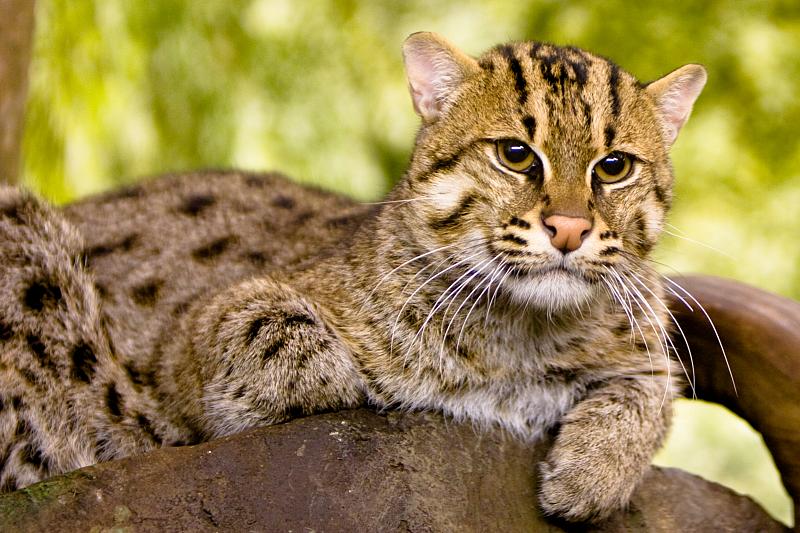 Fishing CatPrionailurus viverrinus
-
 Rusty-spotted CatPrionailurus rubiginosus
-
 Sunda Leopard CatPrionailurus javanensis
-
 Flat-headed CatPrionailurus planiceps
-
 CatFelis catus
-
 TigerPanthera tigris
-
 TilcayoLeopardus tilcayo
-
 LionPanthera leo
Compare
Questions and answers
What is the scientific name of the Leopard Cat?
The scientific name of the Leopard Cat is Prionailurus bengalensis. Written with its author, the full name is Prionailurus bengalensis (Kerr, 1792).
Which family does the Leopard Cat belong to?
Prionailurus bengalensis belongs to the family Felidae, in the order Carnivora and the class Mammalia.
Where is the Leopard Cat found?
Checklists and occurrence records place Prionailurus bengalensis in 20 countries, including South Korea, China, Cambodia, India, Indonesia and Malaysia.
What is the conservation status of the Leopard Cat?
The IUCN Red List category recorded for Prionailurus bengalensis is Least Concern (LC).
What other names does the Leopard Cat have?
Prionailurus bengalensis is also known in English as Common Leopard Cat and Mainland Leopard Cat.
What is a leopard cat's habitat?
The Leopard Cat inhabits tropical evergreen rainforests, subtropical deciduous and coniferous forests, plantations at sea level and agricultural landscapes, including oil palm and sugar cane plantations. In Pakistan, it is mainly associated with Himalayan moist temperate forests and also inhabits Himalayan dry coniferous forests.[12][13][14][15][16]
What do leopard cats eat?
Leopard Cats are carnivorous and consume mammals, lizards, amphibians, birds and insects. Small rodents such as rats and mice constitute the major part of their diet in most parts of their range. They sometimes supplement their diet with grass, eggs, poultry and aquatic prey.[20][21][22]
Sources
Passages the profile rests on
- The leopard cat has a tawny-coloured body and limbs marked with dark spots. Source passage: “The leopard cat (Prionailurus bengalensis) is a small wild cat with dark spots on the tawny-coloured body and limbs.” — English Wikipedia
- The leopard cat has two dark facial stripes extending from its eyes to its ears. Source passage: “There are two dark stripes running from the eyes to the ears” — English Wikipedia
- The leopard cat has two to four rows of elongated spots along its back. Source passage: “two to four rows of elongated spots along its back.” — English Wikipedia
- The leopard cat has moderately long, rounded ears with black backs and central white spots. Source passage: “The backs of its moderately long and rounded ears are black with central white spots.” — English Wikipedia
- The leopard cat has a white chest and belly. Source passage: “The background colour of the spotted fur is tawny, with a white chest and belly.” — English Wikipedia
- Northern leopard cats generally have longer and paler fur than individuals at southern latitudes. Source passage: “At more northern latitudes their fur is longer and paler, and they typically weigh more.” — animaldiversity.org
- Leopard cats in tropical regions weigh between 0.55 and 3.8 kg. Source passage: “In the tropics, leopard cats weigh 0.55–3.8 kg (1.2–8.4 lb)” — English Wikipedia
- The head-body length of tropical leopard cats ranges from 38.8 to 66 cm. Source passage: “have head-body lengths of 38.8–66 cm (15.3–26.0 in)” — English Wikipedia
- The tail of tropical leopard cats measures between 17.2 and 31 cm. Source passage: “with long 17.2–31 cm (6.8–12.2 in) tails.” — English Wikipedia
- Leopard cats in northern China and Siberia can weigh up to 7.1 kg. Source passage: “In northern China and Siberia, they weigh up to 7.1 kg (16 lb)” — English Wikipedia
- The shoulder height of leopard cats is approximately 41 cm. Source passage: “Shoulder height is about 41 cm (16 in).” — English Wikipedia
- The leopard cat inhabits tropical evergreen rainforests. Source passage: “It inhabits tropical evergreen rainforests” — English Wikipedia
- The leopard cat inhabits subtropical deciduous and coniferous forests. Source passage: “subtropical deciduous and coniferous forests” — English Wikipedia
- The leopard cat occurs in plantations at sea level. Source passage: “It lives in tropical evergreen rainforests and plantations at sea level” — English Wikipedia
- The leopard cat can inhabit agricultural landscapes including oil palm and sugar cane plantations. Source passage: “inhabits agriculturally used areas such as oil palm and sugar cane plantations.” — English Wikipedia
- In Pakistan, the leopard cat is mainly associated with Himalayan moist temperate forests and also inhabits Himalayan dry coniferous forests. Source passage: “In Pakistan, the leopard cat is mostly associated with Himalayan moist temperate forest, but also dwells further north in the Himalayan dry coniferous forest” — pmc.ncbi.nlm.nih.gov
- Leopard cats in eastern Russia inhabit areas near rivers, valleys and ravine forests. Source passage: “In far eastern Russia, it lives close to rivers, valleys and in ravine forests” — English Wikipedia
- Leopard cats generally avoid areas receiving more than 10 cm of snowfall. Source passage: “but avoids areas with more than 10 cm (3.9 in) of snowfall.” — English Wikipedia
- Leopard cats in Margalla Hills National Park were recorded at elevations between 664 and 1,441 metres above sea level. Source passage: “The leopard cat was recorded at 13 different sampling sites in the park, with an altitudinal range between 664–1441 m asl.” — pmc.ncbi.nlm.nih.gov
- The leopard cat is carnivorous and consumes mammals, lizards, amphibians, birds and insects. Source passage: “Leopard cats are carnivorous, feeding on a variety of small prey including mammals, lizards, amphibians, birds and insects.” — English Wikipedia
- Small rodents such as rats and mice constitute the major part of the leopard cat's diet in most parts of its range. Source passage: “In most parts of their range, small rodents such as rats and mice form the major part of their diet” — English Wikipedia
- Leopard cats sometimes supplement their diet with grass, eggs, poultry and aquatic prey. Source passage: “which is often supplemented with grass, eggs, poultry, and aquatic prey.” — English Wikipedia
- In Margalla Hills National Park, wild prey recorded in the leopard cat's diet included rodents, two mongoose species, Asian palm squirrels and Cape hares. Source passage: “Wild prey included small mammals (rodents, two mongoose species, Asian palm squirrel, and Cape hare), birds, insects and snails.” — pmc.ncbi.nlm.nih.gov
- In Margalla Hills National Park, domestic prey included poultry birds, sheep, goats and dogs. Source passage: “The domestic prey were poultry birds, sheep, goats and dogs.” — pmc.ncbi.nlm.nih.gov
- Leopard cats in Margalla Hills National Park consumed more wild prey during summer than during winter. Source passage: “Consumption of wild prey was higher in summer (n = 31 scat)” — pmc.ncbi.nlm.nih.gov
- Leopard cats in Margalla Hills National Park consumed more domestic prey during winter than during summer. Source passage: “whereas intake of domestic prey was higher in winter (n = 37 scats).” — pmc.ncbi.nlm.nih.gov
- In the forests of Singapore, Oriental house rats were detected in all examined leopard cat scats. Source passage: “with Oriental house rat (Rattus tanezumi) found in all scats” — pmc.ncbi.nlm.nih.gov
- Leopard cats are generally solitary except during the breeding season. Source passage: “Leopard cats are solitary, except during the breeding season.” — English Wikipedia
- Most leopard cats hunt at night, although some individuals are active during the day. Source passage: “Some are active during the day, but most hunt at night” — English Wikipedia
- Leopard cats are agile climbers and exhibit largely arboreal habits. Source passage: “They are agile climbers and quite arboreal in their habits.” — English Wikipedia
- Leopard cats rest in trees and also shelter in dense thorny ground vegetation. Source passage: “They rest in trees, but also hide in dense thorny undergrowth on the ground.” — English Wikipedia
- Leopard cats can swim but seldom do so. Source passage: “Leopard cats can swim, but seldom do so.” — English Wikipedia
- Leopard cats mark their territories through urine spraying, faecal deposition, head rubbing and scratching. Source passage: “Both sexes scent mark their territory by spraying urine, leaving faeces in exposed locations, head rubbing, and scratching.” — English Wikipedia
- Leopard cats capture prey using a rapid pounce and bite. Source passage: “They are active hunters, dispatching their prey with a rapid pounce and bite.” — English Wikipedia
- Leopard cats in tropical habitats can give birth throughout the year. Source passage: “In tropical habitats, kittens are born throughout the year.” — English Wikipedia
- Female leopard cats in colder northern habitats give birth in spring. Source passage: “In colder habitats farther north, females give birth in spring.” — English Wikipedia
- The gestation period of leopard cats lasts approximately 60 to 70 days. Source passage: “Their gestation period lasts 60–70 days.” — English Wikipedia
- Leopard cat litters generally contain two or three kittens. Source passage: “Litter size varies between two and three kittens.” — English Wikipedia
- Captive-born leopard cat kittens weigh between 75 and 130 grams at birth. Source passage: “Captive-born kittens weighed 75 to 130 g (2.6 to 4.6 oz) at birth” — English Wikipedia
- Captive female leopard cats can reach sexual maturity at one year of age. Source passage: “Captive females reach sexual maturity earliest at the age of one year” — English Wikipedia
- Captive female leopard cats have their first litter at approximately 13 to 14 months of age. Source passage: “and have their first litter at the age of 13–14 months.” — English Wikipedia
- The leopard cat has been listed as Least Concern on the IUCN Red List since 2002. Source passage: “Since 2002 it has been listed as Least Concern on the IUCN Red List” — English Wikipedia
- The leopard cat is listed in Appendix II of CITES. Source passage: “The leopard cat is listed in CITES Appendix II.” — English Wikipedia
- The leopard cat population is threatened by habitat loss and hunting in parts of its range. Source passage: “although threatened by habitat loss and hunting in parts of its range.” — English Wikipedia
- The leopard cat is classified as Data Deficient in Pakistan. Source passage: “Because no recent data are available on its population in Pakistan, the status of this species is categorized as “Data Deficient”” — pmc.ncbi.nlm.nih.gov
- Commercial hunting for spotted fur is identified as a major threat to leopard cats in Pakistan. Source passage: “The main threats to this species in Pakistan include hunting by commercial traders for its richly spotted fur mainly for decorations and coats” — pmc.ncbi.nlm.nih.gov
- Leopard cats are also killed in retaliation for hunting poultry. Source passage: “The species also faces retaliatory killing for hunting poulty.” — pmc.ncbi.nlm.nih.gov
- Leopard cat fur has been used for decorations and coats. Source passage: “for its richly spotted fur mainly for decorations and coats” — pmc.ncbi.nlm.nih.gov
- Leopard cat bones have been used in traditional medicine. Source passage: “and traditional medicinal use of bones” — pmc.ncbi.nlm.nih.gov
Data
- Catalogue of Life, 2026-10-16 XR cc by
- Global Biodiversity Information Facility CC BY 4.0
- Wikidata CC0
- GeoNames CC BY 4.0
- Wikimedia Commons per image; credit shown with each image
- Within the Catalogue of Life, this name comes from The Integrated Taxonomic Information System cc0
References
- InLinnaeus, Anim. Kingdom vol.1 p.151 where the name was published
- Wilson, Don E., and DeeAnn M. Reeder, eds. (1993). Mammal Species of the World: A Taxonomic and Geographic Reference, 2nd Ed., 3rd Printing.
- Wilson, Don E., and F. Russell Cole. (2000). Common Names of Mammals of the World.
- Wilson, Don E., and DeeAnn M. Reeder, eds. (2005). Mammal Species of the World: A Taxonomic and Geographic Reference, 3rd Ed., Vols. 1 & 2.
- Sunquist, M. E. and F. C. Sunquist / Don E. Wilson and Russell A. Mittermeier, eds. (2009). Family Felidae (Cats). Handbook of the Mammals of the World. Vol. 1: Carnivores.
- Kitchener, A. C., C. Breitenmoser-Würsten, E. Eizirik, A. Gentry, L. Werdelin, A. Wilting, et al. (2017). A revised taxonomy of the Felidae. The final report of the Cat Classification Task Force of the IUCN/SSC Cat Specialist Group. Cat News Special Issue, Vol. 11.
This species in other databases
Page built on 28 November 2026. See how the catalog is made and all sources and licences.
Cite this page
ScientificNames.org. (2026). Prionailurus bengalensis (Leopard Cat). Retrieved November 28, 2026, from https://scientificnames.org/species/prionailurus-bengalensis
“Prionailurus bengalensis (Leopard Cat).” ScientificNames.org, 2026, scientificnames.org/species/prionailurus-bengalensis. Accessed 28 Nov. 2026.
ScientificNames.org. “Prionailurus bengalensis (Leopard Cat).” Accessed November 28, 2026. https://scientificnames.org/species/prionailurus-bengalensis.
@misc{scientificnames_prionailurus_bengalensis_leopard_cat,
  author = {{ScientificNames.org}},
  title = {Prionailurus bengalensis (Leopard Cat)},
  year = {2026},
  url = {https://scientificnames.org/species/prionailurus-bengalensis},
  note = {Accessed 2026-11-28}
}