Species · Mammals
Rusty-spotted Cat Prionailurus rubiginosus
The scientific name of the Rusty-spotted Cat is Prionailurus rubiginosus. It is a species of mammal in the family Felidae (cats), order Carnivora. The name dates from 1831.
- Scientific name
- Prionailurus rubiginosus (I. Geoffroy Saint-Hilaire, 1831)
- Common name
- Rusty-spotted Cat
- Genus
- Prionailurus
- Family
- Felidae (Cats)
- Order
- Carnivora
- Class
- Mammalia
- Red List category
- NT Near Threatened
- Recorded in
- 3 countries
- Name status
- accepted in the Catalogue of Life

Overview
Prionailurus rubiginosus is native to India, Nepal and Sri Lanka. It has short reddish-grey fur with rusty-coloured spots across its back and flanks.
Written 26 November 2026 from the sources listed below. Each statement was checked against the passage it cites; statements that could not be supported were removed.
Appearance
The Rusty-spotted Cat has short reddish-grey fur with rusty-coloured spots across its back and flanks. Its paws and tail have a uniform reddish-grey coloration.[1][2]
Four dark lines extend over its eyes, with two continuing along the neck. Each side of its head has six dark streaks extending across the cheeks and forehead.[3][4]
Its chin, throat, inner limbs and belly are whitish and covered with tiny brownish spots. A rusty-coloured band extends across its chest.[5][6]
Its body length ranges from 35 to 48 cm, and its tail measures between 15 and 30 cm. Adults weigh between 0.9 and 1.6 kg.[7][8][9]
Its bushy tail is approximately half the length of its body. The species is described as the smallest wild cat in Asia.[10][11]
Habitat
The Rusty-spotted Cat inhabits moist and dry deciduous forests, scrubland and grassland. It prefers areas with dense vegetation and rocky terrain and is likely absent from evergreen forests.[12][13][14][15]
In Sri Lanka, the species has been recorded in both montane and lowland rainforest. Its Sri Lankan populations are divided between the dry zone and the wet zone.[16][17]
In western Maharashtra, the species breeds in agricultural landscapes dominated by human activity.[18]
In 2016, the species was recorded in Horton Plains National Park, Sri Lanka, at elevations between 2,084 and 2,162 m.[19]
Diet
The Rusty-spotted Cat feeds primarily on rodents and birds. Its additional prey includes lizards, frogs and insects.[20][21]
Adult Sri Lankan rusty-spotted cats in the wild eat birds and mammals.[22]
Behaviour
Most recorded wild individuals have been observed after dark. Individuals recorded at Horton Plains National Park were mostly active between sunset and sunrise, with limited activity during daylight.[23][24]
Some individuals have been observed sheltering in trees and caves. The species primarily hunts on the ground using rapid movements to capture prey and apparently climbs trees to escape larger predators.[25][26][27]
Captive individuals of both sexes scent-mark their home ranges by spraying urine. They are predominantly nocturnal but may also be briefly active during the day.[28][29]
Reproduction and life cycle
The female's oestrus period lasts approximately five days. Females prepare their birth dens in secluded locations, and gestation lasts between 65 and 70 days.[30][31][32]
Females give birth to litters of one or two kittens. Newborn kittens weigh between 60 and 77 g and have rows of black spots at birth.[33][34][35]
The species reaches sexual maturity at approximately 68 weeks of age.[36]
Conservation
The Rusty-spotted Cat has been classified as Near Threatened on the IUCN Red List since 2016. Its lifespan in the wild is unknown, while individuals have been recorded living for up to twelve years in captivity.[37][38][39]
Loss and destruction of deciduous forest habitat affect the global population. Habitat loss and agricultural expansion are identified as serious threats to the species in India and Sri Lanka.[40][41]
The Indian population is listed under CITES Appendix I, while the Sri Lankan population is listed under CITES Appendix II. Hunting and trade are prohibited in India and Sri Lanka.[42][43][44]
Uses
The Rusty-spotted Cat is hunted for food in some areas. Its skins have occasionally been reported in trade.[45][46]
Classification of the Rusty-spotted Cat
| Kingdom | Animalia |
|---|---|
| Phylum | Chordata |
| Subphylum | Vertebrata |
| Infraphylum | Gnathostomata |
| Parvphylum | Osteichthyes |
| Megaclass | Tetrapoda |
| Class | Mammalia (Mammal) |
| Subclass | Theria |
| Infraclass | Eutheria |
| Order | Carnivora (Carnivores) |
| Suborder | Feliformia (Cat-like Carnivores) |
| Family | Felidae (Cats) |
| Subfamily | Felinae |
| Genus | Prionailurus (Asian Small Cats) |
| Species | Prionailurus rubiginosus (I. Geoffroy Saint-Hilaire, 1831) |
Where the Rusty-spotted Cat is found
Checklists and occurrence records place Prionailurus rubiginosus in 3 countries across Asia. GBIF holds 97 georeferenced records of it.
Countries
Regions and cities with the most records
- Andhra Pradesh, India 11
- Bhimdatta, Nepal 7
- Maharashtra, India 7
- Tamil Nadu, India 7
- Karnataka, India 4
- Madhya Pradesh, India 4
- Rajasthan, India 4
- Srisailam Project RFC Township, India 4
- Srīsailain, India 4
- Gujarat, India 3
- Kandy, Sri Lanka 3
- Kannānkurichchi, India 3
- Khatīma, India 3
- Kondalampatti, India 3
- Omalur, India 3
- Salem, India 3
Range as the checklists state it
Southern Asia
A number beside a place is its count of GBIF occurrence records. A place without a number comes from a checklist alone. Records show where a species has been observed or collected, which can include escapes and vagrants.
Common names
English
- Rusty-Spotted Cat
Names in 28 other languages
- Arabic
- قط صدء النقاط
- Breton
- Kazh ruzart
- Bulgarian
- Червена петниста котка
- Chinese
- 鏽斑豹貓
- Czech
- kočka cejlonská
- Danish
- Rustplettet kat
- Dutch
- Roestkat
- Finnish
- ruostetäpläkissa
- French
- Chat Rouge, Chat rougeâtre, Chat rougâtre, Chat-l, Chat-léopard de l'Inde, chat rubigineux
- Galician
- Gato ferruxento
- German
- Rostkatze
- Greek
- Ερυθρόστικτος αγριόγατος, Στικτόγατα
- Gujarati
- કાટવર્ણી ટપકાંવાળી બિલાડી
- Hungarian
- rozsdafoltos macska
- Italian
- Gatto rugginoso
- Japanese
- サビイロネコ
- Korean
- 붉은점박이삵, 붉은점살쾡이
- Lithuanian
- Rudoji katė
- Norwegian Bokmål
- Rustflekkatt
- Polish
- Kot rdzawy, kotek rudy
- Portuguese
- Gato-ferrugem, Gato-leopardo-da-Índia
- Russian
- Пятнисто-рыжая кошка
- Sinhala
- කොළ දිවියා
- Spanish
- Gato Rubiginosa, Gato herrumbroso, gato rojizo
- Swedish
- Rostfläckig katt
- Telugu
- నామాల పిల్లి
- Turkish
- paslı kedi
- Ukrainian
- Кіт плямисто-рудий
Synonyms
3 other scientific names have been used for this species and are now treated as synonyms of Prionailurus rubiginosus.
- Felis rubiginosa I. Geoffroy Saint-Hilaire, 1831
- Felis rubiginosus I. Geoffroy Saint-Hilaire, 1831
- Viverriceps rubiginosa Gray, 1867
Subspecies and varieties
- Prionailurus rubiginosus koladivius (Lowland Rusty-spotted Cat) subspecies
- Prionailurus rubiginosus phillipsi (Forest Rusty-spotted Cat) subspecies
- Prionailurus rubiginosus rubiginosus (Indian Rusty-spotted Cat) subspecies
Related species
-
 Leopard CatPrionailurus bengalensis
-
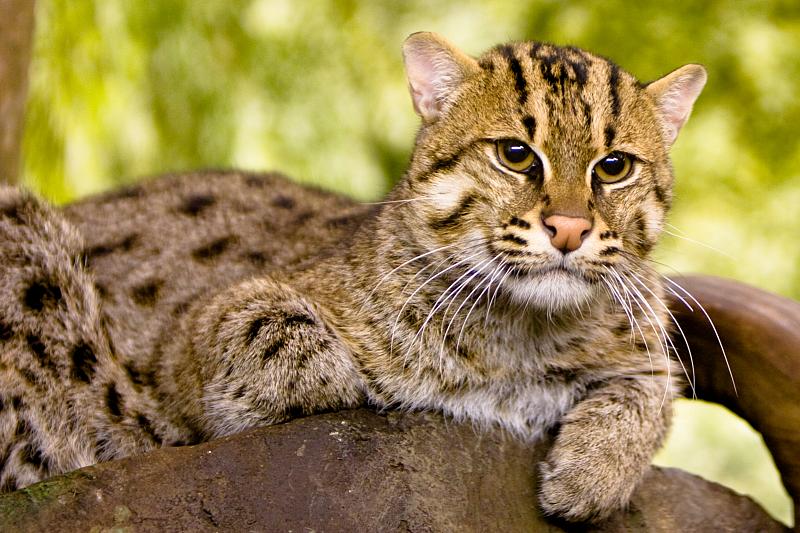 Fishing CatPrionailurus viverrinus
-
 Sunda Leopard CatPrionailurus javanensis
-
 Flat-headed CatPrionailurus planiceps
-
 CatFelis catus
-
 TigerPanthera tigris
-
 TilcayoLeopardus tilcayo
-
 LionPanthera leo
Compare
Questions and answers
What is the scientific name of the Rusty-spotted Cat?
The scientific name of the Rusty-spotted Cat is Prionailurus rubiginosus. Written with its author, the full name is Prionailurus rubiginosus (I. Geoffroy Saint-Hilaire, 1831).
Which family does the Rusty-spotted Cat belong to?
Prionailurus rubiginosus belongs to the family Felidae, in the order Carnivora and the class Mammalia.
Where is the Rusty-spotted Cat found?
Checklists and occurrence records place Prionailurus rubiginosus in 3 countries: India, Sri Lanka and Nepal.
What is the conservation status of the Rusty-spotted Cat?
The IUCN Red List category recorded for Prionailurus rubiginosus is Near Threatened (NT).
Sources
Passages the profile rests on
- The species has short reddish-grey fur with rusty-coloured spots across its back and flanks. Source passage: “The rusty-spotted cat has short reddish grey fur over most of the body with rusty spots on the back and flanks.” — English Wikipedia
- Its paws and tail have a uniform reddish-grey coloration. Source passage: “Its paws and tail are uniform reddish grey.” — English Wikipedia
- Four dark lines extend over the eyes, with two continuing along the neck. Source passage: “Four blackish lines run over the eyes, and two of them extend over the neck.” — English Wikipedia
- Each side of the head has six dark streaks extending across the cheeks and forehead. Source passage: “Six dark streaks are on each side of the head, extending over the cheeks and forehead.” — English Wikipedia
- Its chin, throat, inner limbs and belly are whitish and covered with tiny brownish spots. Source passage: “Its chin, throat, inner side of the limbs and belly are whitish with tiny brownish spots.” — English Wikipedia
- The species has a rusty-coloured band across its chest. Source passage: “It has a rusty band on the chest.” — English Wikipedia
- Its body length ranges from 35 to 48 cm. Source passage: “It is 35 to 48 cm (14 to 19 in) in length” — English Wikipedia
- Its tail measures between 15 and 30 cm. Source passage: “with a 15 to 30 cm (5.9 to 11.8 in) tail” — English Wikipedia
- Adults weigh between 0.9 and 1.6 kg. Source passage: “weighs 0.9 to 1.6 kg (2.0 to 3.5 lb).” — English Wikipedia
- Its bushy tail is approximately half the length of its body. Source passage: “The bushy tail is about half the length of the body.” — English Wikipedia
- The species is described as the smallest wild cat in Asia. Source passage: “It is the smallest wild cat in Asia” — English Wikipedia
- The species inhabits both moist and dry deciduous forests. Source passage: “It occurs mainly in moist and dry deciduous forests” — English Wikipedia
- Its habitats also include scrubland and grassland. Source passage: “as well as scrub and grassland” — English Wikipedia
- The species prefers areas with dense vegetation and rocky terrain. Source passage: “It prefers dense vegetation and rocky areas.” — English Wikipedia
- The species is likely absent from evergreen forests. Source passage: “but is likely absent in evergreen forest.” — English Wikipedia
- In Sri Lanka, the species has been recorded in both montane and lowland rainforest. Source passage: “In Sri Lanka, there are a few records in montane and lowland rainforest.” — English Wikipedia
- In Sri Lanka, the species has two distinct populations, one in the dry zone and another in the wet zone. Source passage: “There are two distinct populations, one in the dry zone and the other in the wet zone.” — English Wikipedia
- In western Maharashtra, the species breeds in agricultural landscapes dominated by human activity. Source passage: “In western Maharashtra, the rusty-spotted cat is breeding in a human dominated agricultural landscape, where rodent densities are high.” — English Wikipedia
- The species was recorded in Horton Plains National Park, Sri Lanka, at elevations between 2,084 and 2,162 m in 2016. Source passage: “In 2016, it was recorded for the first time in Horton Plains National Park at elevations of 2,084–2,162 m (6,837–7,093 ft).” — English Wikipedia
- The species feeds primarily on rodents and birds. Source passage: “It feeds mainly on rodents and birds” — English Wikipedia
- Its additional prey includes lizards, frogs and insects. Source passage: “but also preys on lizards, frogs, and insects.” — English Wikipedia
- Adult Sri Lankan rusty-spotted cats in the wild eat birds and mammals. Source passage: “The Sri Lankan subspecies of rusty-spotted cats ( Prionailurus rubiginosus phillipsi ) as adults in the wild eat birds and mammals” — animaldiversity.org
- Most recorded wild individuals have been observed after dark. Source passage: “Most wild ones were also recorded after dark.” — English Wikipedia
- Individuals recorded at Horton Plains National Park were mostly active between sunset and sunrise, with limited activity during daylight. Source passage: “At Horton Plain National Park in Sri Lanka, they were mostly recorded between sunset and sunrise, with limited daytime activity.” — English Wikipedia
- Some individuals have been observed sheltering in trees and caves. Source passage: “Several individuals were observed hiding in trees and in caves.” — English Wikipedia
- The species primarily hunts on the ground using rapid movements to capture prey. Source passage: “It hunts primarily on the ground, making rapid, darting movements to catch its prey.” — English Wikipedia
- The species apparently climbs trees to escape larger predators. Source passage: “It apparently ventures into trees to escape larger predators.” — English Wikipedia
- Captive individuals of both sexes scent-mark their home ranges by spraying urine. Source passage: “Captive females and males both scent-mark their home range by spraying urine.” — English Wikipedia
- Captive individuals are predominantly nocturnal but may also be briefly active during the day. Source passage: “Captive ones are mostly nocturnal but also briefly active during the day.” — English Wikipedia
- The female's oestrus period lasts approximately five days. Source passage: “The female's oestrus lasts five days” — English Wikipedia
- Females prepare their birth dens in secluded locations. Source passage: “She prepares a den in a secluded location” — English Wikipedia
- Gestation lasts between 65 and 70 days. Source passage: “after a gestation of 65–70 days” — English Wikipedia
- Females give birth to litters of one or two kittens. Source passage: “gives birth to one or two kittens.” — English Wikipedia
- Newborn kittens weigh between 60 and 77 g. Source passage: “At birth, the kittens weigh just 60 to 77 g (2.1 to 2.7 oz)” — English Wikipedia
- Kittens have rows of black spots at birth. Source passage: “and are marked with rows of black spots.” — English Wikipedia
- The species reaches sexual maturity at approximately 68 weeks of age. Source passage: “They reach sexual maturity at around 68 weeks” — English Wikipedia
- The species has been classified as Near Threatened on the IUCN Red List since 2016. Source passage: “Since 2016, it has been listed as Near Threatened on the IUCN Red List” — English Wikipedia
- Rusty-spotted cats have been recorded living for up to twelve years in captivity. Source passage: “Rusty-spotted cats have lived for twelve years in captivity” — English Wikipedia
- The species' lifespan in the wild is unknown. Source passage: “their lifespan in the wild is unknown.” — English Wikipedia
- Loss and destruction of deciduous forest habitat affect the global population. Source passage: “the global population is affected by loss and destruction of its prime habitat, deciduous forests.” — English Wikipedia
- Habitat loss and agricultural expansion are identified as serious threats to the species in India and Sri Lanka. Source passage: “Habitat loss and the spread of cultivation are serious problems for wildlife in both India and Sri Lanka.” — English Wikipedia
- The Indian population is listed under CITES Appendix I. Source passage: “The Indian population is listed on CITES Appendix I.” — English Wikipedia
- The Sri Lankan population is listed under CITES Appendix II. Source passage: “The Sri Lankan population is included on CITES Appendix II.” — English Wikipedia
- Hunting and trade are prohibited in India and Sri Lanka. Source passage: “with hunting and trade banned in India and Sri Lanka.” — English Wikipedia
- The species is hunted for food in some areas. Source passage: “In some areas, it is hunted for food or as a livestock pest.” — English Wikipedia
- The species' skins have occasionally been reported in trade. Source passage: “There have been occasional reports of rusty-spotted cat skins in trade.” — English Wikipedia
Data
- Catalogue of Life, 2026-10-16 XR cc by
- Global Biodiversity Information Facility CC BY 4.0
- Wikidata CC0
- GeoNames CC BY 4.0
- Wikimedia Commons per image; credit shown with each image
- Within the Catalogue of Life, this name comes from The Integrated Taxonomic Information System cc0
References
- InBélanger (ed.), Voy. Indes Orient., Mamm. vol.3(Zoologie) p.140 where the name was published
- Wilson, Don E., and DeeAnn M. Reeder, eds. (1993). Mammal Species of the World: A Taxonomic and Geographic Reference, 2nd Ed., 3rd Printing.
- Wilson, Don E., and F. Russell Cole. (2000). Common Names of Mammals of the World.
- Wilson, Don E., and DeeAnn M. Reeder, eds. (2005). Mammal Species of the World: A Taxonomic and Geographic Reference, 3rd Ed., Vols. 1 & 2.
- Sunquist, M. E. and F. C. Sunquist / Don E. Wilson and Russell A. Mittermeier, eds. (2009). Family Felidae (Cats). Handbook of the Mammals of the World. Vol. 1: Carnivores.
- Kitchener, A. C., C. Breitenmoser-Würsten, E. Eizirik, A. Gentry, L. Werdelin, A. Wilting, et al. (2017). A revised taxonomy of the Felidae. The final report of the Cat Classification Task Force of the IUCN/SSC Cat Specialist Group. Cat News Special Issue, Vol. 11.
This species in other databases
Page built on 27 November 2026. See how the catalog is made and all sources and licences.
Cite this page
ScientificNames.org. (2026). Prionailurus rubiginosus (Rusty-spotted Cat). Retrieved November 27, 2026, from https://scientificnames.org/species/prionailurus-rubiginosus
“Prionailurus rubiginosus (Rusty-spotted Cat).” ScientificNames.org, 2026, scientificnames.org/species/prionailurus-rubiginosus. Accessed 27 Nov. 2026.
ScientificNames.org. “Prionailurus rubiginosus (Rusty-spotted Cat).” Accessed November 27, 2026. https://scientificnames.org/species/prionailurus-rubiginosus.
@misc{scientificnames_prionailurus_rubiginosus_rusty_spotted_cat,
  author = {{ScientificNames.org}},
  title = {Prionailurus rubiginosus (Rusty-spotted Cat)},
  year = {2026},
  url = {https://scientificnames.org/species/prionailurus-rubiginosus},
  note = {Accessed 2026-11-27}
}