Species · Reptiles
Red-bellied Black Snake Pseudechis porphyriacus
The scientific name of the Red-bellied Black Snake is Pseudechis porphyriacus. It is a species of reptile in the family Elapidae (cobras), order Squamata. The name dates from 1794.
- Scientific name
- Pseudechis porphyriacus (Shaw, 1794)
- Common name
- Red-bellied Black Snake
- Genus
- Pseudechis
- Family
- Elapidae (Cobras)
- Order
- Squamata
- Class
- Reptilia
- Red List category
- LC Least Concern
- Recorded in
- 1 country
- Name status
- accepted in the Catalogue of Life
Overview
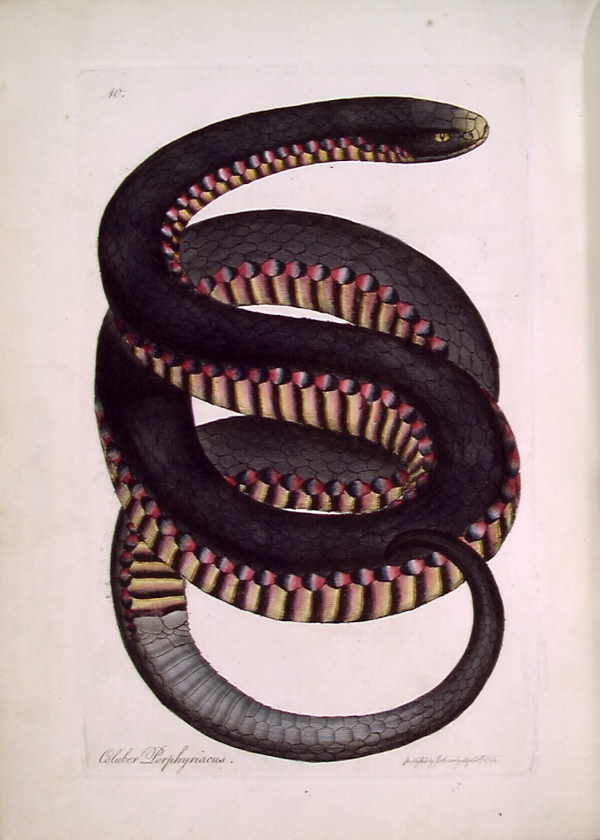
Pseudechis porphyriacus is native to the eastern coast of Australia, occurring from southeastern Queensland through eastern New South Wales and Victoria, with separate populations in Queensland and South Australia. It is distinguished by glossy black upperparts, bright red or orange flanks and a pink or dull red belly.
Written 24 November 2026 from the sources listed below. Each statement was checked against the passage it cites; statements that could not be supported were removed.
Appearance
The Red-bellied Black Snake has glossy black upperparts, bright red or orange flanks and a pink or dull red belly. Its tail is completely black.[1][2]
Its snout is light grey and its mouth is brown. Its head merges into its body without a clearly defined neck, and its body scales are glossy and smooth.[3][4][5]
The species has 17 rows of scales around the middle of its body. It averages approximately 1.25 metres in total length, including its tail, and reliable reports give a maximum total length of approximately 2.54 metres.[6][7][8]
Males are generally slightly larger than females.[9]
Habitat
The species commonly inhabits woodlands, forests, swamplands and riverbanks. It is particularly associated with moist environments such as streams, swamps and lagoons.[10][11]
It also inhabits grasslands, disturbed areas and rural properties. It frequently occurs around drainage canals and farm dams.[12][13]
It prefers shallow water containing tangled aquatic vegetation, logs or debris. Its shelters include thick grass clumps, logs, mammal burrows and large rocks.[14][15]
Individuals maintain several preferred shelter sites within their home ranges.[16]
Diet
Frogs are the principal prey of the Red-bellied Black Snake. Its diet also includes fish, tadpoles, lizards, other snakes and mammals.[17][18]
The species commonly preys on eastern brown snakes. Documented food items include frogs, lizards, snakes, fish and small mammals.[19][20]
The snake can capture and consume prey underwater. It has been observed stirring underwater sediment while hunting, presumably to expose hidden prey.[21][22]
Behaviour
The species is generally non-aggressive and usually retreats when approached. When threatened, it raises its head and forebody horizontally and flattens its neck.[23][24]
It is primarily active during daylight hours and can remain submerged underwater for as long as 23 minutes. Its active body temperature generally ranges from 28 to 31 degrees Celsius.[25][26][27]
It regulates its temperature by basking in sunny locations and resting in shade. It can climb several metres while searching for prey.[28][29]
Reproduction and life cycle
Males engage in ritualised combat during the spring breeding season. Combat can involve wrestling and attempts to push an opponent's head downwards.[30][31]
Females give birth to live young rather than laying eggs. Gestation usually lasts approximately 14 weeks, and birth usually occurs in February or March.[32][33][34]
A litter can contain between eight and 40 young. Newborn snakes average approximately 12.2 centimetres in length.[35][36]
Conservation
Feral cats are documented predators of the species.[37]
Similar species
Copperheads of the genus Austrelaps are also potential identification lookalikes.[38]
Classification of the Red-bellied Black Snake
| Kingdom | Animalia |
|---|---|
| Phylum | Chordata |
| Subphylum | Vertebrata |
| Infraphylum | Gnathostomata |
| Parvphylum | Osteichthyes |
| Megaclass | Tetrapoda |
| Class | Reptilia (Reptile) |
| Order | Squamata (Snakes) |
| Suborder | Serpentes (Snakes) |
| Infraorder | Alethinophidia |
| Family | Elapidae (Cobras) |
| Subfamily | Hydrophiinae |
| Genus | Pseudechis (Black Snakes) |
| Species | Pseudechis porphyriacus (Shaw, 1794) |
Where the Red-bellied Black Snake is found
Checklists and occurrence records place Pseudechis porphyriacus in 1 country across Oceania. GBIF holds 37,871 georeferenced records of it.
Countries
Regions and cities with the most records
- New South Wales, Australia 31,611
- Sydney, Australia 2,695
- Queensland, Australia 2,553
- Victoria, Australia 2,077
- Central Coast, Australia 1,377
- Wollongong, Australia 1,297
- Newcastle, Australia 898
- Coffs Harbour, Australia 892
- Maitland, Australia 720
- South Australia, Australia 632
- Tuggeranong, Australia 495
- Australian Capital Territory, Australia 462
- Canberra, Australia 328
- Port Macquarie, Australia 318
- Brisbane, Australia 299
- Logan City, Australia 189
- Adelaide Hills, Australia 130
- Adelaide, Australia 119
- Sunshine Coast, Australia 76
- Toowoomba, Australia 45
- Cairns, Australia 44
- Caloundra, Australia 39
- Gold Coast, Australia 34
- Bendigo, Australia 16
- Melbourne, Australia 14
- Hervey Bay, Australia 11
- Rockhampton, Australia 11
- Gladstone, Australia 7
- Bundaberg, Australia 6
- Mackay, Australia 6
- Northern Territory, Australia 6
- Ballarat, Australia 4
Range as the checklists state it
Australia (New South Wales, Queensland, South Australia, Victoria)
A number beside a place is its count of GBIF occurrence records. A place without a number comes from a checklist alone. Records show where a species has been observed or collected, which can include escapes and vagrants.
Common names
English
- Red-bellied Black Snake
- Australian Black Snake
Names in 10 other languages
- Chinese
- 紅腹伊澳蛇
- Czech
- pakobra červenobřichá
- Danish
- Rødbuget Sortslange
- Dutch
- zwarte adder
- German
- Rotbauchige Schwarzotter, Rotbäuchige Schwarzotter
- Hungarian
- vöröshasú ausztrálsikló
- Italian
- Serpente nero dal ventre rosso
- Russian
- Краснобрюхая чёрная змея, Краснобрюхий чёрный аспид, Чёрная ехидна
- Spanish
- Serpiente negra de vientre rojo
- xdk
- djirrabidi
Synonyms
9 other scientific names have been used for this species and are now treated as synonyms of Pseudechis porphyriacus.
- Acanthophis tortor Lesson, 1830
- Coluber porphyriacus Shaw, 1794
- Naja porphyrica Schlegel, 1837
- Pseudechis eipperi Hoser, 2003
- Pseudechis porphyraicus Mccoy, 1867
- Pseudechis porphyriacus eipperi Hoser, 2003
- Pseudechis porphyriacus rentoni Hoser, 2003
- Pseudechis rentoni Hoser, 2003
- Trimeresurus leptocephalus Lacépède, 1804
Related species
-
 King Brown SnakePseudechis australis
-
 Blue-bellied Black SnakePseudechis guttatus
- Papuan Black SnakePseudechis papuanus
- Spotted Mulga SnakePseudechis butleri
- Pygmy Mulga SnakePseudechis weigeli
- Eastern Dwarf Mulga SnakePseudechis pailsei
- Papuan Pygmy Mulga SnakePseudechis rossignolii
- Collett's SnakePseudechis colletti
Compare
- Eastern Brown Snake vs Red-bellied Black Snake
- Tiger Snake vs Red-bellied Black Snake
- Indian Cobra vs Red-bellied Black Snake
- Red-bellied Black Snake vs King Brown Snake
- Red-bellied Black Snake vs Blue-bellied Black Snake
- Red-bellied Black Snake vs Papuan Black Snake
- Red-bellied Black Snake vs Spotted Mulga Snake
- Red-bellied Black Snake vs Pygmy Mulga Snake
Questions and answers
What is the scientific name of the Red-bellied Black Snake?
The scientific name of the Red-bellied Black Snake is Pseudechis porphyriacus. Written with its author, the full name is Pseudechis porphyriacus (Shaw, 1794).
Which family does the Red-bellied Black Snake belong to?
Pseudechis porphyriacus belongs to the family Elapidae, in the order Squamata and the class Reptilia.
Where is the Red-bellied Black Snake found?
Checklists and occurrence records place Pseudechis porphyriacus in 1 country: Australia.
What is the conservation status of the Red-bellied Black Snake?
The IUCN Red List category recorded for Pseudechis porphyriacus is Least Concern (LC).
What other names does the Red-bellied Black Snake have?
Pseudechis porphyriacus is also known in English as Australian Black Snake.
What kind of snake is black with a red stomach?
The Red-bellied Black Snake (Pseudechis porphyriacus) has glossy black upperparts, bright red or orange flanks and a pink or dull red belly.[1]
Sources
Passages the profile rests on
- The species has glossy black upperparts, bright red or orange flanks, and a pink or dull red belly. Source passage: “it has glossy black upperparts, bright red or orange flanks, and a pink or dull red belly.” — English Wikipedia
- The snake has a completely black tail. Source passage: “and a completely black tail.” — English Wikipedia
- Its snout is light grey and its mouth is brown. Source passage: “with a light-grey snout and brown mouth” — English Wikipedia
- Its head merges into its body without a clearly defined neck. Source passage: “It lacks a well-defined neck; its head merges seamlessly into the body.” — English Wikipedia
- The scales on its body are glossy and smooth. Source passage: “Body scales are smooth and glossy.” — australian.museum
- The species has 17 rows of scales around the middle of its body. Source passage: “17 rows of dorsal scales at midbody” — English Wikipedia
- The species averages approximately 1.25 metres in total length, including its tail. Source passage: “Averaging around 1.25 m (4 ft 1 in) in total length (tail included)” — English Wikipedia
- Reliable reports give the species a maximum total length of approximately 2.54 metres. Source passage: “maximum total length of about 2540mm (eight feet and four inches) for the species.” — australian.museum
- Males are generally slightly larger than females. Source passage: “with males growing slightly larger than females” — australian.museum
- The species commonly inhabits woodlands, forests, swamplands and riverbanks. Source passage: “Common in woodlands, forests, swamplands, and along river banks and waterways” — English Wikipedia
- It is particularly associated with moist environments such as streams, swamps and lagoons. Source passage: “This species is usually associated with moist habitat, primarily streams, swamps and lagoons” — australian.museum
- It also inhabits grasslands, disturbed areas and rural properties. Source passage: “within forests, woodlands and grasslands. They also inhabit disturbed areas and rural properties” — australian.museum
- The species frequently occurs around drainage canals and farm dams. Source passage: “often encountered around drainage canals and farm dams.” — australian.museum
- It prefers shallow water containing tangled aquatic vegetation, logs or debris. Source passage: “it prefers areas of shallow water with tangles of water plants, logs, or debris.” — English Wikipedia
- Its shelters include thick grass clumps, logs, mammal burrows and large rocks. Source passage: “The snakes shelter in thick grass clumps, logs, mammal burrows and dreys, and under large rocks.” — australian.museum
- Individuals maintain several preferred shelter sites within their home ranges. Source passage: “Individual snakes appear to maintain a number of preferred shelter sites within their home range.” — australian.museum
- Frogs are the principal prey of the species. Source passage: “The diet of the red-bellied black snake primarily consists of frogs” — English Wikipedia
- Its diet includes fish, tadpoles, lizards, other snakes and mammals. Source passage: “fish, tadpoles, frogs, lizards, snakes (including its own species) and mammals.” — australian.museum
- The species commonly preys on eastern brown snakes. Source passage: “commonly the eastern brown snake (Pseudonaja textilis)” — English Wikipedia
- Frogs, lizards, snakes, fish and small mammals are documented food items. Source passage: “They eat frogs, lizards, snakes, fish and small mammals.” — fieldofmar-e.schools.nsw.gov.au
- It can capture and consume prey underwater. Source passage: “Prey captured under water may be taken to the surface or else swallowed while still submerged.” — australian.museum
- The snake has been observed stirring underwater sediment while hunting, presumably to expose hidden prey. Source passage: “Snakes have been observed deliberately stirring up underwater sediment as they hunt, presumably to flush out hidden prey.” — australian.museum
- The species is generally non-aggressive and usually retreats when approached. Source passage: “The red-bellied black snake is generally not an aggressive species, typically withdrawing when approached.” — English Wikipedia
- When threatened, it raises its head and forebody horizontally and flattens its neck. Source passage: “holding its head and front part of its body horizontally above the ground and widening and flattening its neck.” — English Wikipedia
- The species is primarily active during daylight hours. Source passage: “It is generally active by day, though nighttime activity occasionally has been recorded.” — English Wikipedia
- It can remain submerged underwater for as long as 23 minutes. Source passage: “one was reported as staying submerged for 23 minutes.” — English Wikipedia
- Its active body temperature generally ranges from 28 to 31 degrees Celsius. Source passage: “The red-bellied black snake is active when its body temperature is between 28 and 31 °C” — English Wikipedia
- It regulates its temperature by basking in sunny locations and resting in shade. Source passage: “by shuttling between sunny and shady spots.” — australian.museum
- The species can climb several metres while searching for prey. Source passage: “They search widely for prey on land and in water, and are known to climb to several metres.” — australian.museum
- Males engage in ritualised combat during the spring breeding season. Source passage: “In spring, red-bellied black snake males often engage in ritualised combat for 2 to 30 minutes” — English Wikipedia
- Male combat can involve wrestling and attempts to push an opponent's head downwards. Source passage: “engage in head-pushing contests, in which each snake using his chin tries to push his opponent's head downward.” — English Wikipedia
- Females give birth to live young rather than laying eggs. Source passage: “Red-bellied black snakes give birth to live young instead of laying eggs.” — fieldofmar-e.schools.nsw.gov.au
- Females usually give birth after approximately 14 weeks of gestation. Source passage: “after 14 weeks of gestation” — English Wikipedia
- Birth usually occurs in February or March. Source passage: “usually in February or March.” — English Wikipedia
- A litter can contain between eight and 40 young. Source passage: “The young, numbering between eight and 40” — English Wikipedia
- Newborn snakes average approximately 12.2 centimetres in length. Source passage: “have an average length around 12.2 cm (4.8 in).” — English Wikipedia
- Feral cats are documented predators of the species. Source passage: “Feral cats are known to prey on red-bellied black snakes” — English Wikipedia
- Copperheads of the genus Austrelaps are also potential identification lookalikes. Source passage: “Other similar species include the blue-bellied black snake (Pseudechis guttatus) and copperheads of the genus Austrelaps.” — English Wikipedia
Data
- Catalogue of Life, 2026-10-16 XR cc by
- Global Biodiversity Information Facility CC BY 4.0
- Wikidata CC0
- GeoNames CC BY 4.0
- Wikimedia Commons per image; credit shown with each image
- Within the Catalogue of Life, this name comes from The Reptile Database cc by
References
- Shaw, G. (1794). The Zoology of New Holland. London, 33 Pp.
- LaCépède, B. G. E. L. (1804). Mémoire sur plusieurs animaux de la Nouvelle- Hollande dont la description n’a pas encore été publiée. Annales Du Muséum National d’Histoire Naturelle, Paris, 4:184-211.
- Lesson, R. P. (1829). Description de quelques reptiles nouveaux ou peu connus. In: M.L.I. Duperrey, Voyage Autour du Monde Execute par Ordre du Roi, sur la Corvette de La Majeste, La Coquille, Pendant les Annees 1822, 1823, 1824 et 1825. 2. Zoologie Tome 2, Partie 1. Arthur Bertrand, Paris: 1-65 [Published 1829 Fide Lescure 2015 but Often Cited as 1830].
- Schlegel, H. (1837). Essai sur la physionomie des serpens. Partie Descriptive. La Haye (J. Kips, J. HZ. Et W. P. Van Stockum), 606 S. + Xvi.
- Duméril, A. M. C., Bibron, G. & DUMÉRIL, A. H. A.,. (1854). Erpétologie générale ou histoire naturelle complète des reptiles. Tome septième. Deuxième partie, comprenant l’histoire des serpents venimeux. Paris, Librairie Encyclopédique de Roret: I-Xii + 781-1536.
- McCoy, F. (1867). On the recent zoology and palaeontology of Victoria. Ann. Mag. Nat. Hist. (3) 20: 175-202.
- McCoy, F. (1878). Pseudechys porphyriacus (SHAW SP.). The Black Snake. Hoplocephalus superbus (Günth.) The Copper-head snake [... etc...]. Prodromus of the Zoology of Victoria 1: 5-.
- Longman, H. A. (1915). Reptiles from Queensland and the Northern Territory. Memoirs of the Queensland Museum 3: 30-34.
- Simpson, & KNG. (1973). AMPHIBIANS, REPTILES AND MAMMALS OF THE MURRAY RIVER region between Mildura and Renmark, Australia. Mem. Nat. Mus. Vict. 34: 275-279.
- Shine, R. (1977). Habitats, diets, and sympatry in snakes: a study from Australia. Can. J. Zool. 55: 1118-1128.
- Shine, Richard; Grigg, Gordon;Shine, Terri G.;Harlow, Peter. (1981). Mating and male combat in Australian blacksnakes, Pseudechis porphyriacus. Journal of Herpetology 15 (1): 101-107.
- Shine, R. (1987). Intraspecific Variation in Thermoregulation, Movements and Habitat use by Australian Blacksnakes, Pseudechis porphyriacus (Elapidae). Journal of Herpetology 21 (3): 165-177.
- Hutchinson M N. (1990). The generic classification of the Australian terrestrial elapid snakes. Memoirs of the Queensland Museum 29 (3): 397-405.
- Murphy, Michael J. (1994). Reptiles and amphibians of Seven Mile Beach National park, NSW. Herpetofauna (Sydney) 24 (2): 24-30.
- Blackburn, D. G. (1994). Standardized criteria for the recognition of embryonic nutritional patterns in squamate reptiles. Copeia 1994 (4): 925-935.
- Blackburn, Daniel G. (1999). Are Viviparity and Egg-guarding Evolutionarily Labile in Squamates? Herpetologica 55 (4): 556-573.
- Cogger, H. G. (2000). Reptiles and Amphibians of Australia, 6th ed. Ralph Curtis Publishing, Sanibel Island, 808 Pp.
- Hoser, R. (2003). A re-assessment of the taxonomy of the red-bellied black snakes (Pseudechis) with the description of two new subspecies. Boydii, Unnumbered: 15-18.
- Phillips, & Ben L and Richard Shine. (2006). An invasive species induces rapid adaptive change in a native predator: cane toads and black snakes in Australia. Proc. R. Soc. B 273 (1593): 1545-1550, Doi: 10.1098/Rspb.2006.3479.
- Brischoux F, Pizzatto L, Shine R. (2010). Insights into the adaptive significance of vertical pupil shape in snakes. J Evol Biol. 23(9): 1878-85.
- Wilson, S., & Swan, G. (2010). A complete guide to reptiles of Australia, 3rd ed. Chatswood: New Holland, 558 Pp.
- Michael, D.R.; D.B. Lindenmayer; M. Crane; C. MacGregor; R. Montague-Drake; L. McBurney. (2011). Reptilia, Murray catchment, New South Wales, southeastern Australia. Check List 7 (1):25-29.
- Kaiser, H.; Crother, B.I.; Kelly, C.M.R.; Luiselli, L.; O’Shea, M.; Ota, H.; Passos, P.; Schleip, W.D. & Wüster, W. (2013). Best Practices: In the 21st Century, Taxonomic Decisions in Herpetology are Acceptable Only When Supported by a Body of Evidence and Published via Peer-Review. Herpetological Review 44 (1): 8-23.
- Kay, G.M.; D. Michael; M. Crane; S. Okada; C. MacGregor; D. Florance; D. Trengove; L. McBurney; D. Blair; D.B. Lindenmayer. (2013). A list of reptiles and amphibians from Box Gum Grassy Woodlands in south-eastern Australia. Check List 9 (3):476-481.
- Cogger, H. G. (2014). Reptiles and Amphibians of Australia, 7th ed. CSIRO Publishing, Xxx + 1033 Pp.
This species in other databases
Page built on 24 November 2026. See how the catalog is made and all sources and licences.
Cite this page
ScientificNames.org. (2026). Pseudechis porphyriacus (Red-bellied Black Snake). Retrieved November 24, 2026, from https://scientificnames.org/species/pseudechis-porphyriacus
“Pseudechis porphyriacus (Red-bellied Black Snake).” ScientificNames.org, 2026, scientificnames.org/species/pseudechis-porphyriacus. Accessed 24 Nov. 2026.
ScientificNames.org. “Pseudechis porphyriacus (Red-bellied Black Snake).” Accessed November 24, 2026. https://scientificnames.org/species/pseudechis-porphyriacus.
@misc{scientificnames_pseudechis_porphyriacus_red_bellied_black_snake,
  author = {{ScientificNames.org}},
  title = {Pseudechis porphyriacus (Red-bellied Black Snake)},
  year = {2026},
  url = {https://scientificnames.org/species/pseudechis-porphyriacus},
  note = {Accessed 2026-11-24}
}