Species · Flowering plants
Keno Pterocarpus erinaceus
The scientific name of the Keno is Pterocarpus erinaceus. It is a species of flowering plant in the family Fabaceae (bean), order Fabales.
- Scientific name
- Pterocarpus erinaceus Poir.
- Common name
- Keno
- Genus
- Pterocarpus
- Family
- Fabaceae (Bean)
- Order
- Fabales
- Class
- Magnoliopsida
- Red List category
- EN Endangered
- Recorded in
- 21 countries
- Name status
- accepted in the Catalogue of Life

Overview
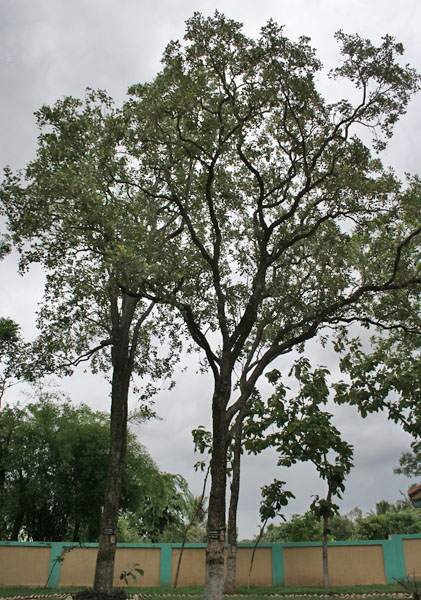
The species is native to the Sahelian region of West Africa. African Rosewood produces yellow flowers, winged pods and red sap known as kino.
Written 26 November 2026 from the sources listed below. Each statement was checked against the passage it cites; statements that could not be supported were removed.
Uses
African Rosewood is harvested for fuel wood and provides material for medicinal applications. Its wood is valued for woodworking and is suitable for charcoal production.[1][2][3][4]
The species produces a red sap known as kino, which is used as a dye in tanning and cloth-making. Its foliage provides nutritious fodder for farm animals and is in high demand among sheep farmers in Mali.[5][6][7]
The species has medicinal applications for reducing fever and suppressing coughs. Its wood is traditionally used to make djembes, the keys and part of the frame of the balafon, and the neck of the kora.[8][9][10][11][12]
African Rosewood can improve nutrient-depleted farmland through nitrogen fixation.[13]
Appearance
African Rosewood reaches an average height of approximately 11 meters and has dark, scaly bark. It produces yellow flowers and winged pods as fruits.[14][15][16][17]
The wood ranges in color from yellowish and rosy red to rich brown.[18]
Habitat
African Rosewood occurs in groves on the savannahs of West Africa. It also grows in forests within Comoé National Park in Côte d'Ivoire.[19][20]
The species grows well on sunny, hot African plains characterized by long dry seasons and frequent fires.[21]
Diet
Chimpanzees consume the seeds of African Rosewood and chew away the fruit pulp.[22][23]
Behaviour
Chimpanzees preferentially select African Rosewood trees for nesting.[24]
Reproduction and life cycle
African Rosewood produces seeds that are directly consumed by chimpanzees.[25]
Conservation
African Rosewood is classified as an endangered tree species and is listed in Appendix II of the Convention on International Trade in Endangered Species of Wild Fauna and Flora.[26][27]
The species is threatened by overexploitation, environmental degradation and climatic changes. Reforestation efforts have achieved some success, and the species is relatively easy to cultivate.[28][29][30]
Classification of the Keno
| Kingdom | Plantae |
|---|---|
| Subkingdom | Pteridobiotina |
| Phylum | Tracheophyta |
| Class | Magnoliopsida |
| Order | Fabales |
| Family | Fabaceae (Bean) |
| Genus | Pterocarpus |
| Species | Pterocarpus erinaceus Poir. |
Where the Keno is found
Checklists and occurrence records place Pterocarpus erinaceus in 21 countries across Africa. GBIF holds 12,460 georeferenced records of it.
Countries
- Angola 9
- Benin 7,337
- Burkina Faso 693
- Cameroon 74
- Central African Republic 6
- Chad 6
- Gabon 1
- Gambia 39
- Ghana 104
- Guinea 319
- Guinea-Bissau 93
- Ivory Coast 2,516
- Liberia 5
- Mali 182
- Mauritania 9
- Niger 36
- Nigeria 118
- Senegal 283
- Sierra Leone 232
- Sudan 6
- Togo 392
Regions and cities with the most records
- Donga, Benin 2,593
- Collines, Benin 1,094
- Vallée du Bandama District, Ivory Coast 1,084
- Borgou, Benin 1,055
- Bassila, Benin 953
- Béoumi, Ivory Coast 912
- Woroba, Ivory Coast 868
- Zou, Benin 862
- Atakora, Benin 591
- Alibori, Benin 519
- Zanzan District, Ivory Coast 350
- Plateau, Benin 275
- Bafilo, Togo 263
- Kara, Togo 233
- Northern Province, Sierra Leone 205
- Savé, Benin 196
- Bohicon, Benin 161
- Koulikoro, Mali 118
- Atlantique, Benin 117
- Banté, Benin 117
- Mamou Region, Guinea 117
- Djougou, Benin 113
- Lacs District, Ivory Coast 113
- Ouémé, Benin 104
- Toukountouna, Benin 99
- Adjaouèrè, Benin 93
- Abomey, Benin 92
- Glazoué, Benin 92
- Djidja, Benin 86
- Fatick, Senegal 84
- Est, Burkina Faso 82
- Plateaux, Togo 81
- Natitingou, Benin 80
- Tchaourou, Benin 80
- Bembèrèkè, Benin 78
- Kopargo, Benin 76
1 more country has a few records outside this range
These countries hold a few records of Pterocarpus erinaceus but lie outside the range the checklists give for it. Such records are often zoo or garden specimens, museum material or vagrants, so the species is not counted as occurring there.
A number beside a place is its count of GBIF occurrence records. A place without a number comes from a checklist alone. Records show where a species has been observed or collected, which can include escapes and vagrants.
Common names
English
- Keno
- African Barwood
- African Kino Tree
- African Rosewood
- African Teak
- African Kino
- African-teak
- Gambian Kino
- Kosso
- Senegal Rosewood
- West African Kino
- West African Rosewood
- Barwood
- Black Camwood
- Madobia
Names in 4 other languages
- French
- Kino de Gambie, Palissandre du Sénégal, Santal rouge d'Afrique, Teak africain, Vène, santal, ven
- German
- afrikanischer Kinobaum
- Portuguese
- Pau de Sangue
- Swedish
- afrikanskt kino
Synonyms
6 other scientific names have been used for this species and are now treated as synonyms of Pterocarpus erinaceus.
- Drepanocarpus senegalensis T.Nees & C.H.Eberm.
- Echinodiscus erinaceus Benth. ex Walp.
- Lingoum erinaceum Kuntze
- Pterocarpus adansonii DC.
- Pterocarpus africanus Hook.
- Pterocarpus senegalensis Vahl ex DC.
Related species
-
 Red SandalwoodPterocarpus santalinus
-
 Amboyna WoodPterocarpus indicus
-
 Malabar KinoPterocarpus marsupium
-
 Wild TeakPterocarpus angolensis
-
 African PadaukPterocarpus soyauxii
-
 Burma PadaukPterocarpus macrocarpus
-
 Andaman PadaukPterocarpus dalbergioides
-
 BloodwoodPterocarpus officinalis
Compare
Questions and answers
What is the scientific name of the Keno?
The scientific name of the Keno is Pterocarpus erinaceus. Written with its author, the full name is Pterocarpus erinaceus Poir..
Which family does the Keno belong to?
Pterocarpus erinaceus belongs to the family Fabaceae, in the order Fabales and the class Magnoliopsida.
Where is the Keno found?
Checklists and occurrence records place Pterocarpus erinaceus in 21 countries, including Benin, Ivory Coast, Burkina Faso, Togo, Guinea and Senegal.
What is the conservation status of the Keno?
The IUCN Red List category recorded for Pterocarpus erinaceus is Endangered (EN).
What other names does the Keno have?
Pterocarpus erinaceus is also known in English as African Barwood, African Kino Tree, African Rosewood, African Teak, African Kino and African-teak.
Sources
Passages the profile rests on
- The species is harvested for fuel wood. Source passage: “It is used for fuel wood, for medicinal purposes, as a woodworking material” — English Wikipedia
- The species is used as a source of medicinal materials. Source passage: “It is used for fuel wood, for medicinal purposes, as a woodworking material” — English Wikipedia
- The species' wood is valued for woodworking. Source passage: “The wood, which varies from yellowish to rosy reds and rich browns, is valued for woodworking” — English Wikipedia
- The species' wood is suitable for charcoal production. Source passage: “and makes good charcoal and fuel wood.” — English Wikipedia
- The species produces a red sap known as kino that is used as a dye in tanning and cloth-making. Source passage: “The tree exudes a red sap called kino, which is used as a dye in tanning and cloth-making.” — English Wikipedia
- The foliage of the species provides nutritious fodder for farm animals. Source passage: “In addition, the foliage is a nutritious fodder for farm animals.” — English Wikipedia
- The foliage is in high demand among sheep farmers in Mali for animal fodder. Source passage: “Mali has an active market for P. erinaceus foliage, which is in high demand by sheep farmers for fodder.” — English Wikipedia
- The species has medicinal applications for reducing fever. Source passage: “The tree has several medicinal uses, including reduction of fever and cough suppression.” — English Wikipedia
- The species has medicinal applications for suppressing coughs. Source passage: “The tree has several medicinal uses, including reduction of fever and cough suppression.” — English Wikipedia
- The species' wood is traditionally used to make djembes. Source passage: “Pterocarpus erinaceus is one of the traditional djembe woods.” — English Wikipedia
- The species' wood is used to make the keys and part of the frame of the balafon. Source passage: “It is also the only wood used to make the keys and part of the frame of the balafon” — English Wikipedia
- The species' wood is the most commonly used material for making the neck of the kora. Source passage: “and is the most common wood used to make the neck of the kora.” — English Wikipedia
- The species can improve nutrient-depleted farmland through nitrogen fixation. Source passage: “and is useful as a nitrogen-fixing plant to improve nutrient-depleted farming land.” — English Wikipedia
- The species reaches an average height of approximately 11 meters. Source passage: “The tree grows to about 11 meters in height on average” — English Wikipedia
- The species has dark, scaly bark. Source passage: “and bears dark, scaly bark and yellow flowers.” — English Wikipedia
- The species produces yellow flowers. Source passage: “and bears dark, scaly bark and yellow flowers.” — English Wikipedia
- The species produces winged pods as fruits. Source passage: “The fruits are winged pods.” — English Wikipedia
- The wood ranges in color from yellowish and rosy red to rich brown. Source passage: “The wood, which varies from yellowish to rosy reds and rich browns” — English Wikipedia
- The species occurs in groves on the savannahs of West Africa. Source passage: “Groves of the tree can be found on the savannahs of West Africa” — English Wikipedia
- The species also grows in forests within Comoé National Park in Côte d'Ivoire. Source passage: “The tree also grows in forests of Comoé National Park in Côte d'Ivoire” — English Wikipedia
- The species grows well on sunny, hot African plains characterized by long dry seasons and frequent fires. Source passage: “P. erinaceus grows well on sunny, hot African plains with long dry seasons and frequent fires.” — English Wikipedia
- Chimpanzees consume the seeds of Pterocarpus erinaceus. Source passage: “For seed items that are consumed (Pterocarpus erinaceus and Terminalia macroptera), the seed is directly consumed” — digital.library.txstate.edu
- Chimpanzees chew away the fruit pulp of Pterocarpus erinaceus. Source passage: “and all fruit pulp is chewed away and” — digital.library.txstate.edu
- Chimpanzees preferentially select Pterocarpus erinaceus trees for nesting. Source passage: “They also preferred certain tree species for nesting, namely Cola cordifolia (taba) and Pterocarpus erinaceus (keno).” — researchonline.ljmu.ac.uk
- The species produces seeds that are directly consumed by chimpanzees. Source passage: “For seed items that are consumed (Pterocarpus erinaceus and Terminalia macroptera), the seed is directly consumed” — digital.library.txstate.edu
- Pterocarpus erinaceus is classified as an endangered tree species. Source passage: “Pterocarpus erinaceus is an endangered tree species native to the Sahelian region of West Africa.” — English Wikipedia
- The species is listed in Appendix II of the Convention on International Trade in Endangered Species of Wild Fauna and Flora. Source passage: “It is listed in Appendix II of the Convention on International Trade in Endangered Species of Wild Fauna and Flora.” — English Wikipedia
- The species is threatened by overexploitation, environmental degradation, and climatic changes. Source passage: “Currently, it is a threatened due to overexploitation, environmental degradation, and climatic changes.” — English Wikipedia
- Reforestation efforts for the species have achieved some success. Source passage: “However, the tree is somewhat prolific and easy to cultivate, so reforestation efforts have shown some success.” — English Wikipedia
- The species is relatively easy to cultivate. Source passage: “However, the tree is somewhat prolific and easy to cultivate” — English Wikipedia
Data
- Catalogue of Life, 2026-10-16 XR cc by
- Global Biodiversity Information Facility CC BY 4.0
- Wikidata CC0
- GeoNames CC BY 4.0
- Wikimedia Commons per image; credit shown with each image
- Within the Catalogue of Life, this name comes from The World Checklist of Vascular Plants (WCVP): Fabaceae cc by
References
- J.B.A.M.de Lamarck, Encycl. 5: 728 (1804) where the name was published
This species in other databases
Page built on 26 November 2026. See how the catalog is made and all sources and licences.
Cite this page
ScientificNames.org. (2026). Pterocarpus erinaceus (Keno). Retrieved November 26, 2026, from https://scientificnames.org/species/pterocarpus-erinaceus
“Pterocarpus erinaceus (Keno).” ScientificNames.org, 2026, scientificnames.org/species/pterocarpus-erinaceus. Accessed 26 Nov. 2026.
ScientificNames.org. “Pterocarpus erinaceus (Keno).” Accessed November 26, 2026. https://scientificnames.org/species/pterocarpus-erinaceus.
@misc{scientificnames_pterocarpus_erinaceus_keno,
  author = {{ScientificNames.org}},
  title = {Pterocarpus erinaceus (Keno)},
  year = {2026},
  url = {https://scientificnames.org/species/pterocarpus-erinaceus},
  note = {Accessed 2026-11-26}
}